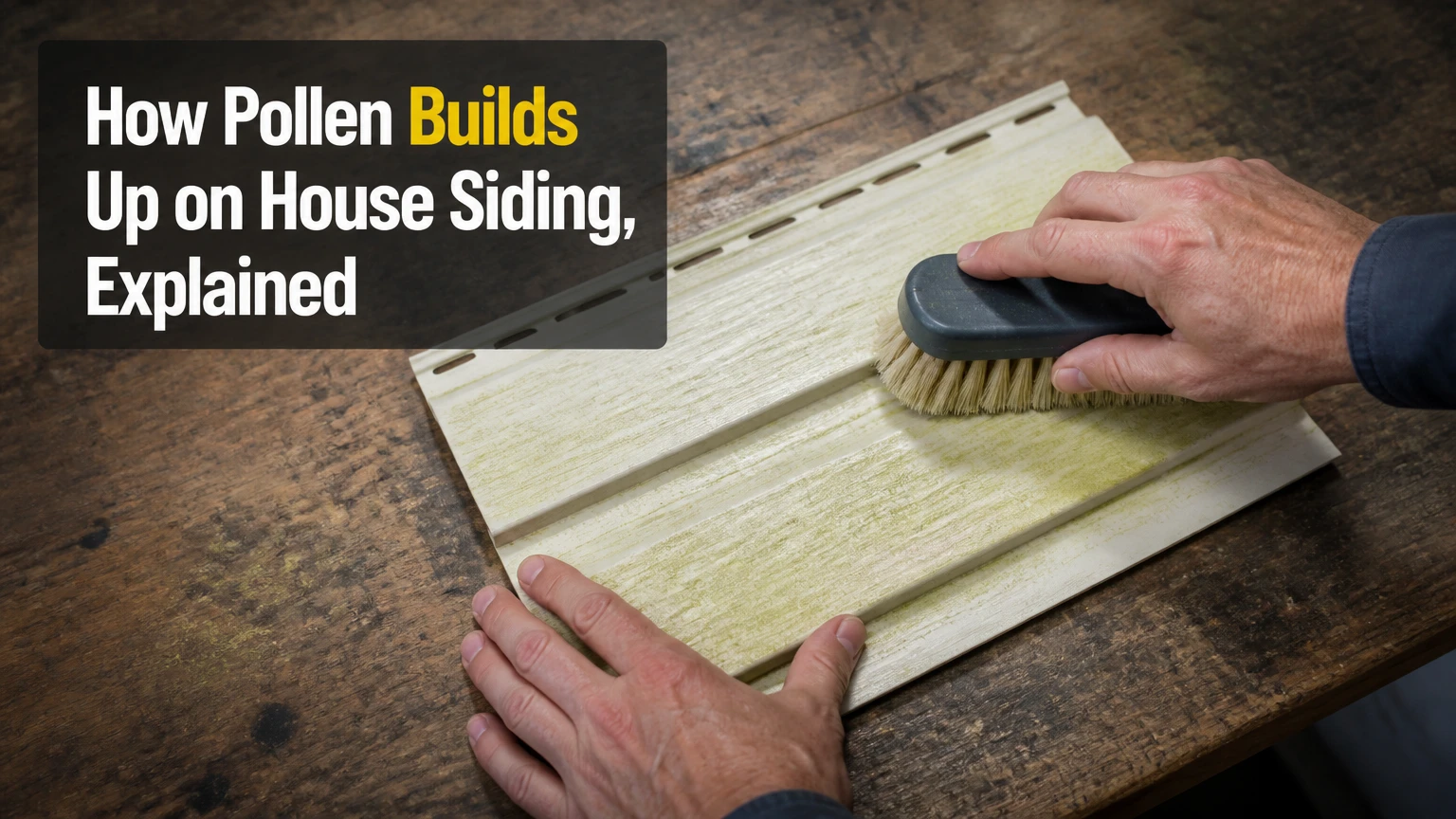
Pollen builds up on house siding when airborne grains settle on a surface and remain attached because of grain texture, resinous coatings, surface roughness, moisture, and trapped dust. Repeated pollen release creates thicker deposits, while dew and humidity turn loose grains into a film that can support algae or mildew on shaded, dirty siding.
Key facts
Most airborne pollen grains measure approximately 10-100 micrometers, although size varies substantially by plant species.
Pollen does not stick because every siding surface has the same electrical charge; humidity, surface texture, resin, dust, and airflow also control adhesion.
Pine, oak, birch, grass, and weed pollen arrive at different times and leave different colors and textures.
A garden hose and diluted detergent are usually safer for routine pollen removal than a close, high-pressure spray.
Green or black growth indicates biological contamination mixed with pollen, not pollen alone.
Typical professional exterior cleaning costs range from $250-$650 for an average one- or two-story house in the United States.
How Does Pollen Build Up on House Siding?
Pollen accumulation on house siding follows four linked events: release into the air, transport to the wall, adhesion to the surface, and repeated layering. Pollen may arrive as individual grains, visible clusters, or a fine film, depending on plant species, wind, humidity, and the siding’s texture.
1. Plants release airborne pollen
Trees, grasses, and weeds release pollen during reproductive cycles. Wind-pollinated plants can release very large quantities because their grains must reach compatible plants without insect transport. The US Forest Service describes pollen as airborne particulate matter whose size, shape, and release timing vary by species.
Pollen commonly reaches siding from nearby trees, street plantings, lawns, unmanaged lots, and regional weather systems. A house does not need a tree immediately beside it to receive a heavy coating. Dry, windy weather can move fine grass and weed pollen across neighborhoods.
2. Airflow deposits pollen on the wall
Pollen reaches siding when wind eddies slow near the wall, when grains collide with the surface, or when rain carries particles downward. Overhangs, window trim, porch roofs, and horizontal ledges interrupt airflow and collect heavier deposits first.
South-facing and windward walls may receive more airborne material, while sheltered walls can retain it longer. The pattern is site-specific. A shaded north wall may look dirtier even when it receives less pollen because slow drying preserves the film.
3. Surface properties keep grains attached
Pollen grains are not perfectly smooth spheres. Many have ridges, pores, spines, or other microscopic structures that increase contact with rough surfaces. Some species also carry oily or resinous outer materials that improve adhesion to plant structures, although the behavior differs by species.
Static electricity can influence small-particle deposition, especially on dry synthetic materials, but the common claim that vinyl siding is always negatively charged and pollen is always positively charged is too broad. Charge polarity changes with material, friction, humidity, contamination, and weather. Physical contact and surface roughness often matter more in outdoor conditions.
4. Wetting and drying create layers
Dew, high humidity, fog, or light rain wets deposited pollen and dissolves soluble material around the grains. When the surface dries, the residue can bind pollen to dust, vehicle exhaust particles, leaf fragments, and other organic debris.
A second pollen release then lands on that roughened film. Repeated wet-dry cycles increase cleaning difficulty because the deposit becomes a composite soil layer rather than loose yellow powder.
What Makes Pollen Deposits Hard to Remove?
Pollen becomes harder to remove when the siding has texture, the deposit has dried repeatedly, or biological growth has begun inside the contaminated film. Smooth, recently painted surfaces generally release loose pollen more easily than oxidized aluminum, porous wood, rough stucco, or textured fiber cement.
Moisture itself does not permanently cement every pollen deposit. Plain water often loosens fresh material, but water alone can spread older residue across the wall. A low-foaming surfactant reduces surface tension and helps water wet the siding evenly, allowing suspended soil to rinse away rather than smear.
The US Environmental Protection Agency states, “The key to mold control is moisture control.” That principle applies here because pollen supplies organic debris, while persistent dampness enables algae and mildew to establish.
Does static electricity cause most pollen buildup?
Static electricity may contribute to pollen deposition, but it is not a complete explanation for buildup on house siding. Dry vinyl can accumulate charge, yet outdoor pollen retention also depends on particle shape, wind speed, surface oxidation, resin, moisture, and dust.
A practical test shows the limits of the static theory: the same wall can collect more pollen beneath a dripping eave than on an exposed area, even though both areas use the same siding. Moisture and airflow changed the result. Treating static as one factor is reasonable; treating it as the primary cause in every case is not.
Which Pollen Types Leave Deposits?
Tree pollen usually creates the most visible spring coating, grass pollen forms a finer summer film, and weed pollen often appears later in the season. Color alone cannot identify the plant source because dust, algae, and siding oxidation can alter the appearance.
| Pollen category | Typical season in temperate US regions | Common appearance on siding | Common nearby sources |
|---|---|---|---|
| Pine and other conifers | March-May | Yellow-green granular coating | Pine, cedar, spruce |
| Oak, birch, and maple | March-June | Yellow, tan, or green fine film | Mature deciduous trees |
| Grass | May-August | Pale yellow or whitish powder | Lawns, fields, roadside grass |
| Ragweed and other weeds | August-October | Dull yellow-gray or brown film | Vacant lots, fields, drainage areas |
Pine pollen often produces dramatic yellow coatings because many conifers release abundant windborne pollen. Its visibility does not prove that pine pollen is chemically stickier than every other type. Deposit thickness and the surrounding dust load can create that impression.
Does Pollen Damage House Siding?
Pollen usually does not chemically damage intact siding during a normal season, but prolonged deposits can increase staining, moisture retention, and biological growth. The main risks are indirect: pollen holds dirt against the surface, shaded damp areas dry slowly, and aggressive cleaning can cause more damage than the pollen itself.
Painted wood is vulnerable when moisture enters failed joints or peeling coatings. Aluminum can show chalking and color transfer when its finish oxidizes. Vinyl can harbor mildew on shaded, dirty sections, while stucco can retain particles in its pores.
Pollen is therefore a maintenance concern rather than a structural threat in most cases. Prompt, low-impact cleaning is preferable to repeated high-pressure blasting.
How Do Siding Materials Change the Cleaning Method?
Siding material determines the safest water pressure, detergent choice, dwell time, and brushing method. Vinyl and fiber cement usually tolerate gentle detergent washing, while painted wood and stucco require tighter control of water volume, moisture exposure, and runoff.
| Siding material | Main pollen retention feature | Typical safe starting method | Primary risk |
|---|---|---|---|
| Vinyl | Seams, grooves, and static-prone dry surfaces | Garden hose, detergent, soft brush | Water entering laps or vents |
| Aluminum | Oxidation and chalking | Low-pressure detergent rinse | Removing oxidized finish |
| Painted wood | Failed paint and porous joints | Low-pressure wash, hand cleaning | Moisture behind paint or trim |
| Stucco | Porous, textured surface | Low-pressure wash with controlled dwell | Erosion, cracking, and intrusion |
| Fiber cement | Painted texture and lap edges | Low-pressure detergent wash | Forcing water behind laps |
Vinyl siding
Vinyl siding normally responds well to a diluted exterior detergent applied from the bottom upward and rinsed from the top downward. The lower-up application reduces streaking from dirty runoff, while the final top-down rinse carries loosened soil away.
Never direct a concentrated jet into panel seams, utility penetrations, dryer vents, or window flashing. Vinyl panels can flex, but that does not make the wall assembly waterproof against a close spray.
Wood and fiber cement
Painted wood needs inspection before washing. Peeling paint, open butt joints, cracked caulk, and soft trim indicate that water may enter the assembly. Fiber cement is more dimensionally stable, but its lap joints and painted surface still require a broad, low-pressure spray.
Hand cleaning is slower but often safer on older wood. A soft synthetic brush and mild detergent can remove pollen without stripping sound paint.
Stucco and masonry-coated surfaces
Stucco traps fine particles inside its texture and may require a longer detergent dwell rather than higher pressure. Test a small hidden section first. If the finish powders, flakes, or changes color, stop and use a conservation-oriented cleaning approach.
Which Cleaning Method Fits the Surface?
For routine pollen, a garden hose with diluted detergent is the lowest-risk option; professional soft washing becomes more useful when the house is large, elevated, heavily contaminated, or mixed with mildew. Pressure washing has a place for selected hard surfaces, but a high-pressure nozzle is a poor default for siding.
| Method | Typical homeowner cost | Typical time for 1,800-square-foot exterior | Best use | Main limitation |
|---|---|---|---|---|
| Hose and detergent | $15-$45 in supplies | 3-6 hours | Fresh pollen on vinyl | Limited reach and agitation |
| Pump sprayer and hand brush | $25-$75 in supplies | 4-8 hours | Small sections and wood trim | Labor-intensive |
| Pressure washer rental | $70-$140 per day | 2-5 hours | Selected durable surfaces | Intrusion and finish damage |
| Professional soft wash | $250-$650 | 1-3 hours | Two-story or biological buildup | Higher upfront price |
Is pressure washing safe for house siding?
Pressure washing is safe only when the operator uses a suitable nozzle, distance, flow rate, and siding-specific technique. A universal threshold such as 1,500 PSI does not determine safety because nozzle angle, distance, machine flow, siding condition, and spray duration change the force delivered to the surface.
For siding, start with the lowest effective pressure and a wide fan pattern. Keep the spray directed downward, maintain distance from seams, and test an inconspicuous area. A close 0-degree or narrow turbo nozzle should not be used on vinyl, painted wood, stucco, or fiber cement.
When is soft washing appropriate?
Soft washing applies detergent at low pressure, allows controlled dwell time, and rinses the loosened soil away. It is especially appropriate when pollen has mixed with mildew or algae, because mechanical force alone may remove color without addressing biological growth.
A responsible contractor should identify the siding, protect plants, control runoff, disclose the cleaning solution, and carry liability insurance. “Soft wash” is a technique description, not a guarantee of safe work.
How Should You Remove Fresh Pollen From Siding?
Fresh pollen can usually be removed in one wash using a mild detergent, a soft brush where needed, and a complete low-pressure rinse. Choose a cool, overcast period, close windows, protect delicate plants, and work in sections small enough to rinse before the solution dries.
Before you start
| Requirement | Typical specification |
|---|---|
| Time | 3-6 hours for a 1,800-square-foot one-story exterior |
| Supplies | 5-gallon bucket, hose, soft brush, gloves, eye protection |
| Detergent | Product label dilution, commonly 2-8 ounces per gallon |
| Water | Enough for a full pre-rinse and final rinse |
| Weather | 50-85°F, low wind, no direct hot sun |
| Access | Stable ground-level work, or a qualified professional for height |
Step 1: Inspect and dry-brush loose material
Remove cobwebs and loose clumps with a soft broom or brush. Do not aggressively dry-brush a heavy deposit near doors or windows because the motion can place airborne pollen into the breathing zone.
You will know this step worked when ledges and corners no longer contain visible clumps. A common mistake is starting with a strong spray that drives dry pollen into vents and trim gaps.
Step 2: Pre-rinse the wall
Rinse from the top down with a broad, gentle spray. The pre-rinse removes loose grains and cools the siding, reducing detergent evaporation.
You will know the wall is ready when loose yellow powder no longer runs from the surface. Avoid spraying upward under laps, soffits, or window trim.
Step 3: Apply diluted detergent
Apply a siding-compatible, biodegradable detergent according to its label. A typical homeowner mixture is 2-8 ounces of concentrate per gallon, but product labels control because formulas vary in alkalinity and surfactant strength.
Work in sections of approximately 100-200 square feet. Keep the surface wet for 3-8 minutes without allowing the solution to dry.
Step 4: Agitate textured areas
Use a soft nylon brush on stubborn grooves, lower-wall splash zones, and trim. Apply light pressure because the detergent should do most of the soil release.
You will know the agitation worked when the film becomes visibly mobile and the brush does not produce paint flakes. A stiff abrasive brush can create permanent gloss differences on vinyl and remove oxidized finish from aluminum.
Step 5: Rinse completely
Rinse each section from the top down until no foam, yellow runoff, or loosened soil remains. Inspect behind downspouts, beneath windows, and around porch roofs.
A complete rinse prevents detergent residue from attracting new dust. Never leave a bleach-containing cleaner on plants, metal fixtures, glass, or siding longer than the label permits.
When Should Siding Be Cleaned?
The best cleaning time is shortly after the dominant local pollen release, with a second light wash if deposits remain during the season. Cleaning after a dry pollen drop but before repeated wet-dry cycles usually requires less detergent and brushing.
| Situation | Typical cleaning interval | Best timing | Reason |
|---|---|---|---|
| Heavy pine exposure | Every 4-8 weeks in spring | After visible yellow drop | Prevents layered resin and dust |
| Ordinary suburban exposure | 1-2 times per year | Late spring and early fall | Matches major seasonal deposits |
| Shaded, damp wall | Every 3-6 months | Dry, mild weather | Limits algae and mildew |
| Allergy-sensitive household | As needed, often monthly | After pollen peaks and low wind | Reduces settled outdoor load |
Local timing varies. In the southeastern United States, tree pollen can begin in late winter; northern regions often shift the main tree-pollen period into spring. Weather and plant species matter more than a universal calendar.
How Can You Prevent Pollen From Sticking?
Pollen prevention depends more on reducing nearby sources, moisture, and surface contamination than on applying a permanent slick coating. Keep gutters functional, trim branches away from walls, maintain ventilation around shaded elevations, and clean before residue becomes layered.
Useful measures include:
- Prune branches that touch or overhang siding, while following local tree-care requirements.
- Repair leaking gutters and downspouts so pollen remains dry instead of repeatedly wetting.
- Keep sprinklers from spraying walls, windows, and foundations.
- Maintain a 6-12 inch clearance between soil or mulch and vulnerable wall finishes.
- Schedule cleaning after peak pollen release rather than during high-wind conditions.
- Treat ceramic or restoration products as optional maintenance coatings, not guaranteed pollen barriers.
A coating cannot correct failed caulk, trapped moisture, oxidized paint, or poor drainage. Test compatibility on the manufacturer’s approved surface first, because some products can change gloss or interfere with repainting.
How Much Does Pollen Removal Cost?
Typical US costs range from $15-$75 for a homeowner’s supplies, $70-$140 for a pressure-washer rental, and $250-$650 for professional soft washing. Actual prices increase with stories, roofline complexity, biological growth, regional labor rates, and plant-protection requirements.
| Project condition | DIY supplies | Professional typical range | Typical duration |
|---|---|---|---|
| Fresh pollen, one-story vinyl | $15-$35 | $200-$350 | 2-4 hours |
| Heavy pollen, two-story vinyl | $30-$60 | $300-$550 | 1.5-3 hours |
| Pollen plus mildew, mixed siding | $40-$90 | $400-$800 | 2-4 hours |
| Small stucco or wood elevation | $20-$60 | $250-$600 | 2-5 hours |
These are planning ranges, not fixed market prices. Request a written scope that identifies detergent, plant protection, water access, height charges, and whether window cleaning is included.
How Do You Identify Stubborn Residue?
Yellow or tan powder that wipes away with a damp cloth is probably pollen. Green, black, chalky, greasy, or crusted residue requires a broader diagnosis because algae, mildew, oxidation, insect deposits, and road film can look similar.
| Appearance or test | More likely cause | Confirmation clue | Appropriate response |
|---|---|---|---|
| Yellow powder, spring peak | Pollen | Wipes away without odor | Detergent wash and rinse |
| Green film in shade | Algae | Slippery or green under wet cloth | Siding-safe biological cleaner |
| Black specks or patches | Mildew or dirt | Persists after plain rinse | Labeled antimicrobial cleaner |
| White chalk on hand | Oxidation | Finish feels powdery | Gentle test cleaning, possible repaint |
| Brown pin-sized spots | Artillery fungus | Difficult dots near mulch | Reduce mulch exposure, spot treatment |
Pollen has turned green or black
Green or black growth means biological contamination may be present, although color alone cannot identify a specific organism. Do not assume that stronger pressure is the solution. Use a labeled exterior cleaner, follow its dilution and dwell instructions, protect vegetation, and rinse thoroughly.
Sodium hypochlorite can control many organic stains, but pool shock is not a universal house-wash recipe. Concentration, pH, contact time, runoff, metals, plants, and respiratory exposure all require control. Professional application is sensible on large or elevated surfaces.
White residue remains after washing
White chalky residue is often oxidized paint or aluminum finish rather than pollen. Vinegar may remove some mineral deposits, but it will not restore an oxidized coating and can produce uneven results. Test a small area, avoid abrasive scrubbing, and consult the siding or paint manufacturer before using acids.
What Should Allergy-Sensitive Homeowners Do?
Allergy-sensitive homeowners should avoid high-pressure spraying and dry brushing during windy conditions because both actions can aerosolize settled pollen. A professional or another household member can perform the work while the sensitive person stays indoors with windows closed.
Clean outdoor furniture, porch screens, window sills, and HVAC intake areas as well as the siding. Wear eye protection and a properly selected respirator when the product label requires it, but do not treat household cleaning equipment as a substitute for medical advice.
A lawn sprinkler aimed at siding is not a dependable cleaning method. It wastes water, can wet wall cavities, and may spread contaminated runoff. Controlled hose rinsing is safer and more effective.
Common Mistakes and How to Fix Them
Using plain water on baked-on pollen
Water can mobilize old residue without suspending enough soil to remove it. Add a compatible surfactant, allow the labeled dwell time, and rinse with a broad spray.
Spraying upward into laps
Upward spray can force water behind siding panels, trim, and flashing. Redirect the nozzle downward and clean vulnerable seams by hand.
Washing in direct hot sun
Heat shortens dwell time and creates detergent streaks. Clean a shaded elevation first, reduce section size, or work during cooler hours.
Treating oxidation as pollen
A chalky finish can worsen when scrubbed aggressively. Perform a small test, document the result, and stop if the coating transfers heavily to the cloth.
Using household bleach without dilution control
Unmeasured bleach can damage plants, metals, coatings, and lungs. Use a labeled exterior product or hire a contractor who can state the concentration and runoff controls.
FAQ
Can pollen buildup happen on new vinyl siding?
Yes, new vinyl siding can collect pollen within days when nearby plants release heavily. Smooth, clean vinyl may release the first layer more easily than oxidized siding, but static charge, wind, grooves, and humidity still affect retention. A gentle hose rinse during the first week can prevent a thicker composite film.
Will rain wash pollen off house siding?
Light rain often relocates pollen rather than removing it. Water can move grains into seams, ledges, and lower-wall splash zones, while drying leaves a concentrated film. A strong, clean rain may reduce loose deposits, but detergent washing remains more reliable after repeated wet-dry cycles.
Does pollen buildup mean the siding has mold?
No. Pollen is usually yellow, tan, or gray particulate matter that wipes away when wet. Mold and mildew create persistent discoloration, odor, or fuzzy and speckled growth, especially in damp shade. Pollen can contribute organic debris that supports growth, but the two conditions are not identical.
Can I use dish soap to clean pollen from siding?
A small amount of mild dish soap can clean fresh pollen from some vinyl surfaces, but concentrated formulas may leave residue or affect adjacent finishes. An exterior siding detergent with label directions is more predictable. Never mix detergent with bleach, ammonia, or acidic cleaners.
Should I clean siding before or after mowing?
Clean siding after mowing if grass clippings or dust usually strike the lower wall. Mowing can redistribute pollen and debris, so remove the source first, wait for settled material, then wash from the top down. Avoid cleaning during windy mowing conditions.
How often should I wash siding in a high-pollen area?
A high-pollen home commonly benefits from one full wash after the main spring release and spot rinses every 4-8 weeks during heavy exposure. Shaded walls, nearby conifers, and persistent humidity may require more frequent cleaning. Inspect the wall rather than following a rigid calendar.
The Bottom Line
How pollen builds up on house siding depends on airborne release, wind deposition, grain structure, surface texture, moisture, and repeated layering. Static electricity can contribute, but it does not explain every deposit. Remove fresh pollen with a mild, siding-compatible detergent and a controlled rinse, identify biological growth before treating it, and avoid close high-pressure spraying that can damage the finish or force water behind the wall.