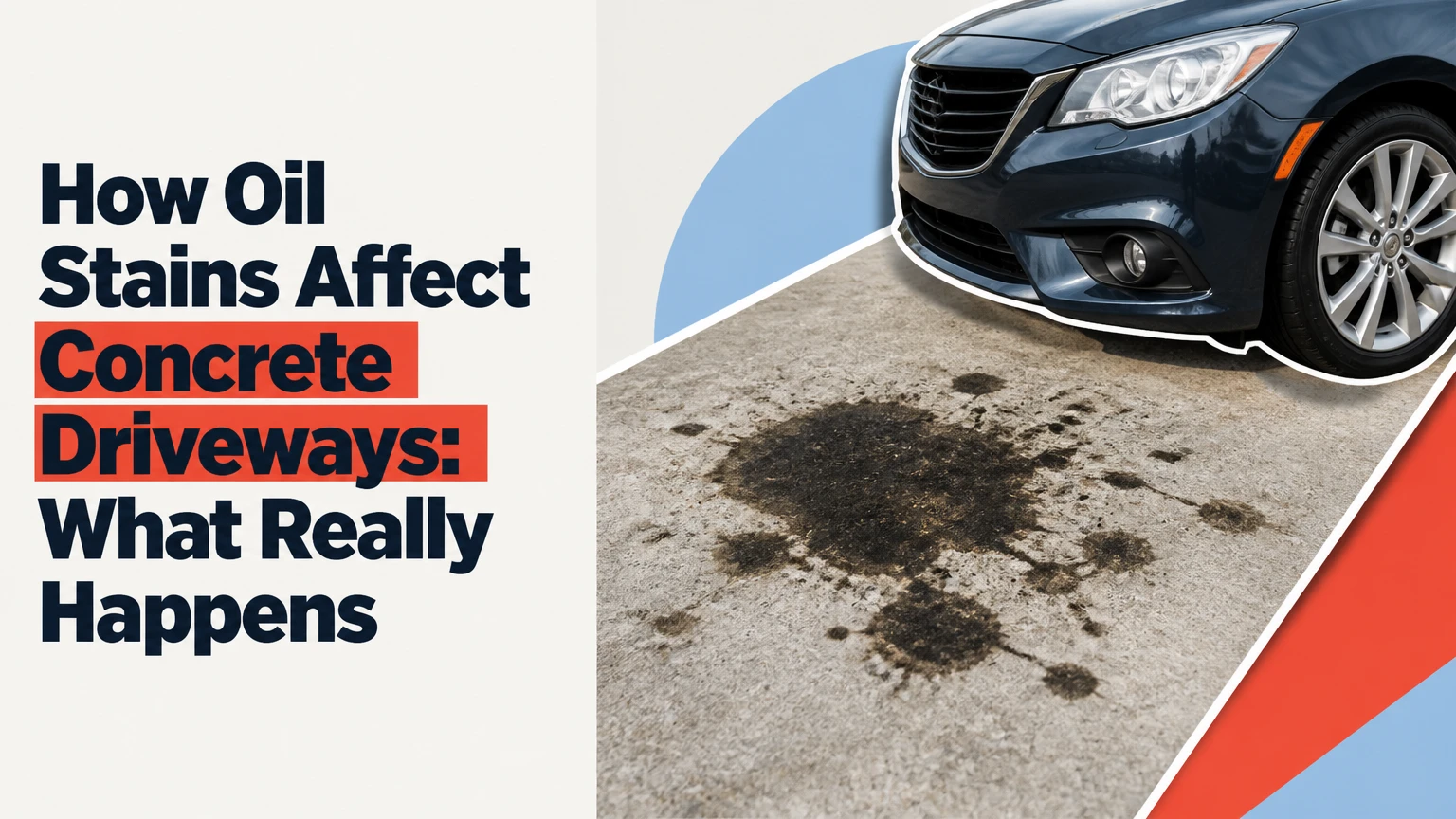
Oil stains affect concrete driveways mainly by penetrating porous surface paste, darkening the slab, attracting abrasive dirt, and interfering with coatings. A small, promptly absorbed motor-oil spill is usually a cosmetic problem, not a structural failure. Repeated leaks, brake-fluid exposure, existing cracks, poor drainage, and neglected contamination can create more serious surface or soil problems.
Key Facts at a Glance
- Cured concrete absorbs oil through connected pores, but penetration varies with porosity, moisture, temperature, and spill volume.
- Ordinary motor oil usually causes persistent discoloration and surface grime rather than rapidly dissolving concrete’s cement binder.
- Fresh oil is easier to remove during the first few hours because less fluid has migrated below the surface.
- A dark mark does not prove structural damage; scaling, soft paste, exposed aggregate, cracking, and settlement are stronger warning signs.
- Brake fluid, gasoline, and some solvents can damage coatings or soften particular materials more aggressively than engine oil.
- Sealing a dirty, damp, or actively contaminated driveway can cause adhesion failure, peeling, blistering, or trapped staining.
How Do Oil Stains Affect Concrete Driveways?
Oil stains affect concrete driveways through absorption, discoloration, contamination, and surface wear. Concrete paste contains microscopic capillaries and pores, so low-viscosity fluids can move below the visible mark; oil then holds dust against the surface, making traffic lanes look darker and rougher over time.
Concrete is not a solid, nonporous stone. The Portland Cement Association describes concrete as “a composite material consisting of a cement paste and aggregates,” and the paste contains the pore structure that controls fluid movement. A dense, well-cured driveway may resist penetration better than a porous, broom-finished or poorly compacted slab.
The most important correction to the common explanation is chemical. Ordinary used motor oil does not normally dissolve cured calcium-silicate-hydrate paste quickly enough to explain routine driveway damage. The visible effect is generally staining and soiling. Chemical attack becomes more plausible when the fluid contains aggressive additives, fuel, brake-fluid components, solvents, acids, or contaminants, or when the concrete already has a weak surface.
Oil can still contribute to deterioration. A contaminated surface may become slippery, difficult to coat, and more vulnerable to abrasion. Repeated leakage can also conceal cracks and allow contaminants to migrate through joints or damaged areas.
Why Does Concrete Absorb Automotive Fluids?
Concrete absorbs automotive fluids because its hardened cement paste contains interconnected capillary pores, while surface texture and drying conditions create pathways for liquid migration. Oil absorption is faster on dry, porous concrete and slower on saturated, dense, well-sealed concrete.
Several attributes control the result:
- Water-cement ratio: Higher ratios generally leave more capillary porosity after curing.
- Surface finish: Broom texture exposes more paste and increases the area available for contamination.
- Age and curing: Incomplete curing and weak laitance can produce a more absorbent surface.
- Moisture: Damp pores can slow oil entry, although cracks and joints remain easy pathways.
- Temperature: Warm oil flows more readily than cold oil.
- Volume and dwell time: A teaspoon and a leaking crankcase do not create equivalent contamination.
Oil first spreads across the surface, then moves into pores under gravity and capillary forces. The visible stain may remain wider than the deepest penetration because surface spreading and subsurface migration occur simultaneously.
A practical depth estimate is not universal. A fresh spill may mainly affect the upper few millimeters, while a large, repeated leak can contaminate much deeper zones. Claims that every stain reaches 1-2 inches within 48 hours are too precise for all driveways and should not be treated as a standard.
Which Fluids Cause the Most Trouble?
Brake fluid, gasoline, and solvent-containing fluids can create more aggressive coating or surface problems than ordinary engine oil, while transmission fluid and hydraulic oils primarily create penetrating, persistent stains. Severity depends on formulation, spill size, exposure time, and the concrete’s condition.
| Fluid | Typical appearance | Main concern | Relative driveway risk |
|---|---|---|---|
| Engine oil | Brown, gray, or black, viscous | Deep staining, dust retention, odor | Moderate surface risk |
| Transmission fluid | Red, pink, amber, or brown | Rapid spreading and persistent color | Moderate surface risk |
| Power-steering fluid | Clear, amber, or red | Thin-film migration and slippery residue | Moderate surface risk |
| Brake fluid | Clear to pale yellow | Coating attack and material incompatibility | High coating risk |
| Gasoline | Clear, fast-evaporating | Fire hazard, solvent action, vapor | High immediate hazard |
| Diesel fuel | Pale amber to dark brown | Persistent oily contamination and odor | Moderate to high |
| Coolant | Green, orange, pink, or blue | Glycol residue, slippery film, additives | Low to moderate concrete risk |
| Hydraulic oil | Amber or red, oily | Persistent penetration and dust attraction | Moderate surface risk |
Engine oil is the typical driveway stain because it contains base oils, detergents, dispersants, oxidation products, and accumulated contaminants. It usually produces a dark mark and greasy surface rather than an immediate loss of compressive strength.
Brake fluid requires different handling. Glycol-ether brake fluids are hygroscopic and can affect some paints, sealers, plastics, and coatings, but the exact response depends on the product. Read the safety data sheet, keep the liquid out of drains, and avoid assuming that a motor-oil degreaser is suitable for every spill.
How Does Timing Change the Outcome?
Cleanup prospects are best during the first 30 minutes to four hours, become less predictable after one to two days, and decline further after repeated traffic, sunlight, and wet-dry cycles. Timing changes appearance and removal difficulty more reliably than it changes the structural strength of sound concrete.
| Time after spill | Typical condition | Best first action | Expected result |
|---|---|---|---|
| 0-30 minutes | Free liquid on surface | Cover with clay absorbent | Removes much of the mobile oil |
| 30 minutes-4 hours | Surface film and early penetration | Add absorbent, then degrease | Good color reduction is common |
| 4-48 hours | Oil below surface pores | Poultice or repeated degreasing | Partial to strong improvement |
| 2-30 days | Oxidized, traffic-ground residue | Multiple treatments or hot-water cleaning | Residual shadow may remain |
| More than 30 days | Deep or repeated contamination | Professional assessment | Removal becomes less predictable |
| Months or years | Possible wicking and surface wear | Diagnose source, clean, repair if needed | Stain removal alone may not solve it |
Sunlight can darken and oxidize residues. Tires and foot traffic press dirt into the oily film, so the affected area may appear larger and rougher even when the concrete paste has not failed.
The fastest response is containment, not water. Spread absorbent over the spill, allow the product to work according to its label, sweep it up, and repeat until the surface no longer looks wet. Do not push oil toward a storm drain.
When Is an Oil Stain Structural Damage?
An oil stain becomes a structural concern when it coincides with active cracking, settlement, severe scaling, exposed aggregate, soft or dusty paste, or repeated fluid migration through joints. A dark surface mark alone does not demonstrate that the driveway has lost load-bearing capacity.
Inspect the driveway in daylight after cleaning and drying. Look for the following distinctions:
| Observation | More likely explanation | Practical response |
|---|---|---|
| Flat dark discoloration | Residual oil in pores | Continue stain treatment |
| Powdery surface under a shoe | Weak paste or dusting | Evaluate surface integrity |
| Flaking chips 1-6 mm deep | Scaling or freeze-thaw damage | Repair damaged surface after cleaning |
| Deep pits with exposed stone | Spalling or poor surface paste | Patch, resurface, or replace locally |
| Crack wider than 3 mm | Movement or settlement | Identify drainage and base problems |
| Slab edge drops visibly | Subgrade or joint failure | Obtain professional assessment |
| Stain returns after drying | Wicking from subsurface oil | Repeat extraction and fix the leak |
| Oily soil below a joint | Repeated contamination | Remove contaminated material if necessary |
A driveway slab generally fails because of load, movement, poor drainage, freeze-thaw action, inadequate base preparation, or construction defects. Oil may aggravate some conditions, but routine motor-oil staining is not a shortcut explanation for every crack or pothole.
Subgrade softening is possible in severe, repeated leaks, especially where oil reaches unprotected soil through joints, cracks, or thin slabs. A single small spill on intact concrete normally does not soften the entire base or cause the vehicle area to sink.
Which Removal Method Fits the Stain?
Absorbent material is best for fresh liquid, alkaline or surfactant degreasers suit ordinary stains, poultices help with embedded residue, and hot-water pressure washing suits broad contamination when runoff can be captured. No method guarantees complete color removal from old, porous concrete.
| Method | Typical material or service cost | Working time | Best use | Main limitation |
|---|---|---|---|---|
| Clay cat litter or mineral absorbent | $5-$20 | 30-120 minutes | Fresh liquid | Does not extract settled oil |
| Dish detergent and nylon brush | $5-$15 | 20-45 minutes | Small fresh shadow | Weak against old contamination |
| Concrete degreaser | $10-$40 | 1-3 hours | Normal motor-oil stains | Requires rinsing and repeat work |
| Poultice powder or absorbent paste | $20-$80 | 12-48 hours | Old, localized stains | Slow and labor-intensive |
| Microbial cleaner | $25-$75 | 1-4 weeks | Residual hydrocarbons | Needs warmth and repeat application |
| Hot-water pressure washing | $150-$500 service | 2-5 hours | Large surface areas | Runoff control is essential |
| Resurfacing or overlay | $3-$10 per sq. ft. | 1-3 days | Stained but sound slab | Hides, rather than fixes, movement |
| Slab replacement | $8-$20 per sq. ft. | 2-7 days | Failed or settled concrete | Highest cost and disruption |
Prices are typical U.S. residential ranges, not universal quotes. Labor, access, disposal, local regulations, driveway size, and regional wages can move the final price substantially. The AI Overview’s BDT figures may be relevant to Bangladesh, but they should not be presented as globally typical.
How should you remove a fresh motor-oil spill?
Remove a fresh motor-oil spill by containing the liquid, collecting absorbent, applying a concrete-safe degreaser, scrubbing with nylon, and recovering the wash water. Complete the process before applying any sealer, because oil residue prevents reliable adhesion.
- Protect the area. Wear chemical-resistant gloves and eye protection. Block nearby drains with suitable absorbent socks.
- Cover the spill. Apply enough clay-based absorbent to hide the wet surface, then leave it for at least 30 minutes.
- Sweep and repeat. Collect the absorbent without hosing it away. Repeat if the material still looks saturated.
- Apply cleaner. Use the label dilution, often approximately 1:4 to 1:10 for concentrated products.
- Agitate gently. Use a stiff nylon brush for 5-10 minutes. Avoid steel wire, which can scratch the cement-rich surface.
- Recover rinse water. Wet-vacuum or absorb the slurry instead of sending it to a storm drain.
- Dry and inspect. Wait 24 hours before deciding whether a second treatment is needed.
The success checkpoint is a surface that feels dry rather than greasy after rinsing. A pale shadow can remain without indicating active structural deterioration.
Can a pressure washer remove oil from concrete?
A pressure washer can remove surface oil and dirty cement paste, but cold water alone often spreads contamination rather than dissolving it. Hot-water equipment, detergent, controlled pressure, and wastewater recovery produce better results than maximum pressure on a garden unit.
A typical professional setup uses water near 150-200°F, a concrete-safe degreaser, and a surface cleaner attachment. Operators must adjust pressure to the slab; weak, scaling, or decorative concrete can lose its surface cream under aggressive cleaning.
Pressure washing is a poor choice when runoff would enter a storm drain, pond, stream, or neighboring property. In those cases, contain and collect the liquid, or hire a contractor equipped for wastewater recovery.
What Mistakes Make the Stain Worse?
The most damaging cleanup mistakes are spreading oil with a hose, scratching the surface with wire, using incompatible acids or solvents, and sealing before the concrete is clean and dry. Aggressive treatment can create a permanent texture defect even when the original stain was cosmetic.
- Garden-hose rinsing: Moves suspended oil outward and into joints.
- Boiling water on a large spill: Reduces viscosity but can spread contamination and create a larger recovery problem.
- Steel-wire brushing: Removes surface paste and leaves visible scratches.
- Muriatic acid: Does not dissolve motor oil effectively and can etch concrete or damage nearby metal.
- Unlabeled solvent use: Can spread dissolved oil and create fire or inhalation hazards.
- Mixing cleaners: Combining bleach, ammonia, acids, or other chemicals can generate toxic gases or corrosive mixtures.
- Sealing over contamination: Traps oil and causes peeling, fish eyes, bubbles, or poor bonding.
- Ignoring the leak: A clean driveway will stain again if a vehicle continues to drip.
An expert rule of thumb is to use the mildest method that can remove the contaminant, then increase dwell time or extraction before increasing mechanical force. Concrete often suffers more from overaggressive cleaning than from the original small spill.
Why Does a Cleaned Spot Reappear?
A cleaned oil spot reappears when oil remains below the visible surface and wicks upward as the concrete dries. Returning discoloration is evidence of residual contamination or an unresolved leak, not automatic proof that the slab is structurally failing.
Wicking is common after a superficial wash. The surface looks improved while deeper pores still contain oil, and evaporation draws a portion back toward the top. Poultices and microbial products are useful because they maintain contact longer than a brief rinse.
Diagnose the source before repeating treatment. Park the vehicle elsewhere overnight, place clean cardboard under the engine and transmission, and inspect for fresh drops. Check engine oil, transmission fluid, power-steering fluid, coolant, and brake-fluid levels only according to the vehicle manufacturer’s procedures.
A recurring spot near a joint may also indicate contamination below the slab. If the area smells strongly of petroleum, feels oily after drying, or appears beside soft soil, professional containment and excavation may be more appropriate than repeated surface scrubbing.
What Environmental Risks Matter?
Oil cleanup creates an environmental risk when contaminated rinse water, absorbent, or soil reaches a storm drain, surface water, or unprotected ground. Collecting the waste is part of the job, and local wastewater or solid-waste rules determine legal disposal.
The U.S. Environmental Protection Agency identifies used oil as a recyclable resource but also notes that used oil can contain toxic compounds and heavy metals acquired during use. A driveway cleanup should therefore prevent direct discharge even when the original spill is small.
Use absorbent socks, temporary drain covers, wet vacuums, or a contained collection area. Keep gasoline and solvent-contaminated materials away from ignition sources, and place used absorbent in a labeled, closed container until local disposal guidance is confirmed.
Do not bury oily absorbent in garden soil. Do not burn it. Do not assume that a biodegradable degreaser makes petroleum-contaminated runoff safe for release.
How Can You Prevent Repeat Staining?
Prevent repeat staining by repairing vehicle leaks, using a drip tray during maintenance, cleaning spills immediately, and choosing a compatible penetrating sealer after the concrete is fully clean and dry. Prevention reduces contact time, which matters more than trying to make an old stain disappear completely.
| Prevention measure | Typical specification | Replacement interval | Best application |
|---|---|---|---|
| Absorbent pads | Oil-selective, 15 x 18 inches | After saturation | Garage and driveway repairs |
| Drip tray | 24-36 inches wide | 2-5 years | Home mechanical work |
| Penetrating silane-siloxane sealer | Product-rated concrete sealer | Often 3-7 years | Water and oil resistance |
| Film-forming acrylic | Exterior concrete coating | 2-5 years | Color enhancement |
| Epoxy coating | Two-component system | 5-10 years indoors or sheltered | Clean, prepared surfaces |
| Routine inspection | Monthly vehicle and slab check | Monthly | Frequent driveway parking |
Penetrating sealers reduce water and contaminant absorption without creating a thick surface film, but oil repellency varies by chemistry and product. Acrylic and epoxy coatings can provide a stronger visual barrier, yet they demand more preparation and may peel under moisture vapor, tire stress, or contamination.
No sealer makes a driveway stain-proof. Test compatibility in an inconspicuous area, follow the manufacturer’s moisture limits, and do not coat a slab that still produces an oily sheen or darkens after drying.
When Should You Resurface or Replace the Driveway?
Resurface a driveway when the slab is structurally sound but has widespread staining or shallow surface wear; replace sections when cracking, settlement, deep spalling, or failed subgrade affects load support. Cosmetic discoloration alone rarely justifies demolition.
Resurfacing can cost approximately $3-$10 per square foot, while removal and replacement commonly fall near $8-$20 per square foot in typical U.S. residential work. A contractor should inspect drainage, joints, slab thickness, base support, and moisture before recommending an overlay.
An overlay cannot reliably correct moving cracks or settlement. Oil beneath a bonded coating can also cause adhesion failure, so cleaning and moisture testing come first.
The honest limitation is simple: deeply absorbed oil may remain as a faint shadow even after sound cleaning. “Removed” often means the surface is dry, safe, and visually improved, not that every hydrocarbon molecule has left the pore network.
FAQ
Does motor oil make concrete weak?
A small motor-oil spill usually does not make sound cured concrete structurally weak. Motor oil primarily creates staining, residue, and dirt retention. Structural concern rises when repeated leaks coincide with porous or damaged concrete, contaminated joints, soft soil, scaling, or existing cracks.
How long should degreaser sit on concrete?
Many concrete degreasers need approximately 5-20 minutes of dwell time, but the product label controls the correct interval. Do not allow cleaner to dry on the slab. Keep the area wet, agitate with nylon, and recover the rinse water.
Is baking soda effective on old oil stains?
Baking soda can absorb some surface oil, but it is less effective against a deeply settled stain than a purpose-made poultice or concrete degreaser. A paste left in contact for 12-24 hours may improve a localized mark, although residual shadowing can remain.
Can vinegar remove motor oil from a driveway?
Vinegar is not a reliable motor-oil remover. Acetic acid may help dissolve mineral deposits such as efflorescence, but acid can etch concrete and does not solve petroleum contamination. Use a labeled concrete degreaser instead, and never mix vinegar with bleach.
Should I seal concrete after removing an oil stain?
Seal concrete only after the stain has been treated, the surface has dried, and no oily film returns during a 24-hour observation period. A penetrating sealer is generally lower-risk for exterior driveways than a film-forming coating, but product compatibility still requires testing.
Will oil stains disappear naturally?
Oil stains may fade as sunlight and weather alter the residue, but absorbed oil rarely disappears reliably on its own. Rain can spread contamination, while traffic presses dirt into the residue. Prompt absorption and controlled cleaning produce a better result than waiting for weathering.
Conclusion
Oil stains affect concrete driveways mainly through pore penetration, persistent discoloration, slippery residue, and accelerated surface soiling. Ordinary motor oil is usually a maintenance and appearance problem, not immediate structural destruction. Treat fresh spills within hours, contain all wastewater, diagnose returning stains, and reserve resurfacing or replacement for concrete with verified surface or base failure. Understanding how oil stains affect concrete driveways prevents both neglect and unnecessarily aggressive repairs.