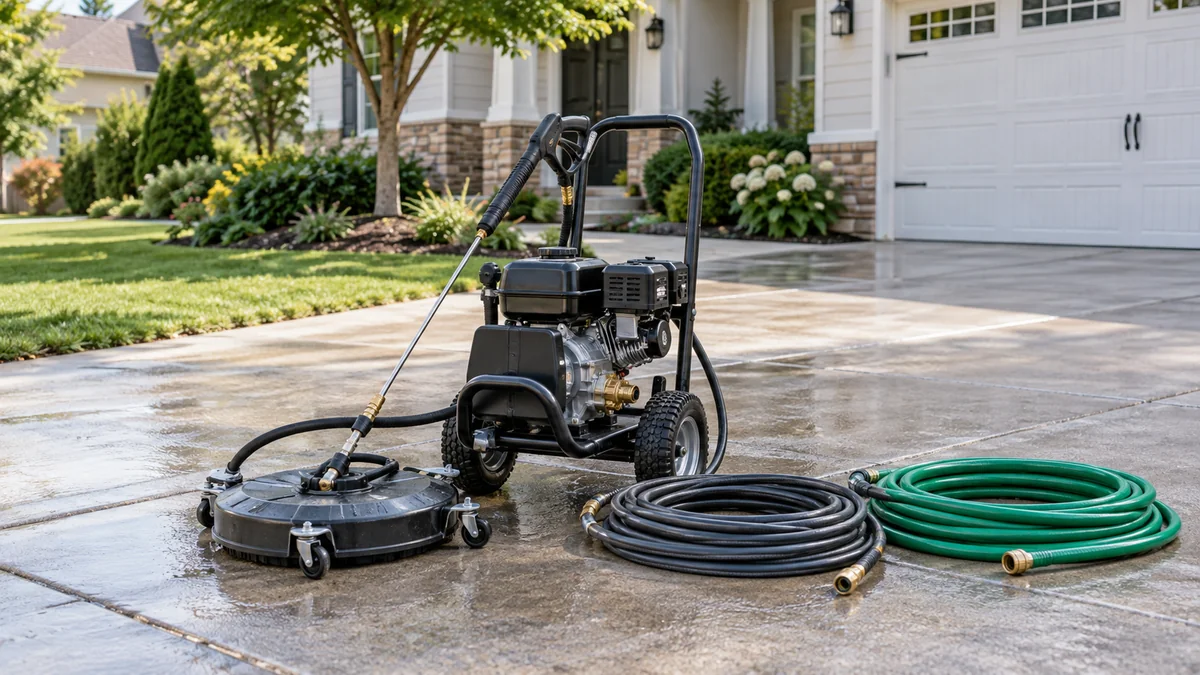
Power washing usually uses 50%-80% less water for the same cleaning task than a garden hose because a pressure washer delivers roughly 1.2-4 gallons per minute, while a typical unrestricted household hose delivers about 5-12 gallons per minute. Actual savings depend on the surface, nozzle, machine, operator, and time spent spraying.
Key Facts at a Glance
- A typical garden hose uses about 5-12 gallons per minute (GPM) when fully open.
- A consumer electric pressure washer commonly uses 1.2-2.0 GPM.
- A gas pressure washer commonly uses 2.0-4.0 GPM, while commercial units may use more.
- A hose can use more total water because rinsing and scrubbing take longer.
- Pressure washer savings are greatest when the machine removes dirt quickly and the operator avoids unnecessary trigger time.
- PSI measures cleaning force; GPM determines water volume.
The frequently repeated “up to 80% less water” claim is plausible for many comparable cleaning jobs, but it is not a universal equipment rating. A low-flow electric washer used efficiently can consume far less water than a hose. A high-flow commercial washer operated slowly can consume more water than a careful hose rinse.
How Does a Pressure Washer Use Less Water?
A pressure washer uses less water by converting a smaller water stream into a faster stream with greater mechanical energy. A motor-driven pump raises the pressure, and a small nozzle concentrates the flow into a controlled spray pattern that loosens soil, algae, and surface residue.
A garden hose generally has much higher volume but little impact force. Water exits at roughly the pressure available from the building supply, often around 40-60 PSI, although actual pressure varies by plumbing, elevation, fittings, and municipal conditions. A pressure washer may operate at 1,400-3,500 PSI, but its pump restricts flow to preserve water.
The distinction matters because PSI and GPM describe different properties:
- PSI, or pounds per square inch: pressure at which water acts on the surface.
- GPM, or gallons per minute: water volume leaving the nozzle.
- Cleaning units: a rough comparison often calculated as PSI multiplied by GPM, although the result is not a complete measure of cleaning performance.
A machine rated at 2,000 PSI and 1.2 GPM does not necessarily use more water than a 1,500 PSI machine rated at 2.0 GPM. The second machine has lower pressure but higher flow, so its total consumption is greater.
Pressure Washing and Power Washing Are Not Always the Same
Pressure washing normally uses unheated water. Power washing often refers to pressure washing with heated water, although manufacturers and contractors use the terms inconsistently.
Hot water, commonly around 140-200°F in commercial equipment, can remove grease and oily residues faster. Faster cleaning can reduce total gallons even when the machine’s flow rate is unchanged. A household cold-water pressure washer is still often called a power washer in consumer product listings, so the name alone does not reveal whether a heating system is present.
How Many Gallons per Minute Does Each System Use?
A typical residential garden hose uses 5-12 GPM, a consumer electric pressure washer uses 1.2-2.0 GPM, and a gas pressure washer uses approximately 2.0-4.0 GPM. The exact figure must come from the equipment label, manual, or a timed flow test at the spigot.
| Equipment type | Typical flow | Gallons in 10 minutes | Common use |
|---|---|---|---|
| Household garden hose | 5-12 GPM | 50-120 gallons | Light rinsing and watering |
| Electric pressure washer | 1.2-2.0 GPM | 12-20 gallons | Cars, furniture, patios |
| Residential gas pressure washer | 2.0-3.0 GPM | 20-30 gallons | Driveways and decks |
| Professional cold-water washer | 3.0-5.0 GPM | 30-50 gallons | Large exterior surfaces |
| Commercial hot-water washer | 3.5-8.0 GPM | 35-80 gallons | Grease and industrial cleaning |
These are typical operating ranges, not guaranteed specifications. A hose fitted with a low-flow nozzle can use less water than an unrestricted hose. Similarly, a compact electric washer may consume only 1.1 GPM, while a large contractor machine can exceed 5 GPM.
How Can You Measure Your Garden Hose?
Measure hose flow by filling a known container for a fixed time. If a 5-gallon bucket fills in 30 seconds, the hose flow is approximately 10 GPM because the bucket fills twice in one minute.
Use this formula:
GPM = container gallons × 60 ÷ filling seconds
The test should be performed with the same faucet, hose, nozzle, and valve position used for cleaning. A long, narrow, kinked, or damaged hose can reduce flow substantially. The result also changes when other fixtures draw water from the supply.
How Much Water Does a Pressure Washer Use in 30 Minutes?
A pressure washer uses approximately 36-60 gallons in 30 minutes at 1.2-2.0 GPM. A 2.5 GPM gas washer uses 75 gallons in the same period, while a 10 GPM garden hose uses 300 gallons.
| Cleaning system | Flow rate | 15 minutes | 30 minutes | 60 minutes |
|---|---|---|---|---|
| Garden hose, low residential flow | 5 GPM | 75 gallons | 150 gallons | 300 gallons |
| Garden hose, high residential flow | 12 GPM | 180 gallons | 360 gallons | 720 gallons |
| Electric washer | 1.5 GPM | 22.5 gallons | 45 gallons | 90 gallons |
| Gas washer | 2.5 GPM | 37.5 gallons | 75 gallons | 150 gallons |
| Commercial washer | 4.0 GPM | 60 gallons | 120 gallons | 240 gallons |
The formula is simple:
Total gallons = GPM × minutes of active spraying
A pressure washer may run for 30 minutes, but the trigger is not necessarily pulled continuously. If the operator sprays for 20 of those minutes, a 2.5 GPM machine consumes 50 gallons, not 75.
What Is the Real Water Saving on a Driveway?
A typical 500-square-foot driveway may use approximately 75-150 gallons with a pressure washer and 250-600 gallons with a garden hose, depending on soil, pretreatment, brushing, and operator speed. The pressure washer usually wins because it removes embedded grime without prolonged rinsing.
Consider two realistic scenarios:
| Scenario | Flow rate | Active cleaning time | Estimated water |
|---|---|---|---|
| Hose, careful rinse and brush | 8 GPM | 45 minutes | 360 gallons |
| Electric washer, detergent and surface cleaner | 1.5 GPM | 35 minutes | 52.5 gallons |
| Gas washer, surface cleaner | 2.5 GPM | 25 minutes | 62.5 gallons |
| Hose, slow manual scrubbing | 8 GPM | 90 minutes | 720 gallons |
The comparison must use the same definition of “clean.” A hose-only rinse may consume little water if the goal is removing loose leaves. It may consume much more if the operator attempts to remove oil stains, algae, or compacted soil by repeatedly rinsing and brushing.
When Can a Hose Use Less Water?
A hose can use less total water for a small, easy task that needs only a brief rinse. Washing a few patio chairs for two minutes at 5 GPM uses about 10 gallons. Setting up a pressure washer, applying detergent, changing nozzles, and rinsing for eight minutes at 1.5 GPM uses about 12 gallons.
This is the main limitation of broad percentage claims. Water efficiency depends on the complete task, not only the equipment’s rated flow. A pressure washer saves the most water when its mechanical force replaces long rinsing or scrubbing.
Which Equipment Uses the Least Water?
For residential cleaning, a low-flow electric pressure washer using about 1.2-1.5 GPM generally uses the least water while retaining enough force for patios, vehicles, furniture, and small siding areas. A larger gas machine cleans faster but may use twice as many gallons per minute.
| Equipment choice | Typical PSI | Typical GPM | Approximate purchase price | Best application |
|---|---|---|---|---|
| Compact electric washer | 1,300-1,800 PSI | 1.2-1.5 | $100-$220 | Cars and patio furniture |
| Full-size electric washer | 1,800-2,300 PSI | 1.5-2.0 | $180-$400 | Decks and patios |
| Residential gas washer | 2,500-3,200 PSI | 2.0-3.0 | $300-$750 | Driveways and masonry |
| Commercial cold-water washer | 3,000-4,000 PSI | 3.0-5.0 | $900-$3,000 | Frequent large-area work |
| Hot-water commercial washer | 3,000-4,000 PSI | 3.5-8.0 | $2,000-$8,000+ | Grease and industrial soil |
The lowest GPM is not automatically the best choice. A machine that is too weak may require repeated passes, increasing total water and electricity use. For many household tasks, a reliable 1.5 GPM electric unit provides a practical balance.
How Should You Use a Pressure Washer to Minimize Water?
Use dry preparation, detergent dwell time, a suitable nozzle, and short trigger intervals. A practical cleaning sequence takes about 20-60 minutes for a small residential project and prevents water loss caused by idle spraying.
Step 1: Remove Loose Debris
Sweep leaves, sand, mulch, and loose soil before connecting water. Dry removal prevents the washer from turning loose debris into slurry and reduces the rinsing required afterward.
Success checkpoint: The surface has no loose material that can be swept away.
Common mistake: Using the pressure washer as a leaf blower for several minutes.
Step 2: Confirm the Water Supply
Connect a suitable hose, open the faucet fully, and check the washer’s minimum inlet requirement. Many consumer machines need around 1.5-2.0 GPM, while some high-flow commercial units need 4 GPM or more.
Success checkpoint: Water exits the gun steadily before the motor starts.
Common mistake: Running a pump with inadequate inlet flow, which can cause cavitation and damage.
Step 3: Apply Detergent at Low Pressure
Apply the manufacturer-approved detergent with a low-pressure soap nozzle or downstream injector. Allow approximately 3-5 minutes of dwell time, but do not let the solution dry on the surface.
Success checkpoint: Dirt softens and begins to release without drying film.
Common mistake: Increasing pressure immediately instead of allowing chemistry to work.
Step 4: Wash with the Correct Fan Tip
Use a wide fan pattern first, commonly 25 or 40 degrees, and begin about 12-24 inches from the surface. Move steadily and overlap passes slightly.
Success checkpoint: Soil lifts without visible etching, striping, or raised wood fibers.
Common mistake: Starting with a zero-degree red tip. That concentrated jet can scar concrete, cut soft materials, and injure skin.
Step 5: Rinse Only the Remaining Slurry
Use the widest effective spray to move loosened residue toward an approved collection or drainage area. Release the trigger whenever you reposition or inspect the surface.
Success checkpoint: The surface is uniformly clean and no longer carries detergent residue.
Common mistake: Continuing to spray already-clean areas.
Is a Garden Hose Better for Some Surfaces?
A garden hose is better for delicate plants, loose dust, light vehicle rinsing, and surfaces that could be damaged by concentrated pressure. A pressure washer is more appropriate for sound concrete, heavily soiled masonry, and durable outdoor materials when the operator uses the correct pressure and distance.
| Surface or task | Preferred method | Typical water range | Main reason |
|---|---|---|---|
| Patio furniture | Hose or 1.2 GPM washer | 5-20 gallons | Low soil load |
| Passenger car | Hose with shutoff or low-flow washer | 10-30 gallons | Avoids trim and paint damage |
| Concrete driveway | 2.0-3.0 GPM washer | 50-150 gallons | Removes embedded soil efficiently |
| Painted siding | Low-pressure washer | 20-80 gallons | High pressure can force water behind panels |
| Older wood deck | Hose or low-pressure wash | 20-100 gallons | Reduces fiber damage |
| Roof shingles | No pressure washing | Variable | High pressure can remove granules |
Vehicle cleaning deserves special care. A hose with a shutoff valve can be efficient for pre-rinsing and final rinsing, while a pressure washer should use a wide nozzle, low effective pressure, and generous distance. Never direct a concentrated jet at weather seals, electrical connectors, paint chips, or soft trim.
Does Hot-Water Power Washing Save More Water?
Hot-water power washing can save water when grease, oil, or industrial soil dissolves faster with heat. Heating does not reduce the machine’s rated GPM, so the water saving comes from shorter active cleaning time rather than a lower flow rate.
For ordinary dust, pollen, mud, and algae, cold water with suitable detergent is often sufficient. Hot water adds equipment cost, fuel consumption, ventilation requirements, and burn hazards. A commercial hot-water washer is justified when faster removal of oil or grease offsets those costs.
The term “power washer” therefore needs clarification. Some consumer brands use it for any electric or gas pressure washer. In contractor terminology, power washing may specifically mean heated cleaning.
How Much Does Pressure Washing Cost Compared with a Hose?
A garden hose costs roughly $20-$80 for the hose and fittings, while a suitable electric pressure washer costs approximately $100-$400. Operating cost includes water, electricity or fuel, detergent, maintenance, and the value of the operator’s time.
| Option | Equipment cost | Typical water cost at $0.01/gal | Typical project time | Suitable scale |
|---|---|---|---|---|
| Existing garden hose | $0-$80 | $2-$8 for 200-800 gallons | 45-120 minutes | Small rinse jobs |
| Compact electric washer | $100-$220 | $0.50-$2 for 50-200 gallons | 20-60 minutes | Cars and patios |
| Gas pressure washer | $300-$750 | $1-$4 for 75-400 gallons | 20-60 minutes | Driveways and masonry |
| Professional contractor | $150-$500 per project | Included in service | 1-3 hours | Large or risky work |
Water prices vary widely, and wastewater charges may be based on metered use or seasonal averages. The water bill alone rarely determines the purchase decision. Labor time, storage, maintenance, noise, fuel, and damage risk often matter more.
What Mistakes Waste Water or Damage Property?
The most common water-wasting mistake is holding the trigger over a clean area while deciding what to do next. Other errors include skipping dry preparation, using an unsuitable nozzle, working without detergent, and repeatedly washing soil that should first be swept or scraped.
Experienced operators follow several practical rules:
- Choose flow for the job, not PSI for the label. A machine with extreme PSI but low cleaning width may require slow overlapping passes.
- Use a surface cleaner on flat concrete. A correctly sized rotary surface cleaner distributes the spray evenly and commonly finishes faster than a wand.
- Do not chase stains with pressure alone. Oil, rust, and organic growth often need chemicals or specialty treatment.
- Keep the wand moving. Pausing can create visible stripes, etch marks, or wood damage.
- Treat runoff as a waste stream. Detergent, sediment, oil, and paint residue should not be directed into a storm drain unless local rules specifically allow it.
A pressure washer is not a sanitizing device by default. Removing soil can improve appearance and hygiene, but disinfection requires an appropriate product, concentration, contact time, and surface compatibility.
Why Is a Pressure Washer Pulsing or Losing Pressure?
Pulsing usually indicates restricted inlet flow, trapped air, a dirty inlet screen, a blocked nozzle, or an unstable water supply. Start by turning off the machine, releasing pressure, inspecting the hose for kinks, and cleaning the inlet filter and nozzle.
Check these conditions in order:
- Confirm the faucet is fully open.
- Remove hose kinks and restrictive quick-connect fittings.
- Verify that the supply provides at least the washer’s stated inlet GPM.
- Run water through the gun before starting the motor.
- Clean the inlet screen.
- Clear the nozzle with the supplied tool.
- Inspect for leaks at fittings and connections.
Never allow a pump to run dry. Avoid extended bypass operation with the trigger released, because some machines can overheat when circulating water internally without an adequate cooling flow.
Can You Use a Rain Barrel or Recycled Water?
Most standard pressure washers should not be connected directly to a rain barrel unless the barrel system supplies clean, filtered water at the required inlet flow. Gravity-fed barrels often lack the pressure and volume needed for a pump, while sediment can damage valves and nozzles.
A dedicated transfer pump, filtration, backflow protection, and adequate storage can make reclaimed water practical for some professional operations. Local plumbing, health, and environmental regulations determine whether that setup is permitted. Never use untreated graywater on a surface where people, pets, or food-contact items could be exposed.
Should You Hire a Professional?
Hire a professional when the work involves multi-story access, extensive oil contamination, fragile historic materials, lead paint risk, large wastewater volumes, or surfaces you cannot identify confidently. Professionals may use hot-water equipment, calibrated nozzles, surface cleaners, and runoff controls that reduce both cleaning time and property risk.
DIY cleaning is reasonable for a small concrete patio, outdoor furniture, or a modern vehicle when the operator can control spray distance and runoff. Roofs, delicate wood, old masonry, and painted siding require more caution than their appearance suggests.
FAQ
Does a pressure washer use more water than a hose if left running?
Yes, a high-flow pressure washer can use more water than a low-flow hose if it runs longer or has a commercial pump. A 4 GPM washer uses 120 gallons in 30 minutes, while a hose flowing at 3 GPM uses 90 gallons. Compare active minutes and GPM, not equipment names.
How much water does a 2,000 PSI pressure washer use?
A 2,000 PSI consumer machine commonly uses about 1.2-2.0 GPM, equal to 12-20 gallons during 10 minutes of active spraying. PSI identifies pressure, not volume, so the pump’s GPM rating is the figure needed for water-consumption calculations.
Is a pressure washer environmentally friendly?
A pressure washer can reduce potable-water use by completing a cleaning task with fewer gallons, but environmental impact also includes electricity or fuel, detergent, noise, and contaminated runoff. Use dry preparation, biodegradable products where appropriate, trigger discipline, and legal wastewater disposal.
Can I pressure-wash during a water restriction?
Possibly, but local restrictions control the answer. Some municipalities prohibit nonessential exterior washing, while others allow equipment that meets specified flow limits or requires reclaimed water. Check the water utility, drought declaration, and wastewater rules before starting.
Does a wider nozzle use less water?
A wider nozzle does not automatically reduce the machine’s GPM. The pump generally supplies the same volume, while the wider pattern distributes it over a larger area and lowers impact per square inch. A wider nozzle can finish sooner and therefore reduce total gallons when used correctly.
What is the best water-saving choice for a driveway?
A 2.0-3.0 GPM pressure washer with a correctly sized surface cleaner is usually the best residential choice for a driveway. Sweep first, apply detergent, allow short dwell time, clean in overlapping passes, and use the wand only for edges and remaining spots.
The Bottom Line
Power washing usually uses less water than a garden hose because a pressure washer combines low flow with high mechanical force. Expect roughly 1.2-2.0 GPM for an electric unit, 2.0-4.0 GPM for a residential gas unit, and 5-12 GPM for a typical unrestricted hose. The final result depends on active spray time, surface difficulty, nozzle selection, detergent, and runoff control.
For a driveway or heavily soiled patio, a pressure washer commonly saves 50%-80% of the water required by prolonged hose rinsing. For a quick rinse of a small item, an existing garden hose may use fewer total gallons because setup and cleaning time are minimal. Use the GPM formula, measure the actual hose flow, and compare complete cleaning tasks rather than rated pressure alone.