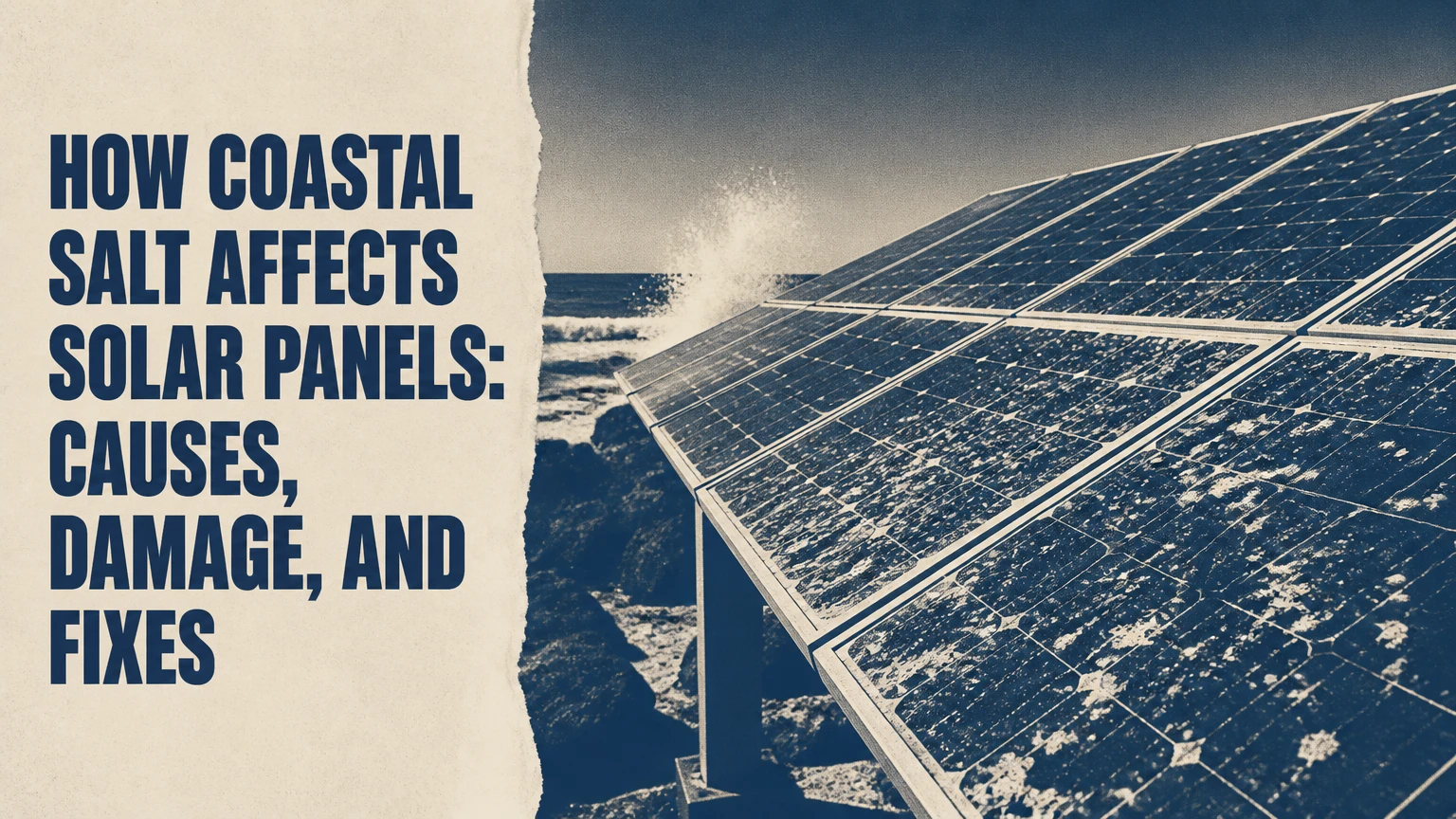
Coastal salt affects solar panels by depositing chloride-rich particles on glass, frames, connectors, and mounting hardware. Humidity turns those deposits into a conductive electrolyte that accelerates corrosion, increases soiling losses, and can eventually damage seals or electrical connections. The severity depends on shoreline distance, wind, humidity, panel design, installation quality, and maintenance.
Key Facts at a Glance
- Salt mist is a saline aerosol made mainly of seawater droplets and dried sodium chloride particles carried by wind.
- Salt deposits reduce light reaching photovoltaic cells and can create uneven soiling, localized heating, and output mismatch.
- Chloride ions damage protective metal films, while moisture and oxygen sustain electrochemical corrosion.
- IEC 61701 salt-mist testing indicates resistance under a defined laboratory protocol; it does not guarantee a fixed coastal service life.
- Dual-glass modules reduce backsheet moisture pathways, but they do not make frames, junction boxes, connectors, or racking corrosion-proof.
- Fresh-water rinsing, compatible materials, drainage, and dissimilar-metal isolation usually provide more durable protection than aftermarket coatings alone.
What Is Coastal Salt Mist?
Coastal salt mist is an airborne mixture of seawater droplets and salt particles produced when wind breaks waves, bubbles burst, and spray becomes aerosolized. The aerosol can travel several kilometers inland, but concentration falls with distance and changes sharply with wind, terrain, storms, vegetation, and building exposure.
A solar array does not need to face the ocean to receive salt. Wind can carry saline particles onto a roof from the side, while sea-facing walls, parapets, and nearby roads can create turbulent deposition zones. Salt exposure is often highest where the array has direct wind access and limited rainfall washing.
| Exposure condition | Typical risk pattern | Main affected components |
|---|---|---|
| 0-500 m from surf | High aerosol and wind-driven spray risk | Frames, connectors, racking, inverter housing |
| 500 m-5 km inland | Moderate to high salt deposition | Glass, fasteners, seals, cable glands |
| More than 5 km inland | Variable, often lower exposure | Glass and exposed metal after storms |
| Direct wave spray or flooding | Extreme liquid-salt exposure | Junction boxes, inverters, cables, all metalwork |
Distance is only a screening measure. A roof 3 km inland on an exposed headland may receive more salt than a sheltered property 800 m from the beach. Local wind roses, prevailing storm direction, roof height, and visible residue provide better design information.
Why does humid coastal air accelerate corrosion?
Humid coastal air accelerates corrosion because salt absorbs water and creates an ionic film across metal surfaces. The film allows electrons and ions to move between anodic and cathodic regions, so oxidation continues whenever moisture and oxygen remain available.
Chloride is particularly damaging because it can penetrate defects in aluminum oxide and other passive films. Repeated wetting and drying concentrates the remaining salts, making the next humid period more aggressive. Corrosion may therefore continue overnight even when a panel looks dry during the afternoon.
How Coastal Salt Affects Solar Panels
The main effects are optical soiling, metal corrosion, seal deterioration, and electrical connection failure. These effects interact: a corroded frame can compromise a seal, a damaged seal can admit moisture, and a contaminated connector can create resistance and heating.
Salt on the glass scatters and absorbs some incoming light. A thin, uniform film may cause a modest loss, while crusted or uneven deposits can produce larger local losses. The exact percentage cannot be predicted from salt coverage alone because particle thickness, light angle, rainfall, panel slope, and cell-string layout all matter.
Salt also reaches places owners rarely inspect. Aluminum rails, grounding hardware, cable clips, module clamps, connector latches, and inverter heat sinks can corrode even when the front glass appears clean.
How much power can salt deposits remove?
Salt deposits can reduce photovoltaic output from a barely measurable amount to several percent, with severe crusting producing substantially greater losses. A frequently cited estimate of approximately 9.7% loss at 10% surface coverage is a useful illustration of partial shading, not a universal coastal-performance law.
Output loss depends on whether deposits cover the entire module or shade narrow cell areas. A narrow opaque streak can affect a cell string disproportionately and may trigger bypass-diode operation. Monitoring data is more reliable than visual coverage estimates.
| Condition | Typical immediate effect | Recommended response |
|---|---|---|
| Thin, transparent salt film | Less than 1-3% suspected loss | Compare production before and after rinsing |
| Visible white deposits | Approximately 2-8% possible loss | Fresh-water cleaning and visual inspection |
| Uneven crusting or bird contamination | 5-15% possible local loss | Clean promptly and check hotspot evidence |
| Persistent deposits with thermal anomalies | Potential cell or diode stress | Arrange infrared and electrical testing |
Rain helps when it is heavy enough to dissolve and remove deposits. Light drizzle can leave concentrated salt rings after evaporation, particularly on low-slope modules.
Which Solar Equipment Resists Coastal Corrosion?
Coastal-resistant solar equipment uses compatible metals, sealed electrical interfaces, durable module construction, and a documented salt-mist test result. No single product feature protects the complete system, because the weakest connector, fastener, cable gland, or grounding point can determine field reliability.
Module construction comparison
| Module feature | Moisture pathway | Coastal benefit | Important limitation |
|---|---|---|---|
| Glass-backsheet module | Rear polymer backsheet and edge seal | Lower weight and broad availability | Backsheet aging remains a design variable |
| Dual-glass module | Glass layers and edge seal | Reduced polymer-backsheet moisture exposure | Heavier, often 15-20% more than comparable modules |
| Standard anodized aluminum frame | Coated aluminum surface | Good basic corrosion resistance | Scratches and cut edges expose reactive metal |
| Salt-mist-certified module | Tested module assembly | Better evidence for saline exposure | Certification does not protect site hardware |
A dual-glass module is often sensible in a high-salt location, especially when its datasheet specifies salt-mist resistance and the roof structure accepts the extra weight. It is not automatically the best choice for every roof: transport, clamping instructions, glass stress, and installer experience still matter.
What does IEC 61701 certification mean?
IEC 61701 is the International Electrotechnical Commission standard for photovoltaic module salt-mist corrosion testing. Severity levels represent increasingly demanding test conditions, but the laboratory result does not translate directly into “25 years beside the ocean” or a guaranteed degradation rate.
IEC 61701 testing evaluates the module under controlled salt exposure, humidity, temperature, and electrical conditions. Buyers should verify the exact severity level, test edition, module model, and manufacturer declaration rather than relying on the phrase “marine grade.”
The supplied overview’s claim that Severity Level 6 proves 80-90% efficiency after 25 years is too strong. A salt-mist test is a qualification result, not a field-life prediction. Product warranty terms, installation conditions, and independent reliability data remain necessary.
| System part | Preferred coastal specification | Installation control |
|---|---|---|
| Module | IEC 61701 report, dual glass where appropriate | Follow approved clamp zones |
| Rails | Anodized 6000-series aluminum | Repair installation damage |
| Fasteners | A4 or 316 stainless steel | Prevent galling and isolate where required |
| Connectors | Genuine, compatible manufacturer connectors | Keep mated pairs dry and fully latched |
| Inverter | IP66 or Type 4X where site conditions require it | Use shade, drainage, and approved glands |
| Cable | UV-rated cable in protected routes | Avoid low loops that retain saltwater |
Why do dissimilar metals create trouble?
Dissimilar metals create galvanic corrosion when an electrolyte connects them electrically. Aluminum in contact with stainless steel, copper, or zinc can become the less noble metal and corrode faster, particularly where chloride-rich water remains trapped.
Metal isolation is not as simple as adding any plastic washer. The washer, coating, clamp, bonding path, and drainage design must match the manufacturer’s structural and electrical requirements. Grounding hardware must preserve a compliant low-resistance path while preventing unintended galvanic couples.
How Should Coastal Solar Panels Be Cleaned?
Coastal solar panels should be rinsed with clean, low-mineral fresh water when salt deposits are visible or monitoring shows unexplained production loss. Many exposed homes need cleaning every 2-4 weeks, while sheltered sites may need it only after storms or during extended dry periods.
Clean early in the morning or near sunset, when the glass is cooler. Use low pressure, a soft nonabrasive brush only when necessary, and no household detergent, rock salt, abrasive pad, or high-pressure nozzle. Hard water can leave its own mineral scale, so filtered or deionized water is useful where local water has high hardness.
Practical cleaning procedure
- Check conditions. Confirm the roof is safe, avoid wet electrical work, and use a qualified technician where access is hazardous.
- Rinse loose particles. Apply low-pressure fresh water from the upper edge downward.
- Remove persistent film. Use a manufacturer-approved soft tool with clean water, without scraping dry glass.
- Rinse again. Remove dissolved salts before the water evaporates.
- Inspect afterward. Look for frame powder, cracked backsheets, lifted seals, damaged cable clips, and connector discoloration.
- Compare production. Use inverter or monitoring data from similar irradiance periods.
Never open a junction box or disconnect energized DC connectors as part of routine cleaning. Saltwater and photovoltaic DC can create arc and shock hazards even when the inverter is switched off.
Does rain remove salt from solar panels?
Heavy rain can remove loose salt from tilted glass, but light rain often dissolves salt and leaves a concentrated residue after evaporation. Rain is less effective on shallow roof pitches, sheltered modules, frame ledges, and the rear electrical hardware.
Panel angle affects runoff. A steeper module generally sheds water and dissolved contaminants more effectively than a nearly flat module, but angle alone cannot compensate for direct sea spray or poor drainage. Inspect after storms rather than assuming rainfall completed the cleaning.
What Failures and Symptoms Should Owners Watch For?
Coastal corrosion usually appears first as residue, discoloration, pitting, fastener staining, or connector damage before it causes an inverter fault. A fixed universal failure timeline is unreliable because exposure and component quality vary widely.
The supplied month-by-month sequence, from three-month salt accumulation to five-year terminal failure, should not be treated as a normal prediction. Some poorly protected systems show serious corrosion within a few years, while properly designed arrays operate for decades with scheduled maintenance.
| Symptom | Likely coastal mechanism | Safe next action |
|---|---|---|
| White powder on aluminum | Aluminum corrosion products | Photograph, rinse, inspect seal and coating |
| Brown or cloudy laminate | Delamination, moisture, or material aging | Request module warranty assessment |
| Repeated insulation fault | Wet or damaged cable, connector, or module | Qualified DC insulation testing |
| Hot connector or melted housing | High resistance from poor mating or corrosion | Shut down per procedure and replace parts |
| Sudden string voltage change | Connector, bypass diode, module, or wiring fault | Professional string and I-V testing |
| Rust-colored fastener staining | Corroding steel or contamination | Check material, isolation, and drainage |
Salt does not automatically cause potential-induced degradation, or PID. PID involves electrical potential, module construction, humidity, temperature, and system grounding characteristics; saline moisture may increase risk in some conditions, but an annual loss above 3% cannot be assigned to coastal salt without measured field data.
Can salt damage inverters and connectors?
Salt can damage inverters and connectors by creating conductive contamination, corroding contacts, degrading gaskets, and blocking heat-transfer surfaces. The inverter may then report insulation resistance faults, ground faults, communication failures, or abnormal temperature warnings.
Connectors are especially sensitive because a small contact area carries substantial current. A connector that is not fully mated, is incompatible with its counterpart, or has a damaged seal can heat before the owner sees visible corrosion. Do not spray contact cleaner or dielectric grease into sealed photovoltaic connectors unless the manufacturer specifically permits it.
What Does Coastal Protection Cost?
Coastal protection commonly adds about 5-15% to equipment and installation costs when it requires upgraded modules, fasteners, racking, cable management, and access planning. The actual premium varies more with roof complexity, labor, wind loading, and inverter location than with stainless-steel hardware alone.
Typical maintenance costs also depend on access. A ground-level array may be rinsed inexpensively, while a multi-story roof can require professional cleaning, fall protection, and electrical inspection.
| Cost item | Typical planning range | Main price driver |
|---|---|---|
| Module salt-mist upgrade | $0.02-$0.06 per watt | Brand, construction, certification |
| 316 stainless hardware | $100-$300 per residential system | Rail design and fastener quantity |
| Professional cleaning | $150-$500 per visit | Roof height, array size, access |
| Electrical inspection | $200-$600 | Testing scope and travel |
| Coating application | $300-$1,000 installed | Product compatibility and labor |
Aftermarket hydrophobic coatings can improve water runoff temporarily, but they do not replace certified module construction, metal isolation, or connector sealing. Some products can alter optical performance, complicate warranty claims, or leave residues that attract dirt. Obtain written manufacturer approval before applying anything to photovoltaic glass.
Which coastal design choices provide the best value?
The highest-value measures usually address water retention and weak interfaces first. A protected inverter location, correct connectors, sound cable routing, and compatible fasteners often prevent more failures than an expensive glass coating.
A practical priority order is:
- Specify a module with documented salt-mist resistance.
- Use the racking manufacturer’s approved aluminum and stainless-steel combination.
- Prevent trapped water with correct slopes, clearances, and drainage.
- Keep connectors off roof surfaces and out of splash zones.
- Place inverters away from direct sea spray while respecting ventilation requirements.
- Establish a visual inspection and fresh-water cleaning schedule.
- Record baseline string performance for later comparison.
How Do Coastal Conditions Differ by Installation?
Coastal conditions affect rooftop, commercial, floating, and marine systems differently because salt concentration, access, wind loading, and direct spray are not the same. Equipment selection must match the exposure category rather than the word “coastal” alone.
Coastal homes
Homes within roughly 0-5 km of the sea should prioritize salt-mist documentation, protected inverter placement, stainless hardware, and routine visual inspections. A homeowner should also check whether the installer’s workmanship warranty excludes corrosion or direct marine exposure.
Commercial arrays
Commercial projects need corrosion allowances in the financial model, documented torque and material records, spare connector strategy, and planned inspection access. Quarterly cleaning may be reasonable for exposed sites, but production monitoring should determine whether that frequency is economically justified.
A modeled 1.5% annual soiling loss can be a useful starting assumption, not a universal rule. Sites with frequent heavy rain may perform better, while dry, windy, salt-exposed sites can perform worse.
Floating solar and marine equipment
Floating arrays and boat-mounted panels face direct spray, immersion risk, movement, and difficult maintenance. Marine-rated tinned copper cable, sealed conduits, strain relief, 316 stainless components, and elevated mounting are appropriate design considerations, but ordinary rooftop modules should not be assumed suitable for direct seawater exposure.
What happens after saltwater flooding?
Saltwater-flooded modules, inverters, batteries, disconnects, and wiring should be electrically isolated and assessed by qualified personnel before reuse. Drying alone does not remove chloride contamination from contacts, insulation interfaces, circuit boards, or battery components.
Flooded batteries and inverters may present delayed fire, shock, or corrosion hazards. Replacement is often safer than field cleaning, especially where water reached energized electronics or battery enclosures.
Expert Rules for Preventing Salt Damage
A clean front glass does not prove a healthy system. Rear connectors, rail channels, grounding lugs, and inverter heat sinks can accumulate salt while the module face remains visually clear.
Do not solve galvanic corrosion by breaking the grounding path. Isolation materials must be used only within an approved bonding design. An electrically isolated frame may create a separate safety problem if protective bonding is missing.
The weakest small part often controls system life. A high-quality module paired with an unsealed cable gland or mismatched connector can still develop an insulation fault. Review the entire bill of materials.
White powder is a warning, not merely dirt. Aluminum hydroxide and oxide deposits near a frame edge may indicate coating failure, trapped moisture, or seal stress. Rinsing removes residue but does not restore damaged metal.
FAQ
Can I install ordinary solar panels near the beach?
Ordinary modules can operate near the beach, but their suitability depends on documented construction, warranty conditions, and installation exposure. For high-salt sites, select modules with an applicable IEC 61701 test declaration, then upgrade racking, fasteners, connectors, cable routing, and inverter protection as one system.
Are solar panels more efficient near the ocean?
Solar panels are not inherently more efficient near the ocean. Cooler temperatures can improve photovoltaic voltage, but salt soiling, humidity, cloud cover, wind, and corrosion can offset that benefit. Compare measured irradiance-adjusted production rather than assuming a coastal climate produces better annual output.
Should I use a pressure washer on salt-covered panels?
Do not use a pressure washer on photovoltaic panels. High pressure can damage seals, backsheets, connector interfaces, and coatings, while forcing water into vulnerable edges. Use low-pressure fresh water and a soft approved tool, or hire a qualified cleaner for difficult roof access.
Do solar panel warranties cover salt corrosion?
Solar panel warranties may cover manufacturing defects but exclude environmental corrosion, improper cleaning, incompatible hardware, or installation outside stated conditions. Review the product warranty, salt-mist documentation, installer workmanship terms, and exclusions for locations exposed to seawater or salt spray.
Is 316 stainless steel always the best fastener?
316 stainless steel generally provides better chloride resistance than 304 stainless steel or zinc-plated steel, but it is not immune to corrosion and can gall during assembly. Correct torque, anti-seize where approved, metal compatibility, isolation, and drainage are necessary for reliable fastening.
The Bottom Line
How coastal salt affects solar panels depends on exposure, moisture, materials, and maintenance rather than shoreline distance alone. Salt mist can reduce light transmission, sustain electrochemical corrosion, damage seals, and create electrical faults, but a documented salt-mist-resistant module is only one part of the solution. Specify compatible racking and fasteners, protect connectors and inverters, inspect early corrosion, and rinse deposits with clean fresh water. With those controls, coastal solar can deliver long service life instead of following an assumed five-year failure timeline.