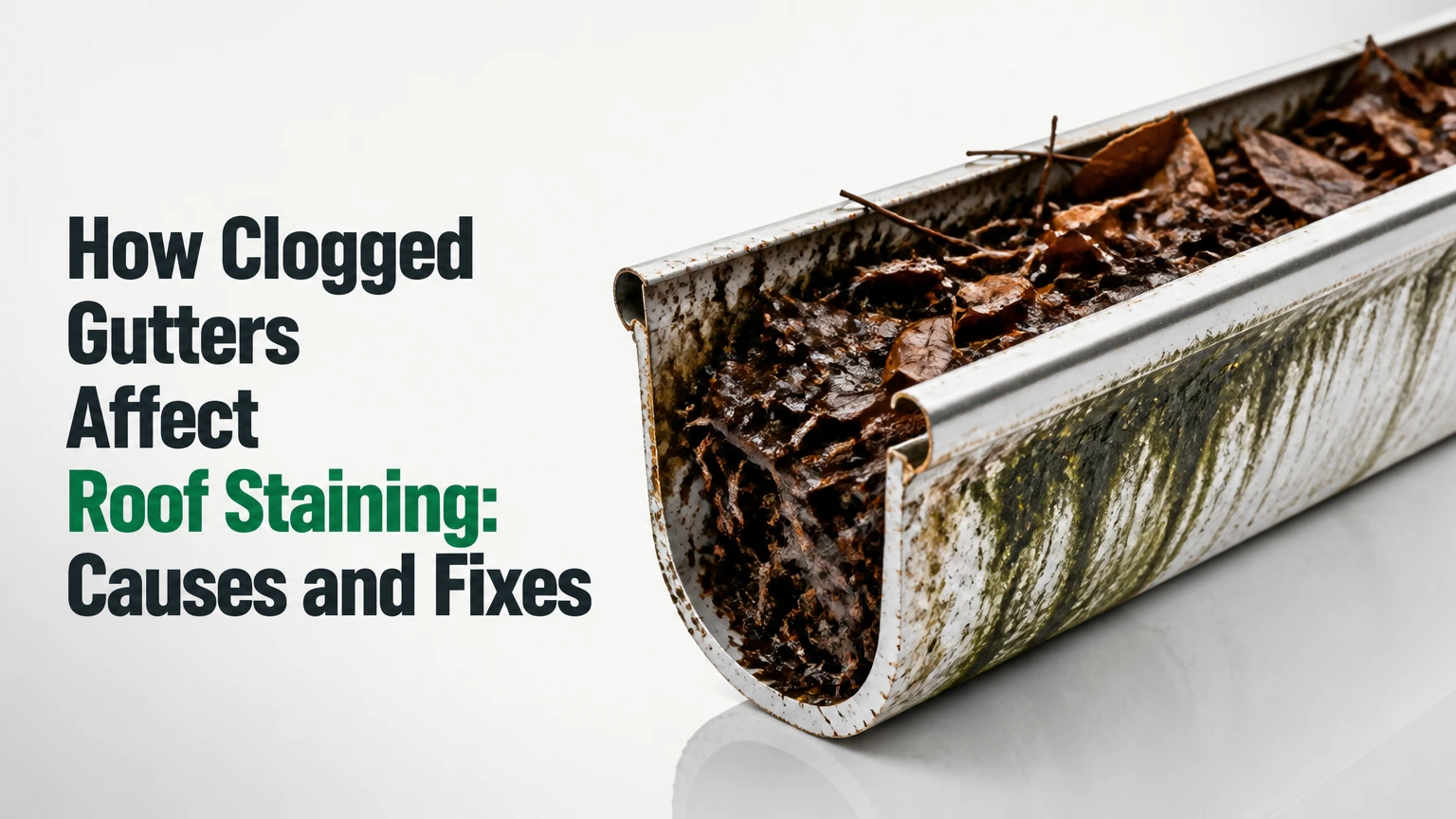
Clogged gutters affect roof staining by keeping roof edges, fascia, and adjacent shingles wet, which supports algae growth and carries dirty runoff across the roof surface. Gutter overflow can also cause rust marks, shingle-edge deterioration, wood rot, and moss where shade and persistent moisture already favor biological growth.
Key Facts at a Glance
- Gloeocapsa magma, commonly called roof algae, produces many black or blue-black asphalt-shingle streaks.
- Gutter overflow usually wets the eaves, fascia, soffit, and roof-edge materials first; it does not normally pull water upward across an entire roof.
- A typical gutter slope is approximately 1/4 inch per 10 feet toward the outlet, although local installation details can require additional outlets.
- Pressure washing asphalt shingles can remove protective granules and shorten roof performance.
- Typical professional gutter cleaning costs about $150-$350, while roof stain treatment commonly costs $300-$800.
- A soft, damp fascia board, peeling paint, or staining beneath the gutter indicates a drainage problem that needs repair rather than cosmetic cleaning.
How Clogged Gutters Affect Roof Staining
Clogged gutters affect roof staining through repeated overflow, edge saturation, dirty runoff, and prolonged dampness. Leaves and pine needles form a dam, rainwater rises in the trough, and water spills over the front or rear edge; the resulting wet environment encourages algae, moss, and lichen near the eaves.
The common explanation that overflow water simply wicks upward into the roof deck is too broad. Capillary movement can carry water through wood fibers, joints, underlayment laps, and porous debris, but roof-wide black streaks usually result from algae colonization, airborne spores, shade, and repeated wetting. Overflow increases those risks without being the only cause.
The American Society of Home Inspectors identifies roof drainage and flashing as frequent sources of moisture intrusion at roof edges. In practice, roof inspectors look for a connected pattern: blocked gutters, deteriorated fascia, darkened sheathing, exposed fasteners, and wet insulation. A stain alone does not prove that the gutter caused it.
The Moisture and Staining Sequence
- Debris blocks flow. Leaves, twigs, seed pods, and conifer needles reduce the gutter’s usable cross-section.
- Water reaches the gutter lip. Heavy rain fills the trough faster than the restricted outlet can discharge it.
- Overflow wets the eaves. Water reaches the fascia, soffit, drip edge, shingle ends, and siding below.
- Runoff deposits contaminants. Soil, decomposed leaves, metal oxides, and organic material leave vertical or horizontal marks.
- Algae colonizes damp shingles. Gloeocapsa magma uses moisture and the mineral filler in many asphalt shingles.
- Moss or lichen may follow. Shaded, wet surfaces allow deeper growth that can disturb granules and lift shingle edges.
Is the Stain Actually From the Gutter?
A stain that begins at the eave may involve gutter overflow, but black streaks descending from the ridge or spreading across sun-exposed slopes more often indicate atmospheric algae. Pattern, moisture evidence, roof orientation, and gutter performance must be considered together.
Roof algae commonly appears on north-facing slopes, beneath trees, and on roof sections shaded by neighboring buildings. Gutter-related discoloration usually concentrates at the lower roof edge, behind the gutter, beneath a leaking end cap, or below a valley that discharges too close to the eave.
| Visible pattern | More likely source | Inspection clue | Typical response |
|---|---|---|---|
| Vertical black streaks from ridge to eave | Atmospheric algae | Streaks continue above the gutter | Soft-wash evaluation and algae prevention |
| Brown band at the lower shingle edge | Overflow or decomposed debris | Wet fascia or leaf residue in trough | Clean gutter and repair drainage |
| Orange streak below a valley or fastener | Metal corrosion | Rust at flashing, nails, or brackets | Replace corroded component |
| Green, raised growth in shaded areas | Moss or lichen | Root-like attachment and lifted granules | Remove with approved treatment and correct moisture |
| White mineral crust below a gutter | Masonry or concrete runoff | Deposits align with downspout discharge | Redirect or extend the downspout |
A useful practitioner rule is to inspect the gutter before cleaning the roof. Removing algae first can hide the continuing source of wetting, allowing the stain and substrate damage to return within the next wet season.
What Damage Happens Beyond the Stain?
Chronic gutter overflow can damage fascia, soffit, roof decking, underlayment edges, insulation, siding, and shingle granules. Roof staining is the visible symptom, while softened wood, moldy insulation, and corroded fasteners can remain concealed until the gutter is removed.
Water can enter behind the fascia when the gutter is pitched toward the building or when the drip edge is short, bent, or installed incorrectly. The roof deck may darken at the perimeter, and repeated wetting can cause edge swelling or decay. Ice-dam climates add a separate failure mechanism because freeze-thaw cycles force water beneath shingle courses.
The 8.34-pound-per-gallon water-weight figure is accurate for liquid water at ordinary temperatures, but a gutter normally drains continuously and does not hold enough water to create the dramatic structural load sometimes claimed online. The more common structural issue is repeated wetting of wood, fasteners, and joints.
What Gutter Specifications Matter?
A typical gutter installation uses approximately 1/4 inch of fall per 10 feet toward a downspout. Long runs, steep roofs, high rainfall, and valleys may require larger outlets, additional downspouts, splash control, or a different gutter profile rather than slope alone.
| Component | Typical specification or observation | Failure sign | Corrective action |
|---|---|---|---|
| Gutter slope | 1/4 inch per 10 feet | Water remains after a hose test | Rehang or add an outlet |
| Downspout outlet | Commonly 2 x 3 inches or 3 x 4 inches | Water backs up during moderate rain | Clear, enlarge, or add a downspout |
| Downspout extension | Often 4-10 feet from foundation | Splashing at the wall or eave | Add an elbow and extension |
| Drip edge | Metal edge directs water into gutter | Water runs behind gutter | Rework edge metal and membrane |
| Gutter hanger spacing | Often 24-36 inches, depending on system | Gutter sags between supports | Add hangers and correct pitch |
| Valley discharge | Concentrated flow at one location | Erosion or staining below valley | Install splash control or larger capacity |
Gutter pitch alone cannot solve a blocked outlet or an undersized downspout. Water testing must cover the full run, especially roof valleys and inside corners where debris accumulates.
How Can You Diagnose the Source?
Diagnose gutter-related roof staining with a visual inspection, a controlled water-flow test, and an examination of the fascia and roof edge. The strongest evidence is a repeatable overflow point combined with moisture or deterioration directly below that point.
Use binoculars from the ground first. Look for sagging troughs, detached end caps, overflowing corners, shingle granules in the gutter, exposed drip-edge metal, rusted fasteners, and dark bands behind the gutter. Do not place a ladder against a gutter because its weight can deform the trough.
For a water-flow test, use a garden hose at low flow and start near the highest part of the run. Move gradually toward the downspout while watching the front and rear edges. Water should move steadily without pooling, spilling behind the gutter, or shooting over the front during a moderate flow.
Inspection Checklist
- Photograph stains before treatment, including their starting points.
- Check whether the gutter contains standing water after dry weather.
- Probe exposed fascia only where safe, using a screwdriver or moisture meter.
- Inspect the attic edge for darkened decking, damp insulation, or daylight near the eaves.
- Confirm that downspouts discharge at least several feet from the foundation.
- Check valley outlets and roof penetrations for concentrated runoff.
- Record roof orientation, nearby trees, shade duration, and recent storms.
- Arrange a professional inspection when decking feels soft or the roof edge sags.
A hose test cannot reproduce a severe thunderstorm, wind-driven rain, or snowmelt. Treat a passing test as evidence about ordinary flow, not proof that the drainage system performs under every weather condition.
Which Conditions Make Staining Worse?
Roof staining accelerates when moisture remains on shingles for long periods, especially with shade, warm temperatures, airborne organic matter, and poor airflow. Clogged gutters amplify those conditions at the eaves, but they do not create algae spores or guarantee a stain.
Wooded properties collect leaves and pollen faster than open lots. North-facing roof slopes dry more slowly in many regions, while humid coastal and subtropical climates support longer periods of surface moisture. A steep roof may shed water quickly but still overflow when valley discharge exceeds gutter capacity.
Visible algae can develop within one to several seasons, but a universal 12-24-month incubation period is not reliable. Roof age, shingle composition, rainfall, shade, temperature, and cleaning history alter the timeline. Likewise, a claim that algae always reduces shingle life by 30%-50% lacks a dependable universal basis.
Regional Maintenance Intervals
| Property condition | Typical inspection interval | Main risk | Practical adjustment |
|---|---|---|---|
| Open lot with few trees | Twice yearly | Windblown grit and storm debris | Inspect after major storms |
| Mature deciduous trees | Every 2-3 months in leaf season | Leaf dams and blocked outlets | Schedule extra cleanings |
| Dense conifers | Monthly during needle drop | Fine needles enter outlets | Use outlet screens cautiously |
| High-rainfall climate | Quarterly | Overflow and saturated fascia | Check capacity and downspouts |
| Snow and ice climate | Before winter and after thaw | Ice dams and concealed leaks | Evaluate insulation and ventilation |
| Humid, shaded roof | Twice yearly plus roof check | Algae, moss, and slow drying | Improve sunlight and drainage |
Which Cleaning Method Fits the Roof?
Low-pressure roof cleaning with a roof-compatible solution is generally safer for asphalt shingles than pressure washing. The correct treatment depends on the roofing material, biological growth, runoff control, and manufacturer instructions, while gutter cleaning must occur before or alongside roof treatment.
The Asphalt Roofing Manufacturers Association warns against high-pressure cleaning because aggressive water can dislodge granules and damage the shingle surface. A qualified contractor should apply a controlled, low-pressure treatment, protect plants, manage runoff, and avoid walking unnecessarily on brittle or steep shingles.
Cleaning removes existing growth but does not correct a sagging gutter, failed drip edge, or shaded moisture trap. A roof that looks clean can stain again if water continues to spill behind the gutter.
| Method | Suitable roof types | Typical cost | Main limitation |
|---|---|---|---|
| Low-pressure chemical treatment | Asphalt shingles, with approved solution | $300-$800 | Requires plant and runoff protection |
| Manual moss removal | Small localized growth | $150-$500 | Can dislodge granules if scraped |
| Pressure washing | Generally unsuitable for asphalt shingles | $250-$700 | Granule loss and water intrusion risk |
| Metal-roof washing | Painted or coated metal, approved cleaner | $300-$900 | Abrasive tools can damage coating |
| Tile-roof cleaning | Concrete or clay tile, trained contractor | $400-$1,200 | Broken tiles and walking hazards |
| Replacement of damaged sections | Any material with substrate failure | $500-$2,000 or more | Matching old roofing may be difficult |
Zinc and Copper Strips
Zinc and copper strips can slow algae growth below the strip because rain dissolves small amounts of metal that move down the roof. Metal strips do not unclog gutters, repair wet fascia, remove established moss roots, or protect roof areas that rainwater cannot reach.
Installations work best near the ridge, with enough exposed metal for rain contact and correct placement under the upper shingle course. Runoff may stain light-colored siding or harm sensitive plants, and incompatible fasteners can accelerate corrosion. Confirm compatibility with the shingle manufacturer.
Do Gutter Guards Prevent Roof Stains?
Gutter guards reduce the amount of debris entering a gutter, but no guard eliminates maintenance or prevents every overflow. Micro-mesh products typically control fine debris better than large-hole screens, while poorly installed guards can trap pine needles on top and redirect water during intense rain.
Guard selection should match the debris type and roof geometry. A wooded property with small conifer needles needs a different screen than a home beneath broad deciduous leaves. Guards also cannot fix insufficient slope, undersized downspouts, damaged fascia, or valley flow that overshoots the gutter.
| Gutter strategy | Typical installed cost | Debris performance | Ongoing requirement |
|---|---|---|---|
| Manual cleaning only | $150-$350 per visit | Depends on cleaning frequency | Usually spring and fall |
| Perforated cover | $4-$12 per linear foot | Moderate for large leaves | Surface brushing and checks |
| Brush insert | $3-$8 per linear foot | Weak for fine needles | Frequent removal and cleaning |
| Micro-mesh guard | $12-$35 per linear foot | Strong for leaves and fine debris | Inspect seams and surface |
| Additional downspout | $300-$900 each | Improves flow capacity | Keep outlet clear |
| Gutter replacement | $1,200-$4,500 typical home | Corrects slope and damage | Periodic inspection |
A guard is a capacity and debris-management decision, not a roof-stain cure. Correct the drainage geometry first when the gutter already sags or leaks behind the back edge.
How Much Does Correction Usually Cost?
Typical correction costs range from $150 for a straightforward gutter cleaning to more than $2,000 when fascia, decking, flashing, and shingles require repair. Local labor rates, roof height, access, material, story count, and the extent of concealed rot create wide variation.
| Work item | Typical price range | Typical duration | Cost driver |
|---|---|---|---|
| One-story gutter cleaning | $150-$250 | 1-2 hours | Linear footage and debris |
| Two-story gutter cleaning | $250-$500 | 2-4 hours | Access and safety equipment |
| Roof algae treatment | $300-$800 | 2-5 hours | Roof area and runoff protection |
| Downspout repair or extension | $100-$400 | 1-3 hours | Number of outlets |
| Fascia repair | $500-$2,000 | 1-2 days | Linear footage and rot depth |
| Local shingle repair | $350-$1,500 | 3-8 hours | Material matching and access |
| Gutter guard installation | $1,500-$4,500 | 1-2 days | Home perimeter and product |
These figures are typical planning ranges, not national price guarantees. Obtain separate line items for cleaning, roof treatment, carpentry, flashing, and replacement shingles so a cosmetic service cannot conceal an unresolved water problem.
When Is Roof Repair or Replacement Necessary?
Roof repair is necessary when overflow has caused soft decking, rotten fascia, exposed underlayment, displaced shingles, corroded flashing, or active interior leakage. Roof replacement becomes a broader consideration when damage is widespread, shingles are near the end of their rated life, or repairs cannot restore a reliable water-shedding surface.
Black algae alone rarely justifies replacement. Asphalt shingles can retain waterproofing performance despite discoloration, although moss and lichen growth can create physical damage. Replacement decisions should consider granule loss, blistering, curling, missing tabs, leak history, roof age, and the condition of the deck.
A roof contractor should remove enough material to inspect concealed wood rather than covering soft fascia with new trim. Insurance policies commonly cover sudden storm damage more readily than gradual maintenance neglect, so document storm dates, leaks, photographs, and professional findings.
Common Mistakes and Better Fixes
- Pressure washing asphalt shingles: High pressure removes ceramic granules and can force water beneath laps. Use a manufacturer-compatible low-pressure treatment.
- Cleaning the roof before the gutter: The stain returns when overflow continues. Clear and test the drainage system first.
- Using concentrated bleach without controls: Strong solutions can damage plants, corrode metal, and discolor siding. Use a trained applicator and protect all runoff paths.
- Assuming a gutter guard is maintenance-free: Fine debris can collect on the guard surface or at seams. Inspect the system at least twice yearly.
- Ignoring the rear gutter edge: Water can run behind the trough and rot fascia even when the front edge appears clean. Check drip-edge alignment and the back channel.
- Scraping moss aggressively: Mechanical removal can pull granules from aged shingles. Treat growth, allow it to die back, and remove loose material carefully.
One counterintuitive field observation matters: a roof can have clean gutters and still suffer gutter-related staining when the gutter has the wrong pitch. Debris is only one failure mode. Sagging hangers, undersized outlets, valley overshoot, and a short drip edge can produce the same wet eave.
What Changes for Metal, Tile, and Low-Slope Roofs?
Metal and tile roofs respond differently to gutter-related moisture than asphalt shingles. Metal usually resists biological penetration but can develop coating failure or corrosion at cut edges and fasteners, while tile can crack under foot traffic and transfer concentrated runoff to fragile underlayment.
Low-slope roofs need special caution because membrane systems may use internal drains, scuppers, or tapered insulation rather than conventional gutters. A blocked scupper can create ponding that is more serious than an ordinary residential gutter overflow. Never apply an asphalt-shingle cleaning method to a membrane roof without the membrane manufacturer’s approval.
| Roof material | Common stain or damage | Cleaning concern | Inspection priority |
|---|---|---|---|
| Asphalt shingle | Algae streaks, moss, granule loss | Avoid high pressure and abrasive tools | Shingle edges and deck |
| Painted metal | Rust, coating discoloration | Avoid incompatible solvents | Fasteners, seams, coating |
| Clay tile | Algae, cracked tile, underlayment exposure | Minimize foot traffic | Broken tiles and valleys |
| Concrete tile | Moss, efflorescence, cracked units | Control pressure and chemicals | Underlayment and flashing |
| Membrane roof | Ponding marks, biological film | Follow membrane specification | Drains, scuppers, seams |
How Should Homeowners Prevent Recurring Stains?
Prevent recurring stains by combining gutter cleaning, downspout testing, roof-edge inspection, vegetation management, and suitable algae control. A twice-yearly schedule works for many homes, while properties under trees or in high-rainfall climates need more frequent checks.
Clean gutters in late spring and late fall when those seasons match local debris cycles. Inspect after severe storms, nearby tree work, or roof installation. Trim branches so they do not contact shingles, but preserve enough clearance to avoid exposing the roof to damaging wind and sun.
A practical maintenance sequence is:
- Remove debris by hand or with a gutter tool.
- Flush each downspout from the top and bottom.
- Check slope, hangers, end caps, and seams.
- Confirm water exits several feet from the foundation.
- Inspect fascia and roof edges for softness or staining.
- Treat roof growth only after drainage works correctly.
- Photograph repairs and record dates for future comparison.
Homeowners should hire a professional for steep roofs, two-story access, fragile roofing, electrical hazards, suspected rot, or chemical treatment near ponds and sensitive landscaping.
FAQ
Can clogged gutters cause black streaks on roof shingles?
Clogged gutters can contribute to black streaks by keeping the eaves wet and increasing the moisture available to roof algae. Black streaks that run from the ridge to the eave usually involve atmospheric algae as well, so gutter cleaning may stop new edge staining without removing existing roof-wide discoloration.
Will cleaning gutters remove roof stains?
Cleaning gutters removes the drainage cause but does not remove established algae, moss, rust, or mineral deposits from shingles. A roof-compatible low-pressure treatment may be needed after drainage correction. If the fascia or decking is already soft, cleaning alone cannot restore the damaged wood.
How often should gutters be cleaned to protect a roof?
Many homes need gutter cleaning twice yearly, typically in spring and fall. Homes beneath mature trees, especially conifers, may need inspections every one to three months during heavy debris periods. Severe storms warrant an additional check because a single blocked valley outlet can cause concentrated overflow.
Can rain gutters cause roof leaks?
Rain gutters can contribute to roof leaks when overflow wets the roof edge, a short drip edge directs water behind the gutter, or trapped moisture damages fascia and decking. Gutters do not usually cause a leak in the middle of an otherwise sound roof, so the leak location should guide the inspection.
Are roof algae and mold the same thing?
Roof algae and mold are different growth types. Gloeocapsa magma is a cyanobacterium associated with dark asphalt-shingle streaks, while mold is a fungus more commonly associated with persistently damp organic materials such as wood, insulation, and sheathing. A laboratory test may be needed when identification affects treatment.
Should you replace a roof because of algae stains?
Algae stains alone usually do not require roof replacement. Replacement becomes more reasonable when staining accompanies widespread granule loss, curling, missing shingles, soft decking, recurring leaks, or an aged roof near the end of its service life. Correct gutter overflow before evaluating whether cosmetic cleaning or replacement is appropriate.
The Bottom Line
How clogged gutters affect roof staining depends on moisture, roof material, drainage geometry, shade, and biological growth rather than debris alone. Clear and test the gutters first, inspect fascia and decking for concealed damage, then choose a roof-compatible cleaning method. Correcting overflow is the step that prevents cosmetic treatment from becoming a recurring expense.