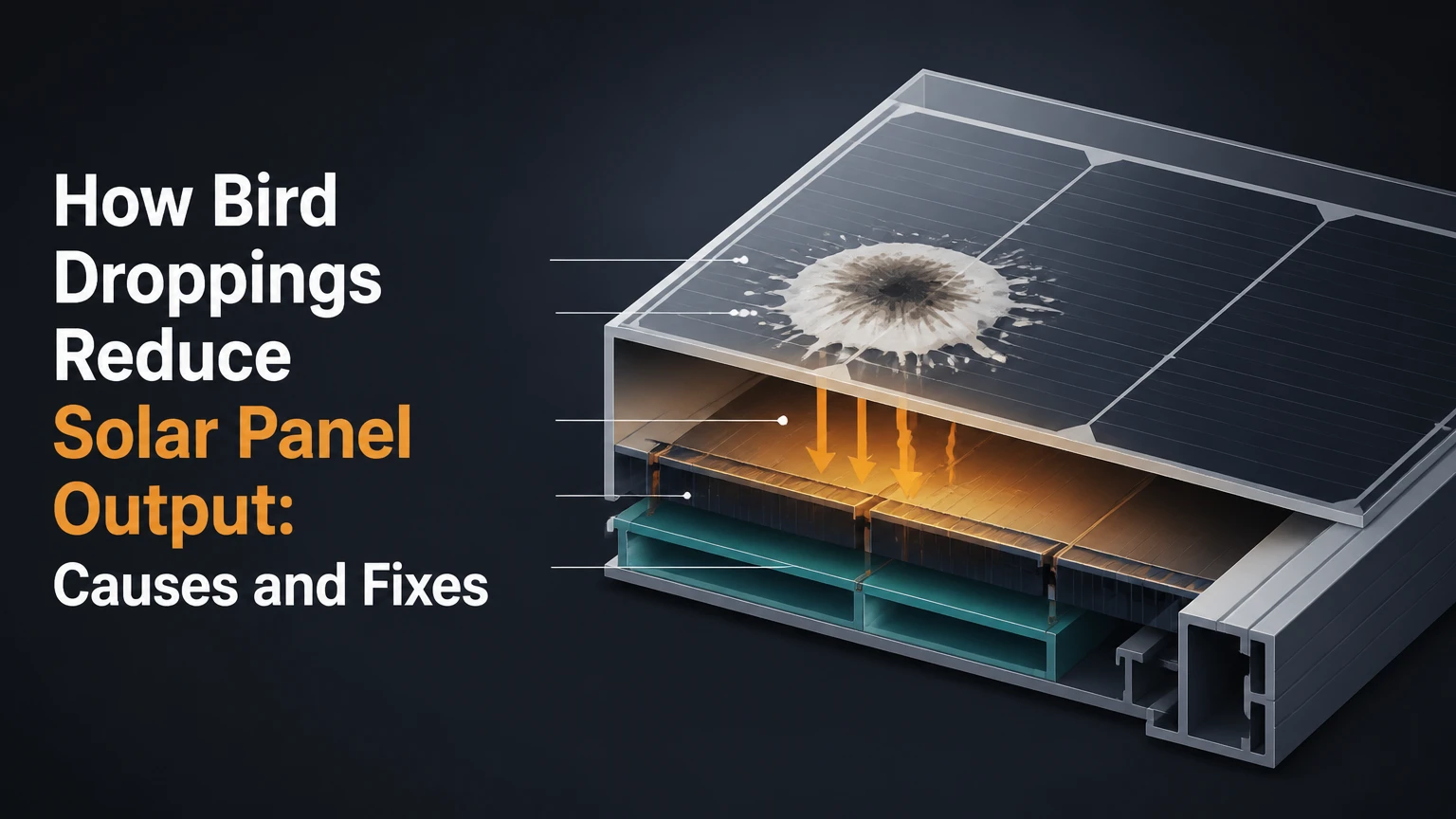
Bird droppings reduce solar panel output by creating opaque, localized shading on one or more photovoltaic cells. Because cells are electrically connected in series within substrings, a shaded cell can limit current, activate a bypass diode, and create a hot spot; the actual loss depends on deposit location, module design, inverter architecture, and whether damage has occurred.
Key Facts
Bird droppings are localized photovoltaic soiling, not ordinary uniform dust.
A deposit over one cell can reduce the output of a cell substring rather than only the covered area.
Bypass diodes can reduce electrical stress, but they do not remove the energy loss caused by shading.
A dropping does not automatically create permanent damage or a 100-150°C hot spot.
String inverters, power optimizers, and microinverters distribute the loss differently.
Cleaning restores irradiance only when the deposit has not damaged the module.
What Does Bird Soiling Mean on a Solar Panel?
Bird soiling is the accumulation of feces, nesting material, feathers, and related residue on photovoltaic module glass. Bird droppings are more disruptive than evenly distributed dust because a small, opaque deposit can cover a high-current part of a cell while the rest of the module remains fully illuminated.
Uniform dust usually reduces incoming light across many cells by a similar proportion. A dropping creates a sharp mismatch between illuminated and shaded regions. Sticky uric-acid residue can also remain after rain, collect dust around its edges, and become harder to remove after repeated heating and cooling.
The most exposed locations include roof ridges, array edges, commercial rooftops near food waste, agricultural buildings, coastal structures, and sites with trees or overhead cables. Panels with a shallow pitch may retain deposits longer because runoff cannot carry the material away.
Why do bird droppings cause more loss than their size suggests?
Bird droppings cause disproportionate losses because photovoltaic cells in a substring must carry nearly the same series current. A deposit covering 2% of a module’s glass can therefore affect a much larger electrical section when it crosses a cell or cell-to-cell current path.
The result is not a fixed percentage. A deposit near a cell busbar, across several half-cells, or at the boundary between substrings can produce a different response from a deposit on an inactive margin. Module datasheets, cell count, bypass-diode placement, and operating current determine the outcome.
How Bird Droppings Reduce Solar Panel Output
Bird droppings reduce solar panel output through four linked effects: reduced photocurrent, current mismatch, possible reverse bias, and bypass-diode conduction. The sequence is electrical rather than merely visual, so a panel that appears mostly clean can still lose substantial power when one deposit sits over the wrong cell region.
- Light reaches fewer active cell areas. Opaque fecal material absorbs or reflects incoming sunlight before it reaches the semiconductor.
- The shaded cell produces less current. Neighboring illuminated cells continue operating at the array’s current level.
- The cell may enter reverse bias. If the operating current exceeds the shaded cell’s available photocurrent, electrical stress is dissipated as heat.
- A bypass diode may conduct. The diode routes current around an affected substring, protecting the module from some stress while sacrificing that substring’s voltage contribution.
- Persistent heat can damage materials. Encapsulant browning, cell cracking, backsheet discoloration, solder fatigue, and diode failure are possible when stress is severe or prolonged.
A bypass diode is a protection component, not an output-restoration component. When it conducts, the protected substring contributes little or no useful voltage, so the panel still produces less power.
How does a hot spot form?
A hot spot forms when a shaded or defective cell is forced to carry current generated by brighter series-connected cells. The affected cell operates in reverse bias, converts electrical energy into heat, and may become visibly hotter than surrounding cells during strong sunlight.
The AI Overview’s 100-150°C figure should not be treated as a normal result for every dropping. Hot-spot temperature depends on irradiance, module current, deposit coverage, cell construction, thermal pathways, and duration. Severe cases can reach damaging temperatures, but an infrared reading alone does not prove permanent failure.
Hot spots are more likely when a deposit remains for days or weeks, covers a substantial cell region, blocks several adjacent cells, or sits on a module with compromised bypass protection. A clean-looking panel can still show a damaged diode or cell if the deposit was removed after the event.
Why does a bypass diode not prevent all damage?
A bypass diode limits stress by carrying current around a substring after the module voltage-current conditions make conduction favorable. The diode cannot prevent the initial mismatch, eliminate all cell heating, or restore the voltage lost from the bypassed substring.
Modern modules commonly divide cells into three bypass-diode substrings, but the exact arrangement differs. Half-cut modules often use multiple parallel cell paths and may respond differently from older full-cell modules. Always use the module manufacturer’s electrical diagram when interpreting a 33% or 66% reduction.
How Much Output Can One Dropping Remove?
One dropping can reduce a panel’s output by less than 1%, approximately one-third, or nearly all of its usable output under severe conditions. The range depends on where the deposit lands, how many cells it covers, whether a bypass diode conducts, and whether the inverter clips or redistributes the loss.
| Condition | Typical immediate effect | Main dependency | Likely recovery after cleaning |
|---|---|---|---|
| Small deposit on inactive glass margin | 0-2% module loss | Distance from active cells | Near-complete |
| Deposit over part of one cell | 5-30% local module loss | Cell current and coverage | Usually high |
| Deposit across one substring | 25-40% module loss | Three-substring layout | High if undamaged |
| Deposits across multiple substrings | 50-100% module loss | Coverage and diode state | Variable |
| Damaged diode or cell | 10-100% persistent loss | Failure mode and wiring | None from cleaning |
These are engineering ranges, not universal guarantees. A one-third loss often indicates that one of three nominal substrings has been bypassed, but a different module design can produce another fraction. A single string-inverter system may show a smaller or larger whole-system effect depending on the other modules and the inverter’s current operating point.
Can one soiled panel reduce an entire string?
One soiled panel can reduce the operating current of a series string when the panel remains electrically active but has a lower current-voltage capability than neighboring modules. The loss is often most visible during high irradiance, when the clean modules can supply more current than the affected module can accept.
String-level impact is not automatically 10-30%. A string with many modules can dilute the panel’s contribution to total string voltage, while current mismatch can still constrain energy production. An optimizer or module-level power electronic device can isolate some mismatch, but it cannot make shaded cells generate light they did not receive.
| System architecture | Where the loss appears | Effect of one affected module | Diagnostic visibility |
|---|---|---|---|
| Central or string inverter | Shared DC string | Current mismatch may affect string energy | String comparison |
| DC optimizer | Module or optimizer input | Loss is more localized | Module monitoring often available |
| Microinverter | Individual AC module output | Neighboring modules remain independent | Module-level app data |
| Parallel strings | Combined inverter input | A weak string contributes less | String current comparison |
Which Module Features Change the Result?
Module construction changes both the size of the loss and the probability of damage. Cell format, bypass-diode layout, half-cut wiring, glass coating, module tilt, and module-level electronics all influence the observed output.
Cell layout and bypass-diode placement
A conventional 60-cell or 72-cell module is commonly divided into protected substrings, but cell counts and electrical layouts vary by manufacturer. Newer modules may use 120 or 144 half-cells, which creates parallel current paths and changes how a deposit affects the module.
A dropping that covers the center of one full cell may affect a different circuit path from a dropping that spans two half-cell regions. The module’s installation manual is more reliable than assuming every panel loses exactly one-third.
Inverter and optimizer architecture
Microinverters prevent a weak panel from directly limiting the DC current of neighboring panels because each module has an independent conversion path. They do not prevent the soiled module itself from losing power, and they do not protect a shaded cell from hot-spot stress.
Power optimizers provide partial isolation and module-level reporting, depending on their design and control strategy. String inverters remain more sensitive to current mismatch, particularly when modules with different irradiance or electrical characteristics share one string.
Can Bird Droppings Permanently Damage a Solar Panel?
Bird droppings can permanently damage a solar panel, but ordinary soiling usually causes temporary loss that cleaning reverses. Permanent damage requires a physical or electrical consequence such as cell cracking, burned encapsulant, diode failure, delamination, backsheet damage, or glass and coating deterioration.
A fixed claim that every untreated deposit causes 0.5-2% annual degradation is not technically defensible without test conditions. Degradation rates differ by module materials, climate, ultraviolet exposure, thermal cycling, and damage mechanism; a single dropping cannot be assigned a universal annual percentage.
Acidity also requires context. Bird feces contain uric acid and other compounds, but pH varies with diet, water content, and sampling method. A typical pH range around 3.5-4.5 is often cited for acidic bird waste, yet pH alone does not establish that a module’s anti-reflective coating will lose 1-3% transmittance.
How can you distinguish temporary loss from damage?
Temporary soiling is likely when power returns close to the prior baseline after safe cleaning and no thermal anomaly remains. Permanent damage is more likely when output remains depressed, a bypass diode continues conducting, a thermal image shows a persistent cell anomaly, or the module has visible browning, cracks, or delamination.
Compare the affected panel with adjacent panels under similar irradiance and temperature. Record power at the same time of day before and after cleaning, because cloud cover, module temperature, inverter clipping, and changing sun angle can otherwise create a false diagnosis.
How Should You Clean Bird Droppings From Panels?
Clean bird droppings when the glass is cool, using manufacturer-approved methods, clean water, and a soft non-abrasive tool. The safest routine is to remove loose material first, soften baked residue with cool or lukewarm water, then wipe gently without standing on the modules or applying concentrated pressure.
- Check the manufacturer’s instructions. Warranty terms may specify water quality, detergents, brushes, and pressure limits.
- Choose a cool period. Early morning is usually safer than spraying cold water onto sun-heated glass.
- Isolate electrical risks. Do not disconnect live equipment or enter a roof area without suitable fall protection.
- Rinse loose grit away. Abrasive dust trapped under a cloth can scratch glass.
- Soak stubborn deposits. Allow water to soften residue rather than scraping it dry.
- Use a soft brush or microfiber head. Apply light, even strokes with purified or low-mineral water where practical.
- Rinse and inspect. Look for cracks, brown cells, coating haze, loose frames, and residue at the deposit perimeter.
- Verify production. Compare monitoring data after irradiance and temperature stabilize.
Never use steel wool, abrasive pads, razor blades, concentrated bleach, ammonia, or aggressive solvents unless the module manufacturer specifically approves them. High-pressure washing can force water past seals and connectors, while thermal shock is a risk when cold water contacts very hot glass.
Does rain remove bird droppings?
Rain removes fresh, thin deposits more effectively than dried guano, but rain often leaves a ring, dissolved residue, or mineral film behind. Low-tilt panels, sheltered roof sections, and deposits with high solids content may remain dirty after several storms.
Natural rainfall is therefore a partial cleaning mechanism, not a maintenance guarantee. Sites with frequent bird activity can require spot cleaning even when rainfall is adequate for ordinary dust.
Which Prevention Method Works Best?
Physical exclusion usually provides the strongest long-term result when birds nest beneath the array, while scheduled cleaning is more practical for isolated perching deposits. Coatings can reduce adhesion, but they do not stop birds from landing and should not replace deterrence or inspection.
| Method | Typical installed cost | Service interval | Best-fit situation | Main limitation |
|---|---|---|---|---|
| Stainless bird spikes | $15-$30 per linear foot | 5-10 years | Ridge and edge perching | Incorrect placement can shade glass |
| Perimeter bird mesh | $8-$20 per linear foot | 5-10 years | Nesting beneath modules | Requires compatible mounting |
| Manual spot cleaning | $100-$400 per visit | As needed | Small residential arrays | Roof access and labor |
| Robotic cleaning | $3,000-$10,000+ equipment | Scheduled cycles | Large commercial roofs | Capital, storage, and logistics |
| Fixed rinse system | $1,500-$4,000 residential | Seasonal inspection | Frequent soiling with water access | Plumbing and mineral deposits |
| Hydrophobic coating | $2-$5 per panel material cost | 2-5 years | Moderate deposits and easy access | Does not prevent hot spots |
Bird spikes should not be attached where they shade active cells, obstruct drainage, puncture roofing, or interfere with module warranties. Mesh guards must leave room for thermal movement and must not trap nesting material against cables.
Hydrophobic and photocatalytic coatings have site-specific results. A smoother surface may reduce adhesion and make rain more useful, but coating compatibility, abrasion resistance, ultraviolet life, and optical performance matter more than a generic “nano” label.
How often should panels be checked?
Inspect panels monthly during heavy bird activity and after storms, nesting events, or extended hot weather. Commercial operators often use a risk-based schedule, combining visual inspection with monitoring alerts instead of cleaning every array at the same fixed interval.
A panel under a favored perch may need weekly spot checks, while a steep residential array with low bird traffic may need only seasonal inspection. The correct interval is the shortest period that prevents recurring deposits from remaining through high-irradiance production hours.
How Can You Diagnose a Bird-Related Loss?
Diagnose bird-related loss by combining physical inspection, production comparison, and thermal evidence. Monitoring data alone cannot identify guano, because inverter clipping, clouds, shading from trees, connector faults, and module degradation can produce similar symptoms.
Use this sequence:
- Compare the affected panel or string with neighboring units at the same time.
- Inspect the upper edge, frame, cable channels, and roof gap.
- Photograph deposits before cleaning if a warranty claim may be necessary.
- Record DC or AC output before and after cleaning.
- Use an infrared camera during stable sunlight, not immediately after a cloud passes.
- Check whether the thermal pattern follows a cell, substring, connector, or diode region.
- Request an installer’s IV-curve test when the loss remains unexplained.
A thermal anomaly 20-50°C above surrounding cells can indicate a serious mismatch, but the exact threshold depends on emissivity, wind, camera accuracy, and operating conditions. Infrared screening identifies where to investigate; it does not by itself prove a failed bypass diode.
What Are the Main Maintenance Costs?
Typical residential spot cleaning costs about $100-$400 per visit, while bird guards commonly cost $150-$500 for a small system. Commercial robotic equipment can exceed $10,000, so recurring service contracts may be more economical than ownership when roof access and bird pressure vary.
| Decision item | Typical residential range | Typical commercial range | Cost driver |
|---|---|---|---|
| Spot cleaning | $100-$400 per visit | $0.10-$0.40 per square foot | Roof access and deposit severity |
| Spikes | $150-$500 total | $15-$30 per linear foot | Array perimeter length |
| Mesh guards | $200-$800 total | $8-$20 per linear foot | Gaps and roof geometry |
| Coating application | $300-$800 professional | $2-$5 per panel material cost | Surface preparation |
| Fixed rinse system | $1,500-$4,000 | $4,000-$20,000+ | Plumbing and controls |
| Module replacement | $200-$700 installed | $250-$900 installed | Module type and labor |
These figures are typical planning ranges, not quotes. A steep roof, high-rise commercial building, crane requirement, fragile roofing, or electrical fault can multiply labor costs.
Replacement makes sense when cleaning does not restore production and testing confirms a failed diode, cracked cell, delamination, or unsafe insulation condition. A panel should not be replaced solely because a dropping once produced a temporary hot spot.
Which Strategy Fits Different Sites?
A low-traffic residential array generally needs inspection and occasional cool-water cleaning. A site under active nesting pressure usually benefits more from exclusion, because repeated cleaning treats the symptom while birds continue depositing material.
| Site condition | First action | Secondary action | Avoid |
|---|---|---|---|
| Few deposits, steep roof | Seasonal inspection | Spot cleaning | Permanent hardware without evidence |
| Daily deposits near trees | Identify perch source | Spikes or mesh guards | Relying only on rain |
| Nesting beneath modules | Professional nest assessment | Perimeter exclusion | Blocking drainage or cables |
| Commercial roof with monitoring | Set module alerts | Scheduled cleaning | Waiting for annual inspection |
| Water-restricted location | Dry-approved robotic cleaning | Spot treatment | Mineral-heavy untreated water |
| Persistent low output after cleaning | IV and thermal testing | Warranty assessment | Assuming soiling is the only cause |
Bird control must also comply with local wildlife rules. Removing active nests or trapping birds can require permission, and deterrents should avoid harm to protected species.
Common Mistakes That Prolong Output Loss
The most expensive mistake is often treating a recurring bird problem as a one-time cleaning issue. Repeated deposits can create avoidable labor costs, while delayed inspection can allow a diode or encapsulant problem to become a warranty dispute.
- Scraping dry guano: Dry grit can scratch glass and damage anti-reflective surfaces. Soak first.
- Cleaning hot modules: Cold water on very hot glass increases thermal-shock risk. Work during cool conditions.
- Using household chemicals: Bleach, ammonia, and strong detergents can attack coatings, seals, frames, or roofing.
- Pressure washing connectors: Water intrusion can cause corrosion, insulation faults, and ground-fault trips.
- Installing spikes across active glass: Poor placement can create new shade and electrical mismatch.
- Trusting a single app percentage: Inverter clipping and changing irradiance can make before-and-after comparisons unreliable.
- Assuming bypass conduction means panel failure: A diode may be protecting a temporary fault. Test after cleaning before replacing the module.
The Bottom Line
Bird droppings reduce solar panel output because localized opaque shading disrupts current flow through series-connected photovoltaic cells. The loss may affect a small cell area, an entire protected substring, one module, or a shared string, but the result cannot be predicted from dropping size alone.
Clean deposits promptly and safely when panels are cool. If production remains low after cleaning, use module-level monitoring, thermal inspection, and professional electrical testing to separate persistent soiling from diode, cell, connector, or inverter faults. For recurring bird activity, physical exclusion usually provides better long-term value than repeated cleaning alone.
FAQ
Does one bird dropping always reduce a panel by one-third?
No. One-third loss commonly corresponds to a bypassed substring in a three-substring module, but module layouts differ. A small deposit on inactive glass may have almost no measurable effect, while a deposit spanning multiple cell paths can remove much more power. Cleaning results and module documentation provide a better answer than a fixed percentage.
Can bird droppings cause a solar panel fire?
Bird droppings can contribute to hot-spot heating, but a fire is not the normal outcome. Risk increases when severe shading, damaged cells, failed bypass diodes, poor connectors, or combustible materials occur together. Persistent thermal anomalies require professional inspection, especially when the module shows browning, melting, smoke, or an inverter fault.
Are solar panels damaged by uric acid?
Uric acid and other compounds can stain or chemically interact with surfaces during prolonged exposure, particularly when deposits repeatedly bake in sunlight. However, a universal 1-3% optical loss is unsupported without module-specific testing. Cleaning technique, dwell time, coating chemistry, and manufacturer instructions determine the actual risk.
Do bird spikes eliminate solar panel droppings?
Bird spikes reduce perching at treated edges but do not eliminate deposits from birds flying over the array or using untreated structures. Mesh guards are more appropriate when birds nest beneath panels. The system should address the actual behavior, including roof ridges, nearby cables, trees, vents, and open module gaps.
Should I use a pressure washer on solar panels?
Pressure washing is generally unsuitable unless the module and cleaning contractor explicitly permit it. High pressure can damage seals, connectors, coatings, and frame interfaces, while debris can scratch glass. Low-pressure rinsing with a soft tool and cool water is safer for most installations, subject to the manufacturer’s maintenance instructions.
How do I know whether cleaning fixed the problem?
Compare the affected module or string with a nearby equivalent under similar sunlight before and after cleaning. A substantial recovery supports temporary soiling, while unchanged output suggests a bypass diode, cell, connector, inverter, or shading problem. A qualified technician can confirm the cause with thermal imaging and an IV-curve test.