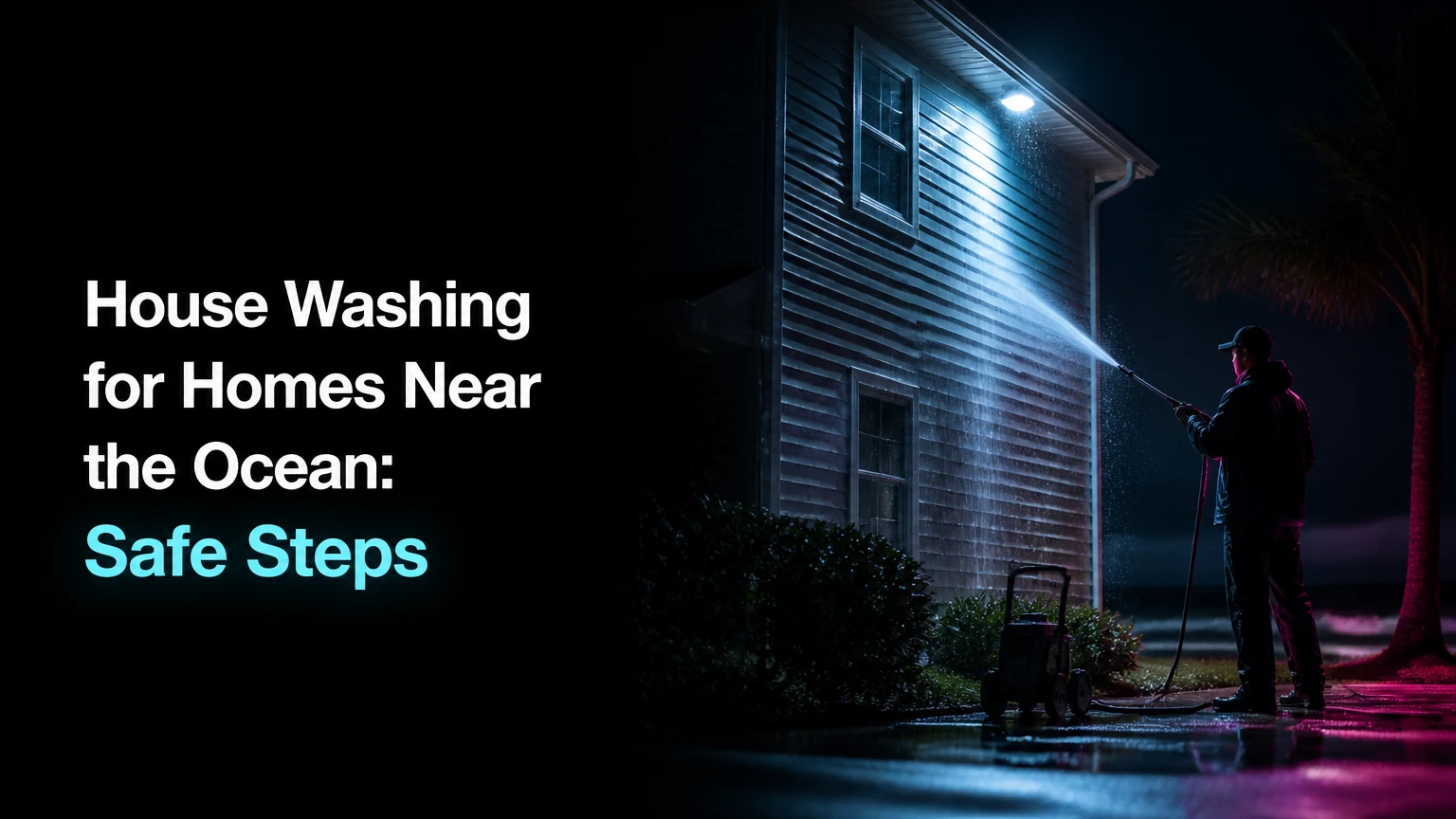
House washing for homes near the ocean removes salt film, sand, algae, mildew, and wind-driven residue with controlled water pressure, compatible cleaners, and thorough freshwater rinsing. The safest approach protects siding, windows, metals, landscaping, and storm drains while matching the process to the home’s material and exposure to surf.
Key Facts at a Glance
Coastal homes typically need exterior washing every 3-12 months, depending on surf distance, wind exposure, shade, and visible residue.
Sodium hypochlorite kills algae, mold, and mildew, but it does not neutralize sodium chloride salt.
Low pressure reduces siding damage, but nozzle distance, water volume, chemical concentration, and operator control matter more than PSI alone.
Typical professional costs range from $300-$1,200 for many coastal houses, with large or difficult properties costing more.
A freshwater pre-rinse and final rinse remove loose salt and chemical residue before they dry into a white film.
Exterior washing cannot repair rotten wood, corroded fasteners, failed caulk, etched glass, or water-damaged wall cavities.
What Is Coastal House Washing?
Coastal house washing is the controlled cleaning of an ocean-exposed exterior where salt aerosol, airborne sand, biological growth, and persistent humidity create a different maintenance load than inland grime. Ocean spray deposits dissolved salts that remain after water evaporates, while shaded siding and roof edges retain moisture that supports algae and mildew.
Salt is a residue problem, not a mold problem. Freshwater dissolves and carries away sodium chloride, whereas a registered detergent or biocide may be needed for organic growth. A “salt-neutralizing” product can improve wetting or remove oily deposits, but no generic cleaner should be assumed to chemically cancel salt unless its label and technical documentation specifically support that use.
The U.S. Environmental Protection Agency requires antimicrobial pesticides, including many products marketed for mold and mildew control, to carry directions for use and environmental precautions. Product labels control dilution, application, contact time, and discharge restrictions. A contractor who cannot identify the product and its label is not demonstrating marine-safe practice.
Coastal cleaning also has a corrosion-control purpose. Salt residue attracts moisture from humid air and increases the time metal surfaces remain electrically conductive. Washing slows contamination, but it does not reverse rust, restore failed paint, or replace corroded screws.
How Does Salt Damage a Coastal Home?
Salt damage occurs when chloride-bearing residue remains on metal, coatings, glass, and porous materials during repeated wetting and drying cycles. The greatest risk usually affects exposed fasteners, balcony hardware, HVAC components, railings, light fixtures, and unsealed joints rather than the siding face alone.
Salt can accelerate corrosion where protective coatings are scratched or where dissimilar metals contact one another. The Federal Highway Administration has long recognized chloride exposure as a major corrosion mechanism for reinforced concrete infrastructure, but a residential house is not a bridge, and the same data should not be converted into a precise home-washing interval.
Paint and sealants can also lose service life through ultraviolet exposure, heat, salt contamination, and repeated wetting. Washing removes contaminants; it cannot compensate for a failing coating system. Windows require separate diagnosis because salt haze, hard-water scale, and permanent glass etching look similar after drying.
Which Coastal Areas Need the Most Washing?
Homes within roughly 100-500 feet of breaking surf usually receive the highest salt aerosol exposure, although wind direction and elevation can matter more than straight-line distance. Properties several blocks inland may still need frequent washing when prevailing winds push spray through open streets.
| Exposure condition | Typical cleaning interval | Main visible contaminant | Maintenance priority |
|---|---|---|---|
| Direct surf, under 100 feet | Every 1-3 months | Salt crust, sand, algae | Freshwater rinse and quarterly inspection |
| Waterfront, 100-500 feet | Every 3-6 months | Salt film, mildew, wind grime | Full exterior wash two to four times yearly |
| Coastal neighborhood, 0.5-2 miles | Every 6-12 months | Pollen, dust, algae | Annual wash with spot rinsing |
| Sheltered inland coastal property | Every 9-18 months | Organic staining, dirt | Wash when shaded growth or residue appears |
These intervals are practitioner planning ranges, not universal standards. A north-facing wall under deep eaves may soil faster than a sunlit ocean-facing wall because rain cannot rinse the sheltered surface and evaporation is slower.
What Equipment and Chemicals Are Appropriate?
Coastal exterior washing requires a low-pressure delivery system, freshwater supply, soft brushes, protective coverings, runoff controls, and cleaning products selected for the substrate. The equipment should apply enough water to rinse completely without forcing liquid behind cladding, seals, vents, or electrical penetrations.
Sodium hypochlorite is useful for killing biological growth when the surface, concentration, application method, and label permit it. It is not a salt remover. Never mix bleach with acids, ammonia, or unknown “neutralizers,” because hazardous gases or uncontrolled reactions can result.
A mild surfactant helps a solution cling to siding instead of running immediately to the ground. For heavy salt, freshwater volume and dwell control usually matter more than an aggressive additive. For windows, a deionized-water system can reduce spotting, but pure water does not kill mold or dissolve every oily contaminant.
| Component | Typical specification | Suitable use | Important limitation |
|---|---|---|---|
| Low-pressure pump | 100-300 PSI at the surface | Vinyl, painted wood, stucco, fiber cement | Pressure alone does not guarantee safety |
| Soft-wash hose and injector | 1/2-3/4 inch hose, adjustable draw | Detergent application | Wind can carry overspray |
| Soft brush | Nylon or flagged bristles, 12-24 inches | Eaves, salt crust, stubborn film | Avoid abrasive pads on coatings |
| Freshwater rinse | Continuous supply, 4-8 gallons per minute typical | Dissolving and removing salt | Low flow can leave residue |
| Pure-water pole system | Deionized water, typically below 20 ppm TDS | Windows and light siding film | Ineffective against heavy biological staining |
| Sodium hypochlorite solution | Label-directed dilution | Mold, mildew, algae | Can damage plants, metals, and finishes |
| Surfactant | Product-label dilution | Wetting and controlled dwell | Excess can leave a sticky film |
The often-repeated rule “under 300 PSI is always safe” is incomplete. A narrow nozzle held close can damage siding at low machine pressure, while a wider fan at greater distance distributes force more gently. Surface condition, angle, flow, temperature, and operator movement must be considered together.
How Should You Wash a Coastal Home?
A coastal house can usually be washed in five controlled stages: protect the property, pre-rinse with freshwater, apply compatible cleaner, agitate only where needed, and rinse from the highest point downward. A typical professional visit takes 3-6 hours, including setup and plant protection, while a small single-story home may take 1.5-3 hours.
The most important success factor is preventing cleaner and dissolved salt from drying on the surface. Work in shaded sections, monitor wind, keep siding wet during dwell, and maintain enough rinse water to flush residue from joints and landscaping.
Before You Start
| Item | Typical requirement | Why it matters |
|---|---|---|
| Active washing time | 2-5 hours | Covers a 1,500-3,000-square-foot exterior |
| Total appointment | 3-6 hours | Includes setup, protection, testing, and cleanup |
| DIY difficulty | Moderate to high | Requires chemical, ladder, and runoff control |
| Freshwater supply | 4-8 gallons per minute | Supports complete salt removal |
| Soft brush | 1-2 brushes, 12-24 inches | Reaches eaves and sheltered areas |
| Protective sheeting | 2-4 rolls or equivalent | Covers electronics and sensitive fixtures |
| PPE | Chemical gloves, eye protection, non-slip footwear | Reduces splash and exposure risk |
| Test area | 1 square foot per material | Confirms compatibility before full application |
Do not begin if wind moves spray toward neighboring property, open windows, pedestrians, vehicles, or a waterway. Postpone work on hot surfaces that dry cleaner rapidly, during freezing conditions, or when local rules prohibit discharge to a storm drain.
Step 1: Protect the Property
Cover outdoor electronics, cameras, doorbell units, speakers, exposed outlets, keyholes, and sensitive metal fixtures. Close windows and doors, move cushions and toys, and identify vents that should not receive direct spray.
Pre-wet landscaping with freshwater until leaves and soil are thoroughly saturated. Keep a hose available for continuous rinsing, and use temporary berms, drain covers approved for the site, or a collection and recovery method when local rules require wastewater control.
You will know the property is ready when fixtures are covered, windows are closed, plants are wet, and the planned spray path does not cross people or unprotected openings.
The common mistake is taping plastic over a hot light fixture or sealing moisture inside a device. Use covers that shield spray without trapping heat, and remove them after the area is dry.
Step 2: Pre-Rinse With Freshwater
Rinse from the top downward using a broad spray pattern and enough flow to dissolve loose salt and release sand. Start with eaves, upper walls, window frames, and railings, then move toward lower siding and foundations.
A freshwater pre-rinse cools sun-heated surfaces and reduces the amount of salt that cleaner must carry. Do not use a concentrated jet to blast sand into window seals, soffit vents, or lap joints.
You will know the pre-rinse worked when loose crust, dust, and sand have left the surface and water runs without carrying visible grit from upper walls.
The common mistake is skipping this stage because the house “looks clean.” Invisible salt film remains chemically active and can become a white haze when detergent dries.
Step 3: Apply Compatible Cleaner
Apply cleaner in small sections, generally from the bottom upward on siding to reduce dirty runoff streaks, while keeping the surface wet. Follow the product label for concentration, contact time, required rinsing, and prohibited materials.
A typical biological-growth treatment may dwell for 5-15 minutes, but hot sun, porous stucco, wind, and strong absorbency can reduce the safe dwell time. Re-wet before the surface dries. Heavy salt deposits may respond better to repeated freshwater passes and soft brushing than to stronger chemistry.
Test painted wood, aged vinyl, stucco, aluminum, and unusual coatings in an inconspicuous 1-square-foot area. Stop if color transfers, gloss changes, chalking increases, or the coating softens.
You will know the cleaner is working when organic staining lightens and the film becomes easier to rinse without dry patches forming.
The common mistake is treating every white deposit with stronger bleach. White deposits are often salt or mineral scale, and stronger bleach can damage plants, metals, and coatings without removing the cause.
Step 4: Agitate Sheltered Deposits
Use a soft nylon or flagged-bristle brush on stubborn salt crust, eave undersides, balcony corners, textured stucco, and areas shielded from rainfall. Apply light pressure after the deposit has been wet for several minutes.
Do not scrub dry siding, scrape painted surfaces, or use abrasive pads on window glass. Salt mixed with sand can act like an abrasive compound, so brushing before pre-rinsing may create fine scratches in glossy coatings or acrylic panels.
You will know agitation is sufficient when the deposit releases with light passes and the surface no longer feels gritty under a gloved hand.
The common mistake is using a stiff deck brush on painted wood. A soft brush and another wetting cycle are safer than increased force.
Step 5: Rinse Thoroughly From the Top Down
Rinse upper walls, eaves, frames, fixtures, and lower siding with clean freshwater until no foam, cleaner, grit, or white residue remains. Keep the spray broad, maintain a safe distance, and direct water away from cladding laps, vents, and failed seals.
Flush windows separately. Hard tap water can leave mineral spots, especially on hot glass, so use a squeegee or a deionized-water rinse when spotting is a known problem.
Rinse plants and soil again after the exterior is clean. Collect, divert, or dilute runoff only where local regulations and the product label allow it. Never assume that a biodegradable product is automatically safe to discharge into a storm drain.
You will know the rinse is complete when water sheets or beads consistently, no cleaner smell remains, and the drying surface shows no streaks or chalky film.
The common mistake is rinsing only until the siding looks clear. Residue trapped under eaves can dry later and create a second cleaning problem.
Which Washing Method Fits Each Material?
Soft washing is generally the safest primary method for painted or weathered residential cladding, while pressure washing is better reserved for durable masonry and hardscape. Pure-water rinsing suits windows and light maintenance, but it cannot replace biological treatment or heavy soil removal.
| Exterior material | Preferred method | Typical surface pressure | Main risk |
|---|---|---|---|
| Vinyl siding | Soft wash and freshwater rinse | 100-300 PSI | Water behind laps or damaged panels |
| Fiber-cement siding | Low-pressure wash, controlled rinse | 100-300 PSI | Coating failure and edge intrusion |
| Painted wood | Low-pressure wash and soft brush | 50-150 PSI | Paint lifting, raised grain, rot exposure |
| Stucco | Low-pressure wash, localized brushing | 50-150 PSI | Cracking, water entry, surface erosion |
| Brick masonry | Moderate pressure after testing | 500-1,000 PSI typical | Mortar erosion and efflorescence |
| Concrete walkway | Pressure washing | 1,000-3,000 PSI typical | Etching and striping |
| Aluminum siding | Low-pressure wash | 50-150 PSI | Dents, oxidation streaks, chalking |
| Glass windows | Pure-water or controlled hand cleaning | Minimal direct pressure | Seal failure and mineral spotting |
Pressure figures are operational starting ranges, not universal limits. A contractor should test the actual substrate, keep the nozzle moving, avoid forcing water behind siding, and lower pressure when paint, caulk, wood, or seals are deteriorated.
High-pressure washing at 2,500-4,000 PSI may clean unpainted concrete quickly, but those settings are inappropriate for most residential siding. Pressure can drive water into wall cavities, remove paint binders, scar wood, and damage window seals.
What Is the Difference Between Salt, Mineral Scale, and Mold?
Salt usually appears as a loose white haze or crust that softens and dissolves with freshwater. Mineral scale is harder, more bonded, and often concentrated around sprinklers or glass edges. Mold, mildew, and algae produce dark, green, brown, or pink biological staining and require a compatible treatment rather than freshwater alone.
| Symptom | Likely cause | First test | Corrective action |
|---|---|---|---|
| White powder on siding | Dried salt or chalking paint | Wet a small area with freshwater | Rinse, then evaluate paint condition |
| Hard white glass spots | Mineral scale | Test with approved glass cleaner | Use specialist glass restoration if etched |
| Green film in shade | Algae | Observe color change after wetting | Apply label-approved biocide |
| Black dots under eaves | Mildew or embedded soil | Test inconspicuous area | Low-pressure treatment and soft brushing |
| Orange streaks near hardware | Rust runoff | Inspect metal source | Remove rust source and repair coating |
| Sticky clear residue | Surfactant or detergent film | Freshwater rinse test | Re-rinse, avoiding stronger chemicals |
A practitioner rule of thumb is simple: if freshwater removes the mark, do not escalate chemistry. If freshwater does not remove it, identify the contaminant before increasing pressure.
How Much Does Coastal House Washing Cost?
Professional coastal house washing typically costs $300-$1,200 for many homes, with a common 1,500-2,500-square-foot property often falling near $450-$950. Location, access, height, siding condition, window count, runoff controls, and the amount of hand brushing can move the quote outside that range.
| Project type | Typical price | Typical duration | Cost drivers |
|---|---|---|---|
| Small single-story home | $300-$550 | 1.5-3 hours | 1,000-1,500 square feet, easy access |
| Standard two-story home | $450-$950 | 3-6 hours | 1,500-2,500 square feet, eaves and ladders |
| Large waterfront home | $800-$1,800 | 5-9 hours | 3,000-5,000 square feet, balconies, glass |
| Add-on window cleaning | $150-$500 | 1-3 hours | Pane count, mineral scale, pure-water equipment |
| Heavy restoration cleaning | $900-$2,500 | 1-2 days | Oxidation, rust, thick growth, access controls |
These are typical planning ranges, not published price standards. Ask whether the quote includes plant protection, freshwater rinsing, window cleaning, gutter exteriors, deck surfaces, wastewater controls, and return visits for missed residue.
The least expensive quote may omit pre-rinsing, test patches, or complete rinsing. A written scope provides more useful comparison than a low advertised square-foot rate.
When Should a Coastal Home Be Washed?
A coastal home should usually receive a full exterior wash two to four times per year when it sits near surf, has persistent shade, or shows recurring salt film. Homes farther inland may need only one annual wash, while direct waterfront properties may benefit from monthly freshwater rinses between professional treatments.
Schedule washing after a low-wind period when surfaces are cool and shaded. Avoid strong wind, intense sun, freezing temperatures, and rain that will interrupt dwell or carry chemicals beyond the work area.
Inspect these locations monthly in high-exposure areas:
- Window corners and tracks
- Stainless steel, galvanized, and painted metal
- HVAC coils and outdoor units
- Balcony hardware and railings
- Eave undersides and soffit vents
- Siding laps and failed caulk joints
- North-facing walls and shaded foundations
An automated freshwater rinse can reduce salt accumulation at luxury waterfront properties, but it does not replace periodic inspection. Repeated wetting can expose leaks, loose coatings, and corroded fasteners that require repair.
What Are the Most Common Coastal Washing Failures?
The most common failures are excessive pressure, dried chemistry, incomplete rinsing, uncontrolled runoff, and misidentification of salt as mold. Each failure has a recognizable symptom and a safer recovery path.
| Failure mode | Visible symptom | Likely consequence | Recovery |
|---|---|---|---|
| High pressure on siding | Fuzzy paint, stripes, lifted laps | Water intrusion or coating loss | Stop, allow drying, inspect, repair |
| Cleaner dries in sun | White streaks or uneven color | Residue and possible discoloration | Re-wet and rinse in smaller sections |
| Bleach runoff reaches plants | Wilting or bleached leaves | Plant injury and soil contamination | Flood foliage and soil with freshwater |
| Sand is brushed dry | Fine scratches or dull patches | Coating or glass damage | Stop abrasion and assess professionally |
| Eaves are ignored | Recurring dark bands and rust | Persistent growth and metal corrosion | Hand-clean sheltered surfaces |
| Runoff enters storm drain | Foamy or colored discharge | Regulatory and environmental exposure | Stop discharge and follow local requirements |
Siding discoloration after washing may indicate oxidation rather than chemical damage. Test by wiping a hidden area with a clean damp cloth; if chalk transfers before cleaning, restoration or repainting may be needed.
A white haze that returns after a second rinse can indicate failing paint, efflorescence from masonry, hard-water scale, or glass etching. Washing alone cannot solve those conditions.
Should You DIY or Hire a Professional?
DIY cleaning is reasonable for a small, one-story home with sound siding, low wind, safe ground access, and no difficult runoff issue. Professional service is safer for two-story waterfront homes, fragile materials, heavy biological growth, deteriorated coatings, balconies, steep roofs, or properties beside sensitive waterways.
Choose DIY only when you can identify the material, read the chemical label, protect plants, avoid ladders where possible, and rinse the entire surface. A downstream injector does not automatically make a pressure washer safe.
Choose a contractor who can provide:
- General liability and workers’ compensation insurance
- A written scope naming pressure approach and cleaning products
- Material-specific test patches
- A plant-protection and runoff plan
- Product labels or active ingredients on request
- Before-and-after photographs of difficult areas
- References from comparable waterfront properties
- A clear policy for residue, plant injury, or missed areas
A rental-property manager commonly benefits from scheduled spring and autumn service plus interim freshwater rinsing after major storms. A direct-surf homeowner may need shorter inspection intervals, while a sheltered coastal homeowner can usually prioritize visible growth and salt accumulation.
FAQ
Can Rain Wash Salt Off a Beach House?
Rain removes some exposed salt, but sheltered eaves, window frames, balcony undersides, and wall recesses often receive little direct rainfall. Wind-driven rain may also redistribute contamination rather than flush it. A freshwater rinse is more reliable because it reaches protected surfaces and carries dissolved salt away under controlled flow.
Is Vinegar Safe for Removing Coastal Salt?
Vinegar can help dissolve some mineral deposits, but it is not a universal salt remover and may damage natural stone, cement-based materials, metals, or nearby plants. Freshwater should be the first treatment for sodium chloride residue. Use a material-specific product only after a small compatibility test and label review.
How Do You Remove Salt From Window Glass?
Rinse window glass with freshwater before wiping so sand does not scratch the surface. Use a non-abrasive glass solution, a clean microfiber tool, and a squeegee, or use a deionized-water system to reduce spotting. Persistent white marks may be mineral scale or etched glass, which ordinary washing cannot reverse.
Can Coastal House Washing Remove Rust?
Coastal house washing can remove loose rust staining and the salt deposits that accelerate corrosion, but it cannot restore rusted metal or replace failed protective coatings. Identify the source, such as a corroded railing, fastener, HVAC component, or runoff path, then repair or coat the metal after it dries.
Does Soft Washing Kill Mold on Siding?
Soft washing can kill or remove surface mold, mildew, and algae when the cleaning product is compatible, properly diluted, and left wet for the label-directed contact time. It cannot eliminate moisture problems inside walls or prevent regrowth caused by leaks, persistent shade, failed flashing, or poor drainage.
What Should You Ask a Coastal Washing Contractor?
Ask which products will be used, whether sodium hypochlorite is part of the treatment, how plants and storm drains will be protected, what pressure approach fits each material, and how residue will be rinsed. Request insurance, a written scope, test-patch confirmation, and an explanation of what repairs the wash cannot address.
The Bottom Line
House washing for homes near the ocean works best as a controlled freshwater and low-pressure cleaning process, not as maximum-pressure blasting or indiscriminate chemical treatment. Pre-rinse salt, treat biological growth only when necessary, keep solutions wet, brush gently, rinse completely, and adapt the method to the siding, windows, weather, and runoff requirements.
For many exposed homes, professional washing every 3-6 months is a practical starting point, with more frequent freshwater rinsing near breaking surf. Sodium hypochlorite can control mold, but freshwater removes salt; confusing those functions leads to residue, plant damage, and unnecessary chemical use.