House soft wash vs pressure wash is primarily a choice between chemical cleaning and mechanical cleaning. Soft washing uses a treated solution and low-pressure rinsing for siding, stucco, painted surfaces, and roofs; pressure washing uses concentrated water force for durable concrete, stone, and masonry. The safest choice depends on the surface, stain, and drainage conditions.
Key Facts at a Glance
- Soft washing typically applies cleaning solution at less than 500 PSI, then rinses with low pressure.
- Residential pressure washing commonly operates around 1,500-3,000 PSI, although equipment may exceed 4,000 PSI.
- Asphalt shingle roofs should generally be cleaned with a low-pressure chemical method, not high-pressure spray.
- Pressure washing is usually the better tool for unsealed concrete, heavy mud, embedded grit, and some grease deposits.
- Soft washing kills algae, mildew, and some lichen more effectively than water-only blasting because treatment reaches biological growth.
- A professional house wash commonly costs about $250-$500, while driveway cleaning often costs about $100-$300.
House Soft Wash vs Pressure Wash: The Core Difference
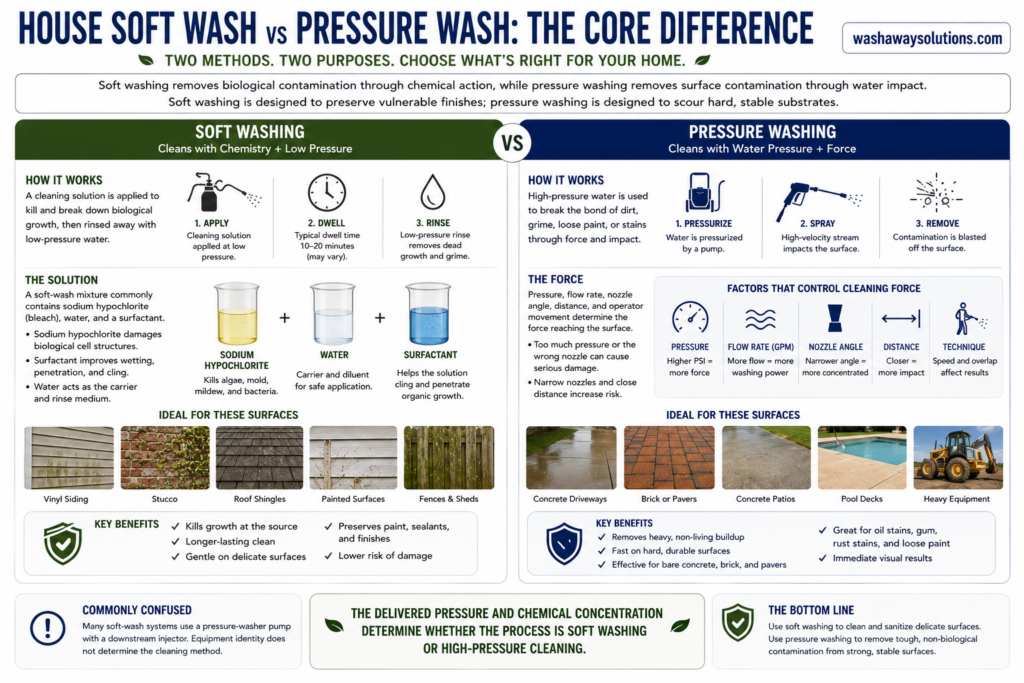
Soft washing removes biological contamination through chemical action, while pressure washing removes surface contamination through water impact. Soft washing is designed to preserve vulnerable finishes; pressure washing is designed to scour hard, stable substrates.
A soft-wash mixture commonly contains sodium hypochlorite, water, and a surfactant. The sodium hypochlorite damages biological cell structures, while the surfactant improves wetting and cling. After a dwell period, low-pressure water removes dead growth and dissolved grime.
Pressure washing uses a pump, hose, gun, and nozzle to concentrate water into a high-velocity stream. Pressure, flow rate, nozzle angle, distance, and operator movement determine the force reaching the surface. A narrow nozzle held too close can cut paint, erode mortar, or permanently scar concrete.
The terms are sometimes confused because many soft-wash systems use a pressure-washer pump with a downstream injector. Equipment identity does not determine the cleaning method. The delivered pressure and chemical concentration determine whether the process is soft washing or high-pressure cleaning.
How does soft washing work?
Soft washing applies a chemical solution, allows adequate dwell time, and rinses the surface without relying on abrasive water impact. The process works best against algae, mildew, moss staining, and atmospheric organic film on exterior materials.
A typical residential workflow begins with an inspection of siding laps, window seals, vents, outdoor outlets, landscaping, and drainage paths. Plants receive a thorough pre-wet, sensitive fixtures are protected, and the solution is applied from the lower section upward to reduce visible runs.
Typical dwell time is 5-15 minutes, but temperature, sunlight, surface porosity, contamination thickness, and product label instructions change the timing. The surface must remain wet during dwell. A final rinse normally proceeds from the top downward, followed by another plant rinse.
Chemical strength must follow the product label and the surface manufacturer’s guidance. A commonly used house-wash range may be approximately 0.5%-2% available sodium hypochlorite at the surface, but stronger is not automatically better. Roof cleaning often uses a stronger treatment than siding, while delicate finishes may require a weaker solution or a non-chlorine product.
How does pressure washing work?
Pressure washing uses pump pressure and water flow to break the bond between dirt and a durable surface. The operator controls cleaning intensity by changing the nozzle, stand-off distance, spray angle, travel speed, pressure, and water temperature.
Common nozzle angles include 0 degrees, 15 degrees, 25 degrees, and 40 degrees. A 0-degree nozzle creates a highly concentrated stream and presents a severe damage risk; it is rarely appropriate for routine residential surfaces. Wider patterns distribute force across a larger area.
Water flow matters as much as PSI. A machine producing 2,500 PSI at 2.5 gallons per minute behaves differently from one producing 2,500 PSI at 8 gallons per minute because the second machine delivers much more water to flush loosened material.
A rotary surface cleaner improves consistency on flat concrete. Two or more rotating jets clean beneath a housing, reducing the wand marks that occur when an operator moves unevenly. Surface cleaners still require correct pressure, overlap, speed, and pre-treatment.
Which Method Works Best on Each Surface?
Soft washing is usually safer for thin, painted, jointed, or water-sensitive exterior materials, while pressure washing fits hard, stable surfaces that tolerate mechanical force. Surface condition matters as much as material type: deteriorated paint, cracked mortar, open joints, and failed caulk increase risk.
| Surface or material | Preferred method | Typical delivered pressure | Main reason |
|---|---|---|---|
| Vinyl siding | Soft wash | 40-300 PSI | Limits water behind laps and protects oxidation-prone finish |
| Stucco or EIFS | Soft wash | 40-150 PSI | Reduces surface gouging and cavity intrusion |
| Asphalt shingles | Low-pressure soft wash | Under 100 PSI at roof surface | Preserves granules and avoids forced water beneath shingles |
| Painted wood | Soft wash plus gentle rinse | 40-150 PSI | Reduces paint stripping and fiber damage |
| Fiber cement siding | Soft wash or controlled low pressure | 100-500 PSI | Protects paint film and board edges |
| Unsealed concrete | Pressure wash | 1,500-3,000 PSI | Removes soil from a durable porous substrate |
| Brick or pavers | Controlled low-to-medium pressure | 500-1,500 PSI | Cleans joints while limiting mortar erosion |
| Natural stone | Test-controlled cleaning | 300-1,500 PSI | Stone hardness and finish vary widely |
Which method is safer for siding?
Soft washing is generally safer for vinyl, stucco, EIFS, painted wood, and fiber cement siding because the cleaning solution performs most of the work. High-pressure spray can drive water behind siding, break weak seals, remove paint, and expose substrate.
Siding should not be treated as waterproof simply because it is designed for outdoor exposure. Vinyl panels shed rain when correctly installed, but upward spray can push water beneath overlaps and around penetrations. Stucco and EIFS are especially sensitive to erosion, cracking, and water entering joints.
A low-pressure rinse does not mean careless application. Windows should be closed, electrical fixtures protected according to their design, and damaged caulk or open vents identified before wetting. A professional should reduce chemical exposure around aluminum, copper, unpainted steel, and delicate landscaping.
Should you pressure wash a roof?
You generally should not pressure wash asphalt shingles. High-pressure water can dislodge granules, damage the mat, lift shingle edges, and force water beneath courses, so roof-cleaning guidance commonly favors a low-pressure chemical treatment.
The Asphalt Roofing Manufacturers Association recommends cleaning asphalt roofing with solutions and low-pressure rinsing rather than aggressive power washing. Roof warranties also vary, so homeowners should check the shingle manufacturer’s maintenance instructions before hiring a cleaner.
Roof moss presents a special case. Chemical treatment can kill moss, but dead growth may remain attached for days or weeks. Scraping or brushing aggressively can remove granules. A safer plan is usually treatment, controlled removal of loose debris, and time for weather to release remaining roots.
Roof pitch, access, weather, runoff, and fall protection determine whether a job is appropriate for a homeowner. A long wand does not replace safe roof access. Many roof-cleaning accidents occur because the operator focuses on spray technique rather than footing and fall exposure.
Can soft washing clean concrete?
Soft washing can remove algae and organic film from concrete, but it may not remove deeply embedded oil, tire marks, rust, mineral scale, or cured paint. Concrete often benefits from chemical pre-treatment followed by controlled pressure rinsing.
Pressure washing is usually the primary method for an unsealed driveway, walkway, patio, or pool deck. A surface cleaner produces more uniform results than a handheld wand, while a degreaser can loosen petroleum staining before rinsing.
Concrete is durable but not indestructible. Excessive pressure can expose aggregate, create pitting, strip a weak sealer, or produce pale cleaning tracks. New concrete requires particular caution because the surface may not have developed full strength.
Brick and pavers require joint awareness. High pressure can remove joint sand, erode old mortar, and increase weed growth or water movement beneath units. Lower pressure, wider spray, and controlled rinsing are safer starting points.
How Do Pressure and Water Volume Differ?
Soft-wash systems commonly deliver 40-500 PSI and 5-10 gallons per minute, whereas residential pressure washers commonly deliver 1,500-3,000 PSI and 2-8 gallons per minute. These are typical field ranges, not universal specifications, and the surface-level pressure can be substantially lower than pump-rated pressure.
| Operating factor | Soft-wash setup | Pressure-wash setup | Practical effect |
|---|---|---|---|
| Delivered pressure | 40-500 PSI | 1,500-4,400+ PSI | Chemical system minimizes impact; pressure system maximizes impact |
| Water flow | 5-10 GPM typical | 2-8 GPM typical | Higher flow improves rinsing and productivity |
| Common nozzle | Black soap tip or J-Rod | 15, 25, or 40 degrees | Wide soft-wash pattern versus concentrated impact pattern |
| Main active agent | Sodium hypochlorite and surfactant | Water, detergent, or degreaser | Biological treatment versus physical removal |
| Typical dwell | 5-15 minutes | Usually minimal after pre-treatment | Chemistry needs contact time |
| Typical equipment | 12-volt pump or injector | High-pressure pump and steel-braided hose | Different delivery demands and failure risks |
A downstream injector can reduce pressure because it draws chemical through a venturi when a wide-bore nozzle creates sufficient flow. The resulting pressure may be below 500 PSI, but the exact value depends on injector size, hose length, nozzle choice, pump output, and elevation.
Dedicated 12-volt diaphragm pumps can apply stronger mixes over long distances. They also require chemical-compatible components. Sodium hypochlorite can degrade unsuitable seals, metals, and pump parts, so equipment compatibility matters.
Which Method Removes Which Stain?
The stain’s chemistry should determine the first treatment, not the homeowner’s machine. Organic growth responds to biocidal treatment; petroleum, rust, mineral scale, and cured coatings require different chemistry or abrasion.
| Contaminant | Best first approach | Typical follow-up | Why |
|---|---|---|---|
| Green algae | Soft-wash solution | Low-pressure rinse | Chemical treatment reaches biological film |
| Black mildew spots | Soft wash with adequate dwell | Repeat treatment if needed | Water alone may leave living residue |
| Roof streaks | Manufacturer-compatible roof treatment | Weathering and gentle rinse | Pressure can damage shingles |
| Thick moss | Low-pressure treatment | Manual removal after die-off | Immediate scraping can remove granules |
| Engine oil | Alkaline degreaser | Hot-water pressure wash | Surfactant alone rarely dissolves petroleum |
| Rust | Acid-compatible rust remover | Controlled rinse | Pressure does not chemically dissolve iron oxide |
| Cured paint | Test-approved stripper or scraping | Low-pressure rinse | High pressure can spread or scar substrate |
| Mud and clay | Pre-rinse and pressure wash | Final low-pressure flush | Mechanical flow removes loose mineral soil |
Soft washing is not a universal stain remover. Sodium hypochlorite can lighten organic staining while leaving rust rings, oil shadows, artillery fungus, and paint overspray largely unchanged. Pressure washing has the opposite limitation: it can remove visible growth while leaving viable biological material in pores.
What Is the Safer Cleaning Process?
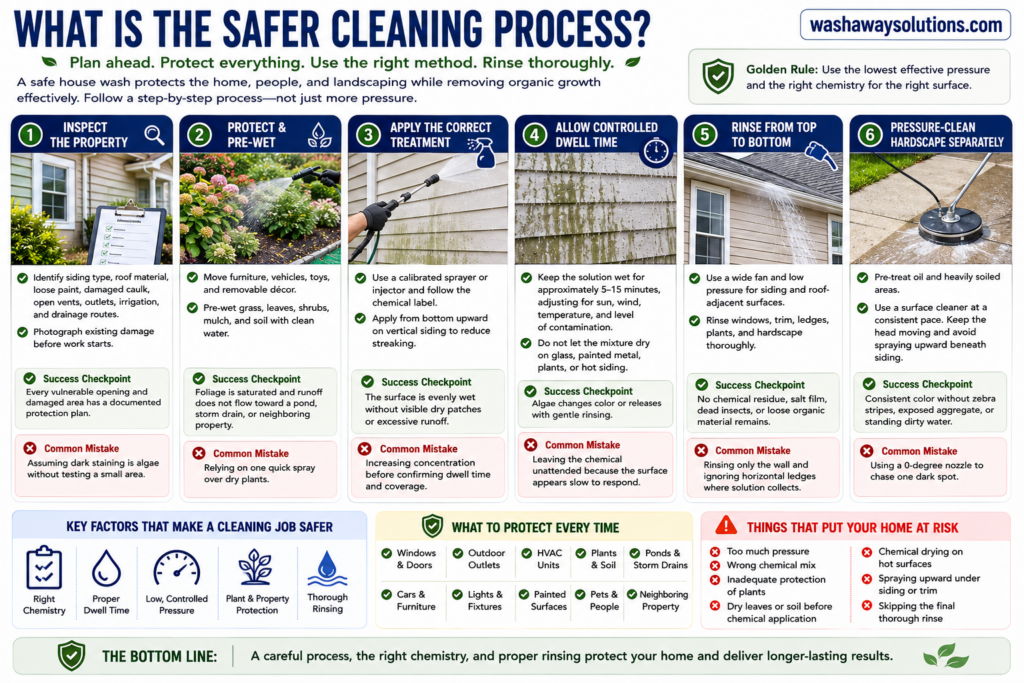
The safer process begins with a substrate inspection, protects people and plants, uses the lowest effective force, and verifies runoff before applying chemicals. A house wash should be planned around water direction and surface vulnerability, not simply around the machine’s maximum PSI.
Step 1: Inspect the property
Identify siding type, roof material, loose paint, failed caulk, cracked windows, open vents, outdoor outlets, irrigation heads, and drainage routes. Photograph existing damage before work starts.
Success checkpoint: every vulnerable opening and damaged area has a documented protection plan.
Common mistake: assuming dark staining is algae without testing a small area.
Step 2: Protect and pre-wet
Move furniture, vehicles, toys, and removable décor. Pre-wet grass, leaves, shrubs, mulch, and soil with clean water, then keep sensitive plants wet during treatment.
Success checkpoint: foliage is saturated and runoff does not flow toward a pond, storm drain, or neighboring property.
Common mistake: relying on one quick spray over dry plants.
Step 3: Apply the correct treatment
Use a calibrated sprayer or injector and follow the chemical label. Apply from the bottom upward on vertical siding to reduce uncontrolled streaking, keeping the spray away from people, pets, unprotected metal, and open windows.
Success checkpoint: the surface is evenly wet without visible dry patches or excessive runoff.
Common mistake: increasing concentration before confirming dwell time and coverage.
Step 4: Allow controlled dwell
Keep the solution wet for approximately 5-15 minutes, adjusting for sun, wind, temperature, and contamination. Do not let the mixture dry on glass, painted metal, plants, or hot siding.
Success checkpoint: algae changes color or releases with gentle rinsing.
Common mistake: leaving the chemical unattended because the surface appears slow to respond.
Step 5: Rinse from top to bottom
Use a wide fan and low pressure for siding and roof-adjacent surfaces. Rinse window frames, ledges, trim, plants, and hardscape thoroughly, then inspect from multiple angles.
Success checkpoint: no chemical residue, salt film, dead insects, or loose organic material remains.
Common mistake: rinsing only the wall and ignoring horizontal ledges where solution collects.
Step 6: Pressure-clean hardscape separately
For concrete, pre-treat oil and heavily soiled areas, then use a surface cleaner at a consistent pace. Keep the wand or surface-cleaner head moving, maintain overlapping passes, and avoid spraying upward beneath siding.
Success checkpoint: the cleaned area has consistent color without zebra stripes, exposed aggregate, or standing dirty water.
Common mistake: using a 0-degree nozzle to chase one dark spot.
How Much Does Each Method Cost?
A typical 2,000-square-foot house wash costs about $250-$500 by soft wash and about $200-$400 when a contractor pressure-washes appropriate hard exterior areas. Roof cleaning commonly costs $300-$700, while a driveway or walkway often costs $100-$300.
| Service | Typical 2026 price | Typical duration | Main price variables |
|---|---|---|---|
| 2,000-square-foot house soft wash | $250-$500 | 2-4 hours | Height, access, algae density, plant protection |
| House pressure washing | $200-$400 | 3-6 hours | Surface type, detail work, equipment access |
| Asphalt shingle roof cleaning | $300-$700 | 2-5 hours | Pitch, stories, roof area, runoff controls |
| Driveway cleaning | $100-$300 | 1-3 hours | Square footage, oil treatment, sealing |
| Walkway or small patio | $100-$250 | 1-2 hours | Furniture removal, joints, stains |
| Minimum contractor service call | $100-$200 | 1-2 hours | Travel, setup, insurance, disposal |
Angi and HomeGuide publish broad national pressure-washing ranges, but local quotes vary because labor, insurance, water access, regional wages, and minimum charges differ. Per-square-foot pricing can fall around $0.15-$0.30 for house washing, $0.10-$0.25 for concrete, and up to about $0.60 for roof cleaning.
A cheaper quote may omit plant protection, stain pre-treatment, gutter rinsing, or post-treatment inspection. Compare the written scope, chemical handling, damage coverage, and warranty language rather than comparing only the final number.
Which Method Fits Your Situation?
The best choice changes with the substrate and contamination. Soft washing is the default for biological growth on a home envelope, while pressure washing is the default for hardscape soil and mechanically bonded debris.
Homeowner cleaning vinyl siding
Choose soft washing with low-pressure application and rinsing. A pressure washer can be used as part of a soft-wash system when the wide nozzle and injector reduce delivered pressure, but a narrow high-pressure tip should never be aimed at siding seams.
Homeowner cleaning a driveway
Choose pressure washing after checking for cracks, weak sealer, oil contamination, and drainage problems. Use a surface cleaner, apply degreaser where needed, and test a small inconspicuous section before cleaning the full slab.
Property manager maintaining commercial buildings
Use a mixed system. Soft wash façades and roofs where organic growth dominates, then use pressure or hot-water cleaning for loading bays, sidewalks, dumpster pads, and oil-affected concrete.
Owner of a historic home
Start with the least aggressive method and obtain a test panel. Old lime mortar, soft brick, aged wood, and fragile coatings can fail under pressure levels that would be acceptable on modern concrete.
DIY homeowner with consumer equipment
Use a manufacturer-labeled detergent and a low-pressure method for compatible siding. Do not mix bleach with acids, ammonia, or unknown cleaners, and do not climb a roof to compensate for inadequate equipment.
What Are the Most Common Failure Modes?
The most expensive cleaning mistakes come from confusing visible speed with correct treatment. A surface can look cleaner immediately after blasting while its coating, mortar, granules, or hidden water barrier has already been damaged.
- Pressure washing siding from below. Upward spray pushes water behind overlaps and may reach insulation or wall framing. Correct the technique by using a downward or controlled horizontal rinse at low pressure.
- Applying chlorine solution to dry plants. Dry foliage can receive a concentrated deposit from overspray. Pre-wet, cover only when appropriate, control runoff, and rinse plants again after the job.
- Using excessive chemical strength. Stronger solution can bleach finishes, corrode fixtures, and injure landscaping. Confirm the active concentration, test a hidden area, and follow the label instead of guessing.
- Creating concrete striping. Inconsistent wand speed or a nozzle held too close leaves alternating clean and dirty bands. Reclean with a rotary surface cleaner and consistent overlapping passes.
- Leaving surfactant residue. White powder or cloudy film usually indicates inadequate rinsing or dried solution. Re-rinse before the surface heats and inspect glass, trim, and horizontal ledges.
- Treating moss like ordinary algae. Thick moss may need a longer biological treatment and delayed manual removal. Increasing pressure can remove roof granules or mortar before the roots have died.
When Is Neither Method Enough?
Neither soft washing nor pressure washing alone reliably removes every exterior stain. Oil, rust, efflorescence, graffiti, oxidation, and cured paint require substrate-specific chemistry, mechanical agitation, heat, or specialty restoration methods.
A contractor should perform a test patch before treating oxidized vinyl, chalking paint, soft limestone, painted masonry, or historic brick. The test reveals color change, chemical sensitivity, dwell requirements, and whether the apparent stain is actually coating failure.
Weather changes the result. Wind increases overspray, direct sun accelerates drying, freezing temperatures create surface hazards, and heavy rain can dilute treatment or move runoff beyond the work area. A competent operator reschedules rather than forcing the job through unsuitable conditions.
Manufacturer instructions also matter. Roofing products, composite cladding, fiber cement boards, sealers, and painted finishes can specify pressure limits or prohibit certain chemicals. Warranty protection depends on following those instructions, documenting the method, and using a qualified contractor where required.
Frequently Asked Questions
Does soft washing last longer than pressure washing?
Soft washing often delays regrowth better when algae, mildew, or other biological contamination causes the stain, because the treatment attacks living material rather than removing only the visible film. Longevity still depends on shade, humidity, tree cover, roof moisture, and surface porosity. Pressure washing may produce a shorter-lived result when biological residue remains in the substrate.
Can pressure washing damage vinyl siding?
Yes, pressure washing can damage vinyl siding by forcing water behind panels, breaking aged lock connections, removing oxidation, or cracking brittle sections. Risk increases with narrow nozzles, high PSI, close stand-off distance, and upward spray. A low-pressure detergent application and controlled rinse are safer for routine vinyl house washing.
Is sodium hypochlorite safe for every house exterior?
No. Sodium hypochlorite can discolor some coatings, corrode unprotected metals, injure plants, and damage surfaces when concentration, dwell, or rinsing is poorly controlled. Product labels and manufacturer instructions govern use. Operators should pre-wet vegetation, prevent runoff, protect fixtures, and test a small area before broad application.
How often should a house be soft washed?
Many homes need exterior cleaning every 1-3 years, but the interval depends on climate and exposure. Shaded, humid walls beneath trees may show algae within a year, while sunny, dry elevations can remain presentable longer. Cleaning should respond to visible biological growth and manufacturer guidance rather than an automatic calendar.
Is power washing the same as pressure washing?
Power washing and pressure washing both use pressurized water, but power washing commonly refers to equipment that heats the water. Hot water improves removal of grease and petroleum from durable hardscape. Neither term by itself indicates that a method is safe for siding, roofing, painted wood, or stucco.
The Bottom Line
House soft wash vs pressure wash is not a contest between two interchangeable machines. Choose low-pressure soft washing for roofs, siding, stucco, painted wood, fiber cement, and biological growth; choose controlled pressure washing for unsealed concrete, durable masonry, mud, and selected grease-related work. When a property contains both delicate exterior materials and hardscape, the safest professional plan uses both methods, each limited to the surfaces and stains it can clean without causing damage.