A house soft wash solution is a low-pressure exterior-cleaning mixture that uses a registered detergent, surfactant, and often sodium hypochlorite to remove algae, mold, mildew, and other organic growth. The correct formula depends on the surface and chemical concentration, so a fixed bleach-to-water ratio is not universally safe or effective.
Key Facts at a Glance
- Soft washing removes biological growth chemically, then rinses it away with low mechanical force.
- Sodium hypochlorite strength should be calculated from the product’s starting concentration and the desired surface concentration.
- Typical application pressure is garden-hose-like, often below 300 PSI, but the pump rating alone does not determine surface safety.
- Keep every treated area wet during dwell time, commonly 5-15 minutes, and never allow the solution to dry.
- Pre-wetting, covering, and rinsing plants reduces chemical injury, but it does not eliminate runoff risk.
- Soft washing does not repair faded paint, remove rust, reverse oxidation, or fix damaged roofing materials.
What Is Soft Washing?
Soft washing is an exterior-cleaning method that combines chemical treatment, controlled dwell time, and a low-pressure rinse. Unlike high-pressure cleaning, which relies mainly on impact to dislodge contamination, soft washing uses a detergent solution to break down organic films before rinsing them from siding, masonry, or roofing.
The method is particularly useful for asphalt shingles, vinyl siding, stucco, painted wood, fiber-cement siding, and other surfaces that can be gouged, cracked, or stripped by concentrated water pressure. A low-pressure rinse still requires judgment: water forced behind siding laps, window seals, soffits, or roof penetrations can cause damage even when the gauge reading appears modest.
Soft washing is not a single chemical recipe. A contractor may use sodium hypochlorite, sodium percarbonate, hydrogen-peroxide-based products, quaternary ammonium compounds, detergents, or a combination selected from the product label. The right choice depends on the organism, substrate, temperature, runoff path, and required dwell time.
What soft washing removes
A chlorine-based cleaner is effective against green algae, black roof streaks caused by cyanobacteria, mold, mildew, moss staining, and many organic films. It is less effective against mineral scale, efflorescence, rust, grease, and weathered oxidation because those contaminants require different chemistry or restoration methods.
Moss deserves special care. Chemical treatment can kill moss, but dead moss still has to detach naturally or be removed with a substrate-safe method. Pulling established moss from shingles can remove granules and shorten roof life.
How Does the Chemistry Work?
Sodium hypochlorite oxidizes organic material and disrupts microbial cells; a surfactant lowers surface tension, improves wetting, and helps the mixture cling to vertical surfaces. The cleaning solution must remain wet long enough to react, while the rinse removes dead growth and residue without forcing water into the building envelope.
The main ingredients
| Ingredient | Typical function | Practical limitation |
|---|---|---|
| Sodium hypochlorite | Oxidizes algae, mold, mildew, and cyanobacteria | Can damage plants, metals, fabrics, coatings, and skin |
| Surfactant | Improves wetting and vertical cling | Excess foam can obscure coverage and complicate rinsing |
| Sodium percarbonate | Releases oxygen-based cleaning chemistry | Usually slower on heavy black roof streaks |
| Quaternary ammonium compound | Provides biocidal and residual treatment | Label instructions and surface compatibility vary widely |
| Water | Dilutes the active ingredient and carries soil away | Hard water can affect detergents and leave mineral residue |
Sodium hypochlorite is sold at different strengths. Pool products may be approximately 10-12.5%, household bleach is commonly lower, and age, heat, sunlight, and storage conditions reduce available chlorine. A nominal “12.5%” container should not be treated as an exact laboratory concentration after extended storage.
Use a dilution calculator or the label’s instructions. The basic relationship is:
Starting concentration × chemical volume = target concentration × final mixture volume.
For example, reaching a 1% available-sodium-hypochlorite concentration from a fresh 10% product requires roughly one part chemical in nine parts total mixture before accounting for product labeling and measurement limits. That example is a calculation, not a universal recommendation.
The Centers for Disease Control and Prevention states, “Never mix household bleach or other bleach-containing products with other cleaners or disinfectants.” Never combine sodium hypochlorite with acids, ammonia, toilet-bowl cleaner, vinegar, or unknown products. Dangerous gases can form.
How to Choose a House Soft Wash Solution
Choose a house soft wash solution by identifying the surface first, then selecting the mildest labeled product that can remove the specific contamination. Vinyl siding, asphalt shingles, painted wood, stucco, and masonry do not have identical tolerances, absorption rates, or runoff risks.
Match the solution to the surface
| Surface and common problem | Preferred chemistry direction | Typical contact approach | Important restriction |
|---|---|---|---|
| Vinyl siding with algae | Diluted labeled hypochlorite house wash | 5-10 minutes, kept wet | Rinse window seals, plants, and metals thoroughly |
| Asphalt shingles with black streaks | Roof-labeled hypochlorite product | 5-15 minutes, low-pressure rinse | Never use high pressure or walk unnecessarily on shingles |
| Painted wood with mildew | Oxygen bleach or carefully controlled labeled cleaner | 5-10 minutes, test first | Strong chlorine can lighten paint and damage fibers |
| Stucco or render | Material-approved detergent, often diluted hypochlorite | 5-10 minutes, gentle rinse | Avoid driving water into cracks and control overspray |
| Brick and concrete with organic staining | Labeled hypochlorite or oxygen cleaner | 10-15 minutes, repeat if needed | Mortar, sealers, and nearby metals may react |
| Fiber-cement siding | Manufacturer-compatible house wash | 5-10 minutes, low-pressure rinse | Avoid forcing water into joints and laps |
| Natural stone | Stone-safe detergent and test patch | 5-10 minutes, surface dependent | Acidic or strongly oxidizing products can etch or discolor |
The table gives typical field ranges, not permission to ignore a manufacturer’s instructions. Test an inconspicuous section, allow it to dry, and inspect for color change, chalking, streaks, softening, or altered gloss before treating the entire elevation.
Is stronger chemical always better?
No. Stronger chemistry can shorten dwell time, but it also increases the chance of plant injury, coating discoloration, corrosion, and residue. A weaker solution applied evenly to a cool, shaded, wet surface often outperforms a stronger solution that dries in direct sun.
An experienced operator adjusts four variables together: active concentration, dwell time, temperature, and delivery volume. If a test patch does not respond, first check whether the stain is organic before increasing chemical strength.
What Tools and Safety Controls Are Required?

A basic house-washing setup needs chemical-resistant gloves, splash goggles, protective clothing, a low-pressure pump or pump sprayer, dedicated chemical hose, wide-angle tips, clean-water access, plastic sheeting, and a method for rinsing plants. Respiratory protection requirements depend on the product label and local occupational rules.
Before mixing
- Read the Safety Data Sheet and product label.
- Confirm the surface manufacturer permits the product.
- Remove toys, cushions, vehicles, and outdoor fabrics.
- Close windows and doors, and identify HVAC intake openings.
- Protect unpainted aluminum, copper, electrical fixtures, and delicate lighting.
- Wet vegetation with clean water before application.
- Establish where rinse water will flow.
Use chemical-rated equipment. Ordinary garden hoses, metal fittings, and pump seals may deteriorate when exposed to concentrated hypochlorite. Never use a pressure washer’s high-pressure nozzle to apply or rinse a roof or fragile siding.
What weather is suitable?
Work in mild, low-wind conditions with no immediate heavy rain forecast. Direct sun, high surface temperature, and strong wind accelerate evaporation and increase overspray. A cool, overcast morning may provide a longer working window, although cold temperatures can slow chemical action.
Stop when wind carries mist toward neighboring property, pedestrians, traffic, ponds, or edible gardens. Local wastewater rules may restrict discharge into storm drains, especially where the runoff contains detergents or biocides.
How to Soft Wash a House Safely
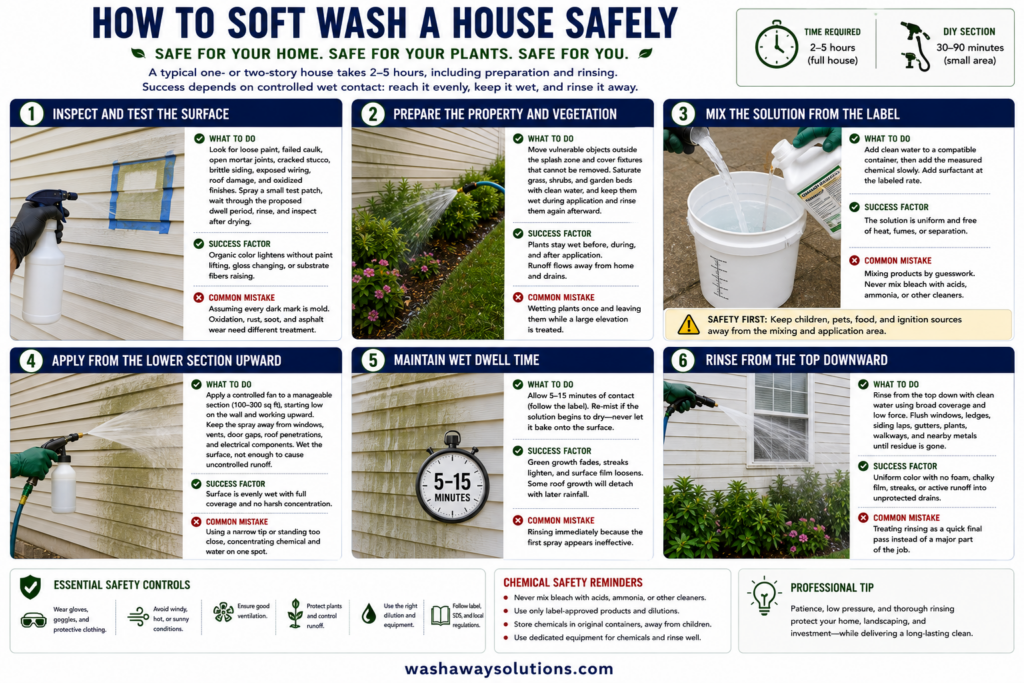
A typical one- or two-story house takes 2-5 hours, including preparation and rinsing, while a small DIY section may take 30-90 minutes. The success factor is controlled wet contact: the solution must reach the contamination evenly, remain wet, and leave the property without damaging plants, finishes, seals, or drainage systems.
Step 1: Inspect and test the surface
Look for loose paint, failed caulk, open mortar joints, cracked stucco, brittle siding, exposed wiring, roof damage, and oxidized finishes. Spray a small test patch, wait through the proposed dwell period, rinse, and inspect after drying.
You will know the test worked when organic color lightens without paint lifting, gloss changing, or substrate fibers raising. The common mistake is assuming every dark mark is mold. Oxidized vinyl, rust, soot, and asphalt wear require different treatment.
Step 2: Prepare the property and vegetation
Move vulnerable objects outside the splash zone and cover fixtures that cannot be removed. Saturate grass, shrubs, and garden beds with clean water, then keep them wet during chemical application and rinse them again afterward.
A helper with a separate garden hose improves plant protection because one person can apply while another monitors vegetation. The common mistake is wetting plants once and abandoning them while a large elevation is treated.
Step 3: Mix the solution from the label
Add clean water to a compatible container, then add the measured chemical slowly according to the label or a verified dilution calculation. Add the surfactant at the labeled rate, because more detergent does not automatically provide more cleaning power.
Do not mix products by approximate bucket ratios when the starting chemical concentration is unknown. Mark the container clearly and keep children, pets, food, and ignition sources away from the mixing area. You will know the batch is ready when the formulation is uniform and free of unexpected heat, fumes, or separation. If heat or fumes develop, leave the area and contact emergency services if exposure occurs.
Step 4: Apply from the lower section upward
Apply a controlled fan of solution to a manageable section, generally 100-300 square feet, beginning low on the wall and working upward. The upward sequence helps prevent dirty chemical runoff from creating uneven lines on dry areas.
Keep the spray away from windows, vents, door gaps, roof penetrations, and electrical components. Use enough solution to wet the surface, not enough to create uncontrolled runoff. The common mistake is using a narrow tip or standing too close, which concentrates chemical and water on one spot.
Step 5: Maintain wet dwell time
Allow approximately 5-15 minutes of contact, depending on the label, temperature, shade, and contamination. Re-mist sections that begin drying; never extend dwell by allowing a concentrated solution to bake onto the surface.
A successful treatment usually causes green growth to fade, black streaks to lighten, and surface film to loosen. The color change may be gradual, and some roof growth will detach over later rainfall. The common mistake is rinsing immediately because the first spray appears ineffective.
Step 6: Rinse from the top downward
Rinse with clean water from the uppermost treated area downward using broad coverage and low force. Flush window frames, ledges, siding laps, gutters, plants, walkways, and nearby metals until chemical residue is gone.
Inspect from several angles after rinsing. A successful result has uniform color and no visible foam, chalky salt film, streaking, or active runoff into an unprotected drain. The common mistake is treating rinsing as a quick final pass rather than a major part of the job.
Soft Washing Versus Pressure Washing
Soft washing is usually the safer choice for biological growth on fragile or coated surfaces, while pressure washing is more efficient for hard, nonporous surfaces with embedded mud or heavy mechanical soil. Neither method is universally superior because chemistry, substrate condition, nozzle selection, and operator control determine the damage risk.
| Decision factor | Soft washing | Pressure washing |
|---|---|---|
| Primary cleaning force | Chemical reaction and low-pressure rinse | Water impact, commonly 1,500-4,000 PSI |
| Typical fragile-surface use | Shingles, stucco, vinyl, painted wood | Generally unsuitable for shingles and delicate coatings |
| Organic growth | Kills or oxidizes surface growth | May remove visible growth without treating roots or spores |
| Concrete and pavers | Useful for algae, often followed by rinse | Effective for mud, tire marks, and embedded soil |
| Main failure mode | Chemical overspray, plant injury, residue | Gouging, chipped paint, leaks, or surface etching |
| Equipment control | Chemical compatibility and runoff management | Nozzle distance, pressure, flow, and angle |
| Best operator priority | Keep chemical wet and contain runoff | Maintain safe standoff distance and avoid concentrated spray |
The frequently repeated claim that soft washing is always below 300 PSI is too absolute. Some systems deliver higher pump pressure but reduce force at the surface through low-flow nozzles, injector systems, distance, and broad spray patterns. Surface impact, not a single gauge number, is the meaningful safety measure.
The American Society of Home Inspectors has repeatedly warned that water intrusion commonly occurs when exterior cleaning forces water behind siding, trim, or flashing. That risk exists with both methods when the operator sprays upward into joints or seals.
When Should You Use Alternatives?
Use oxygen bleach when a lighter environmental footprint, painted wood, or fabric-sensitive setting makes chlorine undesirable, provided the product label covers the surface and contamination. Use quaternary ammonium products only according to their label, especially around roofs, drainage, pets, and aquatic environments.
| Alternative | Best-fit situation | Typical working time | Main trade-off |
|---|---|---|---|
| Sodium percarbonate | Wood decks, fences, painted surfaces | 10-30 minutes | Slower on heavy black algae streaks |
| Hydrogen-peroxide cleaner | Light organic film and sensitive areas | 5-20 minutes | Higher product cost and variable strength |
| Quaternary ammonium | Preventive treatment and selected roofs | 15-60 minutes or label-specific | Residual chemistry requires runoff discipline |
| Detergent-only cleaner | Loose dirt and mild film | 5-15 minutes | Does not reliably kill established algae |
| Mechanical brushing | Small isolated growth patches | Immediate action | May abrade paint, stain, or roof granules |
No chemistry should be described as harmless. Oxygen-based products can irritate skin and eyes, and runoff can still affect plants or aquatic life. “Eco-friendly” is meaningful only when the complete product, dose, exposure, and disposal path are considered.
What Does House Soft Washing Cost?
Typical professional house soft washing costs about $300-$800 in the United States for a standard home, while DIY consumables may cost $50-$150 before specialized pumps, ladders, replacement fittings, and wastewater controls. Local labor rates, house height, roof access, contamination, and plant protection can change the total substantially.
| Job scope | Typical price range | Typical duration | Cost drivers |
|---|---|---|---|
| Small siding elevation | $100-$250 | 1-2 hours | Access, windows, vegetation |
| One-story house wash | $250-$500 | 2-3 hours | Square footage and oxidation |
| Two-story house wash | $400-$800 | 3-5 hours | Height, hose reach, runoff |
| Roof soft wash | $350-$1,000 | 3-6 hours | Pitch, moss, access, roof condition |
| DIY basic supplies | $50-$150 | 3-6 hours | Sprayer, PPE, covers, rinsing |
| Dedicated contractor setup | $2,000-$8,000 | Not applicable | Pump, tanks, hose, proportioning system |
Published contractor pricing varies by region rather than following one national schedule. Housecall Pro’s pressure-washing pricing guidance identifies square footage, labor, equipment, and job difficulty as major pricing variables, which also apply to soft-washing estimates.
A cleaned surface commonly remains visibly improved for 12-24 months, but shaded, damp elevations near trees may regrow sooner. Preventive maintenance, roof drainage, sunlight, humidity, and nearby vegetation usually matter more than the nominal chemical strength.
Common Failures and Repairs
Why did white streaks or a chalky film appear?
White residue usually indicates dried chemical salts, surfactant deposits, hard-water minerals, or disturbed oxidation. Re-wet the area promptly, rinse thoroughly with clean water, and test a manufacturer-approved detergent before using any acidic product.
Acid should never be applied over residual hypochlorite. Neutralize and rinse according to the product instructions first, because incompatible residues can generate hazardous gas.
Why did plants turn brown?
Plant browning usually follows dry foliage exposure, concentrated overspray, or contaminated runoff. Rinse leaves and soil immediately with abundant clean water, remove heavily affected foliage only after the exposure is understood, and monitor the plant for several days.
Pre-wetting reduces absorption but does not guarantee protection. Wind, porous mulch, gutters, and sloped ground can carry diluted solution into root zones after the spray appears finished.
Why are black marks still visible?
Remaining marks may be oxidation, soot, rust, embedded dirt, roof granule loss, or dead staining rather than living algae. Do not automatically increase hypochlorite strength. Compare a cleaned test patch, inspect the surface texture, and select a substrate-specific cleaner if the mark does not respond.
Why did the siding streak?
Streaks often result from uneven wetting, rapid drying, excessive surfactant, top-down application on a dry wall, or insufficient rinsing. Re-wet the complete section, apply a more uniform low-pressure coat, and rinse from the top down after the correct dwell time.
When is DIY soft washing a poor choice?
DIY work is a poor choice on steep roofs, three-story elevations, fragile historic masonry, extensive electrical exposure, strong wind, nearby ponds, or properties with complicated stormwater drainage. A licensed contractor is also preferable when the surface warranty specifies approved cleaning methods.
A professional should provide chemical names, dilution or application information, plant-protection procedures, insurance details, and a clear explanation of where rinse water will go. A low price that excludes runoff control can create a larger repair cost.
Typical Maintenance Intervals
Inspect cleaned siding and roofing twice yearly, especially after humid summers, heavy leaf cover, or prolonged wet weather. Many homes need a full wash every 12-24 months, while shaded north-facing walls may need spot treatment sooner.
Trim vegetation away from walls, clean overflowing gutters, improve splash drainage, and repair roof leaks before washing. Soft washing removes growth; it does not correct the moisture conditions that support regrowth.
FAQ
Can dish soap be used in a house wash mix?
Dish soap can reduce surface tension, but it is a poor default for exterior cleaning because its foam, dyes, fragrances, and rinsing behavior are not designed for siding, roofing, pumps, or plant protection. Use a labeled exterior-cleaning surfactant at its specified rate, and avoid adding detergent to sodium hypochlorite unless compatibility is confirmed.
Is household bleach the same as pool shock?
Household bleach and pool shock both may contain sodium hypochlorite, but their concentration, additives, freshness, and labeling differ. Household bleach can be weaker and may contain fragrances or thickeners. Read the active-ingredient percentage, calculate dilution from that value, and never assume a pool product is interchangeable with a house-wash concentrate.
Can soft washing remove oxidation from vinyl siding?
Soft washing generally cannot reverse vinyl oxidation. Oxidation is a weathered surface condition that may appear as chalky residue, fading, or uneven color; chlorine can clean biological growth while leaving oxidation visible. Restoration may require a specialized oxidation-removal process, and aggressive pressure can worsen the finish.
Should roofs be pressure washed?
Asphalt-shingle roofs should generally not be cleaned with high pressure because concentrated water can remove granules, lift edges, and drive water beneath shingles. A roof-compatible chemical treatment with controlled low-pressure application is usually safer, but damaged, steep, or fragile roofs require professional inspection before cleaning.
How can you tell whether a cleaner is safe for siding?
Check the siding manufacturer’s maintenance instructions, the cleaner’s label, and a hidden test area after the surface dries. A safe result shows no color shift, gloss change, softening, swelling, chalking, or seal failure. Product marketing terms such as “natural” or “eco-friendly” do not replace compatibility testing.
What should be rinsed after soft washing?
Rinse siding, trim, windows, doors, gutters, fixtures, plants, soil, walkways, tools, and exposed metal after treatment. Continue until foam and visible residue disappear. Keep rinse water away from ponds, streams, storm drains, and edible crops unless local requirements and the product label permit the discharge.
The Bottom Line
The best house soft wash solution is the mildest labeled formulation that matches the surface and removes the actual contaminant. Sodium hypochlorite is fast and effective against organic growth, while oxygen-based and quaternary-ammonium alternatives can fit more sensitive or preventive applications. Correct concentration, wet dwell time, low-impact rinsing, and runoff control matter more than copying a universal ratio.
Test first, protect vegetation, never mix incompatible chemicals, and treat steep roofs or complex properties as professional work. A carefully selected house soft wash solution cleans biological growth without substituting chemical risk for pressure damage.