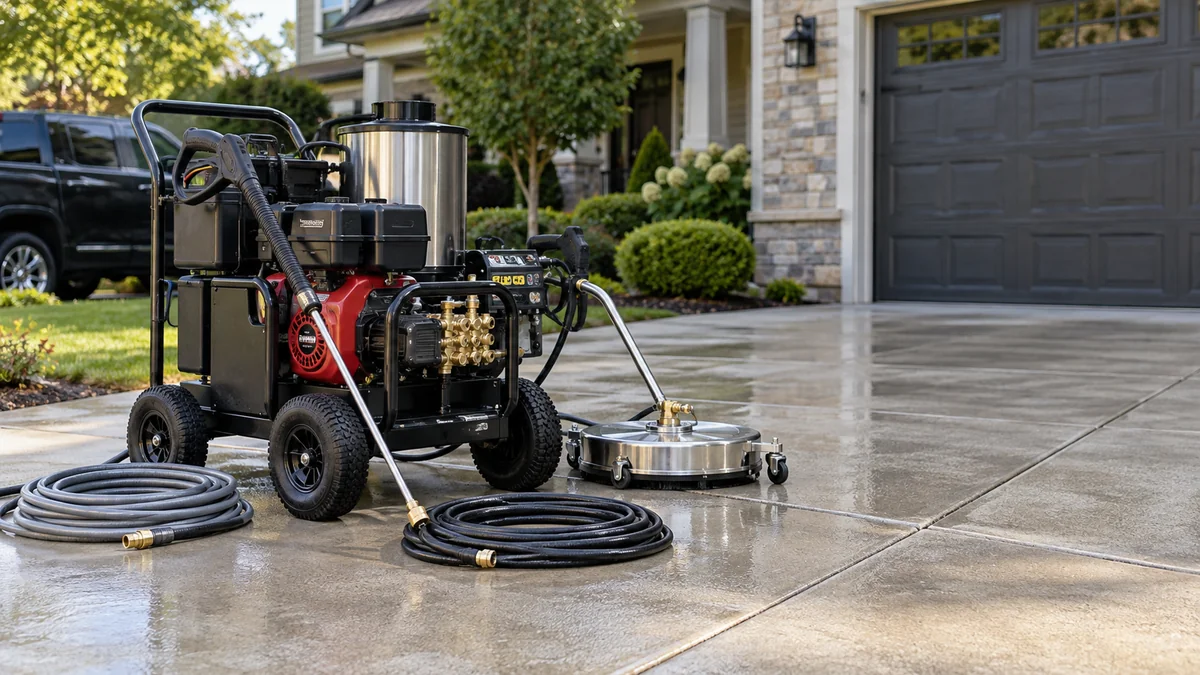
Hot water pressure washing combines mechanical impact with heat, so it removes grease, oil, food residue, and road film faster than cold water. Cold water pressure washing costs less, weighs less, and handles mud, dust, mold residue, siding, decks, and most general exterior cleaning effectively. The better choice depends mainly on the contaminant, surface, flow rate, and workload.
Key Facts at a Glance
- Cold-water pressure washers typically operate at ambient temperature, 1,500-4,000 PSI, and 1.2-8.0 GPM.
- Hot-water pressure washers commonly deliver 60-93°C water, with some steam systems reaching approximately 121°C.
- Heat changes greasy contamination from a bonded, viscous film into a more mobile liquid that detergents can emulsify.
- A 3,000 PSI machine with 4 GPM produces more practical cleaning output than a 4,000 PSI machine with 2 GPM for many large surfaces.
- Residential cold-water electric washers commonly cost $150-$450, while commercial hot-water units often cost $4,500-$12,000 or more.
- Hot water is not automatically a disinfectant; validated disinfection requires the correct temperature, contact time, coverage, and organism-specific process.
What Is the Difference Between Hot and Cold Water Pressure Washing?
Cold-water pressure washing uses pump pressure and nozzle velocity to break the bond between soil and a surface. Hot-water pressure washing adds thermal energy, which softens fats, lowers water viscosity and surface tension, accelerates detergent action, and improves rinsing of petroleum-based contamination.
Pressure is only one part of cleaning performance. A useful practical model is cleaning power as a combination of pressure, flow, temperature, chemistry, dwell time, and operator technique. PSI affects impact, while GPM determines how quickly loosened soil and detergent leave the surface.
A cold-water machine therefore remains effective against loose mud, dust, pollen, loose oxidation, and many biological residues. Hot water becomes valuable when contamination is oily, sticky, waxy, protein-based, or embedded in traffic film.
Master Comparison: Hot Water Versus Cold Water
| Criterion | Cold-water washer | Hot-water washer | Practical consequence |
|---|---|---|---|
| Discharge temperature | 10-25°C typical | 60-93°C typical | Heat softens grease and accelerates detergents |
| Pressure range | 1,500-4,000 PSI | 2,000-4,000 PSI | Pressure ranges overlap substantially |
| Flow range | 1.2-8.0 GPM | 3.5-8.0 GPM | Higher flow usually improves large-area productivity |
| Typical purchase price | $150-$3,500 | $4,500-$12,000+ | Burner, coil, controls, and fuel storage add cost |
| Main energy source | Electricity or gasoline | Electricity or gasoline plus diesel, kerosene, LPG, or natural gas | Hot systems have a second energy demand |
| Grease performance | Low to moderate without chemistry | High when temperature and detergent match the soil | Hot water usually reduces scraping and dwell time |
| Portability | 20-90 kg typical | 150-400+ kg for commercial units | Hot machines often need a trailer or truck |
| Maintenance | Pump, engine, hoses, nozzles | Pump, engine, burner, coil, fuel system, scale control | Hot systems require more service points |
| Surface risk | Primarily pressure and chemical damage | Pressure, chemical, thermal, and scalding damage | Operators need more controls around heat |
How Heat Changes Cleaning
Hot water pressure washing improves grease removal because many fats, oils, and petroleum residues become less viscous as temperature rises. The heat does not magically dissolve every oil; it makes the contaminant easier to mobilize, while detergent chemistry and water flow carry the material away.
Cold water often displaces grease without fully removing it. The result can be a wider smear, a gray shadow, or oil redeposited farther across the slab. A hot system can shorten the cleaning cycle because the operator spends less time scraping, brushing, repeating passes, or waiting for degreaser to work.
Heat also lowers the viscosity of water and helps it penetrate narrow surface irregularities. That benefit is most visible on textured concrete, machinery joints, loading docks, restaurant floors, and vehicle undercarriages.
Contaminant Performance
| Contaminant | Cold-water result | Hot-water result | Best supporting method |
|---|---|---|---|
| Dry dust | Removes efficiently | Removes efficiently | High-flow rinse |
| Loose mud | Removes efficiently | Removes efficiently | Pre-rinse before detergent |
| Motor oil | Often spreads or needs repeated passes | Softens and lifts faster | Alkaline degreaser and oil capture |
| Animal fat | Slow without strong chemistry | Rapid softening and emulsification | Hot water, compatible detergent |
| Mold staining | Removes surface growth | May remove residue faster | Approved biocide where required |
| Gum and adhesive | Limited | Improved softening | Scraper plus targeted solvent |
| Paint | May strip or damage coating | Heat can soften coating unpredictably | Test patch and lower pressure |
| Road film | Moderate | Strong, especially on fleet vehicles | Vehicle-safe detergent |
What Equipment Does Each System Need?
Cold-water systems range from compact electric machines to commercial gasoline units with triplex plunger pumps. A homeowner may use a 120-volt electric washer drawing roughly 13-15 amps, while a contractor may choose a gasoline engine, 4 GPM pump, hose reel, downstream injector, and surface cleaner.
Hot-water systems add a burner, heating coil, thermostat, fuel pump, ignition system, exhaust path, and safety switches. Integrated machines package the pump and heater together. A hot box keeps the cold-water pump separate and heats its discharge water downstream.
Hot Boxes Versus Integrated Units
| Equipment type | Typical cost | Typical use | Main limitation |
|---|---|---|---|
| Electric cold-water unit | $150-$450 | Homes, vehicles, patios | Lower flow and shorter duty cycle |
| Gas cold-water unit | $1,200-$3,500 | Property maintenance, concrete | No thermal advantage for grease |
| Integrated hot-water unit | $4,500-$12,000+ | Fleets, food service, industrial work | Heavy and maintenance-intensive |
| Diesel hot box | $1,800-$3,500 | Existing commercial cold-water pump | Requires compatible flow and plumbing |
| Stationary electric heater | Project-specific, often high | Indoor wash bays | Requires substantial electrical service |
Diesel and kerosene burners remain common in mobile commercial equipment because they provide high heat output in a compact package. Propane and natural gas can suit fixed installations, while electric heating is more practical where combustion exhaust is prohibited and adequate three-phase power exists.
Why Flow Rate Matters More Than Many Buyers Expect
A pressure washer’s flow rate determines how much loosened soil reaches the drain or recovery system each minute. For example, a 3,000 PSI, 4 GPM machine generally rinses and transports soil more effectively than a 4,000 PSI, 2 GPM unit on a broad concrete slab, even though the second machine displays a higher PSI number.
A surface cleaner also needs enough flow to maintain nozzle speed and coverage. Undersized flow can leave stripes, while excessive pressure can etch concrete or damage coatings.
Which Method Fits Each Job?
Cold water is the better default for residential exterior work, while hot water earns its cost in repeated commercial degreasing. The dividing line is not simply “homeowner versus professional”; a homeowner cleaning a heavily greased workshop may need rented hot water, and a contractor washing houses rarely benefits from carrying a burner.
| Job or surface | Recommended system | Typical starting specification | Reason |
|---|---|---|---|
| House siding | Cold water | 1,800-2,300 PSI, 1.2-2.0 GPM | Low pressure and detergent protect cladding |
| Wood deck | Cold water | 1,000-1,800 PSI, 1.5-2.5 GPM | Heat and pressure can raise grain |
| Concrete driveway | Cold or hot | 2,500-3,500 PSI, 3-5 GPM | Heat helps only when oil is substantial |
| Restaurant loading area | Hot water | 3,000 PSI+, 4-5.5 GPM | Grease and food residue justify heat |
| Fleet undercarriages | Hot water | 2,500-3,500 PSI, 4-8 GPM | Heat cuts road film and petroleum residue |
| Painted vehicle body | Cold or moderate hot | 1,200-2,000 PSI, 1.5-3 GPM | Excessive heat can soften finishes |
| Heavy equipment | Hot water | 3,000-4,000 PSI, 4-8 GPM | Oil, hydraulic fluid, and clay combine |
| Roof or delicate masonry | Low-pressure cold water | 500-1,500 PSI at the tool | Heat and high impact can damage substrates |
Should You Use Hot Water on Concrete?
Hot water can improve oily concrete cleaning, but high temperature does not make every concrete job safer or faster. New concrete, sealed concrete, decorative coatings, and freeze-damaged slabs require a test area because thermal stress, pressure, and chemical concentration can cause spalling, discoloration, or sealer failure.
A practitioner rule is to begin with the lowest effective pressure and temperature, then increase one variable at a time. Avoid directing near-boiling water at a cold slab during freezing conditions because a rapid temperature change can worsen cracking or surface delamination.
What Does Each System Cost?
Cold-water equipment has lower purchase and operating costs, while hot-water equipment can reduce labor and chemical consumption on recurring grease work. Typical cold-water fuel or electricity costs may run about $2-$5 per operating hour, compared with approximately $8-$15 or more per hour for a hot unit including burner fuel, depending on heat output and local fuel prices.
| Cost category | Cold water | Hot water | Cost implication |
|---|---|---|---|
| Entry equipment | $150-$450 | $4,500-$12,000+ | Hot systems need recurring work to justify capital |
| Commercial equipment | $1,200-$3,500 | $4,500-$12,000+ | Burner hardware raises acquisition cost |
| Energy use | $2-$5/hour typical | $8-$15+/hour typical | Heat adds fuel consumption |
| Burner service | $0 for cold unit | Seasonal inspection and nozzle service | Hot equipment needs combustion maintenance |
| Typical grease job | 2-4 hours cold | 45-90 minutes hot, site-dependent | Labor can outweigh energy cost |
| Replacement complexity | Pump and engine parts | Pump, burner, coil, controls | More failure points increase downtime risk |
The often-repeated claim that hot water reduces cleaning time by 70% is not a universal production rate. A more defensible field expectation is that hot water can cut labor substantially on heavy grease, while offering little time advantage on ordinary dust or mud.
Does Hot Water Disinfect?
Hot water cleaning is not automatically validated disinfection. A hot washer may reduce microorganisms through temperature and physical removal, but reliable disinfection depends on water temperature at the surface, exposure duration, organism, coverage, and any approved chemical process.
Commercial kitchens, healthcare spaces, and food-processing sites should follow the applicable local health code, manufacturer instructions, and chemical label. A pressure washer that briefly delivers hot water does not prove that every section of a porous or irregular surface reached a disinfecting condition.
Heat can still provide useful sanitation support. It loosens protein residue, removes biofilm-supporting soil, and reduces some microbial load, but “clean,” “sanitized,” and “disinfected” describe different outcomes.
How to Operate Each System Safely
Cold-water operation requires a sufficient water supply, an unobstructed inlet screen, a suitable nozzle, and controlled standoff distance. Hot-water operation requires all of those checks plus burner flow, fuel, exhaust, thermostat, and cooldown controls.
Cold-Water Startup
- Inspect the hose, trigger gun, nozzle, oil level, and inlet filter.
- Confirm that incoming supply exceeds the pump’s rated flow to prevent cavitation.
- Connect the garden hose, open the water supply, and purge air with the trigger open.
- Start the engine or energize the motor before inserting the spray tip.
- Select the nozzle for the surface, beginning farther away than the final working distance.
- Sweep evenly and confirm that the substrate is not etching, splintering, or losing its coating.
A 15-30 cm working distance is only a typical starting point, not a universal rule. A zero-degree tip can damage concrete, wood, paint, and skin within seconds.
Hot-Water Startup and Shutdown
- Complete the cold-water inspection and purge procedure.
- Start the pump and establish continuous water flow.
- Confirm that the gun is open and water is moving through the heating coil.
- Turn on the burner and set a temperature appropriate for the soil and surface.
- Allow approximately 30-60 seconds for thermal stabilization.
- Turn the burner off before stopping the pump.
- Keep the trigger open for approximately 2-3 minutes, or until discharge water is cool.
- Shut down the pump and close the supply.
Never fire a burner without adequate water flow. Trapped heat can damage coils, seals, flow switches, and nearby components, while residual pressurized hot water creates a scalding hazard.
What About Wastewater and Chemicals?
Hot water can reduce detergent quantity, but it does not remove the need to control contaminated runoff. Oil, heavy metals, detergents, paint residue, and food waste can enter storm drains or waterways if the operator cleans without containment.
Use drain covers, berms, wet vacuums, recovery mats, or an approved discharge point when site conditions require them. Local sewer authorities and environmental agencies may impose different rules, so commercial operators should confirm requirements before cleaning fleet yards, garages, restaurants, or industrial sites.
Cold water plus a suitable degreaser can be the lower-cost alternative for occasional oil spots. Hot water plus lower detergent concentration often becomes the better production method when the same greasy surface must be cleaned repeatedly.
What Fails and How Do You Fix It?
Pressure loss commonly comes from a blocked nozzle, inadequate inlet water, air leaks, worn pump valves, or an injector problem. Burner faults add fuel contamination, clogged filters, failed electrodes, poor airflow, thermostat faults, and scale-covered coils.
| Symptom | Likely cause | First corrective action |
|---|---|---|
| Pulsating spray | Blocked tip or pump cavitation | Clean the tip and verify inlet flow |
| Burner will not ignite | Flow switch, electrode, or fuel fault | Stop operation and inspect the service manual |
| White burner smoke | Water-contaminated fuel or poor combustion | Drain contaminated fuel and service filtration |
| Black burner smoke | Soot, restricted air, or incorrect fuel setting | Clean intake and arrange burner adjustment |
| Low hot-water temperature | Scale, low fuel delivery, or thermostat fault | Check fuel supply and schedule coil service |
| Machine overheats after shutdown | Burner stopped with trapped heat | Follow the cold-water cooldown sequence |
| Grease remains | Insufficient heat, flow, dwell, or chemistry | Adjust one variable and test a small section |
Do not bypass flow switches, pressure switches, thermal cutouts, or burner interlocks. Those devices prevent dry firing, overheating, and unsafe combustion.
Which Should You Choose?
Choose cold water when the work involves general exterior dirt, moderate residential cleaning, portability, or occasional use. Choose hot water when the workload repeatedly includes grease, oil, animal fat, heavy road film, restaurant residue, or industrial machinery.
Homeowner Cleaning Siding, Decks, and Patios
Choose a cold-water electric unit around 1,800-2,300 PSI and 1.2-2.0 GPM. Add the correct detergent and use a wider spray pattern rather than relying on extreme pressure, especially on wood, vinyl siding, and painted surfaces.
Property Maintenance Contractor
Choose a commercial cold-water gas unit around 3,500-4,000 PSI and 4 GPM when most work involves sidewalks, houses, patios, and general concrete. A downstream chemical injector and surface cleaner usually provide more value than a burner for this workload.
Fleet or Heavy-Equipment Operator
Choose hot water when vehicles accumulate oil, hydraulic residue, grease, clay, or road film every day. A 3,000 PSI, 4-5.5 GPM hot unit is a common starting range, but wastewater recovery and safe wash-bay design must accompany the equipment.
Restaurant or Food-Service Contractor
Choose hot water for grease-heavy floors, loading areas, dumpsters, and equipment exteriors, while following food-safety procedures and chemical labels. Hot water reduces residue faster, but it does not replace approved sanitation steps.
Occasional User With One Grease Stain
Rent or hire a hot-water unit rather than buying one. For a few small oil spots, apply a compatible degreaser, allow the label-specified dwell time, agitate, and use cold water with runoff control.
Expert Rules That Prevent Expensive Mistakes
- Do not connect a cold-water pressure washer to a hot domestic tap unless the manufacturer explicitly permits the inlet temperature. Many cold-water pumps are limited to approximately 40-60°C, and exceeding the rating can damage seals and valves.
- Do not compare machines by PSI alone. Compare PSI, GPM, nozzle size, duty cycle, water temperature, and the surface-cleaning tool as one system.
- Do not assume more heat fixes poor chemistry. A detergent that is incompatible with aluminum, paint, concrete sealer, or wastewater requirements can create damage faster at elevated temperature.
- Pre-rinse heavy mud before applying hot water to grease. Clay and grit can consume time, clog recovery equipment, and obscure the actual oily contamination.
- Treat hot water as a labor and contamination-control tool, not as a premium version of every cold-water washer.
FAQ
Is cold water enough for washing a house?
Cold water is enough for most house washing because siding, trim, soffits, decks, and masonry usually contain dust, algae residue, pollen, and oxidation rather than heavy grease. Low pressure, appropriate detergent, controlled dwell time, and thorough rinsing matter more than high temperature. Hot water can damage coatings or plants if misapplied.
Can hot water remove oil from a driveway?
Hot water can remove driveway oil faster than cold water because heat lowers oil viscosity and improves detergent emulsification. Results still depend on how long the stain has penetrated, whether the concrete is sealed, the detergent formulation, recovery controls, and the number of passes. Old stains may require absorbent treatment first.
Is a steam cleaner better than a hot-water pressure washer?
A steam cleaner uses lower water volume and higher temperature, making it useful for detail work, grease softening, and indoor applications with limited wastewater. A hot-water pressure washer normally provides higher flow and stronger rinsing, so it suits large concrete areas, fleet washing, and outdoor production cleaning.
Can hot water damage a vehicle?
Hot water can damage vehicle graphics, wax, soft paint, rubber components, and sensitive electrical areas when temperature, pressure, or distance is excessive. Use a vehicle-safe detergent, moderate pressure, a wider nozzle, and a test area. Cold water is generally the safer default for painted body panels.
Should a homeowner buy a hot-water pressure washer?
Most homeowners should not buy a hot-water pressure washer unless they regularly clean substantial grease, oil, or commercial-style contamination. The $4,500-$12,000-plus purchase range, fuel consumption, weight, burner maintenance, and scalding risk rarely make sense for occasional patios, siding, vehicles, or decks.
Can pressure washing remove mold without chemicals?
Pressure washing can remove visible mold and biological residue from many hard surfaces, but it may not kill or prevent regrowth throughout porous material. A compatible treatment may be required, and the operator must protect plants, occupants, and runoff pathways. High pressure can spread contaminated debris or damage the substrate.
The Bottom Line
The practical difference in hot water vs cold water pressure washing differences is thermal cleaning power, not simply a higher PSI number. Cold water is the economical, portable choice for most residential dirt and general exterior maintenance; hot water is the productive choice for recurring grease, oil, food residue, and fleet contamination. Choose by soil type, surface risk, flow rate, labor savings, and wastewater obligations.