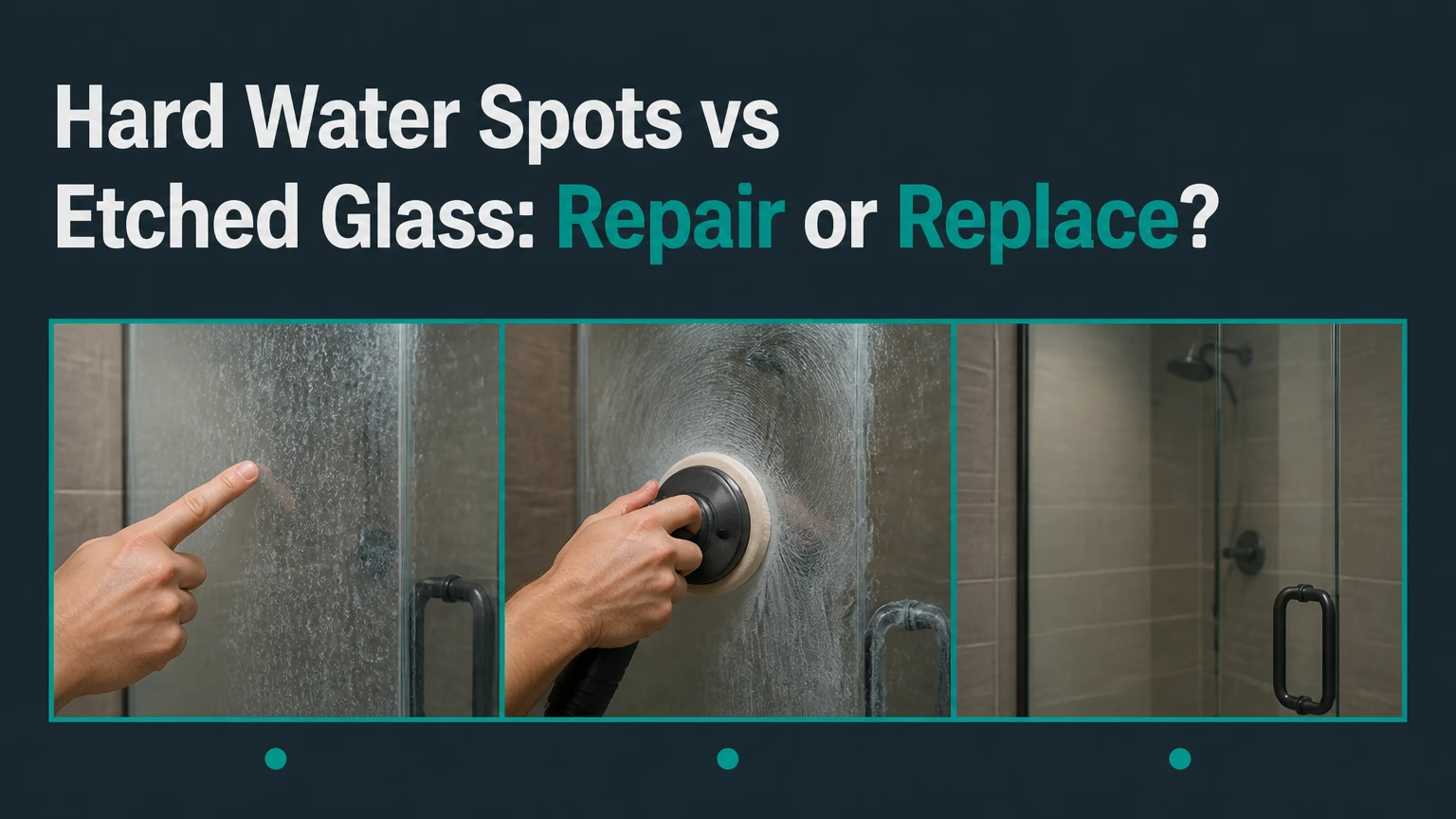
Hard water spots are mineral deposits sitting on glass, while etched glass has a chemically or mechanically altered surface. Raised, crusty residue usually can be removed, but a smooth-looking haze that remains after cleaning may be microscopic surface damage. The correct diagnosis determines whether to clean, polish, professionally restore, or replace the pane.
Key Facts
Hard water spots add calcium, magnesium, silica, or other residue to the glass surface.
Etching removes or disrupts part of the glass surface and cannot be cleaned away.
A raised edge or bump suggests a deposit, while a smooth, frosted haze suggests etching.
Water can temporarily fill etched pits, making damaged glass look clear until it dries.
White vinegar can dissolve light carbonate deposits but will not rebuild etched glass.
Abrasive pads, metal particles, and incorrect polishing can create new scratches.
What Are Hard Water Spots?
Hard water spots are dried mineral deposits left behind when water evaporates from glass. Calcium and magnesium are the main contributors to water hardness, while silica, iron, and other dissolved solids can influence the deposit’s color and persistence.
The United States Geological Survey defines hardness as “a measure of the amount of calcium and magnesium salts in water.” USGS commonly classifies water from 0-60 milligrams per liter as calcium carbonate as soft, 61-120 as moderately hard, 121-180 as hard, and above 180 as very hard. Those concentrations describe the water, not the exact thickness of a spot.
A fresh droplet may leave a faint ring after drying. Repeated sprinkler, shower, or car-wash exposure creates overlapping rings that look white, gray, or chalky. Carbonate-rich deposits respond to acid more readily than silica-rich residue, so two spots from different water supplies can require different treatments.
How Do Mineral Deposits Form?
Mineral deposits form through wetting, evaporation, concentration, and precipitation. Water evaporates, but dissolved minerals remain; as the droplet volume falls, the solution becomes saturated and solids crystallize on the glass.
The deposit may adhere strongly through surface attraction, crystal interlocking, and repeated drying cycles. Describing every deposit as an insoluble ionic bond to glass is too broad. Some residues are loose and acid-soluble, while aged silica-containing scale can resist household acids and require polishing.
What Do Hard Water Spots Look and Feel Like?
Hard water spots usually appear as discrete rings, splashes, droplets, or irregular white patches with identifiable edges. The surface may feel gritty or raised when a clean fingernail crosses the dry area.
A deposit can become so thin and widespread that it feels nearly smooth. Texture alone is therefore a screening test, not proof. Use texture, wetting behavior, cleaning response, and lighting together before choosing an abrasive.
What Is Etched Glass?
Etched glass has microscopic pits, scratches, or chemical changes in its surface that scatter light. The damage can result from hydrofluoric acid, strong industrial cleaners, alkaline dishwasher conditions, abrasive particles, or metal contamination dragged across the pane.
Chemical etching changes or dissolves portions of the glass surface. Mechanical etching creates grooves or scratches. Dishwasher haze often results from a combination of alkaline detergent, heat, water chemistry, and repeated cycles, although removable mineral film can look similar.
Etched glass is not the same as a removable cloudy film. Cleaning removes foreign material; restoration removes a controlled amount of surrounding glass through polishing, which is why deep or widespread damage may make replacement more sensible.
Why Does Etched Glass Look Clear When Wet?
Water can temporarily fill microscopic surface irregularities and reduce the difference between the glass and the damaged cavities. Light then scatters less, so the pane may look clearer while wet and cloudy after drying.
That wet-versus-dry result strongly suggests surface texture, but it is not exclusive proof of etching. A thin residue can also become transparent when wet. A panel that remains hazy after a properly prepared test area has been cleaned and dried is more likely etched.
How Can You Tell Hard Water Spots From Etched Glass?
Hard water spots usually have raised residue, visible boundaries, and at least some response to a suitable mineral cleaner. Etched glass usually has a broad haze, frosted appearance, scratches, or optical distortion that remains after residue removal.
Test a small, inconspicuous area first. Do not begin with aggressive abrasion, because an incorrect diagnosis can convert removable contamination into permanent scratching.
| Diagnostic test | Hard water spot result | Etched glass result | Limitation |
|---|---|---|---|
| Dry fingernail test | Raised edge, grit, or bump | Smooth haze, groove, or depression | Thin deposits can feel smooth |
| Wet-versus-dry test | Usually similar after rinsing | Clearer wet, cloudy dry | Residue can also turn clearer wet |
| White vinegar test | Light carbonate ring softens in 3-5 minutes | No meaningful visual change | Silica-rich scale may resist vinegar |
| Plastic scraper test | Deposit edge may lift | Surface remains unchanged | Never use force on coated glass |
| Flashlight at 45 degrees | Crust or ring catches light | Diffuse haze or sharp scratch catches light | Reflections can hide shallow defects |
| Test polish area | Clarity improves after residue removal | Haze remains after careful polishing | Poor technique can create swirl marks |
Can a Hard Water Spot Become Permanent?
A hard water deposit can become difficult to remove, but the deposit itself is not automatically etched glass. Long exposure may allow mineral scale to harden, trap dirt, stain coatings, or create a surface condition that needs mechanical polishing.
The important distinction is treatment response. If a controlled mineral-cleaning test removes the film and restores clarity, the problem was deposit-related. If the surface remains uniformly cloudy after residue removal, inspect for etching or coating damage.
| Condition | Typical appearance | Likely response | Practical classification |
|---|---|---|---|
| Fresh carbonate residue | Thin white rings | Weak acid in 3-10 minutes | Removable deposit |
| Aged mixed scale | Thick opaque crust | Descaler or polishing in 30-60 minutes | Difficult deposit |
| Silica-rich scale | Gray-white, glassy film | Household vinegar often ineffective | Deposit requiring specialist method |
| Chemical etching | Uniform haze or frosted patch | Cleaning produces little change | Structural surface damage |
| Abrasive scratch | Linear mark or starburst | Cleaning produces no change | Mechanical damage |
| Coating failure | Irregular rainbow or patchy haze | Glass may remain intact | Coating-specific defect |
Hard Water Spots vs Etched Glass: Which Repair Is Appropriate?
Hard water spots require dissolution or removal of the added material; etched glass requires controlled leveling, professional restoration, or replacement. Cleaning is the first-line approach for deposits, while polishing is a surface-removal process that should begin only after residue has been excluded.
| Feature | Hard water spots | Etched glass | Scratched glass |
|---|---|---|---|
| Material location | On top of glass | Pits or altered surface | Grooves cut into surface |
| Common geometry | Rings, droplets, splash marks | Broad haze or frosted patch | Lines, arcs, chips, or starbursts |
| Fingernail sensation | Raised or gritty | Smooth haze or recessed texture | Catches in a line |
| First treatment | Mineral cleaner | Test polish or replacement assessment | Scratch-specific polish assessment |
| Typical DIY cost | $10-$30 | $20-$60 for polishing supplies | $20-$60 for supplies |
| Professional range | $50-$150 per pane | $150-$400 per pane | $100-$350 per pane |
| Main risk | Acid or residue on frames | Distortion from uneven polishing | Enlarging or rounding the scratch |
| Final option | Clean and protect | Restore or replace | Restore or replace |
The price ranges above are typical U.S. practitioner ranges, not fixed market rates. Height, access, pane size, coatings, location, and severity can change the quote substantially.
How Do You Remove Hard Water Spots Safely?
Remove hard water spots by progressing from rinsing to a mild acid, then to a product specifically labeled for glass mineral scale. Keep every chemical wet for its stated dwell time, protect adjacent materials, and test a small area before treating the entire pane.
Step 1: Remove Loose Contamination
Rinse the glass with clean water and wash it with a pH-neutral glass-safe soap. Use a clean microfiber cloth, because grit left on the pane can produce scratches during later wiping.
You will know the step worked when loose dust and oily film no longer interfere with the spot’s shape. A common mistake is polishing over sand or grit, which turns contamination into abrasive debris.
Step 2: Test Diluted White Vinegar
Apply distilled white vinegar to a small area for 3-5 minutes, keeping the surface visibly wet. Wipe gently with a white non-scratch pad or microfiber towel, then rinse thoroughly and dry.
Vinegar contains acetic acid and can dissolve many calcium carbonate residues. Vinegar will not repair etching, and it may have little effect on silica-rich scale. Never allow acid to dry on the pane or run onto marble, limestone, unsealed grout, aluminum, or sensitive coatings.
Step 3: Use a Labeled Mineral Descaler
For deposits that remain, use a commercial glass-safe mineral remover according to the label. Apply only enough product to keep the test area wet, follow the specified dwell time, and rinse with clean water.
Do not assume a lower pH product is automatically safer. Product concentration, contact time, temperature, surfactants, and the frame material all affect risk. Hydrofluoric acid is unsuitable for household use and can attack glass and human tissue severely.
Step 4: Polish Only the Confirmed Deposit
Use a glass-polishing compound, often cerium oxide, with the pad and speed recommended by the manufacturer. Work a small area, keep the compound damp, use light pressure, and inspect frequently for clarity and distortion.
You will know the deposit has been removed when the test area stays clear after rinsing and drying. Stop if the glass develops a circular haze, heat pattern, or optical wave. Uneven polishing can create a visible low spot even when the original stain disappears.
Which Tools and Chemicals Are Safe?
White vinegar, microfiber cloths, a white non-scratch pad, and a glass-labeled mineral remover are reasonable first choices for uncoated architectural glass. Razor blades and abrasive compounds require greater control because a tool that removes residue can also scratch or alter the pane.
| Tool or chemical | Appropriate use | Typical specification | Main restriction |
|---|---|---|---|
| Distilled white vinegar | Light carbonate deposits | Approximately 5% acetic acid | Keep wet; avoid stone and sensitive metals |
| pH-neutral glass soap | Loose soil and oils | Glass-safe, non-abrasive formula | Does not dissolve heavy scale |
| White non-scratch pad | Gentle agitation | Nylon or polyester pad | Replace when contaminated with grit |
| Plastic scraper | Edge deposits on bare glass | Soft plastic blade | Avoid force and coated surfaces |
| Cerium oxide | Controlled glass polishing | Damp slurry with compatible pad | Can create distortion if uneven |
| Green abrasive pad | No household glass use | Coarse kitchen scouring pad | Can scratch glass and coatings |
| Steel wool | No routine glass use | Metal abrasive fibers | Can leave scratches and metal transfer |
| Hydrofluoric acid | Industrial specialist use only | Highly hazardous glass-reactive acid | Never use as a DIY cleaner |
Glass hardness is often described around 5.5-6.5 on the Mohs scale, but hardness comparisons do not predict scratching by themselves. Pressure, trapped grit, contact angle, particle shape, and coating composition matter. Cerium oxide is widely used for glass polishing because it can abrade glass in a controlled slurry; it is not a guarantee against gouging.
Can Etched Glass Be Repaired?
Etched glass can sometimes be improved by professional polishing, but cleaning cannot reverse a surface that has been chemically or mechanically removed. Light haze on a thick, flat pane may respond to uniform resurfacing, whereas deep damage, large areas, thin glass, or severe optical distortion often favors replacement.
Professional restoration removes surrounding glass until the damaged depth is blended into the surface. The process may take 1-3 hours per pane, depending on size, depth, access, and the technician’s equipment. A repair that looks clear from one angle can still show a lens effect from another angle if material removal is uneven.
Dishwasher-etched wine glasses are poor restoration candidates because thin walls make uniform polishing impractical. Replacement is usually safer and cheaper than attempting to remove haze from each glass.
What Does Glass Spot Removal Cost?
Typical U.S. DIY material costs are $10-$30 for a mineral remover and microfiber supplies, while professional hard-water treatment commonly runs $50-$150 per window pane. Etching restoration commonly costs $150-$400 per pane, and replacement may be more economical when restoration approaches the installed glass price.
| Project type | Typical material cost | Typical labor or service cost | Typical duration |
|---|---|---|---|
| Light shower-door deposits | $10-$25 | $50-$100 per door | 15-30 minutes |
| Heavy window scale | $20-$60 | $75-$150 per pane | 30-60 minutes |
| Auto-glass mineral film | $20-$60 | $75-$200 per windshield | 30-90 minutes |
| Light etched haze | $30-$80 | $150-$300 per pane | 1-2 hours |
| Deep etched architectural glass | $50-$120 | $250-$400 per pane | 2-3 hours |
| Dishwasher-etched tumbler | $0-$10 per item | Replacement often $5-$40 | 5-15 minutes to assess |
These are typical planning figures rather than published universal prices. Local labor rates, pane dimensions, ladders, scaffolding, glass coatings, and travel charges can dominate the final estimate.
What Changes by Glass Surface?
Shower doors and exterior windows usually have removable mineral deposits, while dishwasher haze and chemically exposed architectural glass have a higher probability of etching. Automotive glass adds safety and visibility concerns, so a windshield with optical distortion should not receive uncontrolled abrasive treatment.
Shower Doors
Shower-door spots commonly come from repeated droplets containing calcium and magnesium. Squeegeeing after each shower removes the water before evaporation, which prevents the main deposit-forming step.
Check whether the door has a factory-applied water-repellent coating. Acid cleaners and abrasive pads can damage that coating even when the underlying glass remains intact. A coating failure can resemble etching and may require recoating rather than glass replacement.
Home Windows and Sprinkler-Stained Glass
Sprinkler stains often contain calcium carbonate, silica, iron, and fertilizer residue. Treating the pane while it is cool and shaded reduces rapid evaporation, but the cleaner must still remain within its label instructions.
Do not use household glass polishing on low-emissivity, tinted, reflective, or coated windows without confirming compatibility. A clear pane can become visibly patchy if polishing removes only part of a coating.
Car Windshields
Windshield water spots can combine minerals with wiper residue, road film, and microscopic abrasion. A glass-safe automotive stripper should precede polishing, and the final inspection should occur from the driver’s seated position in direct and low-angle light.
A windshield that produces glare, halos, or distortion after cleaning is a safety concern. Professional auto-glass technicians can determine whether the pane meets visibility requirements more reliably than a home test.
Dishwasher Glassware
Dishwasher haze may be removable mineral film or irreversible detergent etching. Lowering the wash temperature, reducing detergent, using a rinse aid, and matching detergent quantity to local water hardness can reduce future damage.
If the haze remains after a small vinegar test and the glass feels smooth, repeated acid treatment will not restore it. Thin stemware generally should be replaced rather than polished.
What Mistakes Make Glass Damage Worse?
The most damaging mistakes are aggressive abrasion, dried chemicals, and treating coated glass as bare glass. Correcting the diagnosis before increasing chemical strength or mechanical force prevents many avoidable repairs.
- Using green Scotch-Brite pads: Coarse abrasive fibers can scratch glass and coatings. Replace the pad with microfiber or a white non-scratch pad.
- Scraping with contaminated tools: A razor may be usable on some uncoated flat glass, but trapped grit or a damaged blade can create linear scratches. A plastic scraper is safer for diagnosis.
- Letting acid dry: Drying concentrates the chemical and can attack frames, seals, stone, and coatings. Work in small sections and rinse completely.
- Mixing bleach and acids: The combination can release chlorine gas. Never combine cleaners, even when the first product appears ineffective.
- Polishing a windshield without inspection: Circular polishing marks can create glare and optical distortion in the driver’s viewing area.
- Assuming every haze is etching: Mineral scale can resist vinegar but still respond to a suitable descaler or professional cleaning.
- Polishing only the visible ring: A small polished island can create a lens effect. Professional work must blend the treated area uniformly.
When Should You Stop DIY Treatment?
Stop DIY treatment when the pane is coated, laminated, tinted, reflective, cracked, safety-critical, or still cloudy after a controlled cleaning test. Stop immediately if a test area develops scratches, rainbow patches, visible swirls, or changing clarity at different viewing angles.
A professional assessment is also appropriate when access requires a ladder, when a large pane has uniform haze, or when restoration would cost more than 50%-70% of a comparable replacement. That percentage is a practical decision rule, not an industry mandate.
How Do You Prevent Future Spots and Etching?
Prevent hard water spots by removing droplets before they dry and preventing repeated mineral contact. Prevent etching by using the correct detergent quantity, avoiding abrasive tools, and confirming cleaner compatibility with coatings and frame materials.
| Surface | Prevention action | Practical frequency | Avoid |
|---|---|---|---|
| Shower door | Squeegee from top to bottom | After every shower | Wet towels left on glass |
| Exterior window | Redirect sprinkler heads | Before each irrigation season | Repeated untreated overspray |
| Windshield | Wash with filtered or clean water | Each vehicle wash | Automatic brushes with trapped grit |
| Dishwasher glassware | Reduce detergent and use rinse aid | Every cycle | Excess detergent in soft water |
| Coated glass | Follow coating manufacturer care | At each cleaning | Unapproved acids or abrasives |
Water softeners can reduce calcium and magnesium, but they do not remove every dissolved solid, especially silica. A softener therefore lowers spot formation without guaranteeing spot-free glass. Deionized-water rinsing is more effective for professional window cleaning because it removes dissolved ions before drying.
FAQ
Will baking soda remove hard water spots?
Baking soda may help mechanically loosen soft residue when mixed with water, but it is not a reliable mineral dissolver. Its particles can scratch or dull coatings if rubbed aggressively. A glass-safe acidic mineral remover is usually more chemically appropriate for carbonate scale, followed by thorough rinsing.
Can lemon juice replace vinegar on glass?
Lemon juice contains citric acid and may loosen light carbonate deposits, but its concentration varies and its sugars or pulp can leave residue. White vinegar provides more predictable household testing. Neither lemon juice nor vinegar repairs etched glass or safely treats every coated pane.
Are water spots on a windshield permanent?
Windshield water spots are not necessarily permanent. Mineral film, road residue, and wiper contamination can often be removed, but chemical etching and scratches remain after cleaning. Test a small area first, inspect for glare from the driver’s position, and use a professional if visibility changes.
Does a water softener prevent shower-door spots?
A water softener can reduce calcium and magnesium deposits, but it may not remove silica or all dissolved solids. Squeegeeing remains effective because it removes droplets before evaporation. A glass sealant can reduce adhesion, but it cannot prevent residue when mineral-rich water repeatedly dries on the surface.
Is cloudy dishwasher glass safe to drink from?
Cloudy dishwasher glass is generally a surface appearance issue, not proof that the glass is unsafe, unless the item is cracked, chipped, or structurally weakened. Persistent haze is often detergent etching and cannot be cleaned away. Replace thin or damaged glassware rather than attempting abrasive restoration.
The Bottom Line
Hard water spots vs etched glass is a distinction between removable material and damaged glass structure. Clean and chemically test a small area first: raised rings that respond to mineral treatment are deposits, while smooth haze that remains after residue removal indicates etching, coating failure, or scratches.
Use mild methods before polishing, never mix bleach with acids, and avoid green abrasive pads and uncontrolled razor work. Professional restoration can improve some etched panes, but replacement is often the better decision when damage is deep, optical distortion is present, the glass is thin or coated, or restoration costs approach 50%-70% of replacement.