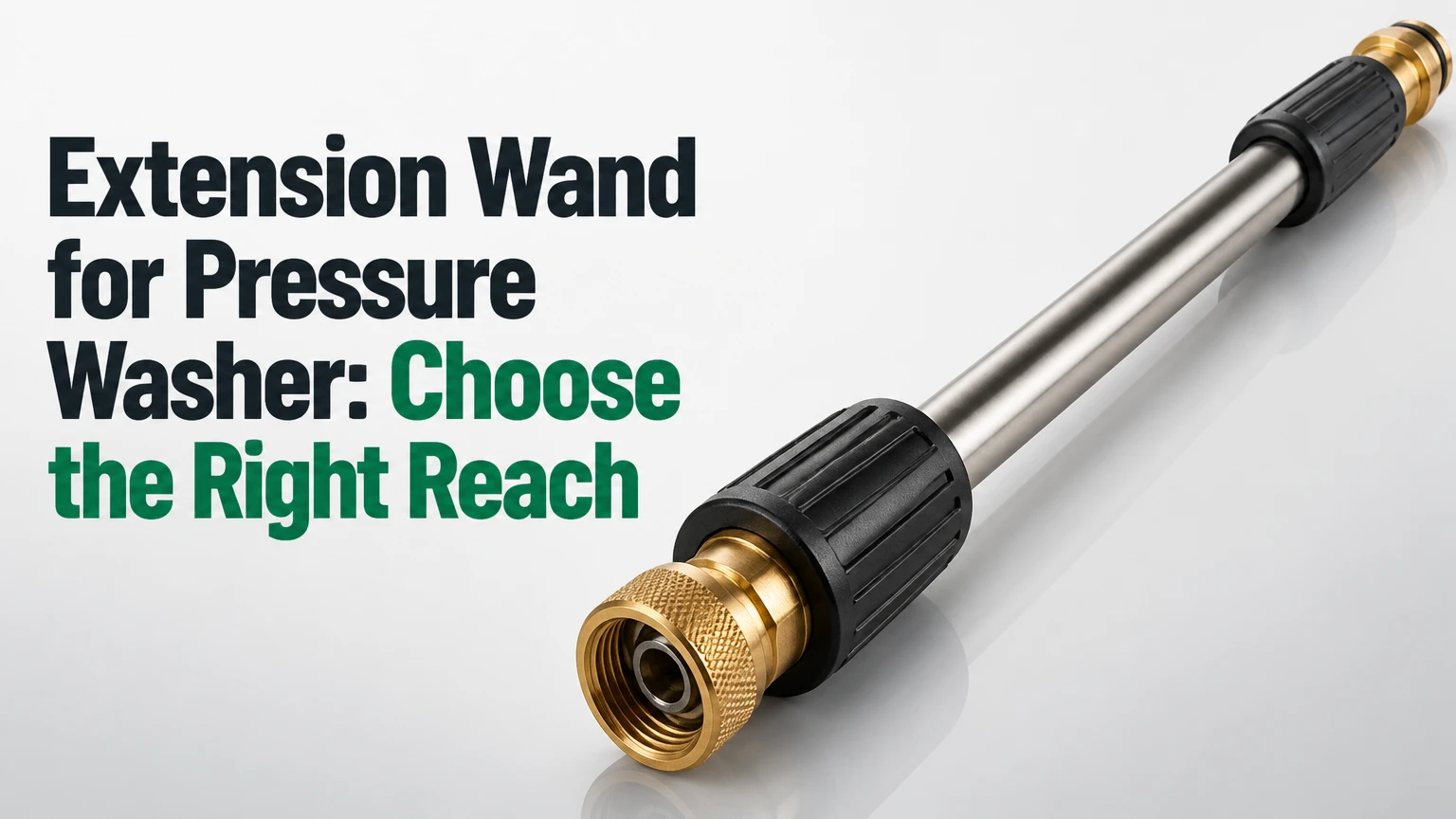
An extension wand for pressure washer equipment is a rigid lance that attaches to the spray gun and places the nozzle farther from the operator. The right wand extends practical reach by roughly 3-24 feet, but compatibility depends on PSI, GPM, fittings, nozzle orifice, weight, and safe control at full length.
Key Facts
- A pressure washer extension wand lengthens the gun-to-nozzle distance; it does not automatically increase pump pressure.
- Most consumer accessories use either M22 threaded connections or 1/4-inch quick-connect fittings, but M22 fittings have multiple inner-diameter variants.
- A 6-10-foot wand suits vehicles, one-story siding, and low gutters; two-story work usually needs 12-24 feet or a specialized system.
- Aluminum weighs less than stainless steel, while fiberglass provides electrical insulation only as a material property, not electrical protection.
- A larger or incorrect nozzle orifice can lower cleaning force at the surface and may make the washer appear weak.
- Never use any pressure washer pole within the clearance zone of overhead power lines.
What Is an Extension Wand for Pressure Washer Equipment?
A pressure washer extension wand is a high-pressure lance installed between the trigger gun and spray nozzle. The lance gives the operator additional physical reach, allowing water to contact gutters, soffits, siding, vehicle roofs, decks, and other elevated or recessed surfaces without placing the operator on a ladder.
A short straight wand typically adds 12-40 inches. Sectional kits can create approximately 3-9 feet of total lance length, while telescoping poles commonly reach 6-24 feet. Advertised length is not the same as usable length because pole flex, operator height, nozzle angle, and recoil determine whether the spray remains accurate.
The attachment does not replace the pressure washer pump. Water still travels from the pump through the high-pressure hose, trigger gun, extension lance, coupler, and nozzle. The wand changes reach and handling, not the pump’s rated PSI or GPM.
What does a pressure washer extension wand do?
A pressure washer extension wand moves the reaction force and spray pattern farther from the operator while reducing ladder use. The accessory is most useful when the operator needs a straight, controlled spray path from ground level, such as washing second-story siding or flushing a reachable gutter channel.
The trade-off is leverage. A long pole behaves like a lever, so nozzle kickback creates more torque at the operator’s hands. A 24-foot pole can reach a high surface, but it requires more bracing, slower movements, and greater attention to fatigue than a 3-foot lance.
An extension pole also changes the spray angle. A nozzle aimed downward from a long pole can push the lower end toward the operator, while a nozzle aimed horizontally can pull the pole sideways. Test the assembly at ground level before raising it.
How Does a Pressure Washer Extension Wand Work?
A pressure washer extension wand carries pressurized water through a narrow internal passage to a nozzle that converts flow into a high-velocity jet or fan. The nozzle controls the final spray pattern, while the pump, hose, gun valve, and nozzle orifice determine the operating pressure and flow available at the surface.
The system’s flow path is:
- Pump pressurizes water.
- High-pressure hose carries water to the trigger gun.
- Trigger gun opens or closes the flow.
- Extension wand transfers water through its lance tube.
- Quick-connect coupler holds the nozzle.
- Nozzle meters the water and shapes the spray.
A sound wand adds relatively little pressure loss when its internal passage and nozzle match the washer. Friction, narrow adapters, damaged O-rings, obstructed passages, excessive length, and an oversized nozzle can reduce pressure. The pump cannot deliver its rated cleaning performance if the final orifice is too large.
Does a longer wand reduce PSI?
A longer wand can reduce pressure at the nozzle through friction and restrictive fittings, but length alone is rarely the main cause of a large pressure drop in consumer cleaning. A damaged hose, undersized adapter, partially blocked nozzle, or incorrect nozzle orifice usually deserves inspection first.
Manufacturers rate wands for maximum PSI and sometimes maximum GPM. A 4,000 PSI rating does not mean every component in the connected system is safe at 4,000 PSI. The lowest-rated gun, hose, coupler, adapter, or nozzle controls the safe operating limit.
Use a pressure gauge at the gun when exact diagnosis matters. Without measurement, compare the spray with and without the wand, then inspect each connection and nozzle.
Which Pressure Washer Wand Length Do You Need?
The appropriate wand length depends on target height, operator height, surface distance, nozzle angle, and control. For most homeowners, 6-10 feet provides useful reach without the handling difficulty associated with 18-24-foot telescoping poles.
| Cleaning task | Typical wand length | Suitable washer class | Main control concern |
|---|---|---|---|
| Cars, wheels, and decks | 1-4 feet | 1,300-2,500 PSI electric | Keep nozzle 12-24 inches from surface |
| One-story siding | 4-8 feet | 1,800-3,000 PSI electric or gas | Avoid forcing water behind siding |
| Ground-level gutters | 6-10 feet | 2,000-3,500 PSI | Use a downward angle and wide stance |
| Two-story siding | 12-18 feet | 2,500-4,000 PSI gas or strong electric | Pole flex and recoil increase fatigue |
| High gutters and fascia | 18-24 feet | Commercial or heavy-duty equipment | Use a harness when manufacturer-approved |
| Delicate roof surfaces | 6-12 feet, low pressure | Soft-wash system preferred | Pressure washing may damage shingles |
Operator height changes the result. A 6-foot user holding a 12-foot wand may reach a lower gutter from the ground than a 5-foot user, but a longer pole does not solve a blocked view or poor spray angle.
What length is best for a two-story house?
A 12-18-foot extension pole is a typical starting range for two-story siding, although a 24-foot model may be necessary for high gables or upper gutters. Choose the shortest wand that reaches the target with the nozzle held at a controlled angle, because excessive length increases flex and shoulder strain.
Main Types of Extension Wands
Pressure washer lances fall into four practical groups: short rigid extensions, sectional poles, telescoping poles, and purpose-built attachments. Flexible and curved accessories solve specific access problems but are less suitable as general-purpose wands.
| Wand type | Typical length | Typical price | Best application |
|---|---|---|---|
| Short rigid extension | 1-4 feet | $15-$45 | Cars, decks, low siding |
| Sectional stainless kit | 3-9 feet | $20-$70 | Homeowner gutters and siding |
| Aluminum telescoping pole | 6-24 feet | $60-$150 | Two-story exterior cleaning |
| Fiberglass telescoping pole | 12-24 feet | $130-$300+ | Commercial high-reach cleaning |
| Curved gutter lance | 2-6 feet | $25-$90 | Downward gutter flushing |
| Flexible specialty wand | 2-5 feet | $30-$100 | Wheel wells and curved access |
Telescoping poles
Telescoping wands use overlapping sections and locking collars. They adjust quickly, but grit inside a collar can prevent full engagement, and extended aluminum sections may flex under nozzle reaction. Retract the pole before moving between work areas.
Sectional wands
Sectional lances use separate rigid pieces joined with threaded or quick-connect fittings. They offer strong rigidity and lower purchase cost, but assembly takes longer and every joint adds a possible leak or pressure restriction.
Gutter attachments
Gutter wands often use curved elbows or U-shaped ends that aim a fan spray into the gutter. A gutter attachment is more precise for a narrow channel than a straight pole, but it cannot remove heavy packed sediment without physical cleaning.
Flexible and adjustable-angle wands
Flexible lances and pivoting couplers help reach wheel wells, roof edges, and awkward recesses. They introduce another joint that can rotate, leak, or redirect recoil, so use the lowest practical pressure and check the locking mechanism before every session.
Which Wand Material Is Best?
Aluminum is usually the lightest practical choice, fiberglass offers electrical insulation as a material characteristic, and stainless steel provides durable rigidity and corrosion resistance. None of those materials makes overhead power-line work safe, and material selection should follow task height, weight tolerance, pressure rating, and storage conditions.
| Material | Typical weight at 12-18 feet | Typical price | Strengths | Limitations |
|---|---|---|---|---|
| Aluminum | 4-10 lb | $60-$150 | Low weight, low cost, rigid sections | Can dent or bend permanently |
| Fiberglass | 7-15 lb | $130-$300+ | Electrical insulation, durability | Heavier, costly, can splinter after damage |
| Stainless steel | 5-12 lb | $40-$180 | Corrosion resistance, rigid short lances | Conducts electricity, tiring when long |
| Composite blend | 5-13 lb | $100-$250 | Reduced flex, moderate weight | Brand-specific repair and rating limits |
Fiberglass is often selected for professional high-reach work, but a cracked or splintered pole should be removed from service. Wet fiberglass is not a guarantee of electrical safety, and no wand should be operated near energized conductors.
Stainless steel makes sense for short, frequently washed lances exposed to detergents or salt. Aluminum is usually the better choice when the operator must hold a long pole for extended periods.
How Do You Check Compatibility?
Check the pressure washer’s maximum PSI, operating GPM, trigger-gun outlet, nozzle connection, and manufacturer restrictions before buying a wand. The fitting must match mechanically, while the accessory’s pressure and flow rating must meet or exceed the washer’s operating specifications.
| Compatibility item | What to inspect | Acceptable decision rule |
|---|---|---|
| Pressure rating | Washer operating PSI and wand maximum PSI | Wand rating at or above operating PSI |
| Flow rating | Washer GPM and wand maximum GPM | Wand rating at or above washer GPM |
| Gun outlet | M22 thread, 1/4-inch plug, or proprietary fitting | Direct match or rated adapter |
| Nozzle socket | 1/4-inch quick connect or proprietary tip | Match the nozzle plug and collar |
| Water temperature | Cold-water or hot-water specification | Do not exceed accessory rating |
| Chemical exposure | Detergent and solvent compatibility | Confirm seals tolerate the chemical |
M22 is a thread family, not one universal internal diameter. M22-14 and M22-15 components can look similar while failing to seal correctly. Measure or identify the gun model instead of forcing an adapter.
A 1/4-inch quick-connect plug is common at the nozzle end, but a quick connect at the gun end does not prove that every pressure washer gun uses the same fitting. Proprietary bayonet systems require a brand-specific extension or adapter.
How Do You Attach a Pressure Washer Extension Wand?
Attach the wand with the pump off, trigger released, water supply connected, and pressure relieved. The installation usually takes 2-5 minutes, but the correct sequence matters because trapped pressure can make couplers difficult to release.
- Turn off the machine and relieve pressure. Shut down the motor, close the water supply, and squeeze the trigger until flow stops.
- Inspect the inlet and O-ring. Confirm that the seal is present, clean, flexible, and seated in its groove.
- Connect the wand to the gun. Thread an M22 fitting by hand or insert the quick-connect plug until the collar locks.
- Install the nozzle. Pull back the wand’s collar, insert the nozzle plug fully, and release the collar.
- Choose the nozzle. Start with a wider fan pattern than the final cleaning setting.
- Test on open ground. Hold the wand with both hands and pull the trigger while the tip points away from people, glass, animals, and electrical equipment.
- Check for leaks and movement. Stop immediately if a collar backs out, a joint sprays sideways, or the pole bends unexpectedly.
You will know the connection worked when the collar remains locked, the spray exits only through the nozzle, and the wand does not rotate or separate under trigger force. Do not use pliers on a quick-connect collar.
Which Nozzle Should You Use?
Nozzle color conventions commonly identify spray angle, but color alone does not determine safe use because brands may vary and nozzle orifice size must match GPM. Start with a wide-angle nozzle, test distance, and move to a narrower pattern only when the surface tolerates the force.
| Common angle | Typical color convention | Starting distance | Suitable surfaces |
|---|---|---|---|
| 40 degrees | White | 18-30 inches | Vehicles, painted siding, windows with caution |
| 25 degrees | Green | 12-24 inches | Concrete, decks, durable siding |
| 15 degrees | Yellow | 18-30 inches | Stubborn concrete and masonry |
| 0 degrees | Red | Not a general starting choice | Specialized spot cleaning only |
| Soap nozzle | Black | 12-24 inches | Detergent application at low pressure |
A nozzle with too-large an orifice allows excessive flow and lowers pressure. A nozzle with too-small an orifice can overload the pump or produce a dangerous, overly aggressive jet. Use the washer manufacturer’s nozzle chart for the exact PSI and GPM combination.
Pressure washing is unsuitable for some roofing materials, damaged mortar, loose paint, and fragile window seals. A soft-wash pump or low-pressure chemical application is often safer for roof algae and delicate siding.
Is a Pressure Washer Wand Safer Than a Ladder?
A pressure washer wand can reduce ladder use, but it is not automatically safer. A long pole creates recoil, overhead strain, wet-surface slip risk, and limited visibility, while a ladder introduces fall risk and requires repeated repositioning.
The safest choice depends on the work. A short or medium wand is practical for gutters and siding when the operator remains on stable ground; a ladder may still be necessary for inspection, scraping, repairs, or removing heavy debris by hand.
Keep well away from power lines and service drops. OSHA construction rules and local utility guidance use specific clearance requirements that vary by voltage and work setting, so follow the applicable local requirement rather than relying on a generic distance.
What alternatives should you consider?
| Alternative | Typical reach | Typical cost | Best use | Main limitation |
|---|---|---|---|---|
| Extension wand | 3-24 feet | $20-$300+ | Pressurized rinsing from ground | Recoil and fatigue |
| Telescoping soft-wash pole | 12-30 feet | $100-$500 | Low-pressure chemical cleaning | Not for high-pressure blasting |
| Gutter vacuum | 20-40 feet | $150-$800 | Removing dry gutter debris | Less effective on wet sludge |
| Ladder | 4-28 feet | $100-$500 | Inspection and hand work | Fall exposure and relocation |
| Water-fed brush pole | 10-60 feet | $150-$1,000+ | Windows and light dirt | Lower cleaning force |
What Does an Extension Wand Cost?
A typical sectional pressure washer wand costs $20-$70, an aluminum telescoping model costs $60-$150, and a professional fiberglass pole commonly costs $130-$300 or more. Total ownership cost also includes compatible nozzles, adapters, replacement seals, a harness where approved, and shipping.
| Purchase category | Typical price | Expected service pattern | Common replacement item |
|---|---|---|---|
| Basic sectional kit | $20-$40 | Occasional homeowner use | O-rings after 1-3 seasons |
| Mid-range telescoping wand | $60-$120 | Seasonal home cleaning | Collar seals and clips |
| Heavy-duty aluminum | $100-$180 | Frequent DIY use | Locking collars or tubes |
| Professional fiberglass | $130-$300+ | Regular commercial work | Sections, clamps, harness parts |
The often-repeated claim that a wand cuts project time by 50-70 percent is not a universal measured result. Time savings vary with setup, height, debris, hose management, and whether a ladder or scaffold would otherwise be required. A ground-based pole can eliminate ladder repositioning, but it may slow detail work.
How Should You Use a Long Wand Safely?
Use a long wand with two hands, a braced stance, controlled trigger operation, and regular breaks. Keep the nozzle pointed away from people and fragile surfaces, and stop work when fatigue prevents stable control.
Follow these operating rules:
- Stand with one foot slightly forward and keep the pole close to your body.
- Raise the wand only after testing the spray at ground level.
- Keep the nozzle moving across painted or soft surfaces.
- Never point the spray at skin, pets, electrical equipment, or unsecured glass.
- Do not operate from a ladder while holding a long pressure lance.
- Use a manufacturer-approved shoulder belt only when the pole system specifies one.
- Inspect fiberglass for cracks, splinters, and crushed ends.
- Keep aluminum away from overhead conductors regardless of apparent insulation.
- Reduce the working length when flex prevents accurate nozzle placement.
- Release the trigger before changing tips or disconnecting fittings.
A useful practitioner rule is to select the shortest pole that reaches the surface while leaving enough angle to keep spray away from joints, vents, and window seals. Maximum advertised reach is a specification, not a recommended continuous working position.
What Problems Occur With Pressure Washer Extension Wands?
Most wand failures involve fitting mismatch, damaged seals, blocked nozzles, slipping collars, excessive pole flex, or a nozzle orifice that does not match the washer. Diagnose from the nozzle backward, because the visible symptom at the tip often originates at the gun, hose, or fitting.
| Symptom | Likely cause | Corrective action | Stop-use condition |
|---|---|---|---|
| Weak spray after installation | Oversized nozzle or restrictive adapter | Compare nozzle chart and remove adapter temporarily | Pump surges or overheats |
| Water leaks at joint | Missing, cut, or flattened O-ring | Replace correct seal and hand-tighten | Joint separates under pressure |
| Collar will not lock | Dirt, damaged plug, worn spring | Clean and inspect coupler | Collar remains loose |
| Pole bends excessively | Too much extension or excessive reaction force | Retract sections and use wider nozzle | Tube stays permanently bent |
| Spray pulses | Air in supply, blocked inlet, pump issue | Check garden hose flow and prime system | Pressure remains unstable |
| Wand rotates in use | Loose threaded connection or worn fitting | Depressurize and inspect threads | Threads are stripped |
Do not apply Teflon tape to every pressure washer connection. Tapered pipe threads may use sealant, but many M22 and O-ring-sealed fittings do not. Tape can shred inside the water path and prevent proper seating.
Why does my wand leak?
A leaking wand usually has a damaged O-ring, mismatched M22 fitting, cross-threaded connection, or worn quick-connect plug. Depressurize the system, remove the joint, clean the sealing surfaces, install the correct seal, and reconnect by hand.
Replace a component when threads are rounded, the coupler no longer retains the plug, or a fiberglass tube has structural damage. A leak that becomes a side jet can injure skin and destabilize the pole.
How Do You Maintain and Store a Wand?
Flush the wand with clean water after detergent use, wipe grit from collars, inspect seals monthly during active use, and store the pole retracted or supported without side loads. Winterize the complete pressure washer system according to the pump manufacturer’s instructions, especially where freezing temperatures occur.
Use silicone-based O-ring lubricant when the seal manufacturer permits it. Avoid petroleum products that can swell rubber or damage seals. Keep nozzles in a clean holder because a small piece of grit can change spray shape or block the orifice.
Do not store a telescoping pole fully extended. Extended storage can load collars and leave moisture trapped between sections. Replace cracked plastic collars, badly pitted metal, distorted plugs, and any tube that no longer locks positively.
Which Wand Should Each User Choose?
Occasional homeowners should choose a 3-9-foot sectional or short rigid stainless kit when cleaning one-story siding, cars, patios, and low gutters. The lower purchase price and rigid handling are more useful than maximum height.
Frequent DIY users should consider a 12-18-foot aluminum telescoping wand when they need two-story siding access several times each year. Confirm the washer can supply the required GPM and select a model with replaceable collars and common nozzle fittings.
Commercial operators should choose a rated fiberglass or heavy-duty aluminum system based on daily carry time, target height, chemical exposure, and accessory support. A harness, belt, or dual-operator method can reduce fatigue, but only when approved for that specific pole.
Choose a soft-wash pole instead for roof algae, delicate painted surfaces, and chemical cleaning where high-pressure impact could remove granules, force water behind cladding, or damage coatings. A pressure wand is a rinsing and blasting tool, not a universal exterior-cleaning solution.
FAQ
Will any pressure washer wand fit any pressure washer?
No. The wand must match the trigger-gun outlet, usually through an M22 thread or quick-connect fitting, and its PSI and GPM ratings must meet the washer’s operating specifications. Brand-specific bayonet fittings and different M22 inner diameters can prevent direct connection even when the parts look similar.
Can I use a pressure washer extension wand on a garden hose?
No, unless the product is specifically a low-pressure garden-hose lance. A standard pressure washer extension wand depends on a pressure washer gun, high-pressure hose, and rated couplers. Garden-hose pressure cannot produce the spray pattern or operating force expected from a high-pressure lance.
How high can a pressure washer wand reach?
Consumer telescoping wands commonly reach 6-24 feet, while a shorter sectional lance may reach 3-9 feet. Actual cleaning height also includes operator height and nozzle angle. A pole should not be extended to its maximum length if flex or recoil prevents stable control.
Can a pressure washer wand clean roof shingles?
A high-pressure wand is generally a poor choice for asphalt shingles because concentrated spray can remove protective granules and drive water beneath roofing materials. Use a roof-appropriate low-pressure soft-wash method, follow the roofing manufacturer’s guidance, and avoid walking on wet or treated shingles.
Do I need a harness for a long pressure washer pole?
A harness is advisable only when the pole manufacturer provides a compatible support system and operating instructions. A harness cannot remove nozzle recoil, snag hazards, or electrical risks. For many homeowners, shortening the pole and taking breaks provides safer control than adding an unapproved strap.
Why does my pressure washer lose pressure with an extension wand?
The most common causes are an oversized nozzle, blocked tip, restrictive adapter, damaged O-ring, or partially locked coupler. Compare the spray with and without the wand, verify the nozzle against the washer’s GPM chart, and inspect every connection before blaming the pole length.
The Bottom Line
An extension wand for pressure washer equipment is the right accessory when ground-based reach matters more than maximum maneuverability. Match the wand’s PSI, GPM, fitting, nozzle, length, and material to the machine and surface, then choose the shortest model that reaches safely. For delicate roofs, electrical hazards, severe fatigue, or inspection work, use a soft-wash system or another access method instead.