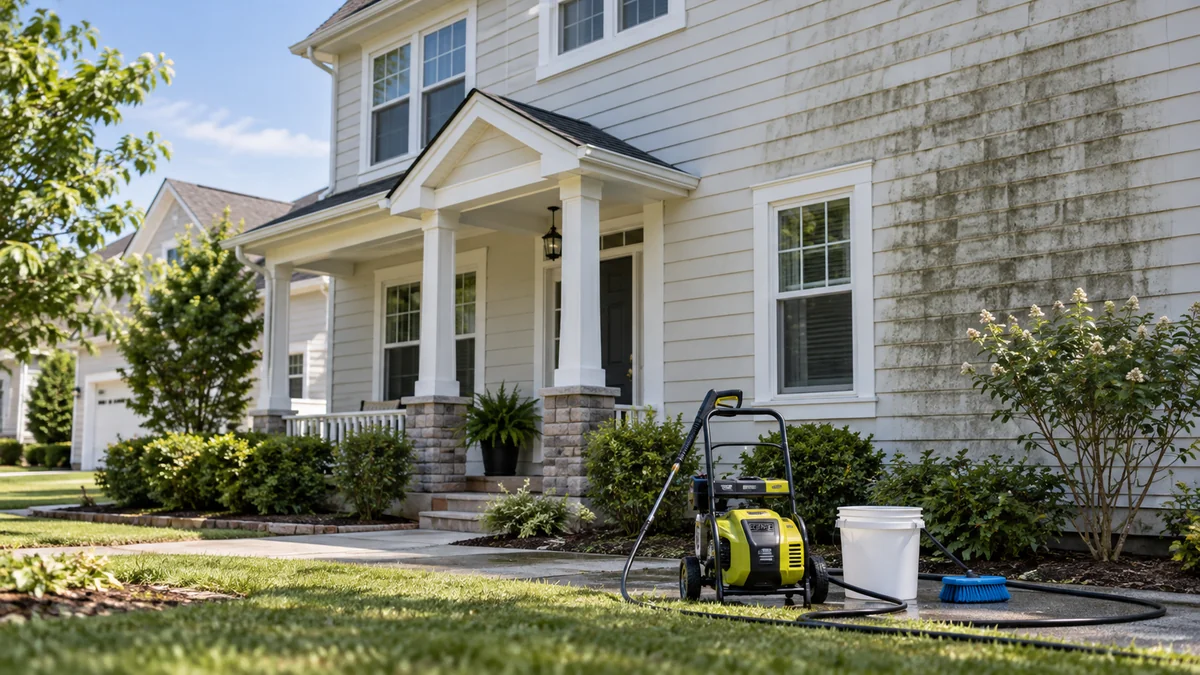
Washing your house exterior can help reduce indoor allergen exposure, but usually only indirectly and modestly. Exterior cleaning removes pollen, settled dust, and surface mold near doors, windows, and air intakes, yet no strong universal evidence shows that house washing alone significantly reduces indoor allergy symptoms. Indoor filtration, humidity control, cleaning, and source removal usually matter more.
Key Facts at a Glance
- Exterior house washing can reduce allergen reservoirs on siding, porches, screens, window frames, and outdoor furniture.
- Outdoor pollen usually enters through open windows, doors, clothing, pets, and mechanical ventilation rather than passing directly through intact walls.
- Cleaning window screens, tracks, entryways, and outdoor air-intake areas often has more practical value than washing an entire facade.
- Pressure washing does not reliably remove the cause of indoor mold, such as leaks, high humidity, or contaminated wall cavities.
- The American Academy of Allergy, Asthma & Immunology recommends reducing indoor allergens through measures such as humidity control, washing bedding, and high-efficiency filtration.
- A typical professional exterior wash costs about $300-$600 in the United States, but the price does not predict its allergy benefit.
Does Washing Your House Exterior Help Reduce Indoor Allergies?
Yes, exterior washing can help reduce indoor allergies when outdoor particles are accumulating close to entry points, but the effect is indirect and highly situation-dependent. Cleaning screens, window tracks, door thresholds, porches, and outdoor air-intake grilles can limit the material carried indoors by airflow, shoes, pets, and hands.
Whole-house washing has a weaker allergy rationale. Pollen on distant siding does not normally travel through the wall into a bedroom, and rinsing a facade cannot remove dust mites, pet dander, or mold hidden inside the building. The strongest case for exterior washing exists when visible pollen or fungal growth surrounds frequently opened windows, doors, or ventilation equipment.
Marketing claims often overstate the evidence. Published allergy-control guidance from organizations such as the American Academy of Allergy, Asthma & Immunology and the Asthma and Allergy Foundation of America emphasizes indoor humidity, bedding, vacuuming, filtration, and moisture control. Those sources do not establish a universal three-to-six-month indoor allergy reduction from washing a house exterior.
How Can Outdoor Allergens Reach Indoor Air?
Outdoor allergens enter homes mainly through openings, air exchange, and transfer on objects, not through clean, intact siding. Wind carries pollen through open windows and doors, while people, pets, shoes, and screens transport settled particles across the building perimeter.
The main exposure pathways
| Pathway | Typical entry location | Practical control |
|---|---|---|
| Open-window airflow | Window opening and insect screen | Close windows during peak pollen; clean screens |
| Door traffic | Threshold, mat, flooring | Use washable mats; remove shoes |
| Mechanical ventilation | Outdoor air intake or damaged filter | Replace filter; inspect intake location |
| Pets and clothing | Fur, cuffs, footwear | Change clothes; wipe pets after outdoor activity |
| Surface disturbance | Porch, furniture, siding near windows | Rinse or wipe high-contact areas |
| Moisture intrusion | Leaks, damp crawlspaces, wall cavities | Repair source; use qualified remediation |
Negative pressure can draw outdoor air through gaps around doors, windows, ducts, and penetrations. However, a central air-conditioning system set to recirculate generally filters indoor air through its installed filter rather than pulling pollen from every exterior wall. The exact effect depends on the HVAC design, filter fit, fresh-air settings, and building leakage.
Which Exterior Areas Matter Most for Allergy Control?
Window screens, tracks, door thresholds, porches, and outdoor-air intakes usually deserve attention before distant siding. These locations sit directly in the path between outdoor particles and indoor occupants, so cleaning them can produce more benefit per minute than washing a large wall.
Priority cleaning targets
- Window screens: Fine mesh traps pollen and dust. Remove screens when practical, rinse them gently, and let them dry completely before reinstalling.
- Window tracks: Tracks collect damp organic debris that can support surface mold. Vacuum loose material first, then wipe with mild detergent.
- Door thresholds: Brush and wash thresholds, mats, and nearby flooring because foot traffic transfers pollen indoors.
- Porches and steps: Clean areas used by people and pets, especially outside bedrooms or frequently opened doors.
- Outdoor HVAC intakes: Keep grilles free of leaves and inspect the filter. Do not spray water into the equipment.
- Gutters and downspouts: Clear blockages and correct overflow, because persistent dampness encourages fungal growth near walls and foundations.
A practical rule is to clean the first 3-6 feet around frequently used openings before paying for a full facade wash. The rule is not a clinical standard, but it reflects how contamination is transferred in ordinary homes.
What Does Exterior House Washing Actually Remove?
Exterior washing can remove settled pollen, dust, bird residue, algae, and some surface mildew from nonporous or semi-porous materials. Washing does not sterilize a building, remove all airborne particles, or correct hidden moisture and mold contamination.
| Exterior contaminant | Washable source | What washing can do | What it cannot do |
|---|---|---|---|
| Tree pollen | Screens, siding, porch furniture | Rinse settled particles away | Prevent new pollen from arriving |
| Grass pollen | Steps, mats, lower walls | Reduce surface transfer | Remove pollen from indoor fabrics |
| Surface mildew | Vinyl, painted siding, masonry | Remove visible growth | Fix leaks or damp wall cavities |
| Algae | Roofs, shaded siding, concrete | Improve appearance and remove growth | Guarantee regrowth prevention |
| Settled dust | Sills, tracks, porches | Remove loose deposits | Replace indoor vacuuming |
| Bird or insect residue | Eaves, ledges, walls | Remove contamination | Eliminate the animal source |
Pollen is not “killed” by pressure washing. Water physically moves it. Mold spores may be removed from a surface, but a rinse does not reliably destroy every spore, and aggressive spraying can spread contaminated water or force moisture into building materials.
Is Soft Washing Better Than Pressure Washing for Allergies?
Soft washing is generally safer for siding, painted surfaces, roof coverings, and screens because it combines low-pressure water with a cleaning solution. Pressure washing is more appropriate for durable hard surfaces such as concrete, brick, and some stone, where high force is less likely to damage the substrate.
| Method | Typical pressure | Suitable surfaces | Allergy-related strength | Main risk |
|---|---|---|---|---|
| Screen and track cleaning | Hand pressure | Mesh, aluminum, vinyl tracks | Removes particles at entry points | Tearing mesh or leaving moisture |
| Soft washing | Often below 500 psi at the surface | Vinyl, painted siding, roof materials | Removes organic surface growth | Chemical runoff and plant damage |
| Garden-hose washing | About 40-80 psi | Light surface dust, screens | Low-risk pollen removal | Limited removal of bonded grime |
| Pressure washing | Commonly 1,500-3,000+ psi | Concrete, brick, some masonry | Removes ground-in debris | Paint loss, water intrusion, screen damage |
| Professional roof cleaning | Method varies by roof | Asphalt shingles, tile, metal | Controls visible roof growth | Foot traffic, runoff, material damage |
A practitioner rule is simple: use the lowest pressure that achieves the cleaning goal. High pressure near windows can drive water behind flashing, damage seals, tear screens, and distribute contaminated runoff without improving indoor air.
How Should You Clean the Exterior Without Increasing Exposure?
A safer cleaning process keeps indoor openings closed, prevents chemical exposure, and targets high-transfer surfaces first. A typical small home project takes 2-5 hours for a professional crew, while screen and entryway cleaning may take 30-90 minutes.
Step 1: Identify the allergen and the source
Determine whether symptoms correlate with tree pollen, grass pollen, visible mold, dust, pets, or damp weather. Washing exterior walls is a weak intervention for dust mites and pet dander, which mainly require indoor controls.
Checkpoint: You can name the suspected trigger and the outdoor surfaces where it accumulates.
Common mistake: Scheduling a facade wash when the actual problem is a damp basement or unfiltered HVAC return.
Step 2: Close and protect indoor openings
Close windows and doors, set the HVAC system to recirculate if appropriate, and avoid spraying near outdoor-air intakes. Do not seal required combustion-air openings or alter mechanical ventilation without professional advice.
Checkpoint: No spray path reaches an open window, vent, intake, or electrical component.
Common mistake: Turning the system off without understanding whether the home needs continuous ventilation.
Step 3: Remove loose debris
Vacuum or brush screens, tracks, thresholds, and ledges before wet cleaning. Dry removal prevents a heavy layer of pollen from becoming muddy residue.
Checkpoint: Loose leaves, webs, and visible dust are removed.
Common mistake: Blasting dry debris with high pressure, which creates unnecessary airborne particles.
Step 4: Pre-wet plants and nearby surfaces
Water landscaping before applying a cleaning solution, and cover sensitive electrical components. Follow the product label for dilution, dwell time, protective equipment, and runoff restrictions.
Checkpoint: Plants are wet, drains are clear, and runoff will not enter ponds or stormwater systems.
Common mistake: Assuming “biodegradable” means harmless to plants, aquatic life, paint, or skin.
Step 5: Apply a compatible cleaner at low pressure
Use a product compatible with the surface. Many professional crews use diluted sodium hypochlorite for organic growth, but concentration, dwell time, ventilation, and runoff control determine safety.
Checkpoint: The solution remains wet for the label-specified time, often about 5-15 minutes.
Common mistake: Mixing bleach with acids, ammonia, or other cleaners, which can produce dangerous gases.
Step 6: Rinse from the top downward
Rinse siding and masonry with controlled flow, keeping water away from window seals, vents, soffit openings, and wall penetrations. Use hand cleaning for screens and tracks rather than a pressure nozzle.
Checkpoint: No visible residue remains, and water drains away from the foundation.
Common mistake: Directing a concentrated jet under siding laps or around flashing.
Step 7: Dry and ventilate appropriately
Leave screens, removable mats, and washable items to dry fully. After outdoor work ends, inspect windows and tracks before reopening the house, particularly when mold or strong chemicals were involved.
Checkpoint: Surfaces are dry, odor has dissipated, and no runoff or dampness remains indoors.
Common mistake: Opening windows immediately after cleaning while nearby surfaces are still wet or airborne particles remain disturbed.
How Much Does Allergy-Focused Exterior Cleaning Cost?
A typical professional house wash costs $300-$600, while targeted screen, track, porch, and entryway cleaning may cost approximately $75-$250 depending on access and local labor rates. Equipment rental commonly costs $75-$150 per day, excluding detergent, protective equipment, water, and possible damage repairs.
| Project scope | Typical cost | Typical duration | Allergy value |
|---|---|---|---|
| Screens and window tracks | $75-$250 | 0.5-2 hours | High near open windows |
| Porch, steps, and entryway | $100-$300 | 1-2 hours | High for foot traffic |
| Single-story house wash | $250-$500 | 2-4 hours | Moderate if pollen or mildew is visible |
| Two-story house wash | $400-$900 | 3-6 hours | Moderate, access-dependent |
| Gutter cleaning and downspouts | $100-$300 | 1-3 hours | Indirect, strongest when dampness exists |
| Roof or extensive mold cleaning | $400-$1,500+ | 3-8 hours | Variable, requires source correction |
Prices vary with square footage, height, regional wages, water access, roof pitch, chemical requirements, and insurance. A low quote may exclude screen cleaning, plant protection, gutter work, or post-cleaning inspection.
How Often Should You Wash a House Exterior?
Most homes do not need exterior washing twice a year solely for allergy control. A reasonable schedule is seasonal inspection, targeted cleaning when pollen or mildew accumulates, and more frequent work where shade, humidity, trees, or heavy traffic create rapid buildup.
| Situation | Suggested timing | Priority |
|---|---|---|
| Heavy spring tree pollen | After peak shedding, when practical | Screens, tracks, porches |
| Grass pollen exposure | After the local season | Entryways and outdoor seating |
| Shaded, damp siding | Once or twice yearly inspection | Moisture and mildew source |
| Coastal or dusty location | As visible deposits accumulate | Screens and lower walls |
| Chronic gutter overflow | Immediate repair | Drainage before washing |
| Asthma with mold sensitivity | Professional assessment first | Source removal, not cosmetic washing |
Cleaning immediately before a high-pollen season may leave surfaces clean for only a short period. In many regions, washing after peak shedding is more useful than washing weeks before it.
What Helps Indoor Allergies More Than Exterior Washing?
Indoor allergen controls usually provide a more direct route to symptom reduction than washing exterior walls. The best intervention depends on the trigger, but properly fitted filtration, moisture control, bedding hygiene, and source removal have clearer support in clinical guidance.
| Trigger | Higher-value intervention | Useful specification | Exterior washing role |
|---|---|---|---|
| Tree or grass pollen | Closed windows and filtration | Use appropriately sized HEPA air cleaning | Clean screens and thresholds |
| Dust mites | Humidity reduction and hot washing | Keep relative humidity below 50% when feasible | Usually minimal |
| Pet dander | Bedroom exclusion and HEPA vacuuming | Wash bedding weekly; groom pets outdoors | Clean pet entry route |
| Indoor mold | Leak repair and professional remediation | Dry wet materials promptly | Remove exterior moisture sources |
| Smoke or fine particles | Portable filtration and ventilation control | Avoid indoor particle generation | Limited |
| Cockroach allergens | Integrated pest management | Seal food and water sources | Wash only contaminated exterior zones |
The Asthma and Allergy Foundation of America recommends measures such as controlling humidity, reducing dust accumulation, washing bedding, and using filtration. A portable air cleaner can reduce airborne particles in a selected room, but its benefit depends on clean filters, adequate airflow, and correct room sizing.
Can Exterior Washing Worsen Allergies or Asthma?
Exterior washing can temporarily worsen exposure because spraying disturbs pollen, mold debris, and contaminated runoff. People with asthma, severe mold sensitivity, or respiratory disease should avoid the work area and should not pressure-wash heavy fungal growth without appropriate training and respiratory protection.
Reduce exposure during cleaning
- Keep occupants and pets indoors or away from the work zone.
- Close windows and disable unnecessary outdoor-air intake during active spraying.
- Avoid dry brushing large mold colonies.
- Wear eye protection, gloves, and label-specified respiratory protection.
- Never mix bleach with ammonia, acids, or unknown cleaners.
- Keep children away until surfaces are rinsed and dry.
- Do not use a pressure washer on asbestos-containing materials or deteriorated lead-painted surfaces.
- Hire qualified professionals when mold affects porous materials, wall cavities, crawlspaces, or HVAC systems.
A portable air purifier may help with particles that enter the home, but it does not make unsafe chemical handling safe. The primary control is distance from the work and correct containment.
Does Washing the Exterior Fix Indoor Mold?
No, exterior washing does not fix indoor mold unless the exterior growth is the direct and limited source of contamination. Indoor mold usually requires moisture control, removal of affected porous materials, drying, and sometimes professional remediation.
Exterior cleaning can help when clogged gutters overflow onto walls, failed caulking allows rain intrusion, or roof algae contributes to persistent dampness. Washing alone cannot repair flashing, replace wet drywall, dry insulation, or correct a plumbing leak.
Signs that require source investigation
- Musty odor that returns after cleaning
- Staining around windows or ceilings
- Peeling paint or swollen trim
- Repeated condensation
- Visible growth on drywall, insulation, or HVAC components
- Indoor relative humidity consistently above 60%
- Symptoms that occur mainly in one damp room
The Environmental Protection Agency recommends addressing the moisture problem rather than relying on routine chemical treatment. Moldy porous materials may need removal, while hard surfaces can often be cleaned and dried.
Which Cleaning Approach Fits Your Situation?
The best approach depends on the allergen, location, material, and health risk rather than on the largest available pressure washer. Target the shortest path between the suspected outdoor source and the indoor breathing zone.
| Situation | First action | Secondary action | Avoid |
|---|---|---|---|
| Pollen on bedroom screens | Wash screens and tracks | Keep windows closed at peak counts | High-pressure nozzle |
| Mildew on shaded siding | Inspect drainage and leaks | Soft wash compatible siding | Forcing water behind cladding |
| Dust at the front door | Wash mat and threshold | Remove shoes indoors | Washing only the upper facade |
| Mold near an intake | Inspect HVAC and source | Hire qualified evaluator | Spraying into the grille |
| Asthma and heavy mold | Leave the work to professionals | Repair moisture source | DIY agitation and chemical mixing |
| No visible exterior buildup | Improve indoor controls | Monitor symptoms and humidity | Paying for cosmetic washing as treatment |
The highest-value exterior job is often smaller than homeowners expect. Screens, tracks, mats, gutters, and drainage can matter more than a visually clean second-story wall.
Common Mistakes That Reduce the Benefit
Treating pressure as a disinfectant
High pressure moves material but does not sterilize surfaces. It can create water intrusion and damage that later supports mold.
Washing without correcting moisture
A clean wall that remains wet from gutter overflow, faulty flashing, or poor grading will grow new organisms. Repair first when moisture is persistent.
Ignoring the HVAC filter
Exterior washing cannot compensate for a loose, overloaded, or poorly fitted filter. Check the filter size, replacement interval, and manufacturer-approved efficiency for the equipment.
Cleaning only where dirt is visible
Transparent screens and dark window tracks can hold substantial pollen even when siding looks clean. Inspect at eye level and along frequently opened windows.
Assuming one cleaning eliminates symptoms
Allergen levels change with weather, ventilation, indoor textiles, pets, and human behavior. Track symptoms and likely exposures rather than using a single wash as a diagnostic test.
Using strong chemicals near plants and waterways
Runoff can damage vegetation and aquatic environments. Product concentration, weather, drainage, and local regulations determine whether a method is appropriate.
FAQ
Can washing siding remove pollen from the air inside?
Washing siding removes settled pollen from the exterior surface but does not remove pollen already suspended indoors. Indoor filtration, closed windows during peak pollen periods, vacuuming, and cleaning fabrics address indoor particles more directly. Exterior washing has the most plausible benefit near frequently opened windows, doors, and outdoor seating areas.
Should I pressure-wash before opening windows in spring?
Pressure washing is not automatically the best preparation for spring ventilation. Clean screens, tracks, sills, and thresholds with gentle methods, then inspect for moisture and residue before opening windows. If pollen season is approaching, opening windows during low-pollen periods may matter more than washing distant siding.
Does rain clean pollen off a house?
Rain can remove loose pollen from exposed surfaces, but it may also move particles onto sills, porches, gutters, and soil. Rain does not clean window tracks, screens, door mats, or sheltered ledges reliably. A targeted rinse or hand wash is more effective for those transfer points.
Can a house wash reduce dust mites?
Exterior house washing does not usually reduce dust mites because dust mites live primarily in indoor bedding, carpets, upholstery, and other reservoirs. Wash bedding regularly, control indoor humidity, and use appropriate mattress and pillow encasements. Exterior cleaning has little relevance unless dust is being tracked through a particular entryway.
Should someone with asthma clean exterior mold?
A person with asthma should avoid personally disturbing extensive exterior mold, especially with dry brushing or pressure washing. A qualified professional can select containment, cleaning chemicals, protective equipment, and waste controls. Seek medical advice for significant breathing symptoms, and leave the area if wheezing or chest tightness develops.
Is exterior washing worth the cost for allergy relief?
Exterior washing is worth considering when visible pollen, mildew, clogged gutters, or dirty screens are concentrated around entry points and windows. It is a poor stand-alone allergy treatment when the home has indoor mold, high humidity, pet dander, dust mites, or unfiltered HVAC air. Targeted cleaning usually offers better value than cosmetic whole-house washing.
The Bottom Line
Does washing your house exterior help reduce indoor allergies? Sometimes, but the benefit is indirect, localized, and less certain than many cleaning advertisements suggest. Prioritize window screens, tracks, thresholds, porches, gutters, drainage, and outdoor-air intakes, then address indoor humidity, filtration, bedding, pets, and hidden moisture. A clean exterior can support better exposure control, but it cannot replace evidence-based indoor allergy management.