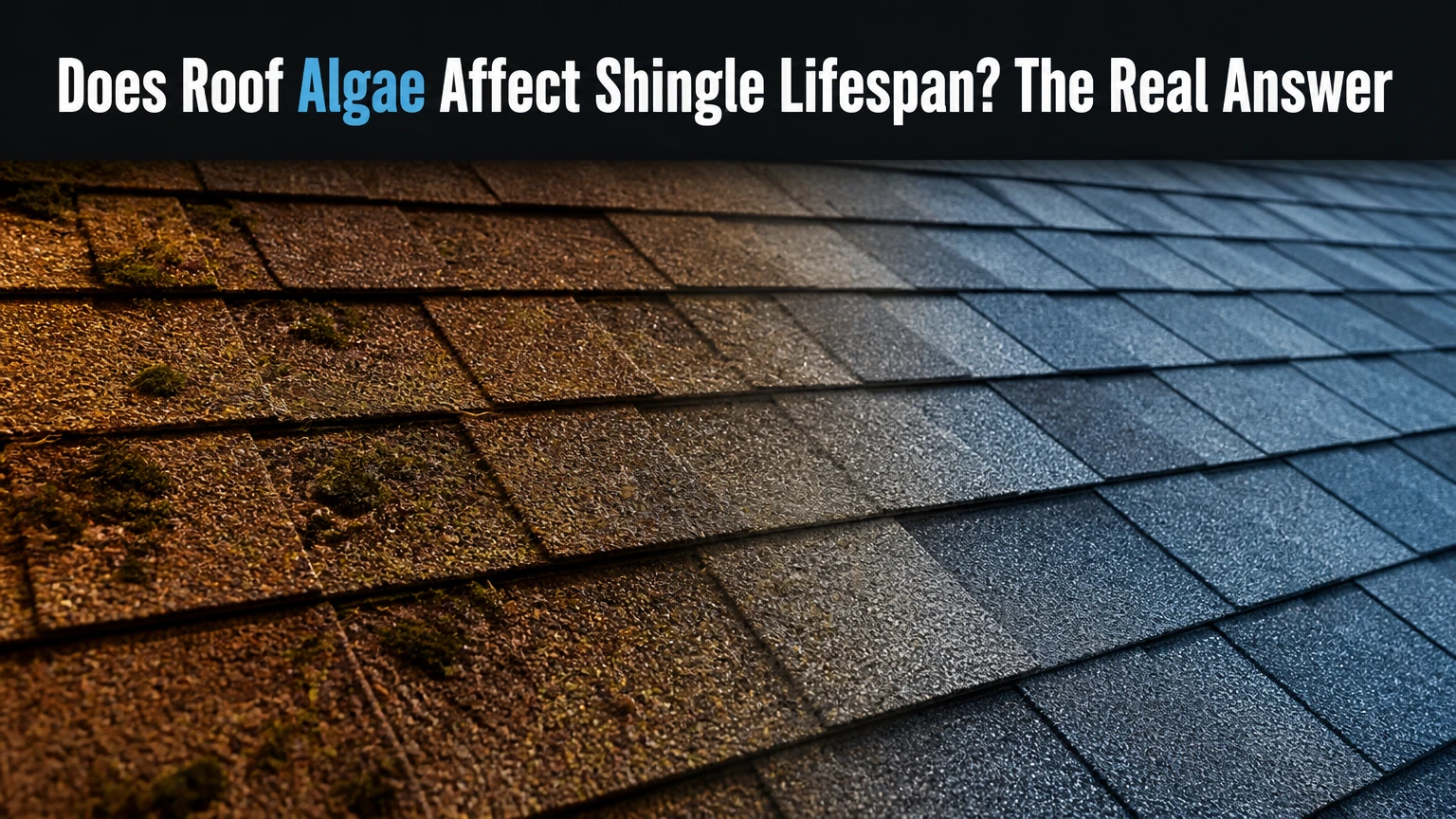
Roof algae can shorten asphalt-shingle service life indirectly, but black streaks alone do not prove that shingles are being structurally destroyed. The main risks are retained moisture, accelerated granule loss, reduced drying, and progression to moss or lichen. A roof’s age, ventilation, climate, slope, and existing wear determine whether cleaning is worthwhile.
Key facts at a glance
Asphalt-roof algae is commonly associated with the cyanobacterium Gloeocapsa magma, which produces dark protective pigments.
Algae usually begins as a cosmetic problem, while moss and lichen create more direct mechanical or biological risks.
The Asphalt Roofing Manufacturers Association says there is no direct chemical evidence that algae alone destroys asphalt shingles.
Pressure washing, scraping, and wire brushing can remove bonded ceramic granules and shorten shingle life.
No reliable universal rule deducts exactly 3, 5, or 10 years from every algae-stained roof.
Cleaning is most defensible when algae is spreading, moisture is persistent, granules are shedding, or moss is beginning to develop.
Does roof algae affect shingle lifespan?
Yes, roof algae can affect shingle lifespan, but usually through secondary conditions rather than rapid chemical destruction. A thin, flat colony on otherwise intact shingles may remain mainly cosmetic for years, whereas dense growth on a shaded, humid roof can keep surfaces damp, encourage moss, and expose aging asphalt after granules loosen.
The distinction matters because many roofs are replaced too early after a visual diagnosis. A dark streak does not reveal the shingle’s remaining flexibility, mat condition, flashing integrity, or granule adhesion. Conversely, a roof with modest-looking discoloration can have serious underlying wear if granules are accumulating in gutters or washing into downspouts.
The ARMA position is often summarized in its own wording: “there is no direct chemical evidence that algae alone destroys asphalt shingles.” That statement does not mean algae is always harmless. It means the evidence does not support treating every black streak as a predictable, quantified structural failure.
How much life can algae remove?
No authoritative field standard assigns a fixed lifespan penalty to algae. Claims that untreated algae automatically removes 3-10 years from a 25- or 30-year shingle should be treated as practitioner estimates, not a universal engineering result.
A roof installed in a dry, sunny climate may show staining without measurable functional damage. A roof in a humid region under tree cover may experience faster deterioration because moisture, shade, windblown debris, and biological growth operate together. The same organism can therefore produce very different outcomes.
What is roof algae?
Roof algae is a photosynthetic microorganism that grows on damp roofing surfaces, with Gloeocapsa magma commonly linked to the black or blue-black streaks found on asphalt shingles. The organism forms a pigmented sheath that helps protect the colony from ultraviolet radiation, giving the growth its characteristic dark appearance.
Roof algae does not look like a thick plant. It generally appears as narrow vertical streaks that follow rainwater flow, broad discoloration on shaded planes, or dark patches near roof penetrations and valleys. The color can range from black and charcoal to brown, blue-green, or gray depending on species, age, dirt, and moisture.
Visual identification remains limited. Soot, dirt, airborne pollution, lichen, and old organic staining can resemble algae from the ground. A roofing professional should inspect close-up when the decision involves chemicals, warranty coverage, or replacement.
Where does algae grow fastest?
Algae grows most readily where shingles dry slowly. North-facing roof planes in the Northern Hemisphere often receive less direct sunlight, but orientation alone does not determine growth. Nearby trees, coastal humidity, frequent rain, roof debris, low pitch, and poor air movement can matter more than compass direction.
A roof does not need a leak to support algae. Condensation, dew, shaded rainwater, and decomposing leaves can provide enough surface moisture for colonization. Clogged gutters and blocked valleys add water exposure, although they are not the sole cause of roof algae.
How does algae contribute to shingle deterioration?
Algae contributes to deterioration by maintaining a wetter surface, collecting debris, and increasing the likelihood of moss or lichen colonization. The most defensible damage pathway is indirect: prolonged moisture and poor drying can weaken already-aging shingles, while granule loss removes the asphalt surface’s main protection from sunlight and weather.
A typical asphalt shingle contains a fiberglass or organic reinforcement mat, asphalt coatings, mineral filler, and ceramic-coated mineral granules. The granules shield asphalt from ultraviolet radiation and provide much of the roof’s weathering surface. Any condition that loosens or removes them deserves attention.
Some roofing sources describe Gloeocapsa magma as consuming limestone filler. That mechanism is debated and should not be presented as settled proof that algae eats through a shingle. ARMA’s more cautious position is useful: algae growth is primarily an appearance issue, but cleaning must avoid damaging the roofing system.
What is the actual deterioration sequence?
The common sequence is:
- Airborne spores settle on a roof surface.
- Shade and moisture allow a colony to persist.
- Pigmented growth produces dark streaking.
- Debris and biomass slow drying.
- Moss or lichen may establish in suitable conditions.
- Existing weak granule bonds worsen through rain, weathering, and freeze-thaw cycles.
- Exposed asphalt ages faster under ultraviolet light.
Algae is therefore a risk multiplier, not a reliable stand-alone clock. A roof already near the end of its service life has less remaining tolerance than a five-year-old roof with strongly bonded granules.
Which roof growth is most damaging?
| Growth type | Typical appearance | Primary risk | Usual response |
|---|---|---|---|
| Algae | Flat black, brown, or blue-black streaks | Moisture retention and staining | Low-pressure treatment or monitoring |
| Moss | Raised green cushions or mats | Water retention and shingle lifting | Professional removal and moisture correction |
| Lichen | Crusty gray, green, or pale spots | Strong attachment and granule disturbance | Carefully controlled professional treatment |
| Mold or mildew | Patchy dark or pale surface film | Often indicates moisture or contamination | Identify moisture source before treatment |
Moss generally presents a more direct roofing hazard than flat algae because its structures can grow into shingle edges, retain water, and lift laps. Lichen can be especially difficult because aggressive removal may pull away granules or tear the surface.
How can you tell whether algae has already damaged shingles?
Algae has probably contributed to meaningful roof damage when staining appears with widespread granule loss, brittle or curling tabs, lifted shingle edges, exposed fiberglass, recurring dampness, or moss growth. Streaking alone does not establish that the roof needs replacement.
Inspect from the ground first. Look for unusually bare areas, dark deposits in gutters, exposed nail heads, damaged flashing, missing tabs, and uneven roof planes. Do not climb a wet or steep roof merely to confirm algae because algae treatment makes the surface even more slippery.
| Inspection finding | Likely meaning | Recommended decision |
|---|---|---|
| Flat streaks, intact granules, no curling | Primarily cosmetic growth | Monitor or arrange gentle cleaning |
| Streaks plus light gutter granules | Existing weathering or treatment damage | Obtain a roof inspection |
| Moss lifting shingle edges | Active moisture and mechanical risk | Professional assessment soon |
| Lichen with bare spots | Granule adhesion may be compromised | Avoid scraping; inspect closely |
| Cracks, exposed mat, widespread curling | Advanced shingle aging | Compare repair with replacement |
| Persistent damp decking or attic odor | Moisture problem beyond surface algae | Inspect ventilation and leaks |
Does roof color change the risk?
Dark staining can increase solar absorption, but a universal claim that algae raises cooling costs by exactly 7-15% is not reliable without a building-specific energy model. Roof color, insulation, attic ventilation, climate, HVAC efficiency, and roof orientation all affect attic temperature and electricity use.
The practical concern is surface protection. Black algae can hide granule loss and make visual roof assessment harder. Light-colored streaks may reveal defects sooner, but color does not determine whether shingles are structurally sound.
Should you clean algae from asphalt shingles?
Cleaning is usually worthwhile when algae is spreading or when the roof has enough remaining life to justify preservation. Cleaning is less valuable when shingles are brittle, heavily worn, leaking, or already scheduled for replacement, because treatment cannot restore lost granules or reverse asphalt aging.
Professional roof cleaning should use a method compatible with the shingle manufacturer’s instructions. ARMA recommends avoiding pressure washing and using solutions applied with low pressure; exact products, dwell times, and rinsing methods vary by formulation and site conditions.
A safe treatment decision considers four factors:
- Roof condition: Newer, flexible shingles tolerate controlled treatment better than brittle shingles.
- Growth type: Moss and lichen need more care than flat algae.
- Runoff risk: Bleach and biocides can damage plants, soil organisms, siding, and metal fixtures.
- Access and fall exposure: A roof is not a safe DIY work surface simply because the growth is visible.
Is a 50:50 bleach mixture always appropriate?
No. A universal 50:50 bleach-to-water recipe should not be treated as an ARMA requirement or a safe formula for every roof. Sodium hypochlorite concentration varies by product, and stronger solutions can harm vegetation, corrode metals, damage painted surfaces, and create hazardous runoff.
Follow the product label and the shingle manufacturer’s maintenance instructions. A contractor should protect landscaping with pre-wetting and controlled runoff management, keep people and pets away from treatment areas, and use low-pressure application rather than blasting the surface.
Never mix bleach with ammonia, acids, or other cleaners. Chemical reactions can release toxic gases. Homeowners uncomfortable with roof access, chemical handling, or fall protection should hire an insured roofing or roof-cleaning contractor.
Which algae-control method protects shingles best?
For existing growth, a properly controlled low-pressure treatment is usually the most practical option. Zinc or copper strips can reduce recurrence after installation, while algae-resistant shingles provide the strongest built-in prevention during a replacement, but none of these methods guarantees a permanently stain-free roof.
| Method | Typical cost range | Useful life or timing | Main limitation |
|---|---|---|---|
| Professional low-pressure cleaning | $350-$1,000 | One treatment, recurrence often possible in 1-5 years | Does not restore missing granules |
| DIY label-compliant treatment | $40-$180 | Seasonal or periodic maintenance | Fall, runoff, and mixing risks |
| Zinc strip retrofit | $150-$600 installed | Several years, depending on exposure | Rain must contact and distribute zinc |
| Copper strip retrofit | $250-$800 installed | Several years, depending on exposure | Higher material cost and installation access |
| Algae-resistant shingles | About 5%-15% material premium, typical | Selected at replacement | Resistance is not immunity |
Prices are planning ranges for many United States markets, not quotes. Roof size, pitch, access, regional labor, growth severity, landscaping, and insurance requirements can move the final price substantially.
Do zinc and copper strips work?
Zinc and copper strips can inhibit new algae growth when rainwater contacts the exposed metal and carries ions down the shingle surface. Strips work best when installed near the ridge with adequate exposure and unobstructed runoff across the roof plane.
Strips do not clean an established colony immediately. They also cannot repair moss-lifted shingles, replace missing granules, or correct shade and moisture problems. On an old roof, installation may require disturbing ridge caps or fasteners, so a contractor should assess leak risk before retrofitting.
Copper and zinc runoff can affect plants and aquatic environments. Installation should follow local requirements and manufacturer guidance, particularly near rain gardens, ponds, or sensitive landscaping.
Are algae-resistant shingles worth choosing?
Algae-resistant shingles are worth considering when a roof is being replaced in a humid, shaded, or algae-prone area. Many products use copper-containing granules or similar technologies, but the warranty period and covered condition differ by manufacturer.
An algae-resistance warranty usually addresses discoloration for a stated period. It does not guarantee a 25- or 30-year structural life, and it generally excludes poor ventilation, installation defects, storm damage, moss, lichen, or maintenance failures.
| Shingle choice | Typical algae protection | Best use case | Important qualification |
|---|---|---|---|
| Standard asphalt shingle | No dedicated algae-resistant granule system | Dry or low-risk locations | Staining may recur sooner |
| Algae-resistant architectural shingle | Copper-containing or equivalent granules | Humid residential roofs | Warranty terms vary by product |
| Premium algae-resistant shingle | Enhanced granule distribution or warranty | Shaded, high-maintenance roofs | Higher material price |
| Metal, tile, or slate roof | Surface does not support asphalt-shingle algae in the same way | Long-life replacement planning | Other biological staining can still occur |
When should you clean, repair, or replace the roof?
Clean a roof when growth is mainly superficial and the shingles remain flexible, sealed, and well covered with granules. Repair when localized damage exists, such as a few lifted tabs or a small flashing defect. Replace when deterioration is widespread or the roof is near its expected service range.
The nominal label on a shingle is not a promise of identical field life. A “30-year” asphalt shingle may perform for less or more time depending on installation quality, ventilation, weather, roof geometry, and maintenance. Algae may be one contributing factor among several.
What should an inspection include?
A useful inspection checks:
- Granule coverage across several roof slopes
- Shingle brittleness and tab adhesion
- Curling, cracking, blistering, and exposed mat
- Valleys, drip edges, vents, skylights, and flashing
- Attic ventilation and underside condensation
- Gutter granule accumulation
- Moss roots or lichen attachment
- Roof deck softness or visible water staining
An inspector should distinguish cosmetic staining from functional failure. A cleaning contractor whose only recommendation is immediate treatment may not be the right professional to evaluate replacement timing.
What mistakes shorten shingle life during algae removal?
Pressure washing is the most common damaging mistake because concentrated water can dislodge ceramic granules, force water beneath laps, and damage seals. Mechanical scraping and stiff brushing create similar problems when algae, moss, or lichen is bonded to the shingle surface.
| Mistake | Immediate consequence | Safer correction |
|---|---|---|
| Pressure washing at high force | Granule loss and lifted tabs | Use manufacturer-approved low-pressure treatment |
| Dry scraping lichen | Torn surface and bare spots | Obtain professional treatment advice |
| Undiluted or mixed chemicals | Plant, metal, and surface damage | Follow the product label exactly |
| Walking on wet shingles | Falls and surface abrasion | Use trained, insured professionals |
| Ignoring gutters and branches | Rapid recurrence | Improve drainage, sunlight, and airflow |
| Treating moss as algae | Incomplete removal and continued lifting | Identify growth before selecting treatment |
A practitioner rule of thumb is simple: if granules are already loose in the gutter, cleaning should become an inspection decision rather than a cosmetic project. Removing the remaining surface protection to improve appearance is a poor trade.
Another counterintuitive point is that visible black streaks may not be the most urgent problem. A small moss colony at a shingle edge can create more immediate mechanical damage than a much larger flat algae stain.
How can you prevent algae from returning?
Prevention starts with reducing surface moisture and organic debris, then selecting a roof product suited to local exposure. Trim branches that shade the roof, keep gutters and valleys clear, correct ventilation problems, and consider algae-resistant shingles or ridge-metal protection during appropriate maintenance.
Do not remove healthy trees solely because a roof has streaks. Selective pruning often improves drying while preserving shade, storm protection, and landscape value. Tree work near utility lines requires a qualified professional.
A practical maintenance schedule includes:
- Inspect roof and gutters twice yearly, especially after storms.
- Remove leaf litter without dragging tools across shingles.
- Check attic ventilation for blocked intake or exhaust paths.
- Watch shaded slopes after wet seasons.
- Photograph recurring areas to track spread.
- Reinspect after cleaning to confirm granules remain intact.
Annual chemical spraying is not automatically necessary. Repeated treatments can create runoff and maintenance costs without solving shade, condensation, or drainage conditions.
What does roof algae mean for insurance and resale?
Algae staining alone usually does not establish an insurance-covered loss because insurers generally cover sudden events, not gradual biological growth or ordinary wear. Policy wording varies, so homeowners should ask their insurer before assuming cleaning or replacement is reimbursable.
Visible staining can affect buyer perception and inspection negotiations, but a universal 3%-5% property-value reduction is not defensible without local comparable-sales data. A documented cleaning receipt, roof inspection, and remaining-life assessment are more useful than an unsupported percentage.
For a sale, disclose known leaks or professional findings accurately. Cosmetic treatment can improve presentation, but it should not conceal active damage or be used to avoid required repairs.
What should homeowners do next?
Homeowners should first identify the growth, inspect shingle condition from a safe position, and determine whether moisture or roof age makes treatment worthwhile. Flat staining on sound shingles usually permits monitoring or gentle cleaning; moss, lichen, granule loss, leaks, or brittle shingles justify a roofing inspection.
Use this decision path:
- Flat streaks only: photograph, monitor, and obtain a cleaning estimate.
- Streaks plus damp shade: prune selectively and inspect drainage and ventilation.
- Moss or lichen: avoid scraping and arrange professional assessment.
- Granules in gutters: ask whether the loss reflects age, storm damage, or prior cleaning.
- Leaks or exposed mat: prioritize repair or replacement over appearance.
- Roof older than its expected service range: compare cleaning cost with remaining useful life.
The best answer to “does roof algae affect shingle lifespan” is therefore conditional but actionable. Algae can contribute to premature aging, yet roof condition and moisture exposure determine the actual consequence.
FAQ
Can roof algae cause leaks?
Flat algae does not normally puncture an intact asphalt shingle by itself. Leaks become more likely when algae accompanies moss, lichen, lifted tabs, damaged flashing, granule loss, or pre-existing roof defects. Water entering the attic, stained decking, or repeated ceiling marks requires a roofing inspection rather than surface cleaning alone.
Is roof algae the same as black mold?
No. Black roof streaks are commonly associated with algae, especially Gloeocapsa magma, while mold is a broader group of fungi that may occur on damp roofing materials or nearby building surfaces. Color is not enough for certain identification. The treatment, runoff controls, and moisture investigation can differ.
Will rain remove roof algae naturally?
Ordinary rain may wash away loose dirt but rarely removes an established algae colony. Rain can also spread spores and keep shaded shingles damp. Persistent growth usually requires improved drying conditions, an approved treatment, or both. Heavy rain does not substitute for inspection when moss or lichen is present.
Can algae grow on newer shingles?
Yes. Algae can become visible on relatively new shingles when humid weather, shade, tree debris, and slow drying create favorable conditions. Newer shingles generally have more intact granules, so staining may remain cosmetic, but early growth still indicates an exposure pattern that can recur.
Does cleaning algae void a shingle warranty?
Cleaning does not automatically void every warranty, but improper methods can create a warranty dispute. Pressure washing, abrasive tools, unapproved chemicals, and damage to granules or seals are common concerns. Keep product records and use methods consistent with the shingle manufacturer’s published maintenance instructions.
Should you replace a roof because of algae?
No. Algae alone is not a sufficient reason to replace an otherwise sound roof. Replacement becomes more reasonable when staining occurs with widespread granule loss, brittleness, curling, leaks, moss-related lifting, failed flashing, or an advanced roof age that leaves little useful life to preserve.
Conclusion
Does roof algae affect shingle lifespan? It can, especially when persistent moisture, shade, debris, moss, lichen, and existing granule loss occur together. Flat algae streaks are often cosmetic at first, but they should prompt a condition-based inspection rather than a fixed claim that every roof loses 3-10 years. Clean gently, prevent recurrence, and replace only when the roofing system shows functional deterioration.