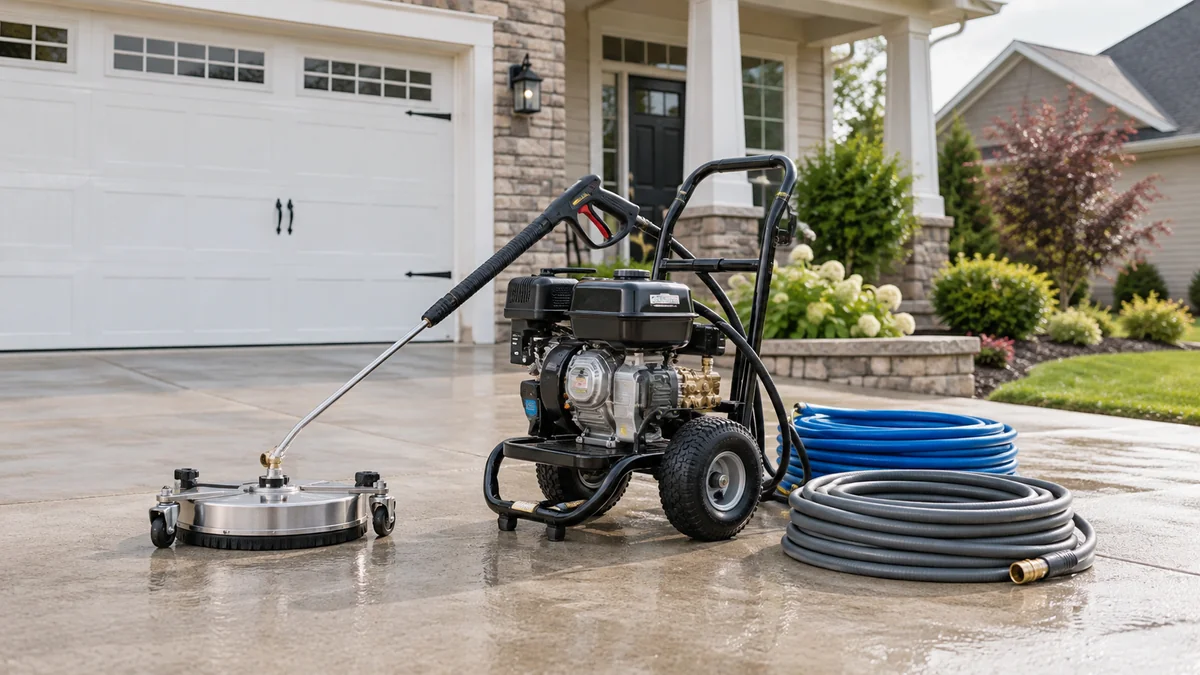
Pressure washing can increase a home’s perceived value and saleability before listing, but it does not reliably add a fixed dollar amount to the appraised value. Cleaning visible grime, algae, and stains improves curb appeal, listing photos, and buyer confidence; the financial return depends on surface condition, local pricing, cleaning cost, and whether repairs are still needed.
Key Facts at a Glance
Pressure washing usually improves presentation rather than changing a property’s structural market value.
A typical professional exterior-cleaning project costs about $250-$1,500, depending on surfaces and location.
Siding and roofs often require soft washing at roughly 100-500 PSI, not aggressive high-pressure cleaning.
Concrete commonly takes 2-3 hours to clean, while a broader exterior package may take 2-5 hours before drying.
Cleaning cannot correct rotten wood, failing mortar, cracked stucco, damaged shingles, leaks, or deferred maintenance.
Sellers should schedule cleaning at least 48 hours before listing photography when surfaces, wood, or landscaping need to dry.
Does Pressure Washing Increase Home Value Before Selling?
Pressure washing increases a home’s visual appeal and can protect the seller from avoidable buyer objections, but the evidence does not support a universal 5%-10% sale-price increase. A clean exterior may help a property compete against similar listings, while the underlying home value remains driven by location, size, condition, comparable sales, and market demand.
The distinction matters. A buyer may interpret black algae streaks, a dirty driveway, or green siding as evidence of roof failure, water damage, or years of neglect. Cleaning removes that visual ambiguity, but it does not prove that the underlying material is sound.
The National Association of Realtors’ 2023 Remodeling Impact Report treats exterior projects as contributors to buyer appeal and homeowner satisfaction, but remodeling reports are not guarantees that one cleaning service creates a specific resale premium. Online claims of a $5,000-$15,000 increase, a 5%-10% boost, or a 400% return should be treated as marketing estimates unless they identify a controlled study and comparable local sales.
How does exterior cleaning influence buyer decisions?
Exterior cleaning influences buyers through three mechanisms: first impressions, photo quality, and perceived maintenance risk. A bright entry path can make the approach feel maintained, while heavily stained concrete can cause buyers to budget for replacement before entering the house.
Real estate photographs amplify exterior defects. Dirt appears as dark contrast around door trim, soffits, window frames, and concrete joints; professional cleaning can therefore improve the listing’s first digital impression without changing the building itself.
Cleaning also creates an inspection advantage. A washed surface is easier to examine, so defects become visible earlier. That is useful when sellers still have time to repair or disclose problems.
Can Pressure Washing Raise the Appraised Value?
Pressure washing rarely raises an appraiser’s opinion of value by itself because appraisals rely primarily on comparable sales, location, gross living area, design, condition, and market evidence. The cleaning can support a favorable condition assessment, but an appraiser will not normally add a fixed line-item premium for a recently washed driveway or facade.
An appraiser may notice a clean exterior as part of overall condition. However, a clean house with a failing roof, damaged siding, or active moisture intrusion remains a property with those defects. Sellers should not clean immediately before an appraisal to conceal a condition that must be disclosed.
| Value factor | Effect of pressure washing | Evidence an appraiser may use |
|---|---|---|
| Gross living area | $0 direct change | Measured square footage |
| Lot size | $0 direct change | Public records and site inspection |
| Exterior condition | Possible presentation improvement | Visible maintenance and defects |
| Comparable sales | No direct change | Recent local transactions |
| Buyer competition | Possible indirect improvement | Offers, showing activity, feedback |
| Repair deductions | Possible reduction if grime caused concern | Inspection findings and repair estimates |
Is Pressure Washing Worth the Cost Before Listing?
Pressure washing is usually worth the cost when visible contamination is one of the property’s most obvious defects and the cleaning price is far below the likely repair or negotiation risk. It is less valuable when the exterior is already clean, the home has major unresolved defects, or the seller must spend limited funds on safety and structural repairs.
Use a break-even calculation rather than a promised ROI:
Net benefit = avoided price concession or added sale proceeds – cleaning cost.
For example, a $450 driveway and entry cleaning breaks even if improved presentation prevents a $1,000 buyer concession. That outcome is plausible, but it is not guaranteed. A $1,200 whole-property wash is difficult to justify when peeling paint, a leaking gutter, or broken steps would dominate buyer feedback.
How much does pre-listing pressure washing cost?
Typical United States professional prices range from $250-$800 for house siding, $100-$300 for driveways and walkways, $400-$800 for soft-washed roofs, and $500-$1,500 or more for bundled exterior work. Local labor rates, access, stories, water supply, stain severity, chemicals, and disposal requirements change the quote.
| Service | Typical price | Typical duration | Main price variables |
|---|---|---|---|
| Driveway and walkway | $100-$300 | 1-3 hours | Oil, rust, size, surface age |
| Siding wash | $250-$800 | 2-4 hours | Stories, siding type, algae |
| Roof soft wash | $400-$800 | 2-5 hours | Roof pitch, access, growth |
| Deck or fence wash | $150-$500 | 2-5 hours | Wood species, staining, repairs |
| Bundled exterior package | $500-$1,500+ | 2-6 hours | Windows, gutters, roof, concrete |
Square-foot pricing commonly falls around $0.15-$0.75 for relevant exterior cleaning, but a minimum service charge can make a small property more expensive per square foot. Sellers should request an itemized quote that identifies pressure, soft washing, chemicals, plant protection, and restoration work separately.
Which Cleaning Method Fits Each Surface?
Soft washing is the safer method for roofs, vinyl siding, stucco, and many painted surfaces because detergent and dwell time remove biological growth without concentrating extreme force on fragile materials. Conventional pressure washing fits durable masonry and concrete when the operator controls nozzle distance, angle, flow, and runoff.
“Power washing” generally describes heated pressure washing, while “pressure washing” often uses unheated water. In practice, contractors use the terms inconsistently, so sellers should ask for the actual pressure, temperature, detergent, and technique.
| Method | Typical pressure | Temperature | Suitable applications | Primary risk |
|---|---|---|---|---|
| Pressure washing | 2,000-3,000 PSI | Ambient | Concrete, brick, some stone | Etching and mortar damage |
| Power washing | 2,000-3,000 PSI | Heated water | Grease, gum, oily concrete | Heat damage and runoff |
| Soft washing | 100-500 PSI | Usually ambient | Siding, stucco, shingles | Chemical or plant damage |
| Hand or low-pressure wash | 50-300 PSI | Ambient | Delicate trim, old paint | Incomplete removal |
How do pressure and detergents affect results?
Pressure removes loose material mechanically, while detergents loosen soil and kill or dissolve biological contamination. A high-pressure stream can make a surface look clean temporarily while leaving algae roots or organic residue behind, especially on shaded siding and roofing.
Concrete cleaning often benefits from a surface cleaner, a circular attachment that distributes spray evenly and reduces zebra-striping. Roof algae usually requires a low-pressure chemical process rather than a wand held close to shingles.
Which Areas Should Sellers Clean First?
Sellers with limited funds should clean the front approach, front elevation, entry steps, porch, and driveway first. These areas receive the most buyer attention and appear in listing photographs, so they generally offer more presentation value than a hidden backyard wall or rarely used side path.
A practical priority order is:
- Remove trip hazards and repair broken steps, loose rails, and unsafe lighting.
- Clean the front walk, driveway apron, porch, and entry door surround.
- Wash the front facade, soffits, gutters, and visible window trim.
- Address roof stains only with a suitable soft-wash method.
- Clean patios, fences, and side elevations if they appear in photographs or inspection views.
Cleaning should follow repairs, not replace them. Pressure washing rotten wood can expose a problem that should have been repaired before listing.
When Should Sellers Schedule Cleaning?
Sellers should schedule exterior cleaning 3-7 days before listing photographs when weather is uncertain, and at least 48 hours before photography for ordinary conditions. The longer window allows surfaces to dry, plants to recover, stains to be reassessed, and touch-up repairs to finish.
Wet concrete can appear uneven in photographs, while damp wood can hide discoloration and affect stain or paint adhesion. Rain, freezing temperatures, strong wind, and municipal water restrictions may require rescheduling.
A typical sequence is:
- Day 1: inspect, repair, protect outlets, move furniture, and photograph existing defects.
- Day 2: clean siding, concrete, roof, gutters, and entry surfaces.
- Day 3: inspect for missed stains, rinse plants, and complete minor touch-ups.
- Day 4 or later: photograph after surfaces are dry and landscaping looks normal.
Should Sellers Hire a Professional or Do It Themselves?
Professional cleaning is usually the better choice when the home has multiple exterior materials, a roof, two stories, fragile landscaping, or a listing deadline within one week. DIY cleaning can be reasonable for a small concrete path when the seller has safe access, understands the equipment, and accepts the risk of permanent surface damage.
| Decision factor | Professional service | DIY rental |
|---|---|---|
| Typical direct cost | $250-$1,500+ | $75-$200 plus supplies |
| Setup time | 15-45 minutes for seller | 1-3 hours for pickup and setup |
| Roof and siding safety | Trained low-pressure process | High misuse risk |
| Concrete uniformity | Surface cleaner often included | Depends on attachment |
| Damage liability | Contractor insurance may apply | Seller bears the loss |
| Best timing | Within 3-7 days of photos | When several spare days exist |
Ask a contractor whether the company carries liability insurance, protects plants, uses low pressure on siding, and provides a written scope. A low bid that omits chemical treatment, gutter cleaning, or runoff control may not be comparable to a complete quote.
What Can Go Wrong During Pre-Listing Cleaning?
Pressure washing can reduce value when the operator scores concrete, drives water behind siding, strips paint, damages mortar, or kills landscaping with concentrated sodium hypochlorite. The most serious mistakes occur when a seller treats every surface as though it were unsealed concrete.
Can pressure washing damage siding?
Yes. Spraying upward into vinyl or wood siding laps can force water behind the cladding, while excessive pressure can crack panels, lift paint, or damage caulk. Use low pressure, a wide fan, and a downward or nearly parallel spray direction.
Can roof cleaning damage shingles?
Yes. High-pressure roof cleaning can remove granules, shorten shingle life, and void some manufacturer requirements. Asphalt shingles with black streaks or moss generally require a roof-appropriate soft-wash process, careful runoff control, and walking restrictions.
What is the concrete “zebra” effect?
The zebra effect is a series of visible stripes caused by overlapping a narrow pressure stream unevenly across concrete. A 25- or 40-degree tip, consistent distance, and rotary surface cleaner reduce the risk; a zero-degree nozzle can permanently etch the slab.
How can chemicals harm landscaping?
Sodium hypochlorite and detergents can scorch leaves when they dry on plants. Pre-wet vegetation, cover sensitive plants temporarily, control runoff, and rinse leaves continuously during application and cleanup.
Which defects should not be pressure washed?
Do not pressure wash loose lead-based paint, friable asbestos-cement materials, unstable mortar, severely rotten wood, active electrical equipment, or surfaces with unresolved leaks. A specialist, painter, roofer, or remediation contractor should assess those conditions first.
How Should Sellers Prepare the Property?
Preparation reduces damage and produces a more uniform result. Remove outdoor furniture, secure gates, close windows, cover delicate fixtures, identify outdoor electrical outlets, and tell the contractor about septic systems, wells, pets, irrigation controls, and freshly painted areas.
Inspect before cleaning. Mark cracked pavers, loose mortar, failed caulk, rotten boards, broken downspouts, and missing roof granules. Cleaning can reveal these conditions, but it cannot correct them.
Contractors may apply detergent from the bottom upward to reduce dirty streaks, allow roughly 10-15 minutes of dwell time without letting the solution dry, then rinse from top to bottom. Exact chemistry varies by material and local regulation, so sellers should not prescribe a bleach concentration without knowing the surface and runoff requirements.
What Alternatives Work When Pressure Washing Is Inappropriate?
Low-pressure detergent washing, hand scrubbing, steam cleaning, professional roof treatment, and concrete-specific stain treatment can replace high-pressure cleaning. The correct alternative depends on the contamination and substrate, not on the seller’s preferred machine.
| Problem | Safer alternative | Typical use | Limitation |
|---|---|---|---|
| Delicate painted wood | Hand wash or low-pressure wash | Loose dirt and mildew | More labor intensive |
| Asphalt roof streaks | Roof soft wash | Algae discoloration | Requires runoff control |
| Oil on concrete | Heated cleaning or degreaser | Garage and driveway stains | May not remove old absorption |
| Efflorescence on brick | Masonry-safe treatment | Salt deposits | Requires diagnosis first |
| Small dirty entry | Scrub brush and detergent | Localized soil | Limited visual coverage |
Cleaning cannot replace painting, tuckpointing, roof repair, gutter replacement, or drainage correction. A seller should fund those projects first when they affect safety, water intrusion, or inspection findings.
Three Pre-Listing Strategies by Seller Situation
Budget-conscious seller
Spend first on the front walk, driveway apron, porch, entry door, and front-facing siding. A focused $150-$400 project can improve the buyer’s arrival experience without paying for invisible surfaces.
Seller with a luxury property
Use a coordinated exterior plan that includes soft-washed siding or roof, cleaned concrete, gutters, windows, outdoor lighting, and landscape protection. High-end buyers may scrutinize finish quality, so streaks, chemical damage, and uneven concrete can undermine the intended result.
Seller listing within seven days
Hire an insured professional, limit the scope to visible surfaces, and schedule cleaning before photography rather than immediately before an open house. Avoid experimenting with rental equipment when there is no time to repair accidental damage.
Expert Rules That Protect Saleability
A clean defect is still a defect. Washing a roof may make the shingles easier to inspect, but it does not extend roof life or resolve missing granules. Sellers should disclose known conditions and preserve invoices, photographs, and repair records.
The cheapest square foot is not always the best investment. A rear patio may cost little to wash, yet a front entry with a smaller area can affect every buyer’s first impression and every listing photograph.
Biological growth requires treatment, not just force. Algae and mildew can return quickly when the process removes surface color but does not address the organism. Soft washing and adequate dwell time often outperform aggressive blasting on these contaminants.
FAQ
Does pressure washing help a house sell faster?
Pressure washing may help a home attract more favorable first impressions and online engagement, but no universal multiplier proves that washed homes sell three or four times faster. Listing quality, price, location, inventory, season, and property condition have much larger effects on marketing time.
Should I pressure wash before or after painting?
Clean before painting so loose dirt, mildew, and chalking do not contaminate the coating. Allow the surface to dry fully, repair damaged material, and follow the paint manufacturer’s preparation requirements. Painting over damp wood or residual biological growth can cause early peeling.
Is driveway cleaning more valuable than house washing?
Driveway cleaning can be the better first expense when the concrete is heavily stained and dominates the approach. House washing becomes more valuable when siding or the front facade has widespread algae, dust, or visible streaking. Compare photographs and buyer sightlines before choosing.
Can a pressure washer remove mold permanently?
A pressure washer can remove visible mold and mildew from suitable surfaces, but it does not guarantee permanent prevention. Moisture, shade, poor drainage, and organic residue allow regrowth. Correcting the moisture source and using a suitable treatment generally produces longer-lasting results.
How long does a pressure-washed house stay clean?
A professionally cleaned exterior may remain presentable for roughly 1-3 years, but climate, shade, humidity, trees, surface porosity, and nearby irrigation can shorten that period. Roof algae and shaded siding often return sooner than sunny concrete.
Do sellers need to disclose pressure-washing damage?
Sellers should disclose known material damage caused by cleaning, including stripped paint, damaged siding, etched concrete, broken shingles, or water intrusion. Concealing damage can create inspection, negotiation, and legal problems after the buyer discovers it.
The Bottom Line
Pressure washing can improve a home’s perceived value before selling by removing visual neglect from the approach, facade, roof, and hardscape. It does not create a guaranteed $5,000-$15,000 premium, a fixed 5%-10% increase, or a universal 400% ROI. The strongest case exists when cleaning is inexpensive, contamination is highly visible, and the rest of the property is already in credible selling condition.
For most sellers, prioritize the entry, front walkway, driveway, and front elevation, then choose soft washing for fragile surfaces and professional help for roofs or multi-story exteriors. Pressure washing increases home value before selling only indirectly, through stronger presentation, lower perceived maintenance risk, and fewer avoidable objections.