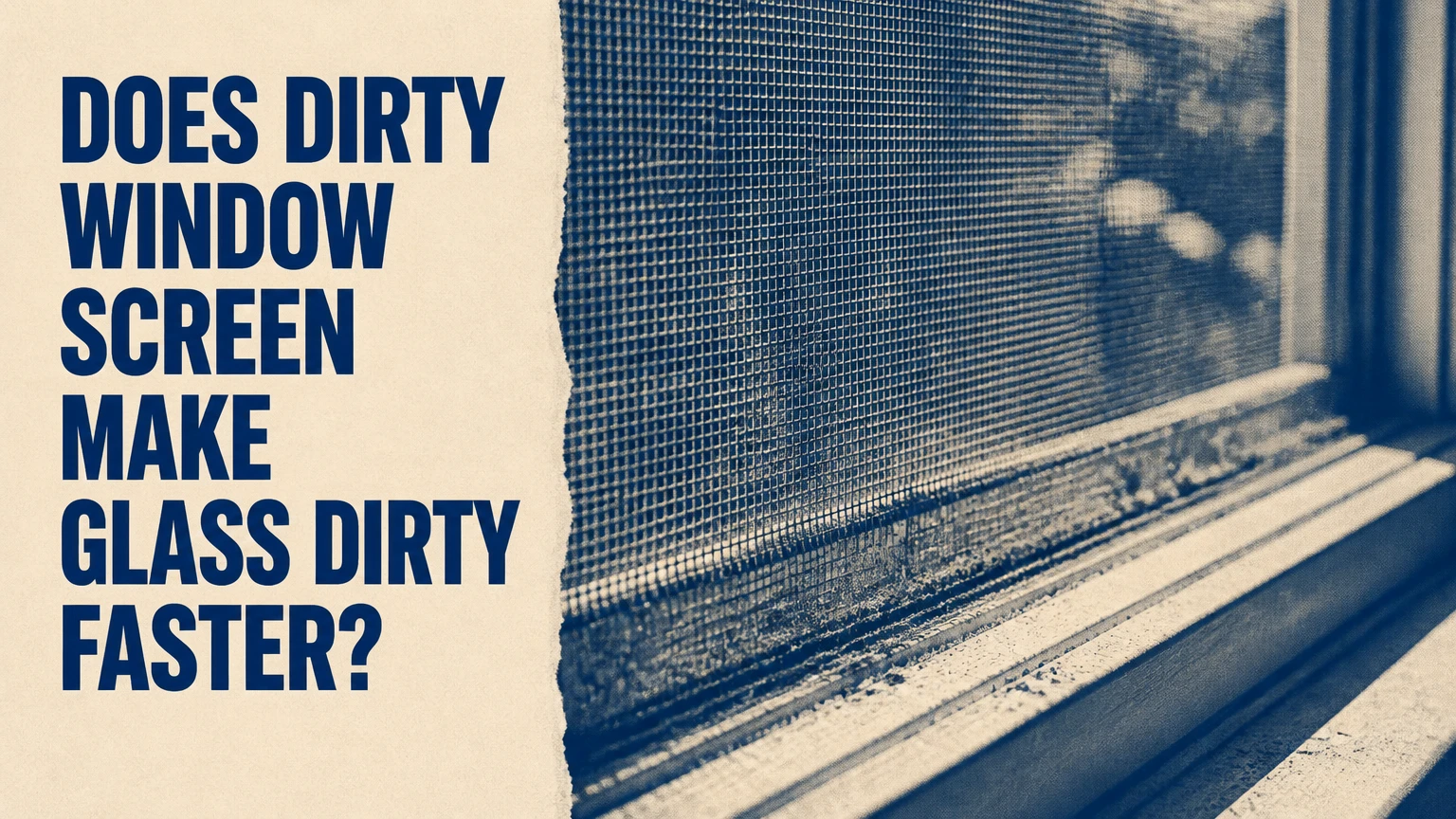
Yes, a dirty window screen makes the glass behind it dirty faster, especially during rain, sprinkler use, fog, or heavy condensation. The mesh collects pollen, dust, soot, insect debris, and mineral particles; moisture then dissolves or carries that material onto the pane, where it dries as spots, streaks, or a dull film.
Key Facts at a Glance
- A dirty window screen can transfer accumulated residue to nearby glass during one rain or sprinkler cycle.
- Screens usually make glass look dirty faster through wet runoff and particle shedding, not through a chemical reaction with the pane.
- Clean screens before cleaning window glass, frames, sills, and tracks.
- Fiberglass screens do not rust, while aluminum screens can leave metal-containing residue when oxidation occurs.
- White deposits may be hard-water minerals, old cleaner, or corrosion residue; only some cases represent permanent glass etching.
- Typical screen maintenance takes 2-5 minutes for light dust and 10-20 minutes for a full wash.
Why Does a Dirty Window Screen Soil the Glass?
A dirty window screen soils adjacent glass because the mesh holds particles in the same narrow air and water path as the pane. When wind moves dust or rain wets the screen, loose contamination can migrate through the mesh, strike the glass, and dry into a more visible pattern than ordinary airborne dust.
Window screens function as filters, but filtration has a finite capacity. Pollen adheres to mesh fibers, traffic soot forms an oily film, and spider webs trap larger particles. The exterior-facing side normally carries the heaviest load, although dust can accumulate on the room-facing side when windows remain open.
The effect is strongest when the screen sits close to the pane. A tight insect screen leaves little distance for runoff to disperse, so droplets can travel from mesh to glass in narrow vertical paths. A dirty sill or frame track can create the same appearance even when the screen itself is clean.
The contamination is usually a visibility problem before it becomes a damage problem. A screen does not normally scratch glass merely by being dirty, because dust is not forced across the pane with enough pressure. Scratching becomes more plausible when grit is dragged during cleaning or when a loose, damaged screen rubs against the glass.
What happens when rain hits a dirty screen?
Rain can wash loose screen debris onto glass, but rainfall does not clean every screen effectively. Light rain may dissolve pollen and dust into streaks, while heavy rain can flush some material away and still leave dirty runoff on the pane, frame, or sill.
Rainwater also collects particles from the atmosphere before reaching the window. Urban soot, agricultural dust, salt, and roof runoff can therefore contribute contamination independently of the screen. Sprinklers are often worse because hard-water droplets contain dissolved calcium and magnesium that remain after evaporation.
What Materials and Residues Make the Problem Worse?
Screen material affects residue type, cleaning frequency, and corrosion risk, but every screen can become a source of glass contamination. Fiberglass avoids rust, aluminum tolerates impact better, and specialty meshes may trap smaller particles because their openings are finer.
| Screen type | Typical service life | Dirt behavior | Main glass-side risk | Practical maintenance |
|---|---|---|---|---|
| Fiberglass insect mesh | 8-12 years | Holds pollen and loose dust | Wet organic streaks | Vacuum and wash gently |
| Aluminum mesh | 10-20 years | Retains soot and oxidized particles | Gray or white runoff residue | Inspect coating and frame |
| Fine or micro-mesh | 5-10 years | Clogs faster with pollen | Dense wet spotting | Clean more often |
| Pet-resistant polyester | 5-15 years | Thick fibers hold lint and dust | Dark runoff film | Use a soft brush |
| Stainless-steel mesh | 15-25 years | Lower corrosion risk than aluminum | Soil from dust, not rust | Check manufacturer guidance |
Service life varies with ultraviolet exposure, pets, handling, coastal salt, and frame condition. A screen that still blocks insects can nevertheless be too brittle, stretched, or clogged to clean safely.
Can aluminum screens cause permanent glass damage?
Aluminum screen oxidation can leave residue on glass, but oxidation alone does not automatically create permanent “screen burn.” Many gray, white, or chalky marks are surface deposits that respond to a glass-safe mineral-residue treatment; true etching occurs only when a contaminant chemically alters the glass surface.
The phrase screen burn is used inconsistently by window cleaners. It may describe removable oxidation transfer, mineral scale, or genuine surface etching. The distinction matters because aggressive polishing can damage low-emissivity coatings, tinted films, sealants, and insulated-glass surfaces.
Look for these clues:
- A deposit that changes when wetted is probably surface residue.
- A rough mark that remains after safe cleaning may be mineral scale or etching.
- A mark visible only at a certain angle may be coating damage or fine abrasion.
- A failed insulated-glass seal produces fog between panes, not a mark on the exterior surface.
Do not begin with 0000 steel wool, abrasive powder, or strong acid. Those methods can scratch glass, remove coatings, or damage the spacer and frame. Test any cleaner on a small area, follow the glass manufacturer’s directions, and use a professional glass-restoration service when the pane has a coating or an uncertain defect.
How Should You Clean Screens and Glass?
Clean the screen, frame, sill, and track before washing the glass. A typical homeowner can clean one removable screen in 10-20 minutes, while light vacuuming takes 2-5 minutes; the most important success factor is removing dry grit before introducing water.
Before You Start
| Item | Typical requirement | Purpose |
|---|---|---|
| Time for one removable screen | 10-20 minutes | Wash, rinse, and dry |
| Mild dish detergent | 1 teaspoon per 4 liters of water | Loosens oily soil |
| Soft vacuum brush | 1 attachment | Removes dry grit |
| Soft nylon brush | 1 brush, 2-5 cm head | Agitates mesh |
| Microfiber towels | 2-4 towels | Wipes frame and glass |
| Garden hose | Low-pressure spray | Rinses without deforming mesh |
| Work surface | 1 clean tarp or towel | Prevents frame damage |
Remove screens only if the window design allows safe removal. Photograph or label each screen before taking it out, because small differences in tabs, corners, and fit can make reinstallation confusing.
Step 1: Remove Loose Dry Debris
Vacuum both sides with a soft brush or wipe the mesh with a dry microfiber cloth. Work from the top downward, and clean spider webs from the corners before wetting the screen.
You will know this step worked when no loose dust falls onto the work surface after a light tap. The common mistake is spraying first, which turns dry pollen and soot into a sticky film that takes longer to remove.
Step 2: Wash With Diluted Soap
Lay the screen flat on a clean towel or tarp. Mix about 1 teaspoon of mild dish detergent into 4 liters of lukewarm water, apply it with a soft brush or sponge, and allow 5-10 minutes of dwell time for oily urban residue.
Use light overlapping strokes rather than forceful circular scrubbing. Fiberglass strands can stretch, and the spline can loosen when a brush catches the edge. You will know the wash is sufficient when the rinse water runs mostly clear and the mesh openings are visible.
White vinegar is not a universal substitute for detergent. Diluted vinegar can help with mineral residue on compatible surfaces, but detergent generally performs better on vehicle exhaust, cooking film, and greasy soot. Never mix vinegar with bleach.
Step 3: Rinse at Low Pressure
Rinse from both sides with a gentle hose spray or shower head. Keep the nozzle several inches away, and avoid pressure-washer settings that can pull mesh from the spline or bend aluminum.
A clean rinse leaves no slippery feel when you lightly touch the frame. The common mistake is directing a concentrated jet at one corner, where water pressure can deform the mesh or open a gap insects can use.
Step 4: Dry and Inspect the Frame
Stand the screen vertically in shade or indirect sun until the mesh and spline are fully dry. Drying commonly takes 20-60 minutes, depending on humidity, airflow, and screen orientation.
Inspect for tears, brittle strands, bent corners, loose spline, and frame oxidation. Reinstalling a damp screen is not the main cause of mold, but trapped moisture combined with pollen and organic debris can prolong dampness and worsen odors or residue.
Step 5: Clean Tracks, Sills, and Glass
Vacuum the window track and wipe the frame before cleaning the pane. Then wash the glass with a clean microfiber applicator and squeegee, replacing dirty solution frequently so removed screen residue does not return to the pane.
Clean the interior and exterior sides separately when practical. If the glass becomes dirty again within one rain cycle, inspect the upper frame, weep holes, roof overhang, nearby trees, and sprinkler direction instead of blaming the screen alone.
How Often Should Window Screens Be Cleaned?
Most homes need a thorough screen wash twice a year, usually after spring pollen season and before autumn weather, while dusty, coastal, urban, or high-pollen properties may need three or four washes. Inspection matters more than a fixed calendar because local exposure varies sharply.
| Exposure condition | Light maintenance | Full screen wash | Inspection trigger |
|---|---|---|---|
| Low-dust suburban area | Every 2-3 months | Twice yearly | Visible gray mesh |
| High-pollen rural area | Every 2-4 weeks in spring | 2-3 times yearly | Clogged openings |
| Urban traffic corridor | Monthly | 3-4 times yearly | Oily or black film |
| Coastal or salty air | Monthly | 3-4 times yearly | White salt or corrosion |
| Construction or wildfire-smoke area | Weekly during events | After exposure clears | Fine powder on sill |
A dry wipe is useful for loose pollen but cannot remove oily soot or mineral deposits. Clean sooner when airflow drops, the screen appears opaque, or glass develops matching vertical spots after moisture.
Which Screen Material Is Best for Cleaner Glass?
Fiberglass is usually the simplest choice when corrosion residue is a concern, while aluminum is better for impact resistance and long service in situations where the coating remains intact. No mesh material stays clean without maintenance, and fine mesh may require more frequent washing than standard fiberglass.
| Decision factor | Fiberglass | Aluminum | Fine micro-mesh | Pet-resistant polyester |
|---|---|---|---|---|
| Corrosion risk | None from the mesh | Moderate if coating fails | Depends on material | None from polyester |
| Typical airflow | High | High | Medium | Medium-low |
| Pollen clogging | Medium | Medium-high | High | Medium |
| Tear resistance | Medium-low | High | Medium | High |
| Best use | General homes | Pets and impact exposure | Small-insect control | Dogs and cats |
| Replacement difficulty | Low-medium | Medium | Medium-high | Medium |
Fiberglass is not automatically the cleanest option. Its flexible strands can hold pollen, and damaged mesh must be replaced rather than scrubbed harder. Aluminum does not “burn” glass simply because it is aluminum; old coatings, salt, moisture, and neglected oxidation create the actual risk.
How Much Time and Money Does Screen Cleaning Take?
DIY screen cleaning typically costs less than $20 in consumables when basic tools are already available and takes 10-20 minutes per removable screen. Professional add-on pricing commonly ranges from about $5-$20 per screen in the United States, with regional labor, access, and bundled-service differences.
| Service or purchase | Typical price | Typical time | What changes the range |
|---|---|---|---|
| Mild detergent and towels | $5-$15 | 10-20 minutes to buy | Existing supplies |
| Soft brush and screen vacuuming | $5-$25 | 2-5 minutes per screen | Soil level |
| DIY full wash | Under $25 total | 10-20 minutes per screen | Removal and drying |
| Professional screen add-on | $5-$20 per screen | 5-15 minutes per screen | Service package |
| Screen rescreening | $20-$60 per panel | 30-90 minutes | Size and frame condition |
| New standard screen | $40-$150 per panel | Same day to several weeks | Custom dimensions |
These are typical consumer ranges, not fixed market prices. Custom screens, upper-story access, storm-window systems, and screens that require repair can cost substantially more than a removable standard panel.
What Problems Can Look Like a Dirty Screen?
Glass can look dirty behind a screen even when the mesh is not the source. Sprinkler minerals, roof runoff, insect residue, construction dust, interior condensation, failed insulated-glass seals, and deteriorated exterior coatings produce different patterns and require different responses.
| Glass symptom | More likely cause | Safe first response | Escalation point |
|---|---|---|---|
| Vertical brown or gray streaks | Screen or frame runoff | Soap solution and rinse | Persistent mark after cleaning |
| White crusty spots | Hard-water minerals | Glass-safe mineral remover | Coated or etched pane |
| Black specks near corners | Insect debris or mold | Detergent and soft brush | Recurring moisture |
| Hazy area between panes | Failed insulated-glass seal | Replace sealed unit | Immediate glazing quote |
| Fine straight scratches | Abrasive cleaning | Stop scrubbing | Professional inspection |
| Sticky amber spots | Tree sap or insect residue | Compatible solvent test | Coating sensitivity |
Can a dirty screen scratch a window?
A dirty screen normally cannot scratch a fixed glass pane by sitting against it. Scratches occur when abrasive grit is dragged across the glass, when a loose frame rubs repeatedly, or when someone uses a rough pad, razor incorrectly, or dry towel on contaminated glass.
Keep a small gap between the screen and pane where the window system provides one. Replace screens that rattle, bow inward, or have exposed sharp frame edges. Never wipe the glass dry while visible grit remains.
Can rain clean a window screen?
Rain can remove some loose dust from a screen, but rain is an unreliable cleaning method. Water may redistribute pollen, soot, salt, and mineral particles onto the glass, especially when the screen is already saturated or when sprinklers add hard-water deposits.
A clean screen may reduce the amount of residue carried to the pane, but it does not prevent rain spots from atmospheric pollution or roof runoff. Window orientation also matters: sheltered elevations may receive little rinsing while exposed elevations receive heavy splash.
What Are the Most Common Cleaning Mistakes?
The most damaging screen-cleaning mistakes are high-pressure rinsing, abrasive brushing, aggressive chemical use, and cleaning glass before the frame and mesh. These errors either damage the screen or move contamination back onto a freshly washed pane.
- Using a pressure washer: High pressure can stretch fiberglass, loosen spline, and fold aluminum mesh. Use a low-pressure hose or shower spray.
- Scrubbing dry grit: Dry dust becomes abrasive when dragged across mesh or glass. Vacuum first and rinse before wiping.
- Using bleach or solvent indiscriminately: Bleach can degrade some coatings and nearby sealants. Check the screen and glass manufacturer’s instructions.
- Applying steel wool to unknown glass: Even fine steel wool can scratch coated, tinted, or contaminated surfaces. Use a professional assessment for persistent marks.
- Cleaning in the wrong order: A clean pane can receive a second layer of screen dust when the screen is replaced or the track is disturbed.
- Ignoring the source of water: A misdirected sprinkler or blocked weep hole can re-soil glass after every cleaning.
A practitioner rule of thumb is simple: if the residue appears in the same vertical path as the screen frame, clean the frame and track as carefully as the mesh. The glass may only be displaying the drainage pattern.
How Do You Fix White Marks That Remain After Cleaning?
White marks that remain after ordinary soap cleaning are usually mineral scale, oxidation residue, or glass etching. Start with a manufacturer-approved, nonabrasive mineral-residue cleaner on a small test area, and stop if the surface changes unevenly or the glass has a low-emissivity coating.
Use distilled or soft water for the final rinse when hard water is the local cause. A squeegee removes water before evaporation, which prevents new calcium and magnesium deposits.
Do not assume stronger acid means better cleaning. Acid can attack metal frames, seals, natural stone, and certain coatings, while abrasive polishing can create optical distortion. A glass-restoration technician can distinguish deposit from etching with controlled inspection and polishing tests.
When Should You Replace the Screen Instead of Washing It?
Replace a screen when mesh is brittle, torn, permanently stretched, detached from the spline, or heavily corroded. Washing cannot restore insect exclusion, frame geometry, or a failed coating, and repeated scrubbing can turn a marginal panel into a replacement job.
Replacement is also sensible when the frame has sharp corrosion blisters or no longer sits securely in the opening. A loose panel can vibrate against the glass, admit insects, and create a safety problem during wind.
A cleanable screen has intact strands, a firm spline, square corners, and a frame that fits without force. If those conditions are present, cleaning is usually more economical than replacement.
Situation-Specific Maintenance Advice
Coastal and humid homes
Rinse salt-laden screens more often and inspect aluminum frames for bubbling paint, white oxidation, and fastener corrosion. Fiberglass avoids mesh rust, but coastal moisture can still affect clips, tracks, and surrounding metal components.
Urban and high-traffic homes
Use mild detergent rather than vinegar alone for greasy soot and exhaust film. Keep windows closed during heavy traffic peaks or nearby roadwork, because a clean screen cannot filter all fine particulate matter.
Rural and high-pollen homes
Vacuum screens every two to four weeks during peak pollen release. Avoid dry brushing when pollen is abundant indoors, because the disturbance can redistribute allergens into the room.
Hard-water or sprinkler-exposed windows
Redirect sprinkler heads away from glazing and use a squeegee after washing. Mineral prevention is more reliable than repeatedly removing established scale.
Interior condensation
A screen does not cause most interior condensation. Warm, moist indoor air contacting cold glass creates condensation on the room side, so ventilation, humidity control, and adequate airflow may be needed in addition to screen cleaning.
FAQ
Should I clean window screens from the inside or outside?
Clean removable screens outdoors when safe, because outdoor washing prevents dust and pollen from entering the room. Vacuum both sides first, then use mild detergent and low-pressure water. For fixed screens, clean the accessible side with a soft brush and protect the sill from runoff rather than forcing the panel out.
Is vinegar safe for every window screen?
Diluted vinegar is not automatically safe for every screen, frame, coating, or nearby stone surface. Vinegar can help with mineral residue, but mild detergent is usually better for oily dirt. Never mix vinegar with bleach, and follow the screen manufacturer’s cleaning instructions when the mesh has a specialty coating.
How soon can I clean the glass after washing the screen?
Clean the glass after the screen, frame, sill, and track are dry enough not to drip. A screen commonly needs 20-60 minutes to dry, depending on humidity and airflow. Cleaning the pane immediately can force you to repeat the job when residual water carries loosened dirt onto the glass.
Do screens make windows cloudy?
Screens can make windows appear cloudy by reducing contrast and casting a dirty mesh pattern across the view. A cloudy appearance that remains after removing or cleaning the screen may indicate mineral scale, a damaged coating, condensation between panes, or surface abrasion rather than screen dirt.
How can I clean a screen without removing it?
Vacuum the screen with a soft brush, then wipe it with a barely damp microfiber cloth and diluted mild detergent. Support the mesh while working and avoid pushing inward. Fixed screens cannot be rinsed thoroughly without risking runoff into the wall, so professional cleaning may be safer for heavy contamination.
Does cleaning the glass first ever make sense?
Cleaning the glass first makes sense only when the screen cannot be removed and you plan to protect the pane from runoff. In the normal sequence, clean the screen and frame first, rinse or wipe away loosened residue, and finish with the glass to avoid repeating the work.
The Bottom Line
A dirty window screen does make glass dirty faster, particularly when rain, sprinklers, dew, or condensation mobilize pollen, soot, dust, salt, and mineral residue on the mesh. The most reliable fix is to vacuum and gently wash the screen, clean its frame and track, let everything dry, and then wash the pane. For persistent white marks, test for mineral deposits before assuming permanent screen burn, because many stains are removable while aggressive polishing can create damage. When asking whether a dirty window screen makes glass dirty faster, the practical answer is yes, but the screen is only one part of the drainage and contamination system.