Yes, you can soft wash a house in the rain when rainfall is light, wind stays below 15 mph, temperatures remain between 50°F and 90°F, and no lightning is present. Soft washing uses low pressure plus a sodium hypochlorite, water, and surfactant solution. Heavy rain, saturated stucco, exposed wood, cold surfaces, and strong runoff call for postponement.
At a Glance
- Light rain can pre-wet siding and slow chemical evaporation during a soft wash.
- Rainfall above 0.25 inches per hour can dilute and remove the cleaning solution too quickly.
- A practical wind limit is below 15 mph, because chemical mist can drift toward workers, neighbors, and plants.
- Sodium hypochlorite works best when the surface temperature remains at least 50°F.
- Lightning requires an immediate stoppage, with work delayed until 30 minutes after the last thunder.
- Rainy weather does not automatically lower the price, because extra surfactant and chemical control offset saved pre-wetting time.
Can You Soft Wash a House in the Rain?
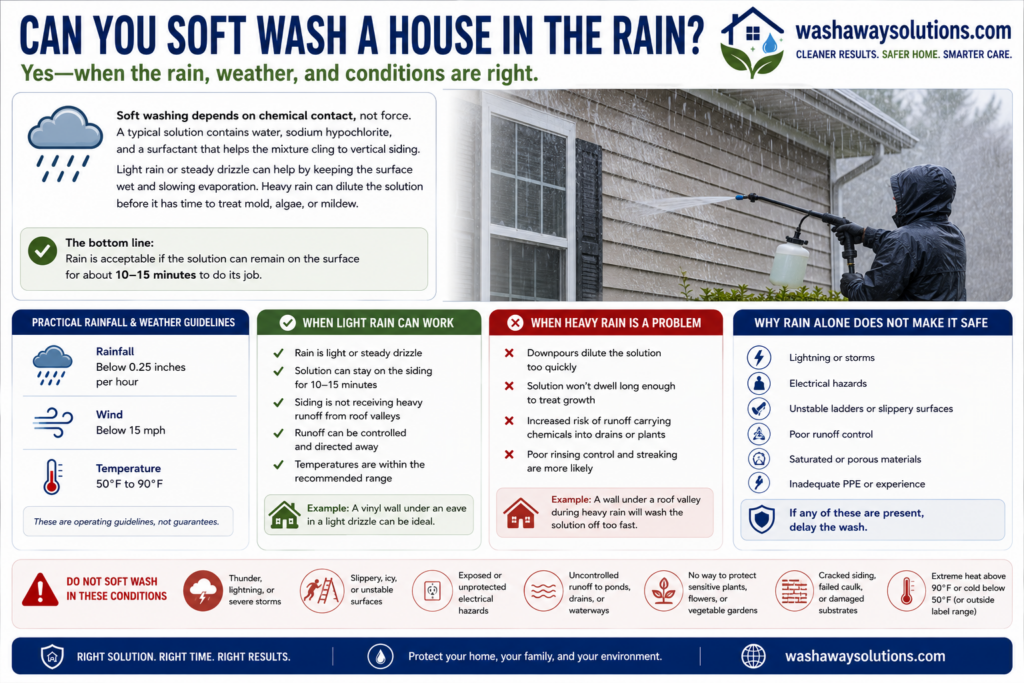
Yes, a house can be soft washed in light rain or steady drizzle if the siding, weather, and runoff conditions remain suitable. The main question is not whether the house is wet, but whether the cleaning solution can remain on the surface for about 10-15 minutes.
Soft washing depends on chemical contact rather than force. A typical solution contains water, sodium hypochlorite, and a surfactant that helps the mixture cling to vertical siding. Light rain may improve contact by keeping the surface wet and slowing evaporation, while a downpour can dilute the solution before it treats mold, algae, or mildew.
A practical benchmark is rainfall below 0.25 inches per hour, wind below 15 mph, and temperatures from 50°F to 90°F. Those figures are operating guidelines, not guarantees. A vinyl wall under a sheltered eave may tolerate drizzle, while a wall beneath a roof valley may receive too much concentrated water.
Rain alone does not make a wash safe. Lightning, unstable ladders, electrical hazards, poor runoff control, or saturated porous materials require a delay.
Why Can Light Rain Help Soft Washing?
Light rain can help soft washing by pre-wetting siding and reducing evaporation from the sodium hypochlorite solution. The benefit applies only when rain does not create visible streams that remove the treatment before the required dwell time.
Dry siding can absorb or spread a cleaning solution unevenly, especially during warm, sunny weather. Pre-wetting reduces that problem. A light drizzle also keeps the surface cool, which may slow evaporation and give the surfactant more time to hold the solution against the wall.
The effect has limits. Rainwater does not strengthen bleach, and rain cannot compensate for an incorrect chemical concentration, blocked runoff, or poor spray coverage. Under a gutter outlet, water may flow fast enough to strip the solution immediately.
Professional operators usually divide the house into manageable sections. Each section receives a controlled application, a 10-15 minute dwell period, and a low-pressure rinse. If the solution disappears within several minutes, the rain intensity or runoff is too high for effective treatment.
How Much Rain Is Too Much for House Washing?
Rain above approximately 0.25 inches per hour is generally too heavy for soft washing a house. Visible sheets of water, rapidly running siding, pooling at the foundation, or water pouring from gutters are stronger cancellation signals than a weather-app percentage.
Rainfall percentage describes the chance of rain, not the amount falling at the worksite. A 90% chance of light drizzle may be workable, while a 30% chance of a short cloudburst may stop the job. The technician should assess actual intensity before and during application.
| Rain condition | Typical effect | Decision |
|---|---|---|
| Trace mist, under 0.05 inches per hour | Minimal dilution, slow evaporation | Usually workable |
| Light drizzle, 0.05-0.15 inches per hour | Pre-wets siding, moderate runoff | Usually workable |
| Steady rain, 0.15-0.25 inches per hour | More dilution and uneven dwell | Use caution |
| Downpour, above 0.25 inches per hour | Flushes treatment from siding | Postpone |
| Roof-valley flow, any measured rate | Concentrated runoff strips chemicals | Protect or postpone that area |
The 0.25-inch threshold is a practical benchmark, not a universal industry rule. Site drainage and wall exposure can make a lower rate unsuitable.
What Weather Conditions Make a Wash Unsafe or Ineffective?
Lightning, wind above 15 mph, surface temperatures below 50°F, and heavy rain can make exterior washing unsafe or ineffective. Thunderstorms require an immediate stoppage, regardless of whether the rain itself is light.
Wind creates two separate problems. Wind-driven rain can soak one elevation while leaving another relatively dry, and low-pressure spray can drift as chemical mist. The drift may reach workers, neighboring property, vehicles, open windows, or sensitive plants.
Cold rain can lower the siding temperature below the useful range for sodium hypochlorite. The solution may remain visible on the wall but work slowly or incompletely. The practical temperature range is 50°F-90°F, with the actual wall temperature more important than the air temperature.
The Occupational Safety and Health Administration advises employers to assess weather hazards and protect workers from falls and electrical risks. For lightning, the National Weather Service uses the rule, “When thunder roars, go indoors,” which is more conservative than judging rainfall alone.
| Condition | Main failure or hazard | Recommended response |
|---|---|---|
| Lightning or thunder | Electrical and elevated-work hazard | Stop immediately |
| Wind over 15 mph | Chemical drift and uneven coverage | Postpone or reassess |
| Surface below 50°F | Slow chemical reaction | Wait for warmer conditions |
| Heavy rain | Premature dilution and runoff | Postpone |
| Strong roof runoff | Localized treatment failure | Isolate or delay area |
Which House Surfaces Can Be Soft Washed While Wet?
Vinyl siding, painted metal, and many brick surfaces usually tolerate a light-rain soft wash better than saturated stucco, EIFS, exposed wood, or cedar shakes. The material, existing moisture, paint condition, and chemical label determine the final decision.
Vinyl siding is relatively predictable because it does not absorb large amounts of water. Brick can also tolerate controlled wet cleaning, although deteriorated mortar, open joints, and water intrusion risks require inspection first. Painted metal needs a check for chalking, oxidation, and loose coatings.
Stucco and Dryvit, also called EIFS, are more difficult after heavy rain because porous areas may already be saturated. Saturated surfaces can prevent consistent chemical uptake and may increase the chance of water entering cracks or vulnerable details.
Exposed wood and cedar shakes require greater control. Rain makes it harder to judge chemical strength, fiber condition, and bleaching progress. A professional may recommend a dry-weather window, lower-strength testing, or a different cleaning method.
| Surface | Light drizzle | Saturated or heavy-rain condition |
|---|---|---|
| Vinyl siding | Usually acceptable | Check runoff and loose panels |
| Brick and sound mortar | Often acceptable | Inspect joints and water paths |
| Painted metal | Test oxidation first | Usually postpone if coating is failing |
| Stucco or EIFS | Case-by-case | Usually postpone |
| Cedar shakes | Prefer dry conditions | Postpone |
| Exposed painted wood | Test a small area | Usually postpone |
Is Soft Washing Safer Than Pressure Washing in Rain?
Soft washing is generally gentler on siding than pressure washing, but rain does not make either method automatically safe. Soft washing uses low pressure and chemical treatment, while pressure washing uses higher mechanical force that can drive water beneath siding, damage paint, or disturb mortar.
Soft washing can be the better cleaning method for vinyl, painted surfaces, and organic growth because sodium hypochlorite attacks the growth instead of relying on force. Pressure washing may be appropriate for durable masonry or hardscape surfaces when an operator controls the pressure and spray distance.
Wet conditions increase risks for both methods. Slippery footing, ladder instability, electrical exposure, and poor visibility affect the operator regardless of equipment. Soft-wash chemicals add drift and runoff concerns that pressure washing alone may not create.
| Comparison point | Soft washing | Pressure washing |
|---|---|---|
| Typical cleaning action | Chemical treatment | Mechanical water force |
| Siding pressure | Low pressure | Higher pressure |
| Rain tolerance | Light rain only | Light rain only |
| Main wet-weather risk | Chemical drift and dilution | Slips, intrusion, surface damage |
| Best use | Mold, algae, mildew on siding | Durable masonry and hard surfaces |
How Should a Technician Soft Wash During Light Rain?
A technician should inspect the weather, protect the site, apply the solution in small sections, verify dwell time, and rinse with controlled low pressure. The technician should stop if rain intensity, wind, runoff, or lightning changes during the job.
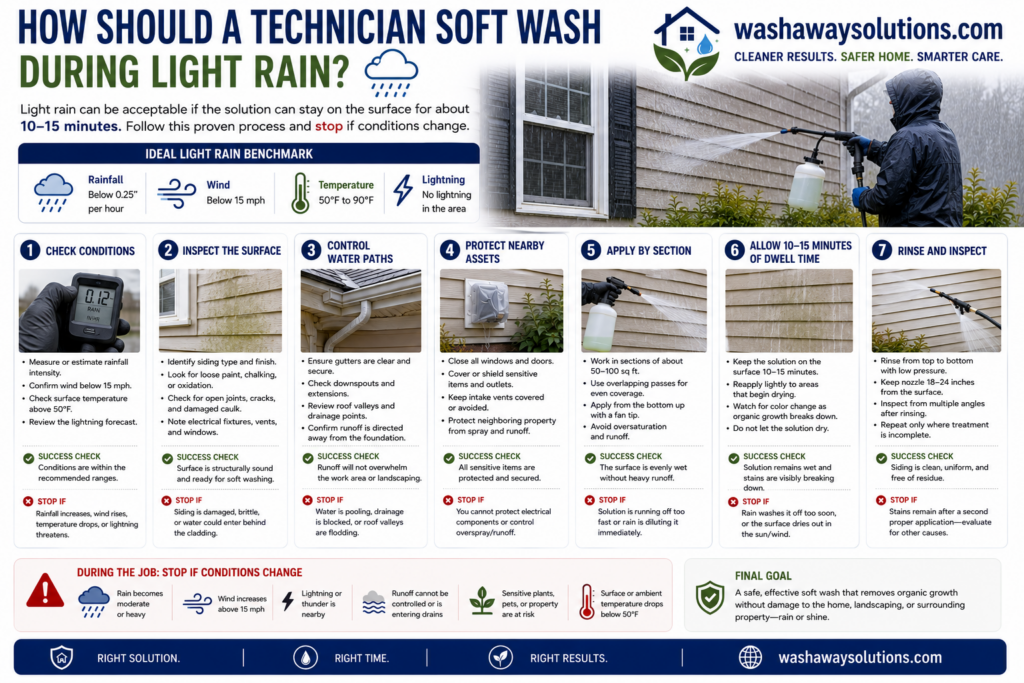
The safest workflow keeps hoses, poles, and electrical equipment organized before the first application.
Should the Chemical Mix Change in Rainy Weather?
The cleaning solution may need a modest surfactant adjustment in light rain, but the sodium hypochlorite concentration should not be changed casually. Product labels, siding type, organic growth severity, and runoff controls determine the correct mix.
Rain dilutes the solution on contact. A professional may increase surfactant by roughly 20%-30% within the product’s labeled use range so the mixture clings longer to vertical siding. More soap is not always better, because excess surfactant can increase residue, runoff, or plant exposure.
Heavy organic growth can require a stronger or repeated treatment, but simply adding more bleach during rain can damage plants, coatings, or materials. Severe black mold and thick green algae often justify postponing the work rather than compensating indefinitely with chemicals.
The technician should use test patches and observe dwell behavior. If the solution runs off immediately, the problem may be rain intensity, wall saturation, nozzle choice, or runoff rather than insufficient chemical strength.
Never mix sodium hypochlorite with acids, ammonia, or other incompatible products. Follow the Safety Data Sheet and the chemical manufacturer’s label.
Will Rain Wash Away the Cleaning Solution Before It Works?
Light drizzle usually will not remove the cleaning solution before it works, provided the surfactant holds the mixture and the surface receives about 10-15 minutes of dwell time. Water visibly streaming down the siding can remove the treatment too soon.
The practical test is simple. After application, the solution should remain distributed across the wall instead of forming clear vertical channels within seconds. A few slow runs are normal on siding, but waterfall-like flow indicates excessive rain or concentrated roof runoff.
Rain can also produce uneven results across elevations. The windward side may receive enough direct rain to dilute the chemical, while a sheltered side retains the solution. The operator should reduce section size, adjust spray timing, or stop when coverage cannot remain consistent.
A second application may correct isolated areas after conditions improve. Repeatedly increasing chemical strength during a downpour usually creates more environmental and surface risk without solving the dwell-time problem.
Can Rain Protect Plants During a Chemical House Wash?
Rain can help dilute incidental chemical residue on plant leaves, but rain does not guarantee plant protection during soft washing. Sodium hypochlorite overspray can still injure foliage, especially when wind carries concentrated droplets directly onto plants.
Pre-wetting plants remains good practice even during rain. Clean water reduces how much solution plant tissue can absorb, while physical barriers and controlled spray patterns reduce direct contact. Rainwater alone may not reach sheltered plants beneath eaves or dense foliage.
The operator should identify sensitive species, vegetable gardens, ponds, and recently planted landscaping before starting. Downspouts and sloped ground can also carry diluted chemicals toward roots or aquatic areas.
Plant protection depends on exposure dose, contact time, species sensitivity, and rinsing. A light shower may reduce residue on an exposed leaf, but a wind-driven spray can deliver a concentrated dose before dilution occurs. Chemical runoff should be controlled rather than allowed to flow freely into storm drains or water features.
Can Wet Siding Hide Missed Algae or Mold?
Yes, wet siding can hide missed algae, mold, and mildew because organic growth often becomes less visible when water darkens or saturates the surface. A professional should verify coverage systematically instead of relying only on a quick visual inspection.
Green algae may appear translucent against wet vinyl, while shadows and rain streaks can resemble untreated growth. The technician should use overlapping spray passes, consistent section boundaries, and inspection from multiple viewing angles.
Some discoloration also remains after the organisms are dead. Soft washing may kill biological growth before rain or rinsing removes all staining, so immediate visual perfection is not always a reliable measure of treatment success.
A useful inspection occurs after the surface has had time to lighten and dry. The operator can compare corners, protected areas, window trim, and sections beneath gutters, where runoff commonly creates inconsistent results.
If missed areas are found, the correct response is targeted retreatment in suitable weather. Aggressive pressure aimed at a remaining stain can damage siding without addressing the underlying organic growth.
What Should You Do If Rain Starts During the Job?
If rain starts during a soft-washing job, stop chemical application, secure equipment, assess lightning and runoff, and decide whether each treated section received adequate dwell time. Do not continue automatically because the house is already wet.
A brief drizzle may allow work to continue after conditions stabilize, especially when the active section still holds solution and no wind or thunder is present. A sudden downpour usually requires rinsing exposed chemicals from vulnerable surfaces, checking runoff, and postponing untreated sections.
The operator should document which elevations were treated and which areas were rinsed early. This prevents duplicate chemical application after rescheduling. Windows, doors, plants, and neighboring surfaces deserve a quick inspection before leaving.
If thunder is audible within 30 seconds of a lightning flash, stop and seek shelter. Resume only after at least 30 minutes have passed since the last thunder, following the National Weather Service lightning safety rule. Wet ladders, poles, hoses, and electrical equipment increase the danger.
How Long Should a House Stay Dry After Soft Washing?
A house does not always need a full dry day after soft washing, but the cleaning solution needs approximately 10-15 minutes of dwell time before controlled rinsing. After rinsing, normal rain usually does not undo a completed treatment.
The important distinction is between treatment time and post-wash drying time. Rain during the first several minutes can dilute the solution before it kills growth. Rain after adequate dwell and rinsing generally has much less effect.
A dry period of 2-4 hours is a practical preference when scheduling allows, particularly for painted wood, sealants, sensitive coatings, and detailed inspection. That period is not a universal chemical requirement. Product labels may specify different contact, rinsing, or re-entry instructions.
Homeowners should ask whether the contractor completed the dwell and rinse stages before the rain began. A house that was sprayed and immediately drenched may need a later inspection or retreatment, while a house that completed the process can usually remain exposed to ordinary rainfall.
Does Washing in Rain Cost More or Less?
Rainy-day house washing usually costs about the same as dry-weather washing, although the final price depends on the contractor’s policy, access, and whether the job must be rescheduled. Saved plant pre-wetting time is often offset by slower application and closer runoff control.
A technician may use extra surfactant, work in smaller sections, perform additional inspections, or spend more time protecting runoff paths. Those tasks can balance the time saved by natural pre-wetting.
| Pricing situation | Typical price effect | Why |
|---|---|---|
| Light drizzle, completed visit | 0% change | Normal labor with minor weather adjustments |
| Moderate rain, slower application | 0%-15% increase | Smaller sections and extra inspection |
| Lightning or downpour cancellation | 0% completed-work charge | Policy determines cancellation terms |
| Return visit after failed conditions | Variable | May involve travel or rescheduling fees |
| Severe growth requiring retreatment | Variable | Extra chemical, labor, and dwell time |
These figures are typical scheduling ranges, not a universal price list. Ask whether the quote includes weather delays, return visits, and partial work before approving the job.
When Should You Postpone a Rainy-Day House Wash?
Postpone the house wash when rain exceeds about 0.25 inches per hour, wind reaches 15 mph, lightning is nearby, surface temperature falls below 50°F, or runoff prevents 10-15 minutes of chemical contact. Postponement is also wise for saturated stucco, EIFS, cedar, and exposed wood.
Severe black mold, thick moss, or heavy algae can require stronger and more controlled treatment than light rain allows. Cold rain creates a second failure risk because the wall may fall below the effective temperature range even when air temperature appears acceptable.
The best decision uses the surface and the forecast together. A sheltered vinyl elevation may be workable during drizzle, while a windward stucco wall beneath a roof valley is a poor candidate during the same hour.
| Situation | Proceed? | Reason |
|---|---|---|
| Vinyl siding, 55°F, drizzle, calm wind | Usually yes | Adequate material and weather conditions |
| Brick, 60°F, light rain, controlled runoff | Often yes | Durable surface with manageable flow |
| Stucco after hours of heavy rain | Usually no | Porous surface may be saturated |
| Cedar shakes during steady rain | No | Moisture obscures chemical and fiber response |
| Any surface during lightning | No | Immediate electrical and fall hazard |
| Thick moss during cold drizzle | Usually no | Dilution and low temperature reduce treatment |
Waiting often produces a more uniform result than forcing a marginal job.
How Often Should a House Be Soft Washed After Rain?
Rain does not determine the soft-washing schedule by itself. Many homes need exterior cleaning about every 1-3 years, but shade, humidity, tree cover, surface type, and local climate can shorten or extend that interval.
Rain can support algae and mildew growth when surfaces remain damp, especially on north-facing walls and areas beneath trees. Rainfall alone does not remove established biological growth because organisms attach to siding and masonry.
A homeowner should inspect the exterior twice each year, preferably in spring and fall. Look for green film, black spotting, streaks beneath gutters, and growth on shaded elevations. Early treatment is usually easier to control than thick moss or deeply embedded staining.
| Home condition | Typical cleaning interval | Inspection priority |
|---|---|---|
| Sunny vinyl with little tree cover | 2-3 years | Annual check |
| Shaded siding in humid climate | 1-2 years | Spring and fall |
| Heavy tree cover near walls | 1 year | Inspect after wet seasons |
| Brick with recurring algae | 1-2 years | Check shaded mortar |
| Cedar or painted wood | Condition-based | Inspect coating and fibers |
These intervals are practical planning ranges, not guarantees. Correct drainage and trimmed vegetation can reduce recurring growth.
What Is the Practical Rule for Deciding?
Proceed with a light-rain soft wash only when the surface can hold the solution for 10-15 minutes, the temperature remains above 50°F, wind stays below 15 mph, and no lightning threatens the site. Postpone when rain creates streams, runoff concentrates, or the material is porous and saturated.
The most reliable rule is to judge what the water is doing on the wall, not what the forecast icon displays. A gentle mist on sound vinyl can be manageable, while the same forecast during a roof-valley discharge can ruin treatment.
Professionals also prioritize safety over completion. No cleaning result justifies working through thunder, unstable access equipment, chemical drift, or uncontrolled runoff.
The Bottom Line
A house can be soft washed in light rain when temperature, wind, material, runoff, and dwell time remain controlled. Use 0.25 inches per hour, 15 mph wind, 50°F minimum surface temperature, and 10-15 minutes of dwell time as practical benchmarks. Postpone work during lightning, heavy rain, cold conditions, saturated stucco, or exposed-wood treatment.