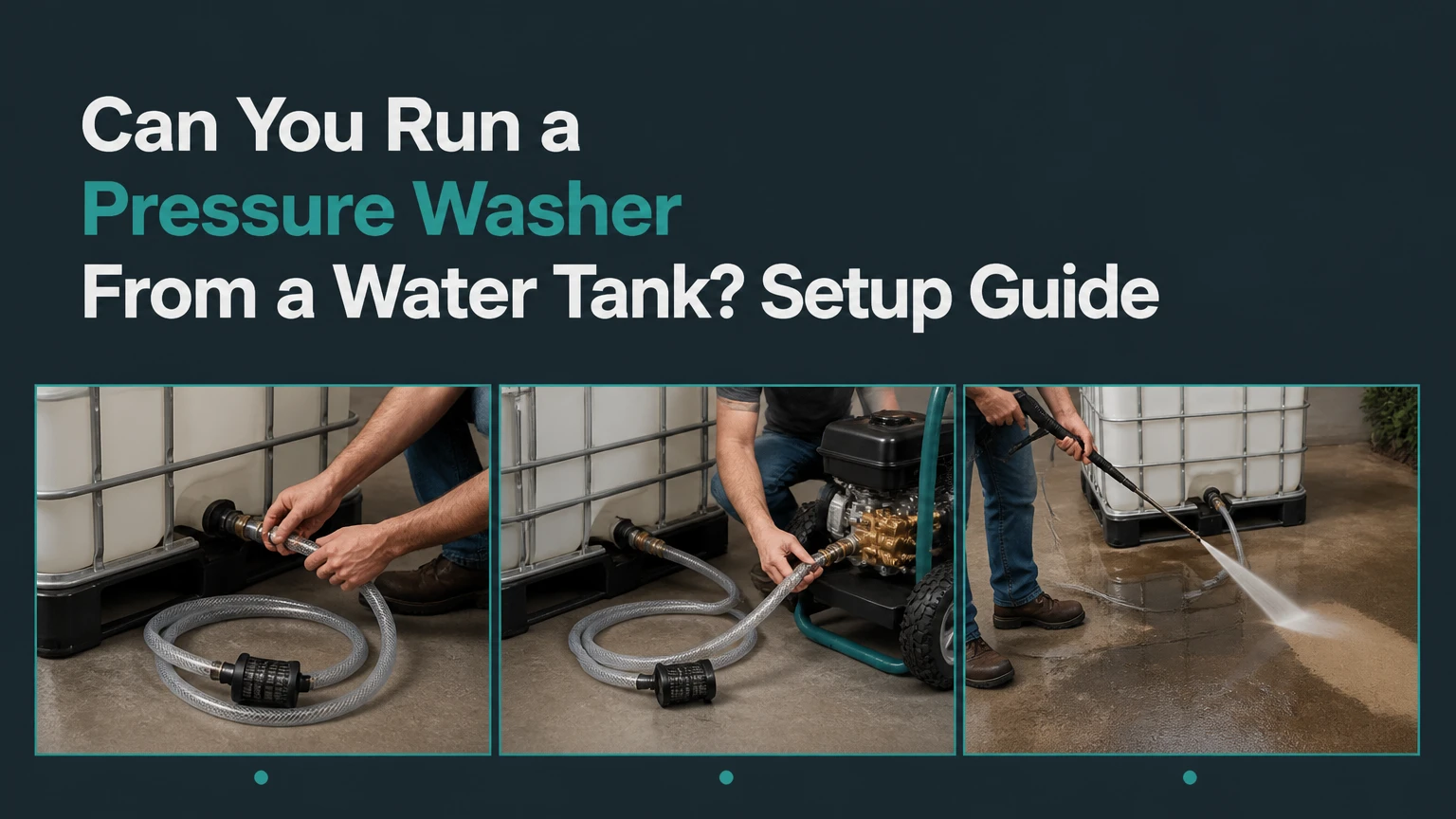
Yes, you can run a pressure washer from a water tank if the machine receives enough water at its inlet. A pressure washer may work from gravity, an internal suction system, or an external booster pump, but the owner’s manual determines the acceptable supply method. Never operate the washer dry or assume every model can lift water from a ground-level tank.
Key Facts at a Glance
- A water tank can supply a pressure washer only when the inlet flow meets the machine’s specified requirement.
- Gravity produces about 0.1 bar of static pressure for every metre of water-level difference.
- A 3/4-inch reinforced suction hose usually performs better than a thin 1/2-inch garden hose.
- The tank outlet, hose, filter, and fittings must deliver water continuously without drawing air.
- A booster pump is needed when gravity cannot provide the required inlet flow or the washer is not approved for suction feed.
- The washer must be fully primed before the motor or petrol engine starts.
Can You Run a Pressure Washer From a Water Tank?
A pressure washer can run from a water tank when its pump design accepts low-pressure or non-mains water and the tank provides sufficient flow. The safest arrangement is a manufacturer-approved suction kit or a gravity-fed tank with a large outlet, clean filter, short hose, and reliable priming procedure.
A standard tap supplies pressure because the water network pushes water through the hose. A tank does not automatically do that. The washer must receive water from the weight of an elevated tank, its own suction capability, or a separate pump.
The important distinction is between pressure and flow. A pressure washer creates high outlet pressure internally, but its inlet still needs a steady volume of water. If the inlet flow falls below the pump’s demand, the machine can pulse, lose pressure, draw air, overheat, or suffer premature valve and seal damage.
What Does the Pressure Washer Manual Need to Say?
Look for wording such as “self-priming,” “suction operation,” “alternative water source,” or a specified maximum suction height. The manual may instead require a pressurized supply with a minimum inlet pressure, a minimum litres-per-minute flow rate, or a particular suction accessory.
Do not treat a brass pump manifold, triplex pump, or petrol engine as proof of tank compatibility. Pump construction can improve durability, but it does not override inlet restrictions, valve design, priming requirements, or the manufacturer’s warranty conditions.
How Does a Pressure Washer Pull Water From a Tank?
A tank-fed pressure washer uses either static head, suction from the washer pump, or an external supply pump to move water into its inlet manifold. The high-pressure pump then compresses the incoming water and sends it through the spray nozzle, where the small orifice converts flow into a fast jet.
The process has four stages:
- Water leaves the reservoir through its outlet or pickup tube.
- A reinforced hose carries water through a sediment filter and possibly a foot valve.
- Gravity or suction fills the pressure washer’s inlet chamber.
- The high-pressure pump sends that water to the trigger gun and nozzle.
A foot valve keeps the pickup hose full when the tank level is below the washer. The valve must remain submerged and clean. Any air leak on the suction side can admit air without producing an obvious water leak, because the line may be under negative pressure.
Why Is Flow More Important Than Tank Pressure?
The washer’s pump needs a continuous volume of water, not merely a high pressure reading at the tank. A wide-open 1/2-inch hose may show water pressure at rest but still deliver too little water when the pressure washer is operating.
Find the washer’s rated water consumption in litres per minute. Then test the tank system under operating conditions. If a 10 L/min machine receives only 6 L/min, adding a finer filter will not solve the shortage, because the filter may increase resistance and reduce flow further.
A practical design buffer of approximately 20% is useful. For a washer using 10 L/min, aim for at least 12 L/min of dependable inlet delivery. The 20% figure is a field-design margin, not a universal requirement from every manufacturer.
Which Pressure Washers Work With a Water Tank?
Pressure washers fall into three practical groups: approved suction-capable models, gravity-fed models, and machines that require a pressurized inlet. The classification must be confirmed against the exact model because similar-looking electric washers can have different inlet requirements.
| Washer type | Typical tank arrangement | Typical limitation | Best verification |
|---|---|---|---|
| Suction-approved electric washer | Ground-level tank, 3/4-inch suction hose | Often limited to about 1-1.5 m lift | Manual’s suction-height specification |
| Gravity-fed electric washer | Tank outlet above washer inlet | Needs continuous positive flow | Bucket flow test at washer inlet |
| Mains-dependent electric washer | Elevated tank or booster pump | Static ground-level tank may fail | Minimum inlet pressure and flow |
| Petrol washer with triplex pump | IBC tote or vehicle tank | Priming and suction limits vary | Pump manual and approved accessories |
| Compact cordless washer | Integrated or external low-pressure tank | Lower flow and shorter runtime | Battery model’s water-source instructions |
Are Self-Priming Pressure Washers Always Suitable?
A self-priming pressure washer is more likely to draw from a tank, but the label does not guarantee a particular lift height, hose length, or water quality. Self-priming pumps can lose their prime when the suction line leaks, the filter blocks, the tank pickup rises above the water, or the hose has excessive resistance.
A machine rated for a 1-metre lift may not work reliably with a 1.5-metre lift, a 5-metre hose, two quick-connectors, and a restrictive filter. Suction performance decreases as the total resistance increases.
Can a Standard Electric Pressure Washer Use Gravity Feed?
A standard electric pressure washer may work from gravity when the tank sits high enough and the outlet delivers the required flow. A 1-metre water-level difference creates approximately 0.1 bar of static pressure before hose, filter, valve, and fitting losses.
That pressure is modest. A tank elevated 0.5 metre above the washer produces only about 0.05 bar of static head, so a narrow hose or dirty filter can consume most of the available pressure. Elevation helps, but it does not make a weak supply strong.
What Equipment Do You Need?
A dependable tank-fed system needs a suitable reservoir, large outlet, reinforced feed hose, sediment filtration, airtight connections, and a way to keep the pickup submerged. A booster pump adds pressure when gravity or washer suction cannot maintain the required flow.
| Component | Practical specification | Typical quantity or size | Why it matters |
|---|---|---|---|
| Water tank | Clean, stable reservoir | 100-500 L for mobile work | Provides usable runtime without frequent refilling |
| Tank outlet | Full-bore valve | 3/4-inch minimum where compatible | Reduces restriction at the source |
| Feed hose | Reinforced suction hose | 3/4-inch internal diameter, under 3 m preferred | Resists collapse and limits inlet losses |
| Sediment filter | Washable inline filter | 50-100 mesh typical | Stops grit, algae, and tank debris entering the pump |
| Foot valve | Non-return pickup valve | 1 per suction line | Keeps the hose flooded during pauses |
| Booster pump | Regulated supply pump | Sized above washer demand | Maintains inlet flow when static head is inadequate |
Do not use a household drinking-water hose as a suction line unless the manufacturer specifically approves it. Thin garden hose can flatten under vacuum, while ordinary push-fit connectors can admit air at their joints.
Does Tank Water Need a Filter?
Tank water should pass through a suitable sediment filter before entering a pressure washer. Rainwater tanks and open containers can hold grit, algae, leaves, rust, plastic fragments, and insects that may damage inlet screens, check valves, seals, or the high-pressure nozzle.
A filter with a finer mesh is not automatically better. A 100-mesh element can restrict flow faster than a coarse screen when the tank contains sediment. Install a filter large enough for the washer’s flow, keep a spare element available, and clean the filter after the first few uses because new systems often release hose and tank debris.
How Should You Set Up a Pressure Washer From a Tank?
Set up the tank-fed pressure washer by confirming compatibility, measuring flow, flooding the supply hose, purging air, and starting the washer only after a steady water stream appears. A basic arrangement takes about 15-30 minutes when the tank outlet and fittings already match.
Before You Start
| Requirement | Typical value |
|---|---|
| Setup time | 15-30 minutes |
| Difficulty | Moderate for gravity feed, higher with booster pump |
| Feed hose | 3/4-inch reinforced suction hose |
| Useful flow margin | Approximately 20% above washer demand |
| Tank elevation | 0.5-1 m above inlet for gravity assistance |
| Filter | Washable sediment filter, commonly 50-100 mesh |
| Safety prerequisite | Electrical supply kept dry and protected |
Check the washer manual, identify the rated inlet flow, inspect the tank for contamination, and confirm that the tank contains enough water for the job. A 200-litre tank feeding a 10 L/min washer provides about 20 minutes of continuous trigger time before allowing for unusable water and interruptions.
Step 1: Position the Tank
Place the tank close to the pressure washer and keep the hose as short and straight as practical. For a gravity-fed system, raise the tank so the water surface is at least 0.5 metre above the washer inlet, while ensuring the stand can support the full tank weight.
Water weighs approximately 1 kilogram per litre. A 200-litre tank therefore adds about 200 kilograms before the tank, stand, and equipment are included. Never improvise an unstable platform for an IBC tote or vehicle tank.
You will know it worked when: the tank outlet sits above the washer inlet and water can flow without a sharp hose bend.
Common mistake: raising only the tank outlet while the water surface remains nearly level with the washer. Static head depends on the water surface, not merely the valve position.
Step 2: Install the Filter and Foot Valve
Fit the sediment filter where it can be inspected and cleaned, usually between the tank outlet or pickup line and the pressure washer inlet. If the pickup draws from the top of a tank, attach a foot valve and strainer, keeping it several centimetres above the bottom so it does not ingest settled sludge.
Use thread sealant only where the fitting manufacturer permits it. Loose tape strands can enter the pump, and an overtightened plastic fitting can split.
You will know it worked when: the filter bowl fills with water and no joint draws visible bubbles while the line is flowing.
Common mistake: placing a small domestic filter in a high-flow line. A restrictive cartridge can starve the pump even when the tank is full.
Step 3: Connect the Suction Hose
Connect a short, reinforced 3/4-inch hose with airtight clamps or properly sealed threaded fittings. Avoid unnecessary elbows, reducers, long runs, and ordinary quick-connects on the suction side, because each restriction increases the chance of air entry or pump starvation.
A 1/2-inch hose may work on a low-flow compact washer in a short gravity-fed arrangement, but it is a poor default for suction service. Follow the inlet diameter specified by the washer and suction-kit manufacturer.
You will know it worked when: the hose remains round under suction and water reaches the inlet without pulsing.
Common mistake: using a thin hose that collapses internally. The outside may look normal while the pump receives almost no water.
Step 4: Flood and Prime the Supply Line
Open the tank valve and fill the hose with water before connecting it to the washer. Keep the pickup valve submerged, remove high loops that trap air, and allow gravity to push water through the complete line where possible.
For a self-priming model, connect the flooded hose according to the manual. For a gravity-fed model, the line must remain full and the tank valve must be fully open.
You will know it worked when: water exits the washer inlet or trigger gun in a continuous stream without sputtering.
Common mistake: relying on the pump to remove a large air pocket. Air in the inlet line can prevent the pump from establishing a stable water seal.
Step 5: Purge the Pressure Washer
Disconnect the spray lance or nozzle and hold the trigger open with the washer switched off. Allow water to pass through the gun until the stream remains steady, commonly for 30-60 seconds in a small system.
This step removes air from the inlet, pump chamber, hose, and gun. It also gives you an early indication that the tank can deliver water before the motor applies full demand.
You will know it worked when: the gun produces a smooth, unpressurized stream with no air bursts.
Common mistake: installing the lance before purging. The nozzle can restrict the flow and conceal an airlock.
Step 6: Start the Washer With the Trigger Open
Keep the trigger open while switching on an electric washer or starting a petrol unit, following the manufacturer’s start procedure. Let the machine stabilize before releasing the trigger, and stop immediately if the pump chatters, the spray pulses severely, or the motor runs without a continuous water supply.
You will know it worked when: the washer produces a consistent spray and the inlet hose does not collapse.
Common mistake: repeatedly cycling a starved pump in the hope that it will eventually prime. Stop, correct the supply, and purge the system again.
How Much Water Does a Tank-Fed Washer Need?
Tank size depends on the washer’s litres-per-minute consumption and the amount of trigger time required. A 10 L/min washer uses approximately 100 litres in 10 minutes of continuous spraying, although real cleaning sessions usually include pauses for moving, brushing, and detergent application.
| Washer consumption | 100 L usable water | 200 L usable water | 500 L usable water |
|---|---|---|---|
| 5 L/min | 20 minutes | 40 minutes | 100 minutes |
| 8 L/min | 12.5 minutes | 25 minutes | 62.5 minutes |
| 10 L/min | 10 minutes | 20 minutes | 50 minutes |
| 15 L/min | 6.7 minutes | 13.3 minutes | 33.3 minutes |
Treat these as continuous-trigger estimates. A tank’s stated capacity is not always fully usable because the pickup must remain submerged, sediment should remain undisturbed, and a vehicle tank may reserve water to prevent air entering during movement.
A mobile detailer using an 8 L/min washer may complete several cars with 200-500 litres, while a high-flow commercial unit can consume 500 litres rapidly during patio or fleet cleaning.
Do You Need a Booster Pump?
A booster pump is needed when the pressure washer cannot self-prime and gravity does not deliver its required inlet flow. A booster pump is also useful when the tank is below the washer, the supply hose is long, the filter is restrictive, or the washer’s manual specifies positive inlet pressure.
Use a pump with a flow rating above the washer’s consumption and a regulated outlet within the washer’s permitted inlet-pressure range. Do not assume a pump rated at 10 L/min will reliably supply a washer that also needs 10 L/min, because hose losses, voltage variation, filter loading, and pump curves reduce real delivery.
| Configuration | Typical usable lift | External power | Suitable situation | Main risk |
|---|---|---|---|---|
| Elevated gravity tank | 0.5-2 m of head | None | Short hose and low-demand washer | Insufficient flow |
| Washer suction system | About 1-1.5 m typical | Washer power only | Approved self-priming machine | Air leaks and loss of prime |
| 12 V diaphragm pump | Tank-dependent | Vehicle battery | Mobile detailing | Battery drain and dry running |
| 230 V booster pump | Tank-dependent | Mains or generator | Fixed washing station | Electrical exposure near water |
| Petrol transfer pump | Tank-dependent | Petrol engine | Remote commercial work | Fuel, exhaust, and overpressure |
Install dry-run protection or a low-level shutoff where possible. A booster pump that runs after the tank empties can overheat quickly, and excess inlet pressure can damage a pressure washer that is designed for low-pressure supply.
Which Tank Setup Is Best for Different Jobs?
The best tank arrangement depends on the washer’s inlet specification, the cleaning location, and the required water volume. A raised water butt suits occasional domestic cleaning, while mobile professionals usually need a baffled tank and regulated pump.
| Use case | Tank recommendation | Supply method | Typical capacity | Practical verdict |
|---|---|---|---|---|
| Occasional car washing | Covered water butt | Gravity or approved suction | 100-200 L | Lowest-cost option |
| Patio cleaning at home | Stable tank near washer | Gravity with measured flow | 200-500 L | Works if inlet flow passes test |
| Mobile vehicle detailing | Baffled van tank | 12 V regulated pump | 200-500 L | Most predictable arrangement |
| Remote farm or site work | IBC tote or steel tank | Approved suction or booster | 500-1,000 L | Requires filtration and safe transport |
| High-flow commercial washing | Large baffled tank | Dedicated supply pump | 500-2,000 L | Better than relying on gravity |
Can You Use a Water Butt?
A pressure washer can use a water butt when the butt is clean, the outlet is large enough, and the washer accepts gravity or suction feed. Many water butts have a low, narrow tap that restricts flow, so the container itself may hold enough water while the outlet cannot deliver enough water.
Rainwater also carries more sediment and biological material than treated mains water. Use a covered butt, keep the pickup above settled debris, and clean the filter frequently. Do not use stagnant water for a hot-water pressure washer unless the manufacturer approves it, because warm conditions can increase scaling and biological growth.
Can You Use an IBC Tote?
An IBC tote can supply a pressure washer effectively because its lower outlet and 1,000-litre capacity support long jobs. The tote must sit on a level surface, remain structurally sound, and use a clean valve, suitable filter, and hose that matches the washer’s inlet.
An IBC tote is heavy when full and must not be placed on an improvised platform. For vehicle work, use a baffled tank designed for transport or secure the IBC according to applicable load-safety requirements.
How Much Does a Tank-Fed Setup Cost?
A basic gravity-fed setup typically costs about £30-£100 or $40-$130 for a suitable hose, filter, fittings, and foot valve, excluding the tank and pressure washer. A mobile booster-pump system commonly costs about £100-£400 or $130-$520, depending on pump controls, tank hardware, and electrical protection.
| Setup | Typical equipment cost | Setup time | Best use | Ongoing task |
|---|---|---|---|---|
| Basic gravity feed | £30-£100 | 15-30 minutes | Home water butt | Filter cleaning |
| Suction kit | £50-£150 | 20-40 minutes | Approved self-priming washer | Prime inspection |
| 12 V booster system | £100-£300 | 1-3 hours | Mobile detailing | Battery and pump checks |
| 230 V booster system | £150-£400 | 1-3 hours | Fixed wash area | Electrical and filter checks |
| Commercial tank system | £500-£2,000+ | Several hours | Fleet or site cleaning | Tank sanitation and servicing |
Prices vary by country, hose diameter, tank size, and pump brand. A cheap pump can cost more than it saves if it lacks dry-run protection or cannot maintain the required flow.
Why Does a Pressure Washer Pulse From a Tank?
A pressure washer usually pulses from a tank because air enters the inlet line, the supply hose collapses, the filter restricts flow, or the tank cannot deliver the washer’s required litres per minute. Pulsing is a supply warning, not a normal characteristic of tank operation.
Check the system in this order:
- Confirm the tank pickup remains below the water surface.
- Inspect every suction-side connection for air entry.
- Remove kinks and replace a soft or collapsing hose.
- Clean the filter and tank outlet.
- Measure the inlet flow with a bucket.
- Purge the pump again with the lance removed.
- Inspect the washer’s inlet screen and nozzle for blockage.
A pressure washer that pulses on mains water but runs smoothly from a tank may have a tank restriction. A washer that pulses from both supplies may have worn inlet valves, a blocked nozzle, a damaged unloader valve, or an internal pump fault.
Why Does the Washer Run Without Pressure?
A tank-fed pressure washer can run without pressure when the pump is airlocked, the water supply is insufficient, the nozzle is blocked, or the unloader system is malfunctioning. Turn off the machine, restore a steady inlet stream, purge the gun, and test again before examining internal components.
Remove the high-pressure nozzle and operate the trigger with the machine off. A steady low-pressure stream confirms that water is reaching the gun. If no water exits, inspect the tank valve, filter, hose, foot valve, and inlet screen.
If water flows steadily but pressure remains low, clean the nozzle and check for leaks in the high-pressure hose. Continued low pressure after those checks requires model-specific service information, especially on petrol machines with adjustable unloaders.
What Happens if the Washer Runs Dry?
Running a pressure washer dry can overheat the pump and damage seals, plungers, valves, or thermal components. Water lubricates and cools parts of the pump, so a machine should be stopped immediately when the tank empties, the inlet hose collapses, or the spray becomes intermittent.
Do not use the trigger gun as a substitute for a low-water cutoff. The trigger can be released while the booster pump continues running, and a small tank can empty faster than the operator expects. Fit a float switch, pressure switch, or dry-run controller when the setup will operate unattended.
Expert Insight: A Larger Tank Does Not Fix a Small Outlet
A 500-litre tank with a restrictive 1/2-inch tap can supply less water than a 100-litre tank with a full-bore 3/4-inch outlet. Tank capacity determines runtime, while outlet geometry and hose resistance determine whether the pump is fed correctly.
Expert Insight: Suction Lines Must Be Airtight, Not Merely Watertight
A suction connection can admit air without leaking water outward. Threaded fittings, proper clamps, sound hose tails, and minimal joints matter more on the inlet side than decorative quick-connect convenience.
Expert Insight: Filter Location Changes the Failure Pattern
A filter before the pump protects the washer, but a small filter can become the main restriction. A transparent, correctly sized filter makes starvation visible because the bowl may show bubbles or an unexpectedly low water level during operation.
Is Tank Water Safe for Every Pressure Washer?
Tank water is suitable only when its cleanliness and temperature fall within the pressure washer manufacturer’s requirements. Dirt, algae, hard-water scale, salt, detergents, and contaminated industrial water can damage the pump or leave deposits in the nozzle.
Use clean water for domestic and vehicle cleaning. Avoid seawater, chemically contaminated runoff, water containing abrasive sediment, and untreated water from a stream unless the equipment is specifically designed for that source and the water has been filtered appropriately.
Cold weather creates another risk. Water left in the pump, filter, or hose can freeze and crack components, so drain the system after use when temperatures may fall below freezing.
The Bottom Line
Can you run a pressure washer from a water tank? Yes, provided the exact pressure washer accepts tank water and the supply delivers its required flow continuously. Use a short 3/4-inch reinforced hose, clean filtration, airtight connections, thorough priming, and a measured flow test rather than relying on tank size alone.
Choose gravity feed for a short, elevated domestic setup. Choose an approved suction system for a ground-level tank. Choose a regulated booster pump for mobile work, long hoses, low tanks, or washers that require positive inlet pressure. Stop immediately if the machine pulses, loses pressure, or shows signs of water starvation.
Frequently Asked Questions
Can I run a pressure washer from a rainwater tank?
You can run a pressure washer from a rainwater tank if the washer accepts non-mains water and the tank system supplies adequate flow. Use a covered tank, sediment filter, clean pickup, and suitable hose. Rainwater tanks often contain grit and algae, so inspect and clean the filter more frequently than with treated mains water.
How high should a water tank be above a pressure washer?
A tank should usually place its water surface at least 0.5-1 metre above the pressure washer inlet for gravity assistance, although the manual may require more. Every metre of elevation produces only about 0.1 bar of static pressure, so height cannot compensate for a blocked filter or undersized hose.
Can I connect a pressure washer directly to an IBC tank?
You can connect a compatible pressure washer to an IBC tank through the correct valve, filter, and reinforced hose. Verify the washer’s flow requirement first, because a full IBC does not guarantee sufficient delivery. Keep the tote level and secure, and avoid lifting a full 1,000-litre container on an improvised stand.
What is the best hose for a pressure washer water tank?
A short, reinforced suction hose with approximately 3/4-inch internal diameter is the safest general choice for a tank-fed pressure washer. The exact diameter should match the washer and suction-kit instructions. Replace any hose that flattens, kinks, becomes brittle, or allows air into the inlet line.
Can a Karcher pressure washer use water from a tank?
Some Kärcher pressure washers support alternative water sources, while other models require a pressurized tap supply. Check the exact model’s manual or Kärcher support documentation for suction height, flow, hose, and accessory requirements. Do not generalize from one Kärcher model to another.
How do I test whether my tank supplies enough water?
Disconnect the pressure washer, open the tank system fully, and collect outlet water in a marked bucket for a timed interval. For example, 10 litres collected in 30 seconds equals 20 L/min. Repeat the test through the filter and complete hose, because the assembled system matters more than the tank outlet alone.