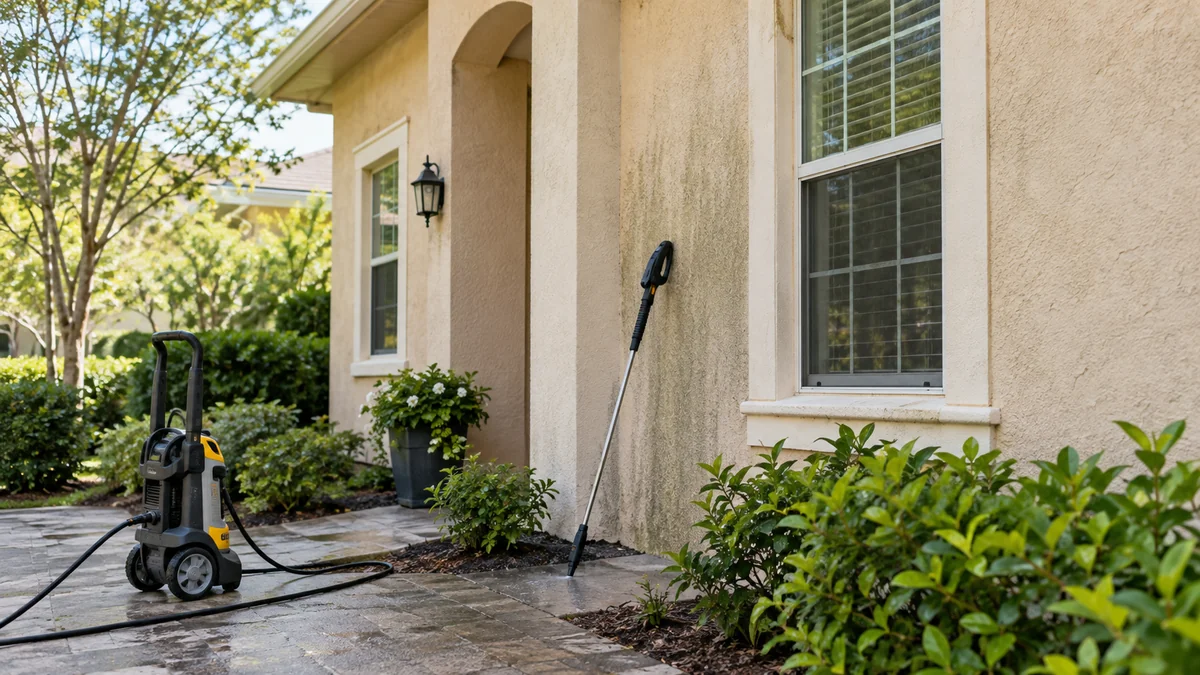
Yes, you can pressure wash stucco safely, but the safe method is controlled soft washing rather than high-pressure blasting. Use a compatible cleaning solution at low pressure, rinse with broad spray coverage, avoid open cracks and joints, and confirm the stucco system before choosing equipment. EIFS and damaged stucco require especially conservative treatment.
Key Facts at a Glance
- Stucco cleaning is safest when detergent does most of the work and water pressure provides only a gentle rinse.
- Traditional cement stucco may tolerate a carefully tested rinse around 500-1,200 PSI, but manufacturer instructions and surface condition control the limit.
- EIFS, painted stucco, and elastomeric coatings often require substantially less pressure than bare traditional stucco.
- A 40-degree fan tip, an 18-24-inch working distance, and a 45-degree spray angle reduce concentrated impact.
- Open cracks, failed sealant, exposed lath, loose aggregate, efflorescence, and damaged flashing should be repaired or assessed before washing.
- Typical professional stucco soft-washing costs about $0.20-$0.30 per square foot, with access, repairs, chemistry, and location affecting the total.
What Does Safe Stucco Cleaning Actually Mean?
Safe stucco cleaning means removing soil, algae, mildew, and atmospheric staining without eroding the finish, opening cracks, lifting paint, or forcing water behind the wall assembly. The process normally combines a low-pressure detergent application with a controlled rinse, so chemical dwell time replaces much of the mechanical force.
Traditional stucco is cementitious and relatively hard, but hardness does not make the wall waterproof. Stucco systems include finish coats, control joints, sealants, flashing, windows, doors, and drainage details that can admit water when sprayed incorrectly.
Pressure-washing equipment is therefore only one part of the risk. A high-flow machine can push water into a failed sealant joint even when the gauge shows a modest pressure. Spray distance, nozzle angle, flow rate, wand movement, surface damage, and operator technique all change the force reaching the wall.
A practical rule is to clean the least aggressively effective way. If a garden hose, pump sprayer, soft brush, and compatible detergent remove the stain, a pressure washer adds unnecessary risk.
What Pressure Is Safe for Stucco?
There is no universal PSI limit for every stucco wall. A conservative starting range is approximately 200-500 PSI for EIFS or delicate coatings and 500-1,200 PSI for sound traditional stucco, but the correct setting must be established with the system manufacturer, a test patch, and the wall’s condition.
The PSI printed on a pressure-washer label is usually maximum pump pressure, not necessarily pressure at the surface. A narrow nozzle concentrates force, while greater distance spreads the spray. A 40-degree tip at 24 inches can be safer than a narrower tip at a lower machine setting.
| Surface or system | Conservative starting point | Preferred rinse method | Main risk |
|---|---|---|---|
| EIFS or synthetic stucco | 200-500 PSI | Garden hose or low-pressure soft wash | Puncturing finish or wetting insulation |
| Sound traditional stucco | 500-800 PSI | 40-degree fan, test patch first | Erosion and crack enlargement |
| Hard, sound cement stucco | 800-1,200 PSI maximum starting range | Broad fan, moving wand | Finish loss and water entry |
| Painted or elastomeric stucco | 300-600 PSI | Low-pressure rinse | Peeling, blistering, chalking |
| Rock-dash or bottle-dash | 0-300 PSI, preferably hose pressure | Garden hose and soft nylon brush | Dislodged aggregate |
These figures are working ranges, not guarantees. Some manufacturers prohibit pressure washing on specific finishes, and an older wall with hidden moisture damage may fail at pressure that a newer wall tolerates.
How Can You Identify the Stucco System?
A knuckle tap can provide a clue, but it cannot reliably identify EIFS. A hollow sound may suggest foam-backed construction, while a solid sound may suggest cement stucco, yet wall assemblies vary and concealed transitions can produce misleading results.
Look for building records, original product information, visible edge details, drainage openings, window trim, and a professional inspection. Do not drill through the finish merely to identify the system.
| Identification clue | Possible indication | Limitation |
|---|---|---|
| Hollow, drum-like sound | EIFS or a cavity behind the finish | Interior framing can also sound hollow |
| Solid, hard response | Cement-based stucco | Thick coatings can alter the sound |
| Visible mesh or foam at damage | EIFS components | Damage should not be enlarged for testing |
| Pebbles embedded in finish | Dash coat | Aggregate may loosen during cleaning |
| Thick paint film or chalk | Coated stucco | Coating manufacturer controls cleaning limits |
How Do You Soft Wash Stucco?
Soft washing stucco takes roughly 1.5-4 hours for a professional house wash and longer for a careful DIY project. The sequence is inspection, protection, detergent application, controlled dwell, gentle rinsing, runoff management, and a final damage inspection.
Step 1: Inspect and Photograph the Wall
Walk the entire elevation before connecting the machine. Mark cracks, loose areas, failed caulk, peeling paint, efflorescence, exposed metal, stained windowsills, vents, electrical fixtures, and locations where stucco meets roofing or paving.
Cracks wider than about 1/16 inch deserve repair or professional evaluation before washing, although width alone does not determine severity. Stair-step cracking, recurring cracks, bulging, soft areas, rust marks, or interior dampness can indicate movement or water intrusion.
Success checkpoint: The wall has no unaddressed opening that could receive a directed stream.
Common mistake: Treating a leaking joint as a cleaning problem.
Step 2: Protect Fixtures and Landscaping
Turn off power to exterior circuits where practical, protect outlets and light fixtures with appropriate covers, and shield HVAC electrical components from direct spray. Do not seal a hot electrical device inside an airtight plastic enclosure that can trap heat or moisture.
Pre-wet plants, grass, and shrubs with clean water. Move portable furniture, grills, and decorations away from the work area. Keep detergent and rinse water away from ponds, storm drains, wells, and edible gardens.
Success checkpoint: Plants are saturated with clean water and runoff has a controlled path.
Common mistake: Covering vegetation without first wetting it.
Step 3: Prepare a Compatible Cleaning Solution
For organic staining, professionals commonly use diluted sodium hypochlorite with a compatible surfactant. A typical applied concentration may fall around 0.5%-2%, but the product label, stain severity, surface coating, temperature, and local runoff rules determine the appropriate mixture.
Never mix bleach with acids, ammonia, vinegar, or other cleaners. Rust removers are commonly acidic, so they require a separate application, complete rinsing, and label-specific protective equipment.
Apply the mildest solution likely to work. Stronger is not automatically better because concentrated chemistry can damage plants, metals, coatings, seals, and nearby surfaces.
Success checkpoint: The solution wets the surface evenly without rapid runoff or damage to adjacent materials.
Common mistake: Using household bleach at full strength or mixing products in the same container.
Step 4: Apply Detergent from Bottom to Top
Apply the cleaner with a low-pressure chemical injector, pump sprayer, or dedicated soft-wash system. Work in manageable sections, usually 50-100 square feet, and begin at the bottom so dirty runoff does not streak across dry areas.
Allow approximately 5-15 minutes of dwell time, adjusting for temperature and label instructions. Keep the wall wet. If the solution begins drying, lightly reapply or shorten the section.
Success checkpoint: Organic growth loses its color and releases without aggressive scrubbing.
Common mistake: Applying too much solution to a large wall and allowing the upper portion to dry.
Step 5: Rinse from Top to Bottom
Use the widest practical fan, commonly a 40-degree tip, and start with the lowest effective pressure. Keep the nozzle at least 18-24 inches from the wall, hold the wand at about 45 degrees, and keep it moving parallel to the surface.
Do not aim upward beneath window sills, trim, flashing, weep screeds, or roof edges. Rinse from the top down with overlapping passes. Stop if the finish changes texture, aggregate moves, paint lifts, or water appears inside.
Success checkpoint: No detergent film remains, and the surface has an even appearance when wet.
Common mistake: Holding the wand stationary to remove one stubborn mark.
Step 6: Rinse Plants and Inspect the Drying Wall
Rinse vegetation, windows, metal fixtures, paving, and other nearby surfaces with clean water. Collect or divert concentrated runoff according to local requirements.
Allow at least 24-48 hours of drying before painting or sealing, and longer if weather is cool, humid, or cloudy. A coating manufacturer may require a specific moisture reading rather than a fixed waiting period.
Success checkpoint: The wall dries evenly without new bubbling, damp patches, powder, or staining.
Common mistake: Painting over a wall that feels dry on the surface but retains moisture in joints or porous areas.
Which Equipment and Nozzle Should You Use?
A garden hose or low-pressure soft-wash pump is usually safer than a powerful gas pressure washer. Equipment should deliver a controllable fan, chemical application at low pressure, and enough water volume to rinse without forcing water into joints.
| Equipment | Typical specification | Appropriate use | Avoid when |
|---|---|---|---|
| Garden hose | 40-80 PSI typical household pressure | EIFS, light dust, final rinse | Heavy embedded organic growth |
| Electric pressure washer | 1,300-2,000 PSI maximum rating | Controlled rinse at reduced setting | Operator cannot reduce output |
| Gas pressure washer | 2,500-4,000 PSI maximum rating | Experienced professional use only | Untrained DIY work on stucco |
| Pump sprayer | 1-4 gallons | Detergent application and spot treatment | Large walls without refill planning |
| Downstream injector | Low-pressure chemical delivery | Professional detergent application | Incompatible chemicals or poor proportioning |
| Nozzle | Fan angle | Typical use on stucco | Risk |
|---|---|---|---|
| Red tip | 0 degrees | Never use for stucco | Cuts and gouges finish |
| Yellow tip | 15 degrees | Generally avoid | Concentrated erosion |
| Green tip | 25 degrees | Limited use only after testing | Can remove soft coatings |
| White tip | 40 degrees | Preferred controlled rinse | Still unsafe at close range |
| Black soap tip | 65 degrees | Low-pressure detergent application | Insufficient rinse force |
The white 40-degree tip is not automatically safe. A 3,000-PSI machine held six inches from a crack can cause damage through a wide nozzle, especially when the operator lingers.
Soft Wash Versus High-Pressure Washing: Which Is Better?
Soft washing is the safer choice for algae, mildew, dust, and general house washing because detergent breaks down organic contamination before rinsing. High-pressure washing is faster for some hard, nonporous materials, but its mechanical force creates unnecessary risk on porous stucco.
| Criterion | Soft washing | High-pressure washing |
|---|---|---|
| Main cleaning mechanism | Detergent and dwell time | Mechanical impact |
| Typical stucco pressure | 200-1,200 PSI, system-dependent | Often above the conservative range |
| Organic growth | Kills or loosens growth chemically | Can spread or remove surface growth without treating residue |
| Crack and joint risk | Lower when applied correctly | High if water enters openings |
| Best application | Sound stucco, EIFS, painted finishes | Concrete, masonry, and selected nonporous surfaces |
| Main limitation | Requires chemical and runoff control | Can erode, strip, or saturate stucco |
Professional cleaning organizations commonly distinguish soft washing from pressure washing by the cleaning mechanism rather than by a single PSI number. That distinction matters because a low-pressure stream can still damage a weak coating, while a properly controlled rinse can remove detergent without abrading the substrate.
When Should You Not Pressure Wash Stucco?
Do not pressure wash before evaluation when stucco has active leaks, widespread cracking, bulges, loose sections, exposed lath, heavy efflorescence, interior moisture, or uncertain EIFS details. Cleaning can hide or worsen the symptom while leaving the water-management defect unresolved.
Efflorescence
Efflorescence is a white, powdery deposit caused by moisture moving through masonry or cementitious materials and carrying soluble salts. Repeated deposits often indicate a moisture source, so aggressive washing treats the visible residue without correcting the pathway.
Rust and Irrigation Stains
Bleach does not remove most rust staining. Use a stucco-compatible rust remover, often based on an appropriate acid or chelating chemistry, with a nylon brush and a small test area. Protect metal, stone, plants, and drainage systems because rust products can damage adjacent materials.
Painted or Elastomeric Surfaces
Painted stucco may fail through peeling, blistering, chalking, or loss of adhesion. Washing pressure must remain low enough to preserve the coating, and the coating manufacturer’s cleaning instructions take priority over generic PSI guidance.
Rock-Dash and Bottle-Dash
Exposed aggregate finishes can lose stones under concentrated spray. Start with a hose, detergent, and soft nylon brush. If aggregate releases during testing, stop pressure washing.
What Mistakes Cause Most Stucco Damage?
The most expensive mistakes are usually not caused by an inadequate machine. They result from spraying a defect, choosing a narrow nozzle, ignoring the coating, or allowing chemicals to dry.
- Using a red or yellow tip: Replace it with a broad fan and increase cleaning time rather than concentration or impact.
- Spraying directly into cracks: Stop, dry the area, document the opening, and repair or assess it before continuing.
- Spraying upward: Change to a downward or near-horizontal angle that keeps water away from laps, trim, and drainage openings.
- Cleaning a dry wall with strong chemistry: Pre-wet the surface and plants, then use smaller sections.
- Assuming a hollow tap proves EIFS: Verify the assembly through records or inspection.
- Painting immediately afterward: Wait for the coating manufacturer’s moisture and cure requirements.
A practitioner rule of thumb is to increase dwell time before increasing pressure. Chemical dwell is slower than blasting, but replacing lost stucco texture or repairing hidden moisture costs far more than an additional rinse cycle.
How Much Does Stucco Cleaning Cost?
Typical professional stucco soft washing costs about $0.20-$0.30 per square foot for accessible surfaces, while an average 1,800-square-foot home may total approximately $325-$650. Height, travel, staining, repairs, chemical handling, water access, and regional labor rates can move the price outside that range.
| Project condition | Typical time | Typical price range | Main cost driver |
|---|---|---|---|
| Small, accessible single-story wall | 1-2 hours | $150-$300 | Minimum service charge |
| 1,800-square-foot house wash | 1.5-4 hours | $325-$650 | Elevation and stain severity |
| Two-story or restricted-access home | 3-6 hours | $600-$1,200 | Lifts, ladders, and setup |
| Cleaning plus minor sealant repair | 4-8 hours | $800-$1,800 | Repair labor and drying time |
A DIY project may cost $40-$150 for cleaner, plant protection, sprayers, and replacement fittings if a suitable hose or washer is already available. Professional service is preferable when the wall is EIFS, the home is multistory, stains are severe, or damage is suspected.
How Often Should Stucco Be Cleaned?
Most stucco homes need inspection annually and cleaning approximately every 1-3 years, depending on shade, humidity, irrigation overspray, trees, pollution, and surface drainage. Cleaning earlier is reasonable when algae or mildew returns, but recurring growth may indicate excessive moisture rather than a cleaning-frequency problem.
Trim vegetation away from the wall, correct sprinkler overspray, maintain gutters and downspouts, and repair failed sealants. Those measures reduce staining more effectively than repeatedly increasing detergent strength.
Should You Hire a Professional?
Hire a professional soft-washing contractor when the building has EIFS, multiple stories, widespread cracks, efflorescence, interior dampness, delicate coatings, or unknown construction. Ask for liability insurance, a written process, chemical details, plant-protection procedures, and confirmation that the contractor will perform a test patch.
A reliable contractor should discuss what the wall is made of before quoting a PSI number. Contractors who promise that one pressure setting is safe for every stucco home are oversimplifying a material and drainage system that varies by construction, coating, age, and condition.
Frequently Asked Questions
Can a garden hose clean stucco?
A garden hose can remove loose dust, pollen, and some fresh surface soil from sound stucco. It may not remove established algae, mildew, rust, or embedded pollution without detergent and brushing. A hose is a sensible first test for EIFS or fragile painted finishes because it produces less concentrated force than a pressure washer.
Is bleach safe for stucco?
Diluted sodium hypochlorite can be used on some stucco surfaces for organic growth, but safety depends on concentration, dwell time, rinsing, coating compatibility, and runoff control. Never use bleach with acids or ammonia. Product labels and the stucco or coating manufacturer’s instructions control the final method.
Can pressure washing cause stucco leaks?
Pressure washing can contribute to leaks when water is directed into cracks, failed sealants, window openings, roof edges, vents, or drainage details. Pressure does not need to be extremely high to enter a defective joint. Existing water-management failures should be repaired or assessed before cleaning.
Can you pressure wash stucco before painting?
You can clean sound stucco before painting, but the wall must dry thoroughly and meet the paint manufacturer’s moisture requirements. Washing does not replace scraping, repairing cracks, removing chalk, or priming. A 24-48-hour wait is typical, while damp weather may require more time.
How do you remove green algae from stucco?
Apply a compatible diluted cleaner at low pressure, allow approximately 5-15 minutes of controlled dwell without drying, and rinse gently from top to bottom. Do not rely on high pressure alone because it can remove visible growth while leaving biological residue or damaging the finish.
Is synthetic stucco more fragile than traditional stucco?
EIFS is generally more sensitive to concentrated spray because its finish coat and drainage design differ from thick cement stucco. Use a garden hose or ultra-low-pressure soft wash unless the EIFS manufacturer specifies another method. A professional should inspect damaged or wet EIFS before cleaning.
The Bottom Line
You can pressure wash stucco safely only when the work is treated as controlled soft washing: identify the system, repair or isolate defects, use compatible detergent, choose the lowest effective pressure, rinse with a wide fan, and test a small area first. Traditional stucco may tolerate a careful 500-1,200 PSI rinse, while EIFS, painted stucco, dash finishes, and damaged walls require more conservative methods. If the answer to “can you pressure wash stucco safely” involves cracks, efflorescence, leaks, or uncertain construction, inspection should come before cleaning.