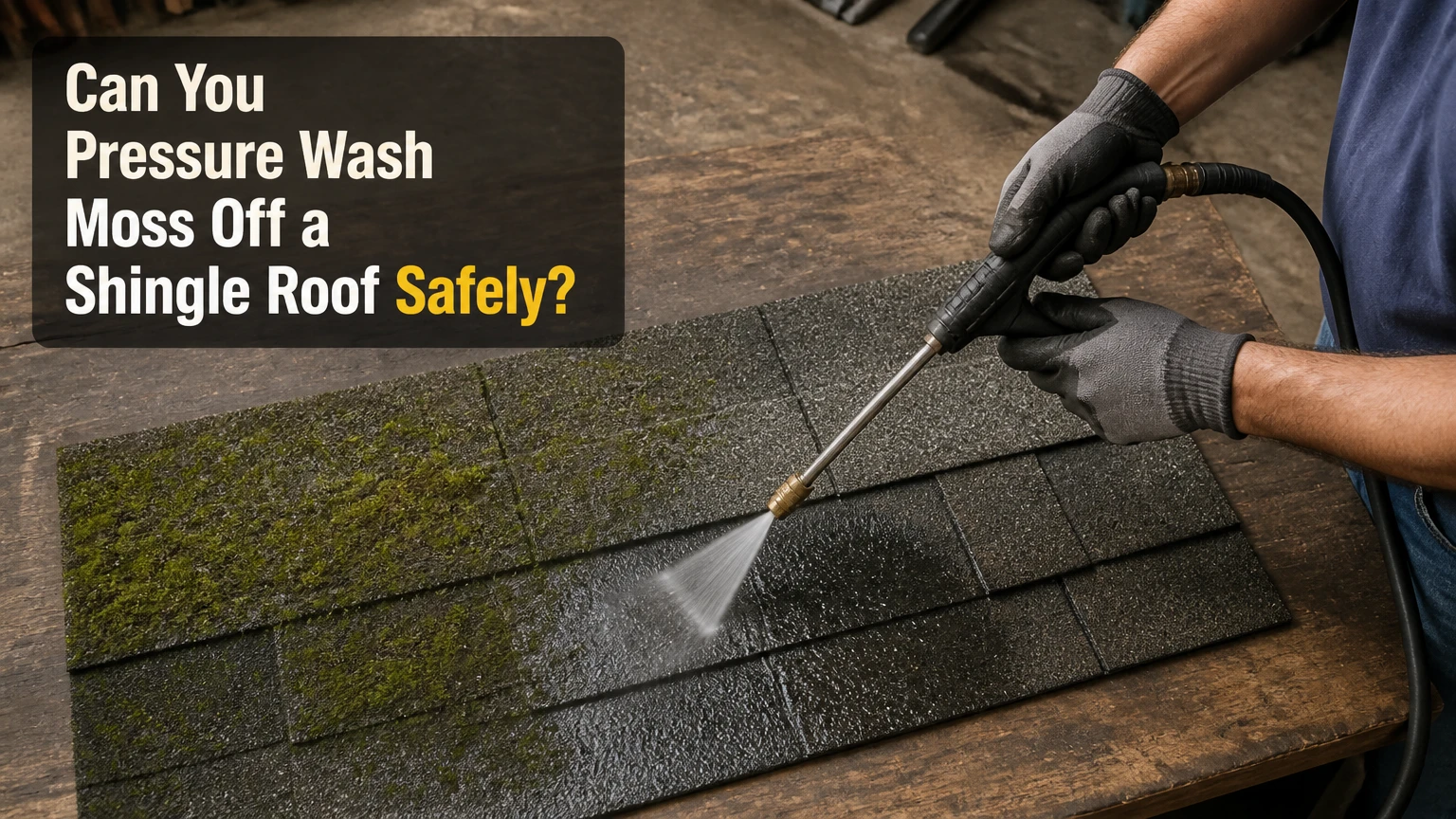
No, you should not pressure wash moss off an asphalt shingle roof. High-pressure water can dislodge protective ceramic granules, damage the asphalt coating, force water beneath shingle laps, and create leaks. The safer method is low-pressure chemical treatment, followed by natural weathering or a gentle garden-hose rinse when the product label permits it.
Key Facts
- A pressure washer is not a safe moss-removal tool for standard asphalt shingles, even when the roof appears structurally sound.
- Soft washing kills moss chemically at low pressure instead of relying on abrasive force to tear it from the roof.
- Dead moss may take 1-3 weeks or several rain events to detach, so instant visual cleanliness is not a safe success criterion.
- Typical professional roof-moss treatment costs about $0.30-$0.75 per square foot, with access, roof pitch, and repairs affecting the final price.
- Roofs with loose granules, exposed underlayment, leaks, brittle shingles, or steep access should receive a roof inspection before cleaning.
- Zinc or copper controls can reduce recurrence, but they cannot repair moisture damage or replace shade and debris management.
Can You Pressure Wash Moss Off a Shingle Roof?
You can physically remove moss with a pressure washer, but you should not do so on asphalt shingles. Roofing manufacturers and the Asphalt Roofing Manufacturers Association generally favor non-abrasive cleaning methods because high-pressure water can remove granules that protect the asphalt from ultraviolet radiation and weather.
A pressure washer also sends water upward and sideways beneath shingle courses, around flashing, and under ridge-cap edges. A roof can remain apparently dry inside while its underlayment, roof deck, or fasteners absorb water. The resulting leak may appear days later, after the cleaning job is complete.
The exact danger depends on nozzle type, pressure, distance, angle, shingle age, and existing deterioration. That variability does not make pressure washing acceptable. It makes the outcome difficult to control.
Why does pressure damage asphalt shingles?
Asphalt shingles are layered products. Their mineral granules protect the weathering surface, while the asphalt coating and fiberglass mat provide water resistance and dimensional stability. A concentrated spray can loosen granules, expose asphalt, lift shingle edges, and remove protective surface material.
Moss makes the situation worse because its rhizoids can grow into surface irregularities and retain moisture. A worker who increases pressure to remove firmly attached moss increases the force applied to the shingle surface. The roof may look cleaner while losing years of weather resistance.
The National Roofing Contractors Association recommends following the shingle manufacturer’s maintenance instructions. Those instructions vary by product, so the roof warranty and installation documentation should be checked before any chemical treatment.
What Is the Safest Way to Remove Roof Moss?
The safest general method is professional low-pressure soft washing: identify the growth, protect the site, apply a roof-compatible moss treatment from a controlled sprayer, allow label-directed dwell time, and remove only loosened residue without abrasive scraping. The safest method changes when shingles are brittle, damaged, steep, or difficult to access.
Step 1: Inspect the roof and identify the growth
Start from the ground with binoculars, then inspect accessible edges from a ladder without stepping onto the roof. Moss appears as raised, three-dimensional green or brown growth. Algae often produces flat dark streaks, while lichen forms crusty, branching patches that attach more firmly.
Look for these conditions before cleaning:
- Missing, cracked, curled, or lifted shingles
- Exposed nail heads, underlayment, or roof decking
- Granules collecting heavily in gutters
- Sagging roof planes or damaged flashing
- Interior stains, damp insulation, or active leaks
- Moss concentrated around valleys, eaves, and shaded north-facing slopes
You will know inspection is complete when the roof’s material, growth type, access route, drainage path, and visible defects are documented. Common mistake: treating every dark roof stain as moss and applying an unnecessarily aggressive product.
Step 2: Plan weather, access, and runoff controls
Choose a cool, calm period with no rain expected during the product’s required dwell time. A hot roof can dry a treatment before it reaches the growth, while wind can carry solution onto windows, siding, neighboring property, or garden beds.
Protect downspout outlets, collect concentrated runoff where local rules require it, and move outdoor furniture, toys, pet dishes, and vehicles. Wet surrounding plants thoroughly before treatment and rinse them again during and after cleanup. Pre-wetting reduces leaf and root exposure, but it does not make chemical runoff harmless.
A safety harness is not a substitute for a proper anchor, training, and a rescue plan. OSHA’s residential construction fall-protection rules commonly require protection at elevations of 6 feet or more, although an ordinary homeowner working alone may not have a safe compliant setup. Hire a roofer or roof-cleaning specialist when roof access requires walking on a pitched, wet surface.
You will know preparation is complete when people, pets, storm drains, plants, and exterior surfaces have a defined protection plan. Common mistake: beginning application because the sky is cloudy while ignoring wind direction.
Step 3: Apply a labeled moss treatment at low pressure
Use a dedicated roof-cleaning product whose label names asphalt shingles as an approved surface. Application equipment may include a pump sprayer or downstream low-pressure system, but the chemical label controls dilution, personal protective equipment, contact time, and rinsing instructions.
Professional roof cleaners commonly apply from the ridge toward the eaves so runoff follows the drainage path rather than traveling beneath shingle laps. Keep the spray pattern controlled and avoid forcing liquid under flashing, ridge vents, or shingle edges.
Sodium hypochlorite solutions can work quickly against organic growth, but concentration, surfactant choice, exposure time, and runoff management determine the risk. Sodium percarbonate products offer a lower-chlorine alternative, although they may require longer contact and more physical rinsing. Never mix bleach with acids, ammonia, or other cleaners.
You will know application is adequate when the growth is evenly wetted without visible streams entering roof penetrations. Common mistake: increasing concentration because moss is thick instead of allowing a qualified contractor to assess whether the roof is too deteriorated to clean.
Step 4: Respect dwell time without letting the solution dry
Typical product directions may specify approximately 10-30 minutes, but no universal dwell time applies to every formulation or weather condition. Keep the surface within the manufacturer’s stated wet-contact range and reapply only according to the label.
Moss often changes color before it releases. A white, tan, or brown appearance can indicate biological death, not complete removal. Scraping immediately after application can damage granules because the moss may still be attached to the shingle surface.
You will know the treatment has worked when the moss loses its normal green color and later becomes loose or weathered. Common mistake: judging the treatment a failure after one hour because the roof is not visually bare.
Step 5: Rinse gently only when the product allows it
Some leave-on treatments are designed to remain on the roof and break down growth through later rain. Other products require rinsing. Follow the label rather than applying a blanket rinse rule.
When rinsing is required, use a wide garden-hose spray directed downward, not a pressure-washer jet directed upward. Flush gutters and downspouts, inspect discharge points, and continue plant rinsing until diluted runoff is no longer visibly concentrated.
You will know cleanup is adequate when gutters drain freely, no chemical residue remains on sensitive surfaces, and runoff has not pooled around plants or entered an uncontrolled drain. Common mistake: using a narrow nozzle to imitate pressure washing after the chemical treatment.
Which Moss Treatment Is Best for Asphalt Shingles?
No single chemical is best for every roof. Sodium hypochlorite usually provides the fastest kill, sodium percarbonate reduces chlorine exposure, and zinc or copper products are primarily preventive rather than a substitute for removing an established moss layer.
| Treatment | Typical use | Main benefit | Main limitation |
|---|---|---|---|
| Sodium hypochlorite | Professional cleaning of heavy organic growth | Fast biological kill, often within one treatment | Plant, metal, paint, and runoff damage if mishandled |
| Sodium percarbonate | Lower-chlorine homeowner or professional treatment | Oxidizing action with less chlorine odor | Often slower and less effective on thick established moss |
| Zinc salts or zinc strips | Recurrence control after cleaning | Rainwater carries zinc down roof slopes | Does not remove mature moss or repair damaged shingles |
| Copper strips or copper-based products | Recurrence control on suitable roofs | Copper ions inhibit later growth | Can stain surfaces and harm aquatic life through runoff |
| Detergent-only cleaner | Light dirt and some surface residue | Lower biological toxicity | Usually inadequate against established moss roots |
| Mechanical scraping | Limited removal of loose dead material | No chemical exposure | Can tear shingle surfaces and remove granules |
Does bleach damage asphalt shingles?
A properly selected, correctly diluted roof treatment may be compatible with asphalt shingles, but bleach can damage nearby plants, painted metal, gutters, siding, and roof accessories. Repeated or overly concentrated application can also accelerate material deterioration, so the product label and shingle manufacturer take priority over a generic recipe.
The frequently repeated 3%-4% figure describes a typical active-solution range used by some professional cleaners, not a universal instruction. Household bleach strength varies, and “bleach” may refer to different formulations. A contractor should document the product, dilution, dwell time, and protection method.
The U.S. Environmental Protection Agency’s pesticide-label principle is straightforward: the label governs legal use when a product is registered for that purpose. A roof cleaner should never recommend mixing chemicals casually or pouring concentrate onto a roof.
How Much Does Roof Moss Removal Cost?
Professional roof moss treatment typically costs about $0.30-$0.75 per square foot, while a common 2,000-square-foot roof may total roughly $600-$1,500 before repairs, difficult access, or extensive plant protection. DIY supplies often cost $50-$150, but fall risk and chemical errors can outweigh the apparent saving.
| Project condition | Typical price range | Typical duration | Main price driver |
|---|---|---|---|
| Small, low-slope roof with light growth | $250-$600 | 1-3 hours | Minimum service charge |
| 2,000-square-foot accessible roof | $600-$1,500 | 2-5 hours | Roof area and growth density |
| Steep roof with heavy moss | $1,000-$2,500+ | 4-8 hours | Fall protection and access equipment |
| Treatment plus gutter cleanup | $700-$1,800 | 3-6 hours | Debris removal and downspout flushing |
| Roof requiring minor repairs | Cleaning plus $300-$2,000+ | 1-2 days | Flashing, shingles, or deck damage |
| DIY product-only treatment | $50-$150 | 2-4 hours of ground work | Product quantity and sprayer |
These figures are typical planning ranges, not a national price schedule. Fixr’s roof-cleaning cost guidance identifies roof size, pitch, access, cleaning method, and location as major variables. A written quote should state whether the price includes inspection, plant protection, gutter clearing, repeat treatment, and repairs.
How Long Does Moss Treatment Take to Work?
Chemical treatment commonly takes 1-3 weeks to kill visible moss, while complete cosmetic removal can require several weeks or multiple rain events. The application itself may take 2-5 hours on a typical home, but the roof should not be judged immediately after treatment.
| Stage | Typical timeframe | What the homeowner should observe |
|---|---|---|
| Site preparation | 30-90 minutes | Plants, windows, drains, and pets protected |
| Chemical application | 30-120 minutes | Moss is evenly wetted at low pressure |
| Initial biological response | 1-7 days | Green growth fades or turns tan |
| Natural release | 1-3 weeks | Rain and wind loosen dead material |
| Follow-up inspection | 3-6 weeks | Remaining patches and roof damage become visible |
| Preventive maintenance | Every 1-3 years | Timing depends on shade, moisture, and debris |
Dead moss that remains attached is not a reason to scrape aggressively. A professional may remove only loose residue with a soft tool from the eave edge, working downward and never lifting shingle courses. If the roof needs force to look clean, the surface may be too fragile for cosmetic cleaning.
When Should You Not Clean Moss From a Shingle Roof?
Do not clean a shingle roof before repairing active leaks, widespread granule loss, exposed underlayment, severe curling, or structural sagging. Cleaning cannot restore an aged roof, and water or foot traffic can convert a marginal roof into a leaking one.
A roof inspection is especially important when the shingles are near the end of their expected service life, when moss has covered the roof for years, or when gutters contain large quantities of granules. The correct decision may be repair or replacement rather than cleaning.
Do not use this asphalt-shingle procedure on cedar shakes, slate, clay tile, asbestos-cement roofing, painted metal, or membranes without material-specific guidance. Those materials have different chemical tolerances, drainage details, and breakage risks.
Is moss itself damaging the roof?
Moss increases moisture retention and can lift shingle edges as it expands, but the severity depends on coverage, climate, roof slope, ventilation, and roof age. Persistent shade and leaf accumulation often create the conditions that allow moss to return after cleaning.
Moss is therefore both a symptom and a contributor. Removing it without correcting overhanging branches, blocked gutters, poor airflow, or chronic dampness usually produces a short-lived result.
What Are the Biggest Roof Moss-Removal Mistakes?
The most damaging mistakes are pressure washing, scraping upward beneath shingle courses, using an unlabeled chemical mixture, ignoring runoff, and walking on a wet or brittle roof. Each mistake creates a different failure mode, so the recovery depends on what happened.
| Mistake | Likely consequence | Immediate response |
|---|---|---|
| Pressure washing from close range | Granule loss, lifted shingles, hidden water intrusion | Stop, photograph damage, arrange a roof inspection |
| Wire-brush scraping | Torn surface and exposed asphalt | Stop abrasion; do not coat damage without manufacturer advice |
| Applying concentrate in heat | Uneven treatment and chemical spotting | Rinse affected surfaces according to the label |
| Ignoring wind and runoff | Browning plants, stained siding, contaminated drains | Drench plants and exterior surfaces with clean water |
| Walking on brittle shingles | Cracks, scuffs, broken seals | Use a roofer for inspection and repair |
| Mixing bleach and another cleaner | Toxic gas or uncontrolled reaction | Leave the area, ventilate, and contact emergency services if exposure occurs |
A practitioner rule of thumb is simple: if a roof cleaner’s main selling point is instant removal, ask what physical force is being applied to the shingles. Safe biological control is usually slower because it protects the roof surface.
How Do You Fix Moss-Treatment Problems?
Green moss after treatment usually means inadequate coverage, unsuitable weather, insufficient dwell time, or a product that does not control established moss. Do not automatically use a stronger mixture; inspect the label, weather conditions, and roof material before any second application.
Dead moss stuck to shingles should normally weather away rather than being pried upward. If material blocks gutters, a trained worker can remove loose debris from safe access points, but attached growth on a fragile roof requires professional judgment.
Browning plants indicate possible chemical injury or overspray. Irrigate the foliage and soil with clean water promptly, isolate concentrated runoff if possible, and keep pets away from treated areas until the product label allows access. Severe exposure requires advice from a local extension service or poison-control resource.
Does Zinc Prevent Moss From Returning?
Zinc or copper installed near the ridge can reduce new moss growth when rainwater carries metal ions down the shingle surface, but prevention works best after existing moss has been treated and moisture conditions have been improved. Metal strips do not cure leaks, remove mature growth, or compensate for heavy shade.
Install only products compatible with the roof and local drainage rules. Copper and zinc runoff can affect plants, soil organisms, ponds, and aquatic systems. The strips must also remain exposed to rain, so placing them beneath ridge caps or under debris reduces their effect.
Trim branches that shade the roof, remove leaves from valleys and gutters, improve attic ventilation where appropriate, and keep roof surfaces dry between rainfall events. Prevention is a maintenance system, not a single accessory.
How Do You Choose a Roof-Moss Removal Contractor?
Choose a contractor who offers low-pressure roof cleaning, identifies the shingle manufacturer, documents chemical products, protects landscaping, and carries current general liability and workers’ compensation insurance. A contractor who proposes high-pressure washing for asphalt shingles should be rejected unless the shingle manufacturer gives unusually specific written instructions.
Ask for these details in writing:
- The proposed pressure range and spray direction
- The product name, label, dilution, and dwell time
- Plant, siding, window, pet, and storm-drain protection
- Whether gutters and downspouts are included
- The response to active leaks or broken shingles
- Proof of insurance and worker coverage
- A warranty that does not contradict the shingle manufacturer’s terms
- Before-and-after photographs and a follow-up schedule
ARMA guidance and individual manufacturers may differ in wording, but both support preserving shingle granules and avoiding damaging maintenance practices. Ask the contractor to identify the exact manufacturer instructions rather than accepting “industry standard” as proof.
FAQ
Can I use a garden hose to wash moss off shingles?
A garden hose is safer than a pressure washer because it applies much less force, but water alone usually does not kill established moss at its roots. Use a garden hose only for pre-wetting, label-approved rinsing, or washing away loose dead residue, and direct the spray downward so water does not enter beneath shingle courses.
Can I use a pressure washer on a roof with no leaks?
No. The absence of current leaks does not make pressure washing safe. High-pressure water can remove granules, lift sealed edges, and create concealed moisture pathways before a leak becomes visible. Roof age, nozzle distance, and shingle condition change the damage risk, but none reliably converts pressure washing into a recommended asphalt-shingle cleaning method.
Should I remove moss before selling my house?
Treating visible moss before listing can improve roof appearance, but obtain an inspection first if the roof is old or heavily covered. A cosmetic cleaning may expose missing granules, damaged flashing, or lifted shingles. Disclose repairs and retain treatment records because a clean-looking roof is not evidence of remaining service life.
Will vinegar kill moss on asphalt shingles?
Vinegar is not a reliable universal roof-moss treatment, and acidic runoff may affect metals, plants, sealants, and painted surfaces. Use a product specifically labeled for asphalt shingles and moss control instead. Never combine vinegar with chlorine bleach because the reaction can release dangerous chlorine gas.
Can moss be removed from shingles in winter?
Winter treatment can be impractical because freezing temperatures, ice, snow, and short drying periods increase slip and runoff risks. Apply only within the product’s temperature range and when the roof can remain safely accessible. In cold climates, late spring or early fall often provides safer working conditions than icy winter access.
How often should I treat roof moss?
A typical treatment interval is 1-3 years, but recurrence depends more on shade, rainfall, roof orientation, leaf debris, and ventilation than on a fixed calendar. Inspect shaded slopes and valleys twice yearly, clear gutters, and address overhanging branches before moss becomes a thick layer.
The Bottom Line
Can you pressure wash moss off a shingle roof? You can, but you should not. Pressure washing trades a fast visual result for granule loss, possible water intrusion, warranty complications, and a shorter roof life. Choose a labeled low-pressure treatment, protect landscaping and drainage, allow moss to die and release gradually, and obtain a roof inspection when the shingles are old, fragile, steep, or already leaking.