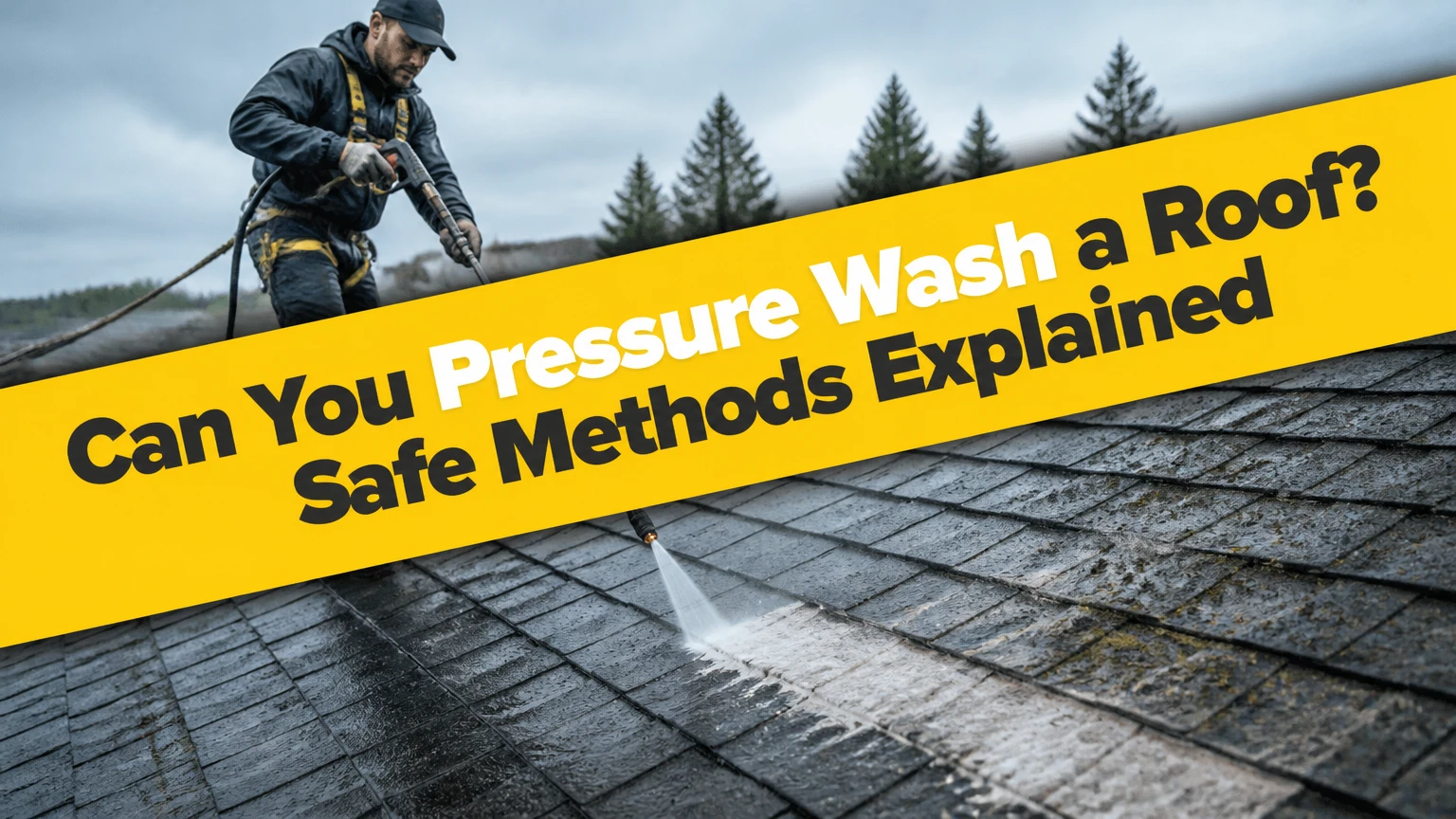
No, homeowners generally should not pressure wash a roof with a standard high-pressure machine. High pressure can strip asphalt-shingle granules, damage tile surfaces, shred wood fibers, force water beneath laps, and void warranties. Roof cleaning is usually safer with low-pressure soft washing, controlled chemicals, adequate water flow, and a pre-cleaning roof inspection.
At a Glance
- Standard pressure washers commonly produce 2,000-4,000 PSI, while roof cleaning usually requires no more than 500 PSI.
- Soft washing removes algae and moss with a diluted sodium hypochlorite solution, surfactant, and low-pressure application.
- A typical soft-wash rinse uses approximately 5-8 GPM to remove cleaning chemicals thoroughly.
- Heavy moss or black algae commonly requires a 3%-4% sodium hypochlorite solution, while light maintenance cleaning uses 1%-2%.
- Professional roof cleaning typically costs $0.30-$0.80 per square foot, or about $600-$1,600 for a 2,000-square-foot roof.
- An attic and exterior inspection should precede washing when the roof has leaks, cracked tiles, loose shingles, or deteriorated underlayment.
What Is the Difference Between Pressure Washing and Soft Washing?
Pressure washing removes contamination mainly through water force, while soft washing uses chemical treatment and low-pressure rinsing. Pressure washing may produce 2,000-4,000 PSI, whereas a roof-safe soft-wash application often operates below 500 PSI and relies on a 5-8 GPM rinse.
Pressure washing can be suitable for some hard outdoor surfaces, such as concrete walkways. Roofing materials behave differently because shingles, tile coatings, sealants, and wood fibers can be damaged by concentrated spray force.
Soft washing applies a solution containing sodium hypochlorite, water, and a surfactant. Sodium hypochlorite kills organic growth instead of merely dislodging its visible surface. The operator then rinses the roof without directing force beneath shingle tabs, tile laps, flashing, or metal seams.
| Cleaning method | Typical pressure | Primary cleaning action | Main roof risk |
|---|---|---|---|
| Standard pressure washing | 2,000-4,000 PSI | Water force | Granule loss and water intrusion |
| Low-pressure washing | 100-500 PSI | Limited water force | Damage from poor technique |
| Soft washing | Often below 500 PSI | Chemical treatment | Runoff or chemical exposure |
The practical rule is simple: roofs need treatment, not brute force.
What Pressure and Water Volume Are Safe for Roof Cleaning?
A roof-cleaning application should generally remain at or below 500 PSI, although the correct setting depends on the material, nozzle, distance, and condition. Soft washing uses high water volume, usually 5-8 GPM, because flow rinses chemicals away more effectively than pressure does.
A standard 3,000 PSI washer can remove protective ceramic granules from asphalt shingles in a single session. Roofing contractors often use lower-pressure pumps or dedicated soft-wash equipment to reduce impact on the roof surface.
Pressure alone does not determine risk. A narrow nozzle held close to a shingle can damage the roof at a lower machine setting, while a wider spray pattern held farther away may distribute water more gently. Spray direction also matters. Water should not be driven upward beneath overlapping materials.
| Roof-cleaning variable | Typical safe target | Why it matters |
|---|---|---|
| Maximum general roof pressure | 500 PSI | Limits surface impact |
| Soft-wash rinse volume | 5-8 GPM | Removes chemical residue |
| Light-growth solution | 1%-2% sodium hypochlorite | Treats maintenance staining |
| Heavy-growth solution | 3%-4% sodium hypochlorite | Treats dense algae or moss |
| Standard pressure-washer output | 2,000-4,000 PSI | Usually excessive for shingles |
These figures are typical practitioner targets, not universal guarantees. The roof manufacturer’s instructions take priority.
Which Roof Materials Can Tolerate Pressure Washing?
Metal roofing generally tolerates more pressure than asphalt shingles, while concrete and clay tiles require moderate handling and wood roofing requires the greatest restraint. No roof material should receive indiscriminate high-pressure spraying, because seams, coatings, laps, and aging surfaces remain vulnerable.
| Roofing material | Typical pressure guidance | Main concern |
|---|---|---|
| Asphalt shingles | 500 PSI or less | Ceramic-granule loss |
| Concrete or clay tile | Never above 1,200 PSI | Surface glaze damage |
| Metal roofing | Approximately 1,500-2,000 PSI maximum in suitable cases | Seam and fastener intrusion |
| Wood shakes or shingles | Below 400 PSI, along the grain | Shredded fibers and rot |
Metal roofing is the most pressure-tolerant option, but spray should not target overlapping seams, penetrations, or rubber washer fasteners. Oxidized coatings may also require a manufacturer-approved cleaner rather than aggressive water pressure.
Concrete and clay tiles can tolerate more force than asphalt shingles, yet damaged glaze can leave tile porous. Wood shakes and shingles should usually receive a specialized low-pressure wash or wood-restoration treatment. A contractor should identify the material before selecting equipment.
What Chemicals Are Used to Soft Wash a Roof?
Roof soft washing typically uses sodium hypochlorite, water, and a surfactant. A 1%-2% sodium hypochlorite concentration is commonly used for light maintenance staining, while 3%-4% may be used for heavy moss or dark black algae when the roof and surrounding property can be protected.
Sodium hypochlorite attacks algae, moss, and other organic growth at the source. The surfactant helps the solution cling to sloped roofing instead of immediately running into gutters. Water dilutes the mixture and supports controlled application.
Chemical strength must match the contamination and roof condition. Stronger is not automatically safer or more effective. Sodium hypochlorite can discolor siding, damage plants, corrode metals, and harm animals if it is mishandled.
Never mix sodium hypochlorite with ammonia, acids, or other incompatible cleaners. Dangerous gases can form. A qualified operator should read product labels, use appropriate protective equipment, control runoff, and rinse affected surfaces with clean water. The roof manufacturer’s cleaning instructions should determine whether a chemical is permitted.
How Do You Safely Clean Moss, Algae, and Lichen?
The safest process is to inspect the roof, protect nearby property, apply a suitable soft-wash solution, allow controlled dwell time, and rinse with low pressure. Moss and lichen should not be scraped aggressively because physical removal can pull away shingle granules or damage tile surfaces.
- Inspect the roof. Check for loose shingles, cracked tiles, exposed underlayment, failed flashing, and visible sagging.
- Protect the property. Wet plants, cover sensitive equipment, secure pets, and redirect or contain runoff.
- Apply the solution. Use a calibrated 1%-2% mixture for light growth or a stronger professional treatment for dense growth.
- Allow treatment time. Follow the product label and monitor drying, wind, and runoff.
- Rinse gently. Use broad spray coverage and avoid forcing water under overlaps.
- Reinspect the roof. Confirm that growth has died and that no new damage appeared.
Dead moss may loosen gradually after treatment rather than disappearing immediately. Removing every dark mark during one aggressive pass is a common cause of roof damage.
Should You Inspect a Roof Before Washing It?
Yes, a roof should be inspected before washing, especially when the roof is older than 15 years or has visible damage. An inspection identifies leaks, cracked tiles, loose shingles, weak underlayment, deteriorated flashing, and areas where even low-pressure water could enter.
The attic deserves attention because exterior stains do not reveal every structural problem. Dark rafters, damp insulation, mold odor, daylight around penetrations, or active moisture can indicate an existing leak. Washing should stop until the leak source is repaired.
A roof with hairline tile cracks or compromised underlayment can admit water through capillary action beneath laps. Soft washing reduces force, but soft washing does not make a structurally defective roof watertight.
| Finding before cleaning | Recommended action | Cleaning decision |
|---|---|---|
| Intact shingles with surface algae | Schedule soft washing | Usually appropriate |
| One or two cracked tiles | Replace tiles first | Delay washing locally |
| Active attic moisture | Diagnose and repair leak | Do not wash yet |
| Widespread granule loss | Obtain roofing assessment | Cleaning may worsen wear |
| Sagging roof deck | Seek structural repair | Do not walk or wash casually |
An inspection is cheaper than treating a preventable interior water problem.
How Should Steep Roofs and Chemical Runoff Be Handled?
Roofs steeper than 8:12 often require long-range application equipment, a lift, or a specialized drone system because technicians may not be able to walk safely on the surface. Chemical runoff also requires active plant protection before, during, and after application.
A short wand used from a ladder may not reach the roof peak on a steep pitch. The operator may compensate by increasing pressure, which creates avoidable surface damage. Long-range nozzles and calibrated delivery systems solve reach problems without increasing impact.
Runoff becomes particularly risky when a roof lacks gutters or has a complex design that drains onto landscaping. Sodium hypochlorite can injure or kill plants. Fresh water should saturate vegetation before treatment and continue during and after the wash to dilute runoff.
Rain barrels should be disconnected or covered, and outdoor furniture, painted surfaces, vehicles, solar equipment, and pet areas should be protected. Wind can carry spray beyond the roof edge, so a professional should postpone work when conditions prevent accurate control.
Can Roof Washing Cause Leaks or Other Damage?
Yes, roof washing can cause leaks, granule loss, broken tiles, wood-fiber damage, corrosion, and interior staining when the method or roof condition is unsuitable. High pressure is the most common mechanical risk, but low-pressure chemical washing can also create problems through runoff or pre-existing defects.
A 3,000 PSI stream directed at asphalt shingles may remove protective granules. Those granules protect the asphalt coating from ultraviolet exposure and weathering. The supplied industry estimate is that one session can remove roughly 10%-15% of granules in affected areas, potentially reducing remaining service life by 2-5 years.
Water can also move backward beneath laps when sprayed upward or too closely. The risk increases on cracked tile, loose shingles, failed flashing, and deteriorated underlayment. Metal roofs can develop leaks when spray enters seams or fastener locations.
Roof cleaning should stop when shingles lift, tiles move, runoff enters an attic, or the operator cannot control spray direction. Cleaning is maintenance, not a substitute for roofing repair.
Will Roof Cleaning Void a Warranty?
High-pressure cleaning can void a roofing warranty, while manufacturer-approved soft washing may be allowed under specific conditions. The warranty language for the exact shingle, tile, coating, or metal system should be checked before work begins.
Some shingle manufacturers prohibit power-washer use because pressure can remove granules and alter the roofing surface. Other manufacturers publish cleaning methods involving approved solutions and gentle rinsing. A contractor’s general claim that soft washing is always warranty-safe is not enough.
Ask for the manufacturer’s written cleaning guidance and keep the contractor’s method, chemical specification, and insurance documents. The warranty may distinguish between approved maintenance and damage caused by a third party.
| Warranty question | Why it matters | Best evidence |
|---|---|---|
| Is pressure washing prohibited? | High pressure can trigger exclusions | Manufacturer warranty |
| Is chemical cleaning approved? | Approved mixtures may differ | Product care instructions |
| Is contractor damage excluded? | Workmanship may not be covered | Written service agreement |
| Are coatings or fasteners covered separately? | Metal systems have distinct limits | Roofing-system documentation |
The safest approach is to verify the rule before scheduling the cleaning, not after a claim is denied.
How Much Does Professional Roof Cleaning Cost?
Professional roof cleaning typically costs $0.30-$0.80 per square foot. A 2,000-square-foot roof therefore commonly costs $600-$1,600, with pitch, roof height, access, material, growth severity, and property protection affecting the final price.
Roof area is not always the same as the home’s floor area. A steep roof has more surface area than its building footprint, and complex valleys or multiple elevations increase labor time. A contractor may also charge more when plant protection, gutter control, lift equipment, or extensive rinsing is required.
| Roof-cleaning situation | Typical price basis | Example total |
|---|---|---|
| Simple, low-pitch roof | $0.30-$0.45 per square foot | $600-$900 for 2,000 square feet |
| Moderate growth or access limits | $0.45-$0.65 per square foot | $900-$1,300 for 2,000 square feet |
| Steep, tall, or heavily contaminated roof | $0.65-$0.80 per square foot | $1,300-$1,600 for 2,000 square feet |
These are typical planning figures, not a guaranteed quote. A suspiciously low estimate may omit runoff control, attic inspection, insurance, or return treatment.
How Long Does a Soft-Washed Roof Stay Clean?
A properly soft-washed roof typically stays visibly clean for 3-5 years. The actual interval depends on shade, humidity, nearby trees, roof orientation, drainage, and whether the treatment killed the organic growth rather than merely removing its surface.
North-facing slopes and shaded roof sections often regrow sooner because moisture remains longer. Overhanging branches deposit leaves and spores, while clogged gutters keep roof edges damp. A roof in a sunny, open setting may remain cleaner for the full five-year range.
A maintenance treatment at 1%-2% sodium hypochlorite may be appropriate before heavy buildup returns. Repeated aggressive washing is not a good maintenance plan because each high-pressure session can remove more roofing material.
| Site condition | Typical expected interval | Maintenance approach |
|---|---|---|
| Sunny roof with little tree cover | 4-5 years | Inspect annually |
| Mixed sun and shade | 3-4 years | Watch north-facing slopes |
| Dense trees and persistent moisture | 1-3 years | Improve drainage and trim branches |
| Heavy moss at first cleaning | 3-5 years after treatment | Schedule follow-up inspection |
A clean roof that quickly regrows may have a moisture-management problem, not a need for stronger chemicals.
Can You Clean a Roof Yourself With Rented Equipment?
Most homeowners should not rent a standard pressure washer for roof cleaning. Rental machines usually provide high pressure rather than the high-volume, low-pressure delivery needed for soft washing, and roof work adds fall, chemical, and water-intrusion hazards.
A homeowner may safely perform limited ground-level preparation, such as clearing leaves from gutters with suitable equipment. Walking on a roof, carrying chemical containers up a ladder, or operating a pressure washer on a slope creates multiple failure points.
DIY risks include falling, breaking tiles, stripping shingle granules, burning vegetation, damaging siding, and forcing water beneath roof laps. A rented machine also may not include proportioning equipment, downstream injection, long-range nozzles, or runoff controls.
If a homeowner proceeds with any approved maintenance method, the homeowner should first obtain written manufacturer instructions, avoid roof walking when possible, protect plants, keep pressure within the stated limit, and use no chemical mixture that conflicts with the label. For steep, tall, old, or damaged roofs, professional work is the safer choice.
When Should You Repair or Replace a Roof Instead of Washing It?
Repair or replacement is preferable when a roof has active leaks, widespread granule loss, sagging, exposed underlayment, repeated shingle failure, or damage across a large percentage of the surface. Cleaning improves appearance and removes organic growth, but cleaning cannot restore failed roofing materials.
The roof’s age changes the financial decision. An asphalt-shingle roof near the end of its expected service life may not justify repeated cleaning if several repairs are already necessary. A relatively young roof with isolated algae and intact shingles is a stronger cleaning candidate.
| Roof condition | Cleaning value | Better next step |
|---|---|---|
| Black streaks, intact shingles | High | Soft wash |
| Thick moss lifting shingles | Moderate | Remove growth carefully, then inspect |
| Several cracked or missing shingles | Low until repaired | Repair before cleaning |
| Active interior leak | None until diagnosed | Roof repair |
| Widespread bald spots | Low | Roofing assessment or replacement plan |
The key distinction is cosmetic contamination versus material failure. A roof inspection should settle that distinction before chemical treatment.
How Do You Choose a Safe Roof-Cleaning Contractor?
Choose a contractor who identifies the roof material, explains pressure and chemical controls, verifies warranty requirements, protects landscaping, and provides proof of insurance. A contractor who promises to blast every stain away is using the wrong performance measure.
Ask for the proposed PSI range, rinse flow, chemical concentration, runoff plan, access method, and treatment warranty. The contractor should explain how steep sections will be reached without unsafe ladder positioning or unnecessary roof walking.
Request before-and-after photographs and a written scope that identifies the roof area, included repairs, plant protection, and cleanup. Confirm whether the quote includes gutter clearing and whether damaged materials are excluded from the cleaning warranty.
The best contractor may recommend no cleaning if the roof is structurally unsound. That recommendation demonstrates assessment rather than sales pressure. Verify licensing requirements locally, workers’ compensation coverage, liability insurance, and experience with the specific roofing material.
What Should You Do If Roof Stains Return Quickly?
If roof stains return within months, inspect moisture conditions and confirm that the previous treatment killed the growth instead of only removing its visible layer. Quick recurrence can result from shade, tree debris, clogged gutters, excessive humidity, weak chemical application, or untreated neighboring surfaces.
A contractor should review the original concentration, dwell time, coverage, rinse process, and weather conditions. A weak solution or rushed application may leave living algae or moss behind. Applying a stronger chemical without diagnosing the cause can damage plants and shorten roof-system life.
Trim branches that keep the roof damp, improve gutter drainage, and remove debris from valleys when safe. Do not scrape or pressure wash recurring stains simply because the first treatment did not last.
If black streaks return on one slope but not another, orientation and shade are likely contributors. If moss returns along the eaves, trapped moisture or poor drainage may be involved. A written reinspection is more useful than an automatic repeat wash.
The Bottom Line
You generally should not pressure wash a roof with a standard 2,000-4,000 PSI machine. Soft washing, usually below 500 PSI with controlled sodium hypochlorite and a 5-8 GPM rinse, is safer for most roofing. Roof material and structural condition change the method, especially for metal, tile, wood, steep roofs, and damaged underlayment. Check the manufacturer’s warranty guidance and obtain a roof inspection before cleaning.