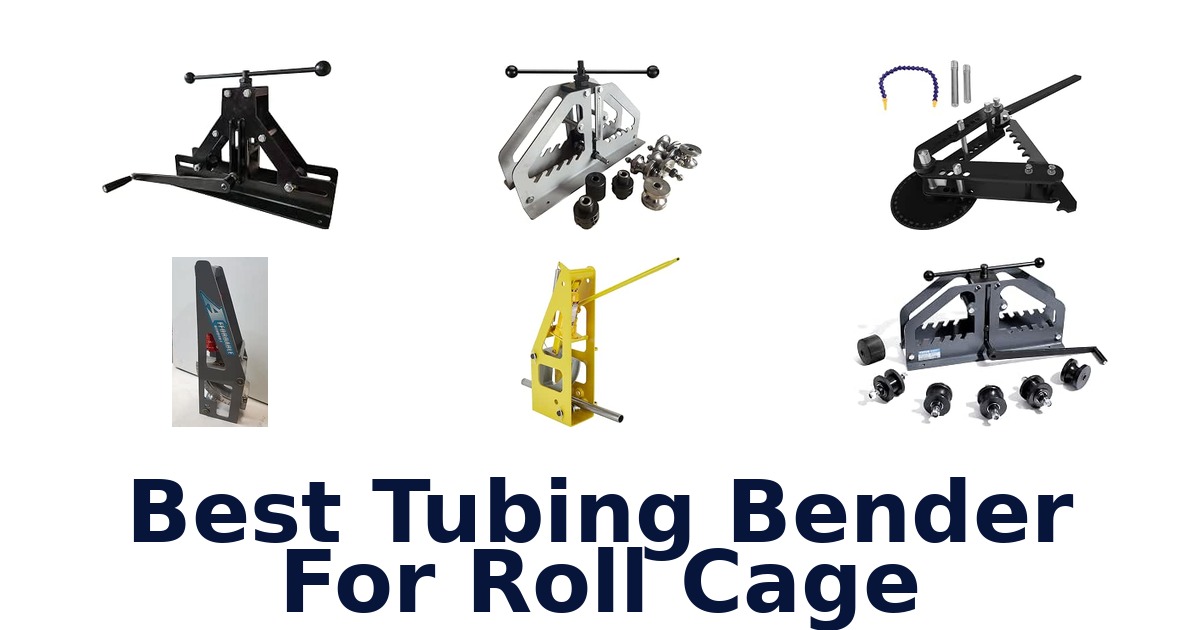
A strong roll-cage tubing bender needs to form the tubing size and material in your build without confusing a tight die bend with a broad-radius roll. Speedway Motors Hydraulic Round Tubing Bender is a focused choice for round tubing and controlled bends up to 90 degrees; Eastwood offers a wider stated tube-diameter range for builders who need more capacity. This roundup also includes manual ratcheting benders, hydraulic bottle-jack models, and roller machines, which serve different jobs.
Check your tube’s outside diameter, wall thickness, material, and required bend radius against the stated capacity before choosing. The listings do not establish that every model includes the dies needed for every cage tube, so treat included die size and compatibility as essential checks, not assumptions.
Speedway Motors Hydraulic Round Tubing Bender leads for roll-cage work because its listing specifically describes 90-degree bends for roll cages and frames, and gives compatibility up to .110-inch-wall mild steel or .096-inch-wall chromoly. It includes a 1.50-inch die with a 7-inch bend radius and cast incremental marks for repeating bends. Choose it when that round-tube size and material range match your project; consider Eastwood Electro-Hydraulic Bender if you need its stated 1-to-2-inch OD range instead.
Our Top Picks
 Best Overall
Speedway Motors Hydraulic Bender
Specifically listed for roll cages, it makes bends up to 90 degrees and includes a 1.50-inch die with a 7-inch radius.
View on Amazon Highest Capacity
Eastwood Electro-Hydraulic Bender
Its stated 1-to-2-inch OD and .120-inch-wall capacity covers a broad range, and the listing explicitly names roll cages.
View on Amazon Broad Manual Range
The ratchet-style manual bender forms round tubing up to 2 inches and square tubing up to 1-1/2 inches, with roll cages named as a use.
View on Amazon- 1-3/4-Inch Die ab105 Hydraulic Bender
- Large-Radius Roller WTK0042 Tube Roller
Compare the Tubing Benders
| # | Product | Dimensions | Weight | Buy |
|---|---|---|---|---|
| 1 | 1. Speedway Motors Hydraulic BenderBest Overall | 1 x 1 x 1 in | 69 lb | View on Amazon |
| 2 | 2. Eastwood Electro-Hydraulic BenderHighest Capacity | — | 149 lb | View on Amazon |
| 3 | 3. maXpeedingrods Manual BenderBroad Manual Range | 30.35 x 11.97 x 5.59 in | 52.9 lb | View on Amazon |
| 4 |  4. ab105 Hydraulic Bender1-3/4-Inch Die | — | 50 lb | View on Amazon |
| 5 |  5. ECOTRIC Manual BenderRatchet bender for mixed tubing | 29.53 x 10.83 x 2.76 in | 52.9 lb | View on Amazon |
| 6 | 6. ab103 Hydraulic BenderHydraulic 1-1/2-inch tube bends | — | — | View on Amazon |
| 7 |  7. WTK0042 Tube RollerLarge-Radius Roller | 24 x 8 x 15 in | 70.4 lb | View on Amazon |
| 8 |  8. KASTFORCE KF5013 RollerSix-die tube rolling setup | — | — | View on Amazon |
| 9 |  9. VEVOR Tube Roller BenderManual roller for mixed profiles | 24.41"L x 12.6"W | 72.3 lb | View on Amazon |
| 10 |  10. Quaintfab TR-03 RollerBench-mounted square-tube rolling | — | 51.4 lb | View on Amazon |
Detailed Reviews: Best Tubing Bender For Roll Cage
#1 · Best Overall
1. Speedway Motors Hydraulic Bender
- Dimensions: 1 x 1 x 1 in
- Weight: 69 lb
Best for: Hydraulic 90-degree cage bends.
Why it ranks #1: Specifically listed for roll cages, it makes bends up to 90 degrees and includes a 1.50-inch die with a 7-inch radius.
An 8-ton hydraulic jack powers bends up to 90 degrees, giving the Speedway Motors bender controlled force for chassis, roll-cage, and frame work. It arrives with a 1.50-inch aluminum die and a 7-inch bend radius, while cast-in incremental marks help repeat bend positions on compatible round tubing.
The included 1.50-inch die is specified for round tubing, with a 7-inch bend radius, so buyers can plan a roll-cage layout around a known die size. Its 8-ton jack supplies hydraulic bending power, and the tool bends up to 90 degrees. Incremental marks cast into the aluminum die support repeatable positioning across bends. Compatibility is stated for mild steel up to .110-inch wall or chromoly up to .096-inch wall, making material thickness an important selection boundary.
- 8-ton hydraulic jack supplies bending power
- Bends up to 90 degrees
- Includes a 1.50-inch die with 7-inch bend radius
- Cast incremental die marks support repeatable bends
- The included die is for 1.50-inch round tubing only.
Skip it if you need rolling curves across multiple profiles; KASTFORCE KF5013 includes six exchangeable dies for round and square tube.
This fits roll-cage or chassis fabricators making controlled bends in compatible 1.50-inch round stock. Check the stated wall limits for mild steel or chromoly before choosing it; the included die and 90-degree range define its working scope.
Full product details
| Brand | Speedway Motors |
|---|---|
| Item Weight | 69 pounds |
| Item model number | 91084112-1.50 |
| Manufacturer | Speedway Motors |
| Part Number | 91084112-1.50 |
| Model | Speedway Motors |
| Dimensions | 1 x 1 x 1 inches |
Listed on Amazon as: Hydraulic Round Tubing Bender, 90 Degree Bends for Roll Cages, 1.50 In. Die
View on Amazon#2 · Highest Capacity
2. Eastwood Electro-Hydraulic Bender
- Weight: 149 lb
Best for: Electro-hydraulic cage fabrication.
Why it ranks #2: Its stated 1-to-2-inch OD and .120-inch-wall capacity covers a broad range, and the listing explicitly names roll cages.
The Eastwood electro-hydraulic bender handles tubing from 1 to 2 inches outside diameter at .120-inch wall, a stated range that covers substantial fabrication stock. Its included stand and 149-pound steel construction place it in shop-tool territory for roll cages, headers, and tube bumpers rather than lightweight portable bending.
The electro-hydraulic format provides powered operation for tubing in the stated 1-to-2-inch OD range, with .120-inch wall thickness, giving roll-cage and bumper builders clear stock parameters to check. An included stand supports a dedicated shop setup, while the 149-pound weight signals that placement deserves forethought. The supplied details do not specify a bend angle or die set, so buyers should make their decision around the documented capacity and stand rather than assume a particular bend geometry or included tooling.
- Electro-hydraulic operation
- Handles tubing from 1 to 2 inches OD
- Lists .120-inch wall capacity
- Includes a stand
- At 149 pounds, it is a heavy shop tool to place and move.
Skip it if you need a manual roller for multiple profiles; KASTFORCE KF5013 includes six exchangeable dies for round and square tubing.
This suits fabricators setting up a shop station for 1-to-2-inch OD tubing up to .120-inch wall, including roll cages and bumpers. Its 149-pound weight and unspecified bend geometry make placement and tooling requirements important considerations.
Full product details
| Brand | Eastwood |
|---|---|
| Color | Blue |
| Included Components | Electro-Hydraulic Tubing Bender and Stand |
| Item Weight | 149 pounds |
| Item model number | 98375 |
| Manufacturer | Eastwood |
| Material | Steel |
| Warranty Description | 1 Year |
| Additional Information | Important Information Proposition 65 Warning for California Consumers WARNING: Cancer and Reproductive Harm – www.P65Warnings.ca.gov |
Listed on Amazon as: Eastwood Electro-Hydraulic High Capacity Metal Fabrication Pipe Tubing Bender
View on Amazon#3 · Broad Manual Range
3. maXpeedingrods Manual Bender
- Dimensions: 30.35 x 11.97 x 5.59 in
- Weight: 52.9 lb
Best for: Manual roll-cage and frame work.
Why it ranks #3: The ratchet-style manual bender forms round tubing up to 2 inches and square tubing up to 1-1/2 inches, with roll cages named as a use.
Molds for up to 2-inch round and 1-1/2-inch square tubing give this maXpeedingrods bender a defined range for frame and roll-cage projects. Its ratchet-style handle supplies leverage for manual bending, while the steel frame and cast-iron base provide a sturdy foundation for shop fabrication.
The 2-inch round and 1-1/2-inch square mold capacities cover two common tubing profiles for frames, roll cages, awnings, furniture, and canopies. A ratchet-style handle supports manual bending, so operation does not rely on hydraulic power. The steel frame and cast-iron base provide a solid structure, and quick bolt-on installation with supplied hardware gets the tool mounted for use. At 52.9 pounds, it is a substantial shop tool rather than a lightweight carry-around bender.
- Molds accommodate round tubing up to 2 inches
- Molds accommodate square tubing up to 1-1/2 inches
- Ratchet-style handle provides leverage for manual bending
- Steel frame and cast-iron base support a sturdy setup
- Listed mold capacity stops at 2-inch round and 1-1/2-inch square tubing.
Skip it if you need hydraulic power or bends beyond its listed mold sizes; Speedway Motors' 90-degree hydraulic bender may suit that workflow better.
Choose this for manual frame, canopy, or roll-cage work using tubing within the listed mold sizes. Its bolt-on setup suits a workshop with room for a 52.9-pound tool; look elsewhere if hydraulic bending is essential.
Full product details
| Brand | maXpeedingrods |
|---|---|
| Color | Black |
| Included Components | No |
| Item Weight | 52.9 pounds |
| Item model number | Manual Pipe and Tube Bends |
| Manufacturer | maXpeedingrods |
| Material | Steel |
| Dimensions | 30.35 x 11.97 x 5.59 inches |
| Warranty Description | No |
Listed on Amazon as: maXpeedingrods Manual Tube Bender, 2" Round and 1-1/2" Square Tubing Bender
View on Amazon#4 · 1-3/4-Inch Die
4. ab105 Hydraulic Bender
- Weight: 50 lb
Best for: Hydraulic 1-3/4-inch tubing.
Why it ranks #4: This hydraulic bottle-jack bender includes a die set and bends up to 90 degrees; its listed 1-3/4-inch size suits matching round-tube work.
The 1-3/4-inch die set gives this AB105 a defined tubing size for hydraulic fabrication, while an 8-ton bottle jack supplies the bending force. It bends up to 90 degrees, a useful limit for planning roll-cage or frame angles without assuming a broader die range than the supplied details specify.
Fully hydraulic operation through an 8-ton bottle jack provides the tool’s stated power source, while the included 1-3/4-inch die set establishes the supplied size. A maximum 90-degree bend gives a clear boundary for angle planning on fabrication work. Additional size die sets are available, so other sizes can be addressed by adding the corresponding set rather than treating the included die as universal. The provided product details do not state material thickness limits, so this choice centers on the specified die and bend angle.
- Fully hydraulic operation
- Uses an 8-ton bottle jack
- Includes a 1-3/4-inch die set
- Bends up to 90 degrees
- The included die set is limited to 1-3/4-inch tubing.
Skip it if you need an included 1-1/2-inch die; Speedway Motors' hydraulic bender comes with a 1.50-inch die and a 7-inch bend radius.
Choose the AB105 for hydraulic work centered on its included 1-3/4-inch die and bends up to 90 degrees. Additional size sets are available, but buyers should plan around the supplied die and verify material requirements from relevant specifications.
Full product details
| Item Weight | 50 pounds |
|---|---|
| Part Number | ab105 |
Listed on Amazon as: ab105 1-3/4" Hydraulic Tube Bender
View on Amazon#5
5. ECOTRIC Manual Bender
- Dimensions: 29.53 x 10.83 x 2.76 in
- Weight: 52.9 lb
Best for: Ratchet bender for mixed tubing.
Why it ranks #5: Its ratcheting handle and dies up to 2-inch round and 1-1/2-inch square tubing suit frame work, though the listing gives no included die size.
The ECOTRIC bends round tubing up to 2 inches and square tubing up to 16 gauge, giving fabricators a manual option for both profiles. Its ratcheting handle improves leverage, and the stated wall limits—.125-inch tubing and 16-gauge square—help buyers match material to the tool before starting a roll-cage or frame job.
The included degree ring and handle support setup for angled bends, while the ratcheting action improves leverage during manual operation. Its dies cover round tubing up to 2 inches and square tubing up to 1-1/2 inches; the stated limits are .125-inch wall tubing and 16-gauge square tubing. That combination can serve frame and roll-cage fabrication across both shapes, but buyers should keep material within those limits. Installation instructions are included, helping with assembly before bending begins.
- Ratcheting handle improves leverage
- Dies accommodate round tubing up to 2 inches
- Supports square tubing up to 16 gauge
- Includes degree ring, handle, and installation instructions
- Square-tubing capacity is limited to 16 gauge.
Skip it if you need hydraulic power for 90-degree bends; Speedway Motors' hydraulic round tubing bender offers an 8-ton jack and stated 90-degree capacity.
This suits a shop fabricator who wants a manual ratchet tool for round and square tubing within the listed limits. The included degree ring and instructions help with setup, but it is not the hydraulic choice for powered bending.
Full product details
| Brand | ECOTRIC |
|---|---|
| Included Components | 1 piece Manual Pipe and Tubing Bender including degree ring and handle. Instruction is included for easier installation. |
| Item Weight | 52.9 pounds |
| Item model number | VC-LYOM-001 |
| Manufacturer | ECOTRIC |
| Dimensions | 29.53 x 10.83 x 2.76 inches |
Listed on Amazon as: ECOTRIC Tube and Pipe Bender Black Oxide Coating Steel Manual Hand Bender
View on Amazon#6
6. ab103 Hydraulic Bender
Best for: Hydraulic 1-1/2-inch tube bends.
Why it ranks #6: The included die set, 8-ton bottle jack, and 90-degree capability are useful for cage bends, but its 1-1/2-inch size limits fit.
An included 1-1/2-inch die and 8-ton bottle jack give the AB103 a defined hydraulic setup for tubing bends up to 90 degrees. That combination offers a straightforward starting point for roll-cage or frame work when the project calls for the supplied die size and hydraulic bending rather than a manual roller.
The AB103 uses fully hydraulic operation via an 8-ton bottle jack, providing the listed force source for bending work. Its included die set is 1-1/2 inches, and the stated maximum bend is 90 degrees, so both tube size and angle can guide project planning. Additional size die sets are available for other sizes, but are separate from the included setup. The supplied details do not state material thickness limits, making this a choice based on die size and bend range.
- Fully hydraulic operation
- Powered by an 8-ton bottle jack
- Includes a 1-1/2-inch die set
- Bends up to 90 degrees
- The included die set is limited to 1-1/2-inch tubing.
Skip it if you need an included 1-3/4-inch die; the AB105 hydraulic tube bender comes with that larger die set.
Pick the AB103 for hydraulic fabrication centered on 1-1/2-inch tubing and bends up to 90 degrees. Additional die sizes are available, but the included setup defines the starting range, so match it to the roll-cage layout and stock.
Full product details
| Part Number | ab103 |
|---|
Listed on Amazon as: ab103 1-1/2" Hydraulic Tube Bender
View on Amazon#7 · Large-Radius Roller
7. WTK0042 Tube Roller
- Dimensions: 24 x 8 x 15 in
- Weight: 70.4 lb
Best for: Large-radius tube rolling.
Why it ranks #7: It handles round tube up to 2 by .095 inches and includes 1-1/2- and 2-inch dies, but its roll-bending format targets large radii.
A manual crank and adjustable square and rectangular rollers give the WTK0042 a role in large-radius bends, with listed capacities reaching 2-inch round tube. Its minimum radius varies by profile—60 inches for round, 20 inches for 1.5-inch pipe, and 10 inches for 1-by-2-inch rectangle—helping buyers plan around geometry.
The manual crank is described as making large-radius bends quick to produce, while shafts on precision ball bearings support smooth operation. Included roller sets cover adjustable square and rectangular tubing plus 1.5-inch and 2-inch OD tube dies. Listed capacities distinguish 2-by-.095-inch round tube, 1.5-inch pipe, 2-by-.083-inch square mild steel, and 1-by-2-inch rectangle. The differing minimum radii mean the intended profile should guide setup and layout before rolling begins.
- Manual crank supports large-radius bending
- Shafts turn on precision ball bearings
- Includes adjustable square and rectangular roller sets
- Lists 2-inch round-tube capacity
- Round-tube minimum radius is 60 inches.
Skip it if you need tight-radius bends in round tube; Speedway Motors' hydraulic bender provides a 7-inch bend-radius die for 1.50-inch round tubing.
This suits a shop rolling larger-radius curves across round, square, and rectangular stock within its listed capacities. Consider the profile-specific minimum radii before laying out a cage; the 60-inch round-tube radius rules out tighter round curves.
Full product details
| Brand | Generic |
|---|---|
| Included Components | Body |
| Item Weight | 70.4 pounds |
| Item model number | C22-5150040 |
| Manufacturer | MANDA STORE |
| Dimensions | 24 x 8 x 15 inches |
Listed on Amazon as: WTK0042 Tube/Pipe Roller/Ring roller/Tube bender with Adjustable square die,1-1/2" die and 2’’ die
View on Amazon#8
8. KASTFORCE KF5013 Roller
Best for: Six-die tube rolling setup.
Why it ranks #8: Six interchangeable dies cover round tubing up to 1.5 inches and square tube up to 1.6 inches, but this roller is less suited to tight cage bends.
Six exchangeable dies—three for round tube and three for square—let the KASTFORCE KF5013 roll more than one tubing profile on a single machine. Round capacity reaches 1.5 inches, while square capacity reaches 1.6 inches wide by 1.6 inches high, giving buyers explicit size boundaries for fabrication planning.
The interchangeable die arrangement means the machine can be set up for either round or square tubing rather than restricting work to one profile. Three dies serve round tube up to 1.5 inches, and three serve square tube up to 1.6 by 1.6 inches. Those stated capacities help a fabricator assess whether a project’s stock fits before changing dies and beginning a roll. The supplied information identifies a metal machine, but does not specify a drive method or installation hardware.
- Includes six exchangeable dies
- Three dies are for round tube
- Three dies are for square tube
- Lists round capacity of 1.5 inches and square capacity of 1.6 by 1.6 inches
- The listed round-tube capacity tops out at 1.5 inches.
Skip it if you need powered bending or a stated larger round-tube capacity; Eastwood's electro-hydraulic bender handles tubing from 1 to 2 inches OD.
Pick the KF5013 if your work involves rolling both round and square stock within its stated capacities and you value interchangeable dies. Its supplied details do not specify a drive method, so confirm that the documented setup suits your workflow.
Full product details
| Brand | KASTFORCE |
|---|---|
| Color | Blue |
| Manufacturer | KASTFORCE |
| Material | Metal |
Listed on Amazon as: KF5013 Tube Roller bender Pipe Rolling Machine With 6 Dies For Both Round And Square Tubes
View on Amazon#9
9. VEVOR Tube Roller Bender
- Dimensions: 24.41"L x 12.6"W
- Weight: 72.3 lb
Best for: Manual roller for mixed profiles.
Why it ranks #9: Its six dies handle round and square tube, but stated limits include low-carbon steel under .08-inch thick and diameters up to 1-1/2 inches.
Six dies split between square and round tubing give the VEVOR roller a clear multi-profile role, with capacity up to 1-1/2 inches. It can bend low-carbon steel under .08-inch thick and aluminum under .16-inch thick, and its stated maximum angle is 360 degrees for varied rolling tasks.
Three square-pipe dies and three round-pipe dies let the operator configure the manual roller around the stock profile, instead of relying on a single shape. Its capacity reaches 1-1/2 inches, with material limits of under .08-inch low-carbon steel or under .16-inch aluminum. A maximum 360-degree bending angle supports continuous curves where the stock and die combination allow. The 72.3-pound weight and 24.41-by-12.6-inch footprint are useful shop-planning details for placing and storing the machine.
- Includes three square-pipe and three round-pipe dies
- Handles stock up to 1-1/2 inches
- Lists low-carbon steel under .08-inch thick
- Maximum bending angle is 360 degrees
- Low-carbon steel must be under .08 inch thick.
Skip it if you need to bend thicker low-carbon steel; Eastwood's electro-hydraulic bender lists tubing from 1 to 2 inches OD at .120-inch wall.
Choose this manual roller for varied square- and round-tube work within its material limits, including projects needing extensive curves. Its 72.3-pound weight calls for a considered shop location, and the stated steel thickness ceiling matters for roll-cage stock.
Full product details
| Brand | VEVOR |
|---|---|
| Color | Gray |
| Included Components | 3 x Square Pipe Die (1.6'' x 1.25'') |
| Item Dimensions L x W | 24.41"L x 12.6"W |
| Item Weight | 72.3 pounds |
| Manufacturer | VEVOR |
| Material | Q235 |
| Dimensions | 24.41"L x 12.6"W |
#10
10. Quaintfab TR-03 Roller
- Weight: 51.4 lb
Best for: Bench-mounted square-tube rolling.
Why it ranks #10: It handles square and rectangular tubing and flat bar, but its stated 1-1/2-inch square capacity and rolling format are less targeted to round cage bends.
Bench mounting and hand-powered operation make the Quaintfab TR-03 a shop-based roller for square and rectangular tube, as well as flat bar. It handles square tube up to 1-1/2 inches with 1/16-inch thickness and mild-steel flat bar up to 2 by 1/4 inches, setting practical boundaries for fabrication.
The top roll adjusts with a lever handle while the lower rolls are fixed, giving the operator a manual way to set the roller for a curve. Lower-roller center distance adjusts between 12.2 and 18 7/8 inches, a useful layout constraint for stock and workspace. The unit handles square and rectangular tubing, flat bar, steel, copper, and aluminum; bottom rolls can be dropped in quickly. Its bench-mounted format and 51.4-pound weight suit a shop station more than portable field work.
- Handles square tube up to 1-1/2 inches and 1/16-inch thickness
- Rolls mild-steel flat bar up to 2 by 1/4 inches
- Top roll adjusts by lever handle
- Bottom rolls can be dropped in quickly
- Operation is hand-powered and requires bench mounting.
Skip it if you need a portable powered bender; Speedway Motors' hydraulic round-tubing bender uses an 8-ton jack for powered bends.
This is a fit for a bench-equipped fabricator rolling square or rectangular tube and flat bar, including decorative curves. Its hand-powered, bench-mounted format and stated stock limits should suit the workspace and material before you commit.
Full product details
| Brand | Quaintfab |
|---|---|
| Included Components | body and handle |
| Item Weight | 51.4 pounds |
| Item model number | 7170050 |
| Manufacturer | Quaintfab |
| Package Dimensions | 20.9 x 18.6 x 11 inches |
Listed on Amazon as: -TR-03 Manual flat bar Roller,Square and Rectangular Tube Bender,Tube Roller
View on AmazonWhy a roll bender is not a die bender
A roller machine is designed to produce broad curves, while a hydraulic die bender is the more direct match for discrete cage bends. The distinction matters here: Speedway Motors specifies bends up to 90 degrees with a 7-inch-radius die, whereas the WTK0042 lists minimum radii of 60 inches for 2-by-.095-inch round tube and 20 inches for 1.5-inch pipe. KASTFORCE and VEVOR also use multiple dies in a rolling format, but their listings do not give comparable tight-bend radii.
A roller may suit a large arc or hoop, but its stated capacity alone does not mean it can create the tighter bends a cage layout may require. Confirm the required radius and bend style before treating a tube-diameter match as proof of compatibility.
Check the wall-thickness and material match
A tube’s diameter alone cannot establish whether a bender suits a roll-cage tube; material and wall thickness matter too. Speedway Motors states capacity up to .110-inch-wall mild steel or .096-inch-wall chromoly. Eastwood lists tubing from 1 to 2 inches OD with .120-inch wall, while VEVOR specifies low-carbon steel under .08 inch thick and aluminum under .16 inch.
Those figures describe different machines and material categories, so do not assume the largest number is automatically suitable for your tube. A mismatch can mean the die does not fit, the bender exceeds its stated capacity, or the bend shape fails your design requirements.
Check the exact tube OD, wall, and material, then verify the die and tooling configuration with the manufacturer when the listing leaves a compatibility detail unclear.
How to Choose a Roll-Cage Tubing Bender
Bend style and radius
Look first for a bender whose format and stated radius match the bends your cage requires. Speedway Motors lists a 7-inch bend radius and bends up to 90 degrees; its hydraulic design is aimed at formed bends. By contrast, the WTK0042 lists minimum radii of 60 inches for 2-by-.095-inch round tube and 20 inches for 1.5-inch pipe, which points to broader curves.
KASTFORCE and VEVOR are also tube rollers, without a tight-bend radius stated in the supplied details. Choose a die bender for defined bends in a cage layout; favor a roller when the job mainly involves sweeping arcs.
If your design specifies a radius, treat that value as a compatibility requirement, not a preference.
Tube size, wall, and material
Match the bender’s stated limits to the actual tube OD, wall thickness, and material before deciding by headline capacity. Speedway Motors specifies 1.50-inch round tubing, up to .110-inch-wall mild steel or .096-inch-wall chromoly. Eastwood lists 1-to-2-inch OD tubing at .120-inch wall, while maXpeedingrods and ECOTRIC list round dies up to 2 inches and square dies up to 1-1/2 inches.
VEVOR instead specifies low-carbon steel under .08 inch thick and aluminum under .16 inch. Builders using the Speedway die size and stated material range have a direct match there; those needing the broader OD range may consider Eastwood.
Do not infer an unlisted material or wall limit from a similar diameter.
Power and supplied die size
Check how the machine applies force and which die comes with it, since those details vary across the choices. Speedway Motors uses an 8-ton hydraulic jack and includes a 1.50-inch die; the ab105 and ab103 also use an 8-ton bottle jack and include a die set, but are listed at 1-3/4 and 1-1/2 inches respectively. maXpeedingrods and ECOTRIC use ratcheting manual handles, while Eastwood is described as electro-hydraulic and includes a stand.
A buyer seeking a specified 1.50-inch round die can start with Speedway Motors; someone who wants a manual tool may prefer a ratcheting model, after verifying its supplied tooling. The supplied details do not establish electrical requirements or every die option, so confirm those before purchase.
Which tubing bender fits my roll-cage project?
For defined round-tube cage bends up to 90 degrees, choose Speedway Motors Hydraulic Bender if its included 1.50-inch die, 7-inch radius, and stated mild-steel or chromoly wall limits match your design. Choose Eastwood Electro-Hydraulic Bender when its stated 1-to-2-inch OD and .120-inch-wall range better fits your tube, while confirming the required die setup. For manual operation across round and square tube sizes, maXpeedingrods Manual Bender lists capacities up to 2 inches round and 1-1/2 inches square.
The ab105 and ab103 are alternatives when their respective 1-3/4- or 1-1/2-inch hydraulic die sizes fit. Consider WTK0042 Tube Roller, KASTFORCE KF5013 Roller, or VEVOR Tube Roller Bender for broad curves, not as automatic substitutes for tight die bends.
Related Buying Guides
Frequently Asked Questions
How do I calculate the bend radius needed for my roll-cage design?
Start with the radius specified by your cage design, measured to the tube centerline or inside edge as required by that design. Check that the bender die’s stated radius uses the same reference. Compare the resulting bend path with vehicle clearances and joint locations, and confirm the die and tube dimensions are compatible before bending.
How can I prevent a tube from flattening or wrinkling during a bend?
Use a die matched to the tube’s outside diameter and the intended bend radius, and support the tube as the bender is designed to do. Make a test bend using matching material when possible, then inspect for flattening, wrinkles, or cracking. Avoid forcing a tube through an incompatible die or beyond the tool’s stated capacity.
What tube material and wall thickness should I use for a roll cage?
Use the material and wall thickness required by the rules or engineering specifications that apply to your vehicle and intended use. Confirm those requirements before selecting a bender: the Speedway listing specifies mild steel up to .110-inch wall or chromoly up to .096-inch wall, while Eastwood states a .120-inch-wall range. These tool limits do not determine cage requirements.
How do I know whether a roller or die bender suits my bends?
Match the tool to the bend shape: a die bender is the more appropriate choice for defined bends, while a tube roller is suited to broad curves. Check the listed tube size, material limits, die setup, and required bend angle against your design. A roller should not be assumed to replace a die bender for tight cage bends.
What should I check before choosing a bender for my tube?
Compare the tube’s outside diameter, shape, material, and wall thickness with the tool’s stated capacity and included die. Also verify the bend radius and angle your design requires, along with whether you prefer manual or hydraulic operation. The listed capacities differ, so confirm that the exact setup—not just the tool category—fits your project.
Final Words
For defined round-tube cage bends up to 90 degrees, the Speedway Motors hydraulic bender is the clearest fit when its included 1.50-inch die, 7-inch radius, and stated material and wall limits match your design. Choose Eastwood if its stated 1-to-2-inch outside-diameter range better fits, after confirming the die setup. For manual versatility, consider maXpeedingrods; reserve the rollers for broad curves.