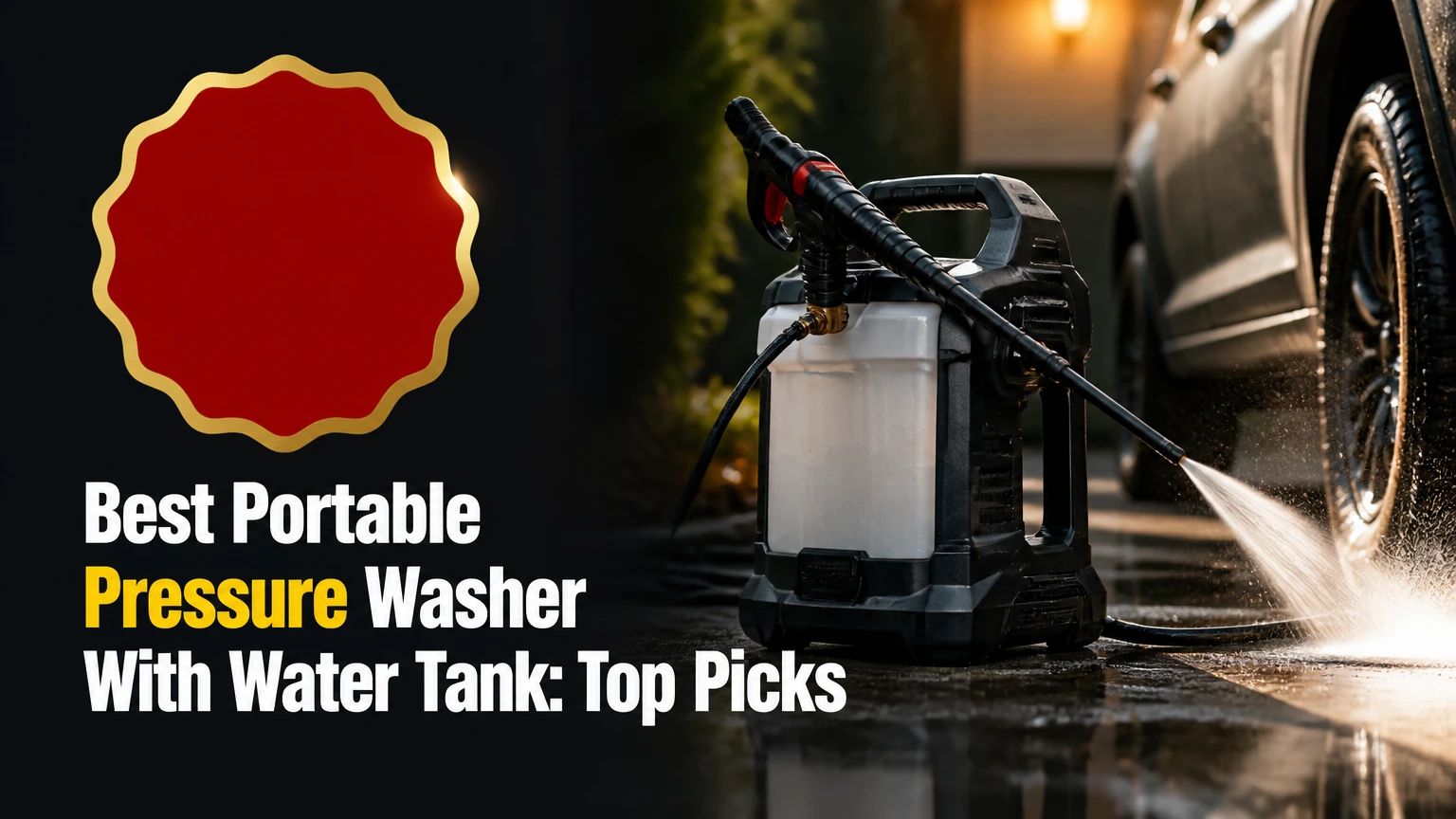
The best portable pressure washer with water tank for most vehicle owners is a battery-powered hard-tank washer with a 3-5 gallon reservoir, adjustable spray modes, a washable intake filter, and a real low-pressure setting. Choose an integrated tank for immediate, self-contained cleaning; choose a siphon-hose cleaner when higher pressure and bucket flexibility matter more than all-in-one portability.
Key facts at a glance
- A 4-gallon tank supplies about 5 minutes of continuous spraying at a typical 0.8 gallons per minute.
- Portable tank washers commonly deliver roughly 300-1,200 PSI, but advertised maximum pressure is not the same as pressure at the nozzle.
- Hard-tank units transport more securely; collapsible tanks store smaller but need careful support and cleaning.
- Battery runtime of 25-50 minutes does not mean 25-50 minutes of uninterrupted spraying.
- A washable intake filter matters when water comes from a bucket, jerry can, or campsite tap.
- Portable tank washers suit cars, bicycles, outdoor equipment, patios, and rinsing jobs, not large concrete restoration.
Which Portable Tank Washer Is Best for Each User?
The best choice depends on water access, cleaning surface, storage space, and acceptable refill frequency. A hard-tank washer is the strongest general-purpose option, a collapsible model is better for compact storage, and a battery hydro-gun with a siphon hose is usually better for users who already keep a large bucket nearby.
| User and job | Best design | Typical useful specification | Main compromise |
|---|---|---|---|
| Car owner washing one vehicle | Hard integrated tank | 3-5 gal, 400-900 PSI, 20-40 min battery use | Filled weight can exceed 30 lb |
| Mountain biker rinsing trail mud | Low-pressure tank or specialist bike washer | 300-650 PSI, 0.5-0.8 GPM | Slow removal of dried clay |
| Camper or overlander | Collapsible-tank washer | 3.4-5.3 gal, fold-flat reservoir | Less rigid during transport |
| Apartment resident | Compact hard tank | 2-4 gal, under 25 lb empty | Usually requires at least one refill |
| DIY user cleaning masonry | Siphon-hose power cleaner | 550-800 PSI typical, bucket-fed | No integrated reservoir |
| Boat or marina user | Filtered tank system | 4-5 gal, corrosion-resistant fittings | Saltwater still requires fresh-water flushing |
These figures are typical market ranges, not universal specifications. Product names, battery packs, charging systems, and included accessories vary by country and retailer, so the listing and owner’s manual should control the final decision.
Best overall: a hard-tank battery washer
A hard-tank cordless washer is the best default for washing a car, rinsing a bicycle, or cleaning equipment away from a hose. The rigid reservoir protects the pump inlet, keeps the machine stable, and makes the water volume predictable when the unit is carried in a vehicle.
Look for a 3-5 gallon tank, an adjustable fan nozzle, a trigger gun with a safety lock, a removable intake filter, and a hose that reaches at least 15-20 feet. Wheels help when the tank is full, but a carrying handle matters more on stairs or rough ground.
Best for tight storage: a collapsible-tank model
A collapsible-tank washer is the better choice for an apartment, small hatchback, or camping kit that must store flat. The empty reservoir may take substantially less space than a rigid canister, while the pump base remains compact enough for a storage bin.
The trade-off is mechanical support. A flexible reservoir can fold against the intake, tip during operation, or retain dirty water in creases. Place it on a level surface, inspect the fabric or silicone for punctures, and dry it fully before storage.
Best for higher pressure: a siphon-hose hydro-gun
A cordless hydro-gun with an intake hose is the better choice when a 5-10 gallon bucket is already available. DeWalt 20V MAX Power Cleaner and EGO Power+ pressure-cleaning systems illustrate this category, although battery and accessory bundles differ by market.
Siphon systems commonly occupy the 300-800 PSI range, with some listings quoting higher maximum values. They do not provide a built-in water tank, so they technically answer a different need. Their advantage is refill freedom: replace the bucket instead of carrying the entire machine’s reservoir.
How to Choose the Best Portable Pressure Washer With Water Tank
Choose a portable tank washer by ranking flow rate, usable pressure, water capacity, battery format, filtration, nozzle control, and serviceability. Tank size alone does not identify the best machine because a large reservoir paired with a high-flow pump can empty faster than a smaller, more efficient system.
| Criterion | Practical target | Why it matters | Warning sign |
|---|---|---|---|
| Tank capacity | 3-5 gal | Covers a vehicle rinse with limited refills | Capacity listed only in liters without usable fill level |
| Flow rate | 0.5-0.8 GPM | Extends water supply and reduces runoff | 1.2 GPM paired with a small tank |
| Working pressure | 300-900 PSI | Adequate for vehicles and outdoor gear | Only maximum PSI is published |
| Battery system | 18V-20V lithium-ion | Enables spare batteries and easier replacement | Proprietary pack with no replacement listing |
| Hose length | 15-25 ft | Reduces carrying and repositioning | Hose under 10 ft |
| Intake filtration | Removable mesh filter | Protects pump and nozzle from grit | Unprotected open inlet |
| Empty weight | Preferably under 20 lb | Determines portability before filling | Weight omitted from product page |
Why flow rate often matters more than PSI
Flow rate determines how quickly the tank empties, while pressure determines the force available at the nozzle. A 4-gallon tank lasts approximately 8 minutes at 0.5 GPM, 5 minutes at 0.8 GPM, or 3 minutes 20 seconds at 1.2 GPM during continuous discharge.
Manufacturers frequently advertise maximum pump pressure under controlled conditions. Greenworks’ pressure-washer buying guidance distinguishes pressure from flow, and the same principle applies to cordless machines: cleaning performance depends on both values, plus nozzle design and distance from the surface.
What pressure is safe for cars and bicycles?
A 300-900 PSI portable washer is generally suitable for exterior vehicle rinsing when used with a wide fan pattern and sensible distance. Pressure does not become automatically safe because the machine is cordless; a narrow jet held close to paint, decals, wheel-bearing seals, or electrical connectors can still cause damage.
For car paint, begin 12-18 inches away with the widest spray pattern and use detergent to loosen soil before increasing intensity. For bicycles, avoid directing a concentrated jet at headset bearings, bottom brackets, hub seals, suspension pivots, and electronic interfaces. Muc-Off’s mobile-cleaning guidance emphasizes controlled washing around sensitive bicycle components rather than indiscriminate high-pressure blasting.
How much water does a portable washer use?
A portable pressure washer uses 0.5-1.2 gallons per minute in common configurations, so a small tank provides minutes of spray time rather than an hour of continuous cleaning. Actual use lasts longer because users release the trigger while moving, brushing, applying foam, or inspecting a surface.
| Tank volume | 0.5 GPM | 0.8 GPM | 1.2 GPM |
|---|---|---|---|
| 2 gal | 4 min | 2 min 30 sec | 1 min 40 sec |
| 3 gal | 6 min | 3 min 45 sec | 2 min 30 sec |
| 4 gal | 8 min | 5 min | 3 min 20 sec |
| 5 gal | 10 min | 6 min 15 sec | 4 min 10 sec |
| 5.3 gal | 10 min 36 sec | 6 min 38 sec | 4 min 25 sec |
The calculation is tank volume divided by flow rate. Usable time is usually lower because manufacturers reserve tank volume below the pickup point, and a pump may lose prime before every advertised gallon is available.
Which Tank Design Fits Your Use?
Integrated hard tanks prioritize durability and predictable operation, while collapsible reservoirs prioritize storage efficiency. A siphon-hose cleaner is an alternative rather than a direct substitute because the water container remains separate from the motor and pump.
| Design | Typical capacity | Empty storage | Typical price | Best application |
|---|---|---|---|---|
| Hard canister | 3-5 gal | Large, rigid footprint | $120-$250 | Vehicle cleaning and repeated transport |
| Collapsible reservoir | 3.4-5.3 gal | Folds flat | $80-$150 | Camping and small apartments |
| Hydro-gun with hose | External bucket | Small motor body | $70-$180 | Quick rinses with available water |
| Hose-fed cordless washer | No tank | Compact | $100-$300 | Homes with a spigot but no outlet |
Price ranges are typical retail ranges and exclude occasional battery promotions. A tool-only hydro-gun can appear inexpensive until the battery, charger, intake hose, and nozzle kit are added.
Hard tank versus collapsible tank
Hard tanks are better for rough vehicle transport, fast filling, and stable pump pickup. Collapsible tanks are better when the machine must fit under a seat or inside a narrow equipment locker.
A full 4-gallon reservoir contains approximately 33.4 pounds of water before the machine, battery, hose, and wand are counted. That physical limit affects portability more than the advertised empty weight, especially when the washer lacks wheels.
How Do You Use a Portable Tank Pressure Washer?
Using a portable tank pressure washer correctly takes about 5-10 minutes of setup and requires clean water, a charged battery, the correct nozzle, and a stable water container. The most important success factor is preventing air from entering the pump while keeping grit out of the intake.
Before you start
- Time: 5-10 minutes for setup, plus 20-45 minutes for a vehicle or equipment wash.
- Difficulty: Basic, but pump priming and nozzle selection require care.
- Materials: Clean water, optional low-foaming detergent, microfiber mitt, soft brush, and a bucket for rinsing.
- Prerequisites: Charged battery, intact hose seals, clear intake filter, and a non-freezing storage location.
- Water quantity: Prepare 3-5 gallons for a thorough vehicle rinse, or 1-2 gallons for a bicycle rinse.
Step 1: Charge the battery and inspect the machine
Install a fully charged lithium-ion battery and inspect the hose, trigger, wand, tank cap, intake screen, and quick-connect seals. Do not rely on the battery indicator alone, because a pack can show charge while thermal protection or age reduces available runtime.
You will know the washer is ready when the battery locks securely and every water connection seats without visible gaps. A loose quick connector is a common cause of air leaks and intermittent pressure.
Step 2: Fill the tank with filtered clean water
Fill the reservoir with clean tap water below the marked maximum line. If the source contains sediment, pour through a clean mesh filter or allow the container to settle before filling.
Use detergent only in a compartment approved by the manufacturer. Never add household bleach, chlorine cleaner, solvent, or undiluted automotive chemical to the main tank unless the manual specifically permits that formulation.
Step 3: Prime the pump and purge air
Attach the intake assembly, wand, and widest spray nozzle. With the machine switched off, squeeze the trigger if the design permits free flow; then power the unit and allow water to run for 5-10 seconds until the stream becomes continuous.
You will know priming worked when the spray stops coughing and the pump tone becomes consistent. Running a dry pump can overheat seals, although the exact damage risk depends on the pump’s thermal protection and the manufacturer’s instructions.
Step 4: Select the widest effective spray pattern
Start with a broad fan pattern and low or eco mode. Hold the nozzle 12-18 inches from automotive paint, 18 inches from bicycle components, and farther away when testing an unfamiliar coating.
You will know the setting is appropriate when dirt moves without paint chips, loose decals, bearing noise, or water entering electrical housings. A narrow jet increases surface loading sharply as distance decreases.
Step 5: Pre-rinse, wash, and rinse systematically
Work from the top of the surface downward, keeping the nozzle moving rather than concentrating spray on one seam. Pre-rinse loose grit, apply compatible detergent with a foam attachment if available, agitate with a clean mitt, and finish with a controlled rinse.
You will know the process is working when runoff carries away loose soil without forcing abrasive grit across the surface. Refill before the pump begins to sputter, not after pressure has already collapsed.
Step 6: Empty, purge, clean, and store
Switch off the washer, remove unused water, and briefly squeeze the trigger to release residual pressure. Remove and rinse the intake filter, drain the hose, wipe the tank opening, and store the battery separately in a dry, moderate-temperature location.
You will know storage is complete when no standing water remains in the tank, hose, or pump inlet. In freezing climates, follow the manual’s winterization procedure because trapped water can expand and damage valves or fittings.
What Can You Clean With a Portable Tank Washer?
Portable tank washers are best for low-to-moderate soil on vehicles, bicycles, patio furniture, camping equipment, garden tools, and small outdoor areas. They are poor substitutes for a full-size 2,000-3,000 PSI electric washer when the task requires paint stripping, thick oil removal, or rapid concrete cleaning.
| Surface or task | Recommended setting | Water estimate | Main precaution |
|---|---|---|---|
| Car exterior | Wide fan, low or medium mode | 3-5 gal | Keep spray away from damaged clear coat |
| Mountain bike | Wide fan, low mode | 1-2 gal | Avoid hubs, pivots, seals, and electronics |
| Patio furniture | Medium fan, 12-18 in distance | 1-3 gal | Test fabric, wicker, and paint first |
| Camping gear | Low mode, 18 in distance | 1-2 gal | Avoid forcing water into tent seams |
| Muddy boots and tools | Medium mode | Under 1 gal | Remove stones from tread manually |
| Concrete oil stain | Not recommended as sole tool | 5+ gal | Use detergent, agitation, and stronger equipment |
The AI Overview’s suggestion that portable washers are “safe for delicate car clear-coats and bicycle bearings” needs qualification. Lower pressure reduces risk, but technique, nozzle angle, distance, contamination, and component condition determine the outcome.
Portable Tank Washer Versus Other Cleaning Tools
A tank washer wins on independence from mains water and electricity, but it does not win every cleaning comparison. A garden hose is cheaper for light rinsing, a corded pressure washer is faster for large hard surfaces, and a siphon cleaner offers a useful middle ground.
| Tool | Pressure or output | Water source | Setup and mobility | Best use |
|---|---|---|---|---|
| Portable tank washer | 300-1,200 PSI typical | 2-5 gal reservoir | 5-10 min, highly mobile | Cars, bikes, remote rinsing |
| Corded electric washer | 1,500-3,000+ PSI | Garden hose | Outlet and hose required | Patios, driveways, siding |
| Garden hose nozzle | 40-60 PSI typical hose supply | Tap and hose | Fast setup, tethered | Dust and loose pollen |
| Cordless siphon cleaner | 300-800 PSI typical | Bucket, tank, or hose | Small body, separate container | Camp and workshop rinsing |
| Pump sprayer | Hand-pumped low pressure | 1-2 gal tank | Very portable | Detergent pre-treatment |
Tank washer versus garden hose
A portable washer offers more concentrated cleaning force and works without a spigot, while a garden hose supplies water continuously at lower pressure. For dust, pollen, and loose mud, the hose may be faster because it does not require refilling.
For a vehicle in a parking area, the tank washer is more practical. For a driveway beside an outdoor tap, the hose is simpler and usually produces less pump noise and battery waste.
Tank washer versus corded pressure washer
A corded washer is the correct tool for large masonry surfaces, heavy algae, and paint preparation. Portable tank units conserve water and remove the need for an outlet, but their limited reservoir makes large-area work inefficient.
Consumer Reports and manufacturer buying guides commonly warn that PSI should not be evaluated without flow rate. That rule is especially important here: a compact device with a high advertised PSI may still clean slowly if its flow is only 0.5 GPM.
Common Problems and Their Fixes
Most portable washer failures come from air entering the inlet, debris blocking the filter or nozzle, battery protection activating, or seals losing compression. Diagnose the water path first, then the power system, because replacing a battery will not fix a blocked intake.
| Symptom | Likely cause | Immediate fix | Prevention |
|---|---|---|---|
| Motor runs with no spray | Air lock or unprimed pump | Remove wand and run trigger open for 5-10 sec | Keep inlet submerged and connections tight |
| Pulsing spray | Clogged tip or intake mesh | Rinse filter and clear nozzle with manufacturer-approved tool | Use clean or filtered water |
| Leak at tank base | Misaligned O-ring or connector | Depressurize and reseat seal | Inspect seals before each use |
| Motor stops quickly | Low battery or thermal protection | Cool pack and pump for 10 minutes | Use eco mode and avoid dry running |
| Weak spray after refill | Pickup tube shifted or water low | Reposition tube and refill above minimum | Do not operate below pickup level |
| Bad odor in tank | Water stored after use | Drain, rinse, and air-dry reservoir | Store empty with cap loose |
Do not force a metal paperclip through a precision nozzle unless the manufacturer permits it. A damaged or enlarged orifice changes the spray pattern and can reduce cleaning control.
What water and chemicals should you avoid?
Avoid muddy river water, sandy pond water, seawater, bleach, solvent, and thick household cleaners unless the washer manual explicitly approves them. Fine grit can score pump components or clog the spray tip, while incompatible chemicals can swell seals and attack plastic parts.
A dedicated external foam cannon or detergent bottle is safer than pouring concentrated cleaner into the main tank. Rinse the system with clean water after detergent use, particularly before storage.
What Should You Check Before Buying?
Check replacement batteries, charger inclusion, filters, nozzle availability, warranty terms, and regional model numbers before comparing headline PSI. A washer that costs $90 but has no replacement battery or inlet filter can cost more to keep operational than a $160 tool with supported consumables.
Use this buying checklist:
- Confirm whether the battery and charger are included.
- Find the rated flow rate, not only maximum PSI.
- Check the usable tank capacity and minimum water level.
- Prefer a removable, washable intake filter.
- Confirm hose, wand, and nozzle replacement availability.
- Look for an adjustable fan nozzle or at least two spray patterns.
- Verify whether detergent belongs in a separate reservoir.
- Compare empty weight and full operating weight.
- Check charging time, battery warranty, and pack availability.
- Confirm voltage, plug type, and model number for your country.
Bosch Fontus models, Muc-Off mobile washing systems, DeWalt 20V MAX Power Cleaner products, and EGO Power+ cleaners demonstrate different approaches to mobility and battery ownership. They should not be treated as identical products: some include a reservoir, some draw from an external container, and some bundles omit the battery.
How Much Should You Spend?
Expect approximately $80-$150 for a basic collapsible or tool-only portable cleaner, $120-$250 for many integrated hard-tank machines, and $200-$400 or more for premium battery systems once a battery, charger, hose, and specialist accessories are included.
| Budget | Likely configuration | Suitable workload | Value test |
|---|---|---|---|
| $70-$120 | Tool-only hydro-gun or basic compact washer | Short rinses and boots | Battery and charger may be extra |
| $120-$180 | Collapsible tank or entry hard tank | One bicycle or light car rinse | Inspect filter and seal quality |
| $180-$300 | Hard tank with better battery system | Regular vehicle and gear cleaning | Confirm replacement battery pricing |
| $300-$450 | Premium battery cleaner and accessories | Frequent mobile use | Pay for serviceability, not PSI alone |
Pricing changes with seasonal promotions and battery bundles. A lower purchase price is worthwhile only if the machine can maintain a seal, accept clean water easily, and obtain replacement consumables.
Expert Rules That Prevent Bad Purchases
Rule one: calculate water time before buying capacity. A 5-gallon tank at 1.2 GPM gives only about 4 minutes 10 seconds of continuous spray, so a slower 0.6-0.8 GPM machine may be more practical for vehicle washing.
Rule two: treat filled weight as the portability specification. Four gallons of water weigh about 33.4 pounds. Add the machine and battery, and a supposedly portable washer may become awkward to lift into a trunk.
Rule three: low pressure does not eliminate technique. A concentrated nozzle can damage decals, seals, soft timber, and deteriorated paint even when the pump’s maximum rating looks modest.
Rule four: filter quality predicts ownership experience. A washable inlet filter protects both the pump and nozzle, especially when users fill from a jerry can or campground tap.
Frequently Asked Questions
Can a portable pressure washer use hot water?
Most consumer cordless tank washers are designed for cold or ambient-temperature water, commonly below the temperature specified in the manual. Hot water can deform tanks, weaken hoses, or damage pump seals, so use warm water only when the manufacturer gives an explicit maximum temperature.
Can I use rainwater in a tank washer?
Rainwater can work if it is clean and filtered, but stored rainwater often contains roof grit, organic debris, and sediment. Filter it before filling, inspect the intake screen during use, and flush the washer with clean tap water afterward.
How long does a portable washer battery take to charge?
Typical lithium-ion charging time is approximately 60-180 minutes, depending on battery capacity and charger output. Runtime is often 25-50 minutes of motor operation, but trigger-off pauses mean the usable cleaning session can be longer than the continuous spray figure.
Can I wash a motorcycle with a portable tank washer?
Yes, a portable tank washer can rinse a motorcycle when used with a wide fan pattern, moderate distance, and low-to-medium pressure. Avoid wheel bearings, chain seals, electrical connectors, instrument clusters, and air intakes; hand agitation remains necessary for greasy drivetrain deposits.
Are portable pressure washers allowed at apartment buildings or campsites?
Permission depends on property rules, wastewater controls, noise limits, and local water restrictions. A 3-5 gallon washer reduces water use, but runoff may still carry detergent, oil, or mud into storm drains, so check the site’s cleaning and drainage requirements.
Is a portable tank washer worth buying without a garden hose?
A portable tank washer is worth buying when vehicle, bicycle, camping, or equipment cleaning occurs away from a spigot. It is poor value for frequent driveway cleaning beside a tap, where a hose-fed or corded machine avoids refills and provides longer uninterrupted operation.
The Bottom Line
The best portable pressure washer with water tank is usually a hard-tank cordless model with a 3-5 gallon capacity, 0.5-0.8 GPM flow, adjustable low-pressure control, a washable intake filter, and a supported battery system. Choose a collapsible unit for storage constraints, or a siphon-hose cleaner for higher pressure from an external bucket. Verify working pressure, actual flow, full operating weight, battery inclusion, and replacement parts before purchase.