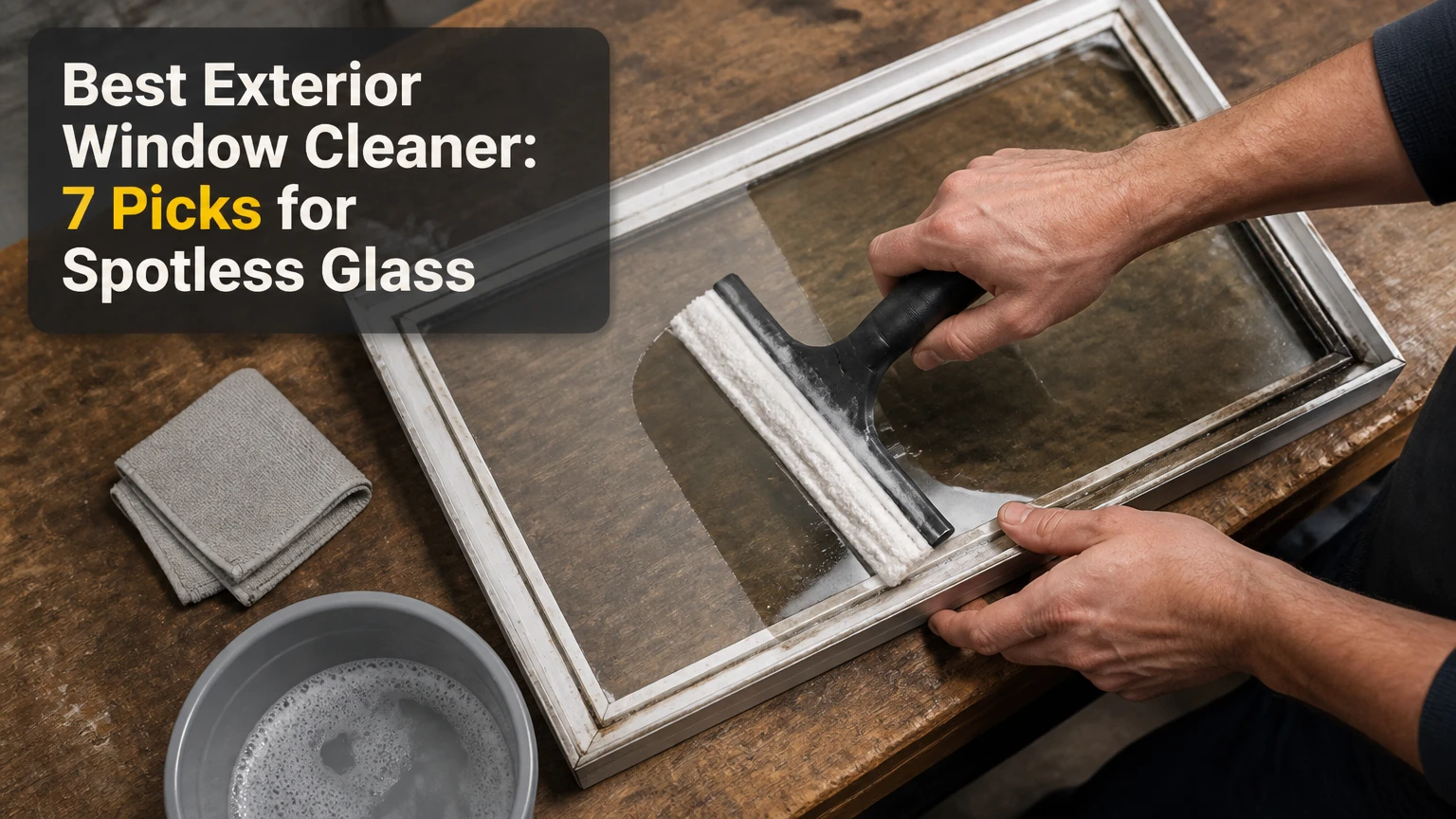
The best exterior window cleaner for most homes is a professional glass soap used with a microfiber washer and squeegee, because it removes organic grime economically and gives precise control. Pure-water cleaning is better for second-story glass, frames, and hard-water regions, while hose sprays suit quick maintenance and robots suit large, reachable panes rather than heavy buildup.
Key Facts at a Glance
- A squeegee-and-soap kit typically costs $25-$60 and works best for accessible, moderately dirty windows.
- Pure water should measure 0-10 parts per million total dissolved solids before spot-free rinsing.
- Excess detergent leaves a sticky film that attracts dust, pollen, and airborne pollution.
- Hard-water scale requires mineral treatment, not simply more glass cleaner.
- Exterior window washing usually takes 2-4 hours for a typical home, depending on pane count and access.
- Metal scraping can scratch coated, tempered, or dry glass; inspect the glass label before using a blade.
What Is the Best Exterior Window Cleaner?
A low-residue professional glass detergent paired with mechanical agitation is the best exterior window cleaner for ordinary residential grime. The strongest all-purpose setup uses a washer sleeve, clean water, a sharp rubber squeegee, and a separate microfiber detailing cloth, rather than a spray bottle alone.
Exterior glass accumulates several different soils. Pollen, dust, insect residue, bird droppings, and tree sap are mostly organic or particulate contaminants. Lawn sprinklers and rain add calcium and magnesium deposits, which remain after water evaporates and may eventually etch the glass.
The product matters, but the method matters more. A mediocre detergent used with abundant water, a clean washer, and a sound squeegee often outperforms a premium spray applied to dry, sun-heated glass. For upper-level windows, a water-fed pole can reduce fall exposure because the operator works from the ground.
A practical buying rule is simple: select soap for control, pure water for height and frames, a hose-end product for light maintenance, and a robot only when automation outweighs slow preparation and limited soil removal.
How We Chose the Top Exterior Window Cleaners
The ranking weighs soil-removal ability, drying behavior, surface compatibility, access, recurring cost, and operator safety. A cleaner that reaches a second story but leaves mineral spots does not rank above a slower system that produces a reliable finish.
The American Cleaning Institute explains that surfactants reduce water’s surface tension and help detach soil from surfaces. That mechanism explains why a small amount of glass detergent improves wetting and squeegee glide, but it does not mean more detergent cleans better.
Product labels control the final decision. Check dilution instructions, warnings for anodized aluminum or painted frames, restrictions on tinted film, and directions for runoff near plants. Never mix acids, ammonia, bleach, or other cleaners unless the manufacturer explicitly permits the combination.
Selection Criteria
| Criterion | Strong target | Why it matters |
|---|---|---|
| Squeegee detergent dilution | 1 teaspoon per 2 gallons | Limits residue while preserving glide |
| Pure-water output | 0-10 ppm TDS | Reduces mineral spotting during drying |
| Washer sleeve size | 10-18 inches | Covers common residential panes efficiently |
| Replacement squeegee rubber | Every 3-12 months typically | Prevents lines from nicks and rounded edges |
| Exterior cleaning frequency | 2-4 times yearly | Controls buildup before mineral damage worsens |
| Typical DIY setup | $25-$60 | Covers basic manual equipment |
| Typical professional pure-water cart | $1,500-$4,500+ | Includes filtration and water-fed access |
1. Professional Glass Soap and Squeegee: Best Overall
Professional glass soap used with a washer and squeegee is the best overall exterior window-cleaning system for most one- and two-story homes. The method removes dust, pollen, oily pollution, bird residue, and light sap with low equipment cost and excellent control.
A typical setup includes a 14-inch squeegee, a 14- to 18-inch microfiber or synthetic washer, a 4- to 6-gallon bucket, a lint-free towel, and concentrated window soap. Use approximately 1 teaspoon of detergent per 2 gallons of water unless the label specifies another dilution.
This method handles frames and screens well because the operator controls the water volume. It also exposes remaining defects immediately, allowing a second scrub before the pane dries. The trade-off is labor and access: upper-level glass may still require a properly rated extension pole or professional service.
A useful practitioner rule is to clean the frame before the glass. Frame dirt becomes slurry when wetted, and that slurry is often the source of recurring edge streaks.
Choose this if: windows are reachable, grime is moderate, and finish control matters.
Skip it if: ladder work is unavoidable or the local water supply creates severe spotting.
2. Pure-Water Water-Fed Pole: Best for High Windows
A reverse-osmosis and deionization pure-water system is the best exterior window cleaner method for second-story glass, conservatories, glass railings, and homes where ladder work creates unnecessary risk. Purified water rinses soil from glass and frames, then dries without mineral spots when the output remains near 0-10 ppm TDS.
Systems from manufacturers such as Unger use filtration and a brush attached to a telescoping pole. The brush agitates the glass while jets deliver purified water; the final rinse must flood the pane evenly so no tap-water residue remains.
Pure water does not dissolve every contaminant equally well. Fresh bird droppings, grease, silicone residue, paint, and heavy sap usually need additional agitation or a detergent pre-treatment. Pure water also cannot reverse glass that has already been chemically etched by minerals.
The initial cost is substantial. A basic deionization setup may cost hundreds of dollars, while commercial RO/DI carts with carbon-fiber poles commonly reach $1,500-$4,500 or more.
Choose this if: panes are high, frames need washing, or tap water is hard.
Skip it if: the home has only a few accessible windows and the equipment will sit unused.
3. Hose-End Window Spray: Best for Quick Maintenance
A hose-end exterior glass spray is the best choice for light, infrequent maintenance when reach is more important than perfect control. Concentrated bottles mix detergent with garden-hose water and can reach upper panes without a ladder.
Hose-end systems work acceptably on fresh dust, pollen, and loose cobwebs. They are less dependable on bird droppings, dried insect residue, tree sap, and mineral scale because the spray provides limited dwell-time control and the final rinse may contain 150-400 or more ppm TDS.
A common failure occurs when the bottle’s mixing ratio is misunderstood. A setting designed for a strong rinse may dilute the detergent excessively, while a concentrated setting can leave surfactant film. Follow the product label and test one shaded pane before treating the entire elevation.
Protect nearby plants and painted surfaces from runoff. Do not allow detergent solution to dry on siding, limestone, unfinished wood, or hot metal.
Choose this if: windows need a fast seasonal wash and spotting is tolerable or water is naturally soft.
Skip it if: the glass has hard-water scale or requires a polished, inspection-ready finish.
4. Neutral Ready-to-Use Glass Cleaner: Best for Light Soil
A ready-to-use neutral glass cleaner is best for small exterior panes, touch-ups, and lightly soiled glass that can be dried immediately. It is convenient because no dilution or bucket is required, but convenience does not compensate for poor reach or heavy soil.
Many consumer sprays are formulated for fingerprints and interior dust. Exterior contamination needs more liquid, more dwell time, and mechanical agitation than a quick mist provides. Spraying a hot pane can cause the carrier to evaporate before wiping, producing haze.
Use a wet microfiber cloth or washer rather than a paper towel. Paper fibers can shed, and a cloth washed with fabric softener may transfer a greasy film. Work in shade, rinse or wring the cloth frequently, and finish with a clean, dry edge towel.
Choose this if: the pane count is low and soil is fresh.
Skip it if: the windows have screens, heavy frames, dried droppings, or mineral deposits.
5. Chelating or Acidic Mineral Remover: Best for Hard-Water Scale
A purpose-made mineral remover is the best cleaner for white, chalky deposits caused by hard water, sprinkler overspray, or construction runoff. Chelating agents bind certain metal ions, while carefully formulated acidic products dissolve mineral deposits that ordinary detergent leaves behind.
Mineral removal requires a compatibility test. Apply the product to a small, inconspicuous section, use the label’s dwell time, agitate with a non-abrasive pad, and rinse completely. Protect stone, grout, aluminum finishes, vegetation, and painted surfaces according to the label.
Not every cloudy pane has removable scale. If the haze remains after safe cleaning, the glass may be etched. Etching is surface damage, not residue, and usually requires polishing or professional glass restoration.
Choose this if: white deposits feel rough or disappear when wet but return after drying.
Skip it if: the product label excludes the glass coating, frame material, or surrounding masonry.
6. Robotic Window Cleaner: Best for Routine Automation
A robotic window cleaner is best for recurring maintenance on large, relatively clean panes where manual labor is inconvenient. Models such as the Ecovacs Winbot W2 Omni and Hobot 388 use suction or adhesion, cleaning pads, and programmed paths, but they remain maintenance devices rather than restoration tools.
Robots generally need a cleanable contact area, a power source, safety tether, and manufacturer-approved fluid. They may struggle with deep frame recesses, narrow panes, textured glass, heavy mud, loose debris, and corners. Setup and pad-washing time can erase much of the convenience on a small home.
A robot should not be trusted as the only fall-prevention measure near an open drop. Follow the tether and surface restrictions exactly, and remain present during operation.
Choose this if: large picture windows need frequent light cleaning.
Skip it if: the glass has heavy deposits, divided-light grids, or uncertain adhesion.
7. Distilled Water and Microfiber: Best Low-Chemical Backup
Distilled or deionized water with a clean microfiber washer is a useful low-chemical backup for small panes and final rinsing. It reduces mineral residue but provides less lubricating action than a purpose-made soap solution.
This approach works best after loose soil has been removed. A dry dusty pane can turn abrasive when wiped with a damp cloth, and repeated rubbing may drag grit across the glass. Pre-rinse or wet the surface generously before contact.
Distilled water is practical for a few windows, not a whole house. A typical gallon weighs about 8.3 pounds, so carrying enough water for dozens of panes becomes inefficient.
Choose this if: chemical runoff is a concern and the pane count is modest.
Skip it if: grease, sap, or heavy environmental film requires strong wetting and agitation.
Which Cleaning Method Fits Your Windows?
The best method depends on access, soil, water quality, and desired finish. Soap wins for control, pure water wins for elevated work, and hose-end products win for speed only when mineral spotting is acceptable.
| Situation | Recommended method | Typical equipment cost | Expected finish |
|---|---|---|---|
| First-story windows with dust and pollen | Soap, washer, squeegee | $25-$60 | High control, low residue |
| Second-story exterior panes | Pure water and water-fed pole | $500-$4,500+ | Spot-free if TDS is 0-10 ppm |
| Sprinkler scale on glass | Mineral remover, then rinse | $15-$40 product cost | Variable, depending on etching |
| Large picture windows, light soil | Robot or squeegee | $150-$500 robot | Moderate to high, slow setup |
| Seasonal quick wash | Hose-end spray | $12-$25 per bottle | Variable with tap-water hardness |
| Small balcony panels | Distilled water and microfiber | $5-$15 | High when soil is light |
What Should You Use in Hard-Water Areas?
Use pure water for routine washing and a compatible mineral remover for existing scale. A hose-end spray cannot eliminate dissolved minerals from the rinse water, so a spotless result is unlikely when local TDS is high.
What Is Safest for Second-Story Windows?
A ground-based water-fed pole is generally safer than ladder work when the operator has adequate training and the pole can reach the glass. Do not extend beyond stable footing, work near electrical lines, or use a pole in wind that makes control unreliable.
How to Clean Exterior Windows Without Streaks
A typical DIY exterior window wash takes 2-4 hours for 15-25 medium panes and requires a washer, squeegee, bucket, towels, screen rack, and safe access. The factor that most determines the finish is keeping the glass wet until the squeegee completes each pass.
Step 1: Remove Screens and Protect the Area
Remove exterior screens, label their positions, and place them on a clean surface. Cover delicate plants if detergent runoff could reach them, and move furniture away from the work zone.
Wash screens separately with mild detergent, rinse them with a hose, and let them dry fully. A wet screen installed too soon can transfer dirty water to clean glass.
Checkpoint: every screen is dry and matched to its opening.
Common mistake: forcing a screen that belongs in another frame.
Step 2: Dry-Brush Frames and Sills
Use a soft-bristle brush to remove webs, loose dust, insect nests, and grit from frames, sills, tracks, and corners. This prevents loose debris from becoming abrasive slurry.
Checkpoint: no visible cobwebs or dry grit remains around the pane.
Common mistake: spraying first and turning dry dirt into mud.
Step 3: Wet and Scrub the Glass
Fill a bucket with clean water and add approximately 1 teaspoon of professional soap per 2 gallons, unless the label gives a different ratio. Saturate the washer, squeeze out excess only enough to control drips, and scrub in overlapping vertical and horizontal passes.
Give corners and the lower edge extra agitation. Keep the pane shaded whenever possible; direct sun can dry the working film before removal.
Checkpoint: the entire pane has a uniform wet film with no dry islands.
Common mistake: using extra soap to compensate for inadequate scrubbing.
Step 4: Squeegee the Wet Pane
Start at the upper corner and pull the squeegee in a continuous stroke or overlapping S-pattern. Keep consistent pressure, wipe the blade after each pass, and re-wet any section that begins to dry.
A clean, sharp rubber blade is more important than an expensive handle. Replace or turn the rubber when it develops nicks, rounded edges, or persistent lines.
Checkpoint: the pane shows no continuous water trails immediately after the final pass.
Common mistake: finishing a large pane with a dry blade.
Step 5: Detail Edges and Frames
Use a fresh waffle-weave or lint-free microfiber towel to remove water from gaskets, corners, the sill, and the top edge. Keep separate towels for frames and final glass detailing.
Checkpoint: no droplets remain at the upper gasket or lower sill.
Common mistake: using one saturated towel until it redeposits dirt.
Step 6: Inspect Before Reinstalling Screens
View the glass from two angles, preferably from inside and outside. If streaks appear, determine whether they are detergent residue, frame runoff, or mineral deposits before rewashing.
Reinstall dry screens only after the frame and sill are dry. Clean one small pane again if the cause remains uncertain.
Checkpoint: glass is clear in reflected daylight and screens sit squarely.
Common mistake: blaming the squeegee for residue that came from a dirty frame.
Common Problems and Precise Fixes
| Problem | Likely cause | Corrective action | Prevention |
|---|---|---|---|
| White spots after drying | High-TDS rinse water | Rewash with pure or distilled water | Measure output below 10 ppm |
| Squeegee chatter | Drying film or damaged rubber | Re-wet and replace rubber | Work in shade, wipe blade |
| Hazy center streaks | Dirty cloth or excess soap | Use a fresh towel and clean water | Wash cloths without softener |
| Dark edge trails | Dirty frame or gasket | Brush, wash, and detail edges | Clean frames before glass |
| Scratch-like lines | Grit or unsafe scraping | Stop and inspect under angled light | Pre-rinse, avoid dry blades |
| Sticky dust film | Over-concentrated detergent | Rinse and squeegee with low soap | Measure dilution precisely |
Mineral spots are the most misunderstood failure. If a deposit feels raised, safe chemical treatment may remove it; if the surface feels smooth and the mark remains after wetting, the glass may be etched.
Do not use a razor on tempered glass, coated glass, or unknown architectural glass without manufacturer approval. The Family Handyman and window manufacturers commonly advise wetting glass before any approved scraping, but wetting alone does not make every blade safe.
How Much Does Exterior Window Cleaning Cost?
DIY manual equipment typically costs $25-$60, hose-end concentrates cost $12-$25 per bottle, consumer robots cost approximately $150-$500, and professional pure-water systems often cost $1,500-$4,500 or more. Professional service pricing varies by region, pane count, access, screens, and restoration needs.
| Approach | Initial cost | Typical active time | Best economic case |
|---|---|---|---|
| Manual soap kit | $25-$60 | 2-4 hours per home | Few accessible windows |
| Hose-end concentrate | $12-$25 | 30-90 minutes | Light seasonal maintenance |
| Consumer robot | $150-$500 | 1-3 hours including setup | Repeated large-pane cleaning |
| Pure-water pole | $500-$4,500+ | 1-3 hours after setup | High windows or frequent work |
| Professional service | $150-$600 typical residential range | 1-3 hours onsite | Unsafe access or many panes |
The service range is a typical residential estimate, not a universal price. Local labor rates, height, storm windows, screens, paint, hard-water restoration, and travel can move the final quote substantially.
How Often Should Exterior Windows Be Cleaned?
Most homes benefit from exterior cleaning two to four times per year. Increase frequency near coastlines, construction, farms, dense trees, high-pollen regions, or sprinkler systems that wet the glass.
Seasonal washing is preventive rather than cosmetic. Removing deposits before they dry repeatedly reduces the chance that minerals, salt, and pollutants will bond to or etch the surface. A professional maintenance schedule may use quarterly visits, while a sheltered suburban home may need only spring and fall cleaning.
Inspect after major construction, roof work, wildfire smoke, or repeated irrigation overspray. Those events can create concentrated deposits that ordinary annual washing will not remove easily.
Which Exterior Window Cleaner Should You Pick?
Choose professional glass soap and a squeegee for the best balance of price, control, and finish on accessible residential windows. Choose pure water when height, frames, or hard water make conventional rinsing inefficient, and choose a mineral remover only for confirmed scale.
A hose-end spray is a maintenance shortcut, not a universal solution. A robotic window cleaner is a specialized convenience product, not a substitute for first-time deep cleaning or glass restoration.
The best exterior window cleaner is therefore a method matched to the soil and building. Start with access and water quality, then select chemistry, tools, and safety controls around those facts.
Frequently Asked Questions
Can I Use Dish Soap to Clean Exterior Windows?
A small amount of plain dish soap can clean exterior windows, but professional glass soap usually leaves less residue and provides more predictable squeegee glide. If using dish soap, begin near 1 teaspoon per 2 gallons, avoid antibacterial or lotion formulas, and rinse thoroughly because excess surfactant attracts dust.
Does Vinegar Remove Hard-Water Spots?
Vinegar may soften light mineral deposits because acetic acid reacts with some carbonate scale, but household vinegar is inconsistent on thick buildup and does not repair etched glass. Test compatibility first, protect stone and metal, and use a labeled mineral remover when the deposit is substantial.
Can I Clean Windows in Direct Sunlight?
You can clean windows in direct sunlight, but rapid evaporation increases streaking and detergent residue. Work on the shaded side, clean early or late in the day, use smaller sections, and re-wet any area that begins drying before the squeegee reaches it.
Are Hose-End Window Cleaners Spot-Free?
Hose-end window cleaners are not reliably spot-free when the final rinse uses hard tap water. Dissolved calcium and magnesium remain after evaporation, so a pure-water rinse or squeegee removal is necessary when the glass must dry without mineral marks.
How Do I Know Whether Glass Is Etched?
Wet the pane and inspect the mark under angled light. A raised, rough deposit that changes with wetting may be removable scale; a smooth haze that remains visible when wet may be etched glass, which requires polishing or professional restoration rather than stronger detergent.
Should I Hire a Professional for Second-Story Windows?
Hire a professional when windows require unstable ladder positions, extend over stairs or roofs, sit near electrical lines, or need pure-water equipment you will rarely use. Ground-based poles can reduce risk, but they still require stable footing, weather awareness, and correct equipment limits.