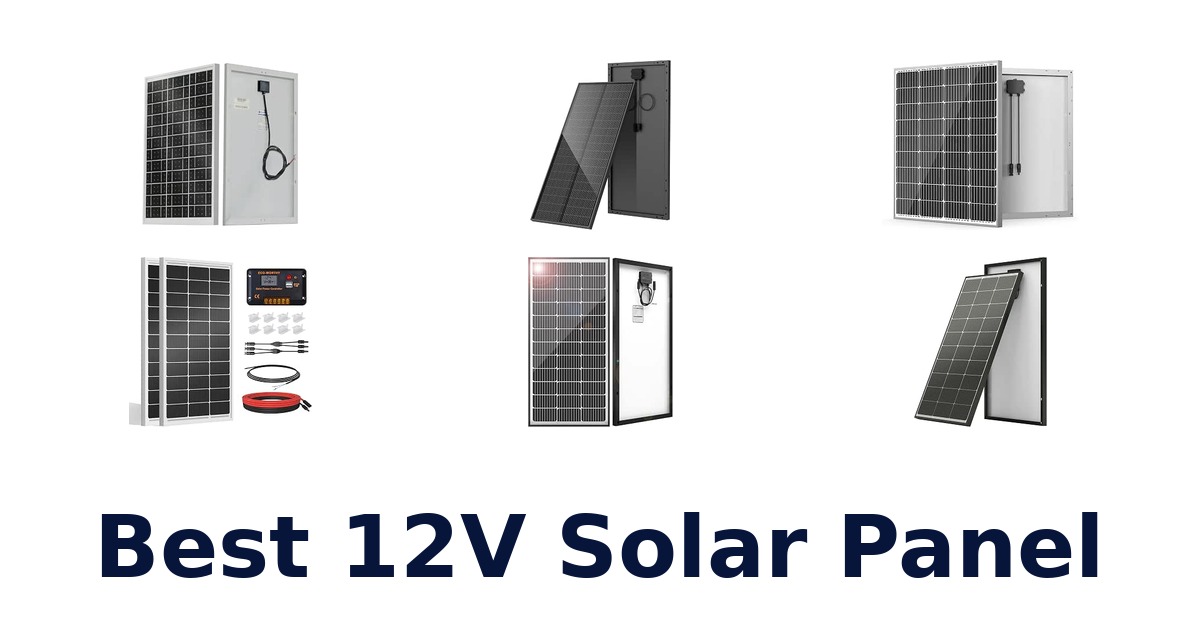
A strong 12V solar panel choice matches your battery system, available mounting space, and daily power needs; RV owners, boat users, and off-grid DIYers should also check whether a charge controller is included. This roundup compares ten rigid monocrystalline panels ranging from 25W to 200W, plus a 200W kit identified for 12V/24V use. The listed output-voltage figures vary, and a panel’s voltage is not necessarily the voltage delivered to a battery, so system compatibility matters more than a title alone.
For a ready-to-use starting point, the ECO-WORTHY 200-Watt Kit pairs a 200W rating with a stated 12V output and a PWM controller in its title. Smaller panels suit maintenance and limited loads, while higher-wattage options are aimed at greater generation potential.
The ECO-WORTHY 200-Watt Kit is the Best Overall pick because it combines a 200W rating with stated 12V/24V use and a 30A PWM charge controller in the product title. Its listed maximum voltage is 27.4V, and its panel dimensions are 35.2 by 23.1 inches. Check the supplied kit contents and controller wiring before installation, since the specifications list only the solar panel as an included component.
For a smaller battery-maintenance panel, the ECO-WORTHY 25W Panel is a more compact alternative.
Our Top Picks
 Best Overall
Its 200W rating, stated 12V/24V use, and 30A PWM controller in the title make it a compelling higher-output option for 12V setups.
View on Amazon Best Certified 200W Panel
This 200W panel states 12V output and lists TÜV certification to IEC 61215, IEC 61730, and UL 61730 standards.
View on Amazon Best Compact 100W Panel
Its 31.8-by-27.5-inch dimensions are described as 11% smaller than traditional panels, and the listing identifies it as a 12V panel.
View on Amazon- Best for Battery Maintenance ECO-WORTHY 25W Panel
Compare 12V Solar Panel Options
| # | Product | Dimensions | Weight | Amperage Capacity | Maximum Voltage | Buy |
|---|---|---|---|---|---|---|
| 1 | 1. ECO-WORTHY 200-Watt KitBest Overall | 35.2"L x 23.1"W x 1.3"H | 31.6 lb | 11 A | 27.4 V | View on Amazon |
| 2 | 2. ECOBOSS 200W PanelBest Certified 200W Panel | 30.3"L x 1.18"W x 52.7"H | 26.6 lb | 9.6 A | 20.84 V | View on Amazon |
| 3 |  3. Rvpozwer 200W PanelHigher-Output RV Roofs 3. Rvpozwer 200W PanelHigher-Output RV Roofs | 26.38"L x 1.18"W x 52.76"H | 19.2 lb | 9.75 A | 20.52 V | View on Amazon |
| 4 | 4. HQST 100W PanelBest Compact 100W Panel | 31.8"L x 27.5"W x 1.18"H | — | — | — | View on Amazon |
| 5 |  5. JJN 100W N-Type PanelHigh-Efficiency Rigid Panels 5. JJN 100W N-Type PanelHigh-Efficiency Rigid Panels | 22.7"L x 1.2"W x 38.2"H | 13.7 lb | 6.42 A | 20.8 V | View on Amazon |
| 6 |  6. JJN 100W 10BB PanelRigid 100-Watt Setups 6. JJN 100W 10BB PanelRigid 100-Watt Setups | 38.2"L x 22.7"W x 1.2"H | 13.7 lb | 6.42 A | 20.8 V | View on Amazon |
| 7 |  7. Renogy 50W PanelCompact 12-Volt Projects 7. Renogy 50W PanelCompact 12-Volt Projects | 22.8"L x 19.8"W x 1.2"H | 5.1 lb | 2.67 A | 24.3 V | View on Amazon |
| 8 |  8. ECO-WORTHY 25W PanelBest for Battery Maintenance 8. ECO-WORTHY 25W PanelBest for Battery Maintenance | 16.57"L x 12.6"W x 0.67"H | 2.06 kg | 1.22 A | 18 V | View on Amazon |
| 9 |  9. EtnalSolar 100W PanelN-Type Low-Light Setups 9. EtnalSolar 100W PanelN-Type Low-Light Setups | 39.76"L x 18.11"W x 1.18"H | 10.6 lb | 4.37 A | 25.92 V DC | View on Amazon |
| 10 |  10. Renogy ShadowFlux 120W PanelShaded Roof Installations 10. Renogy ShadowFlux 120W PanelShaded Roof Installations | 41.4"L x 22.8"W x 1.2"H | 8.69 kg | 4.57 A | 33.69 V | View on Amazon |
Detailed Reviews: Best 12V Solar Panel
#1 · Best Overall
1. ECO-WORTHY 200-Watt Kit
- Dimensions: 35.2"L x 23.1"W x 1.3"H
- Weight: 31.6 lb
- Amperage Capacity: 11 A
- Maximum Voltage: 27.4 V
Best for: Controller-Included RV Kits.
Why it ranks #1: Its 200W rating, stated 12V/24V use, and 30A PWM controller in the title make it a compelling higher-output option for 12V setups.
This ECO-WORTHY kit pairs a 200-watt solar-panel setup with a 30A PWM charge controller, giving RV and off-grid buyers both a panel and a named controller component. Its listed 12-volt DC output and broad application examples make it relevant to vehicle, marine and cabin power projects.
The 30A PWM charge controller is the key workflow detail for buyers assembling a charging setup, while the panel’s 12-volt DC output and 11-amp capacity provide electrical figures for system planning. ECO-WORTHY states up to 800 watt-hours per day under four hours of full sunshine, a planning estimate tied to those conditions. The monocrystalline panel is listed at 35.2 by 23.1 inches and 31.6 pounds, so its mounting surface and handling requirements deserve attention.
- Includes a 30A PWM charge controller
- 200-watt kit rating
- Listed 12-volt DC output
- Stated 800 watt-hours per day under four hours of full sunshine
- The 31.6-pound listed weight makes handling and mounting a consideration.
Skip it if you need a lightweight panel; Renogy’s 50W panel weighs 5.1 pounds.
Choose this ECO-WORTHY kit for an RV, camper, marine or cabin project where the included 30A PWM controller is useful. Plan around the panel’s listed weight and dimensions, and treat its daily-output figure as conditional on four hours of full sunshine.
Full product details
| Brand | ECO-WORTHY |
|---|---|
| Amperage Capacity | 11 A |
| Folded Size | / |
| Included Components | solar panel |
| Dimensions | 35.2"L x 23.1"W x 1.3"H |
| Item Weight | 31.6 pounds |
| Manufacturer | ECO-WORTHY |
| Part Number | AM-L02M100N-LCWMZ-2 |
| Material | Aluminum |
| Maximum Voltage | 27.4 volts |
| Model Number | L02M100N-LCWMZ-2 |
| Output Voltage | 12 volts_of_direct_current |
#2 · Best Certified 200W Panel
2. ECOBOSS 200W Panel
- Dimensions: 30.3"L x 1.18"W x 52.7"H
- Weight: 26.6 lb
- Amperage Capacity: 9.6 A
- Maximum Voltage: 20.84 V
Best for: Certified High-Output Roofs.
Why it ranks #2: This 200W panel states 12V output and lists TÜV certification to IEC 61215, IEC 61730, and UL 61730 standards.
TÜV certification to IEC 61215, IEC 61730 and UL 61730 distinguishes this 200-watt ECOBOSS panel for buyers prioritizing stated module and electrical-safety standards. Its N-type 16BB cells are specified at up to 25.8% conversion efficiency, targeting higher output from limited roof space.
The listed certifications address photovoltaic module design durability and electrical and mechanical safety, providing specific standards for buyers evaluating an RV, marine, rooftop or off-grid installation. N-type cells and 16BB technology are paired with a stated efficiency of up to 25.8%, while the 200-watt rating and 9.6-amp capacity help frame output planning. At 30.3 by 52.7 inches and 26.6 pounds, the panel calls for a suitably sized mounting area and secure handling.
- TÜV certified to IEC 61215, IEC 61730 and UL 61730
- 200-watt panel rating
- N-type 16BB cells
- Stated conversion efficiency up to 25.8%
- At 30.3 by 52.7 inches, the panel needs a large mounting area.
Skip it if you need a compact panel; ECO-WORTHY’s 25W panel measures 16.57 by 12.6 inches.
This ECOBOSS suits buyers seeking a certified 200-watt panel for rooftop, RV, marine or off-grid installations. Its standards and efficiency claims are specific advantages, but the 30.3-by-52.7-inch footprint and 26.6-pound weight set practical mounting boundaries.
Full product details
| Brand | ECOBOSS |
|---|---|
| Amperage Capacity | 9.6 A |
| Included Components | 200W solar panel 1 pack |
| Dimensions | 30.3"L x 1.18"W x 52.7"H |
| Item Weight | 26.6 pounds |
| Manufacturer | Hong Kong Xianglin |
| Part Number | 2244 |
| Manufacturer Warranty Description | 1 Year Manufacturer |
| Material | 3.2MM Tempered Glass, Aluminum, EVA Film, N-Type Monocrystalline Solar Cells, TPT Backsheet |
| Maximum Voltage | 20.84 volts |
| Model Number | 200W |
| Output Voltage | 12 volts |
| Special Features | 30 Year Long Lasting Outdoor Performance, Compact & Easy Installation, IP68、25.8% High Conversion Efficiency, N-Type 16BB CELL, TÜV Certified to IEC 61215, IEC 61730 & UL 61730 |
Listed on Amazon as: 200 Watt TÜV Certification N-Type Solar Panel, 25.8% Efficiency
View on Amazon#3
3. Rvpozwer 200W Panel
- Dimensions: 26.38"L x 1.18"W x 52.76"H
- Weight: 19.2 lb
- Amperage Capacity: 9.75 A
- Maximum Voltage: 20.52 V
Best for: Higher-Output RV Roofs.
Why it ranks #3: It pairs a 200W rating with listed 25% N-Type efficiency and 18BB technology, though its stated maximum voltage is 20.52V.
A 200-watt rating paired with N-type cells and stated 25% conversion efficiency makes this Rvpozwer panel an option for buyers seeking more output from a single module. Its 18BB technology is also presented as an efficiency and service-life improvement over traditional 10BB or 12BB designs.
The maker estimates approximately 1,000 watt-hours per day with around five to six hours of light, giving buyers a stated production reference for planning an installation. N-type cells and 18BB technology are linked to the panel’s claimed conversion efficiency, while the 9.75-amp capacity and 20.52-volt output specifications help inform electrical planning. At 26.38 by 52.76 inches, this 200-watt module needs a long, open mounting area; its tempered-glass and aluminum-frame materials are specified.
- 200-watt rated output
- N-type cells with stated 25% conversion efficiency
- 18BB technology
- Stated daily output of approximately 1,000 watt-hours under stated sunlight conditions
- At 26.38 by 52.76 inches, it requires a long mounting area.
Skip it if you have a compact roof area; HQST’s 100W panel measures 31.8 by 27.5 inches.
Consider this Rvpozwer panel when a 200-watt module and its stated daily production estimate fit your RV or off-grid planning. Its 26.38-by-52.76-inch footprint and electrical specifications should suit the available mounting and system layout.
Full product details
| Brand | Rvpozwer |
|---|---|
| Amperage Capacity | 9.75 A |
| Included Components | Case |
| Dimensions | 26.38"L x 1.18"W x 52.76"H |
| Item Weight | 19.2 pounds |
| Manufacturer | Rvpozwer |
| Part Number | Solarpanel black1502 |
| Material | 3.2MM Tempered Glas, EVA Film, Electroplated Aluminum Frame, Monocrystalline Solar Cell, TPT Backsheet See more |
| Maximum Voltage | 20.52 volts |
| Model Number | panneau solaire |
| Output Voltage | 20.52 volts |
| Special Features | 18BB Cell Design 、N-Type Solar Panel、 25% Conversion Efficiency 、30 Year Life Period |
Listed on Amazon as: 200 Watt Solar Panel 18BB, 25% High Efficiency, N-Type 12V 200W Solar Panel
View on Amazon#4 · Best Compact 100W Panel
4. HQST 100W Panel
- Dimensions: 31.8"L x 27.5"W x 1.18"H
Best for: Space-Conscious Roof Layouts.
Why it ranks #4: Its 31.8-by-27.5-inch dimensions are described as 11% smaller than traditional panels, and the listing identifies it as a 12V panel.
HQST’s square 31.8-by-27.5-inch footprint is presented as 11% smaller than traditional panels, making this 100-watt option relevant when roof area is constrained. Its Grade A+ cells and stated 23% conversion efficiency add a defined cell specification to that space-focused proposition.
The compact, square form is intended to make better use of limited roof areas and confined spaces, while the 100-watt rating identifies its output class. HQST specifies Grade A+ 166mm cells, 100% EL testing and up to 23% conversion efficiency; those details support buyers comparing cell quality and conversion claims. Its 12-volt DC output is relevant to system planning. At 31.8 by 27.5 by 1.18 inches, the panel’s listed dimensions provide a practical check against available mounting space.
- 100-watt panel rating
- Square 31.8-by-27.5-inch footprint
- Grade A+ 166mm cells
- Stated conversion efficiency up to 23%
- The listed output voltage is 12 volts DC; buyers needing another output specification should consider that limit.
Skip it if you need a stated 200-watt panel; ECOBOSS’s 200W panel has twice this panel’s rated wattage.
This HQST fits buyers seeking a 100-watt panel for a confined roof area who value its square footprint and specified Grade A+ cells. Compare the 31.8-by-27.5-inch dimensions with the mounting space and plan around its 12-volt DC output.
Full product details
| Brand | HQST |
|---|---|
| Included Components | solar panel |
| Dimensions | 31.8"L x 27.5"W x 1.18"H |
| Manufacturer | HQST |
| Part Number | HSP100DL-36 |
| Model Number | HSP100DL-36 |
| Output Voltage | 12 volts_of_direct_current |
Listed on Amazon as: HQST 100W 12V Solar Panel, 9BB, 23% High Efficiency, Grade A+ Cells, IP65
View on Amazon#5
5. JJN 100W N-Type Panel
- Dimensions: 22.7"L x 1.2"W x 38.2"H
- Weight: 13.7 lb
- Amperage Capacity: 6.42 A
- Maximum Voltage: 20.8 V
Best for: High-Efficiency Rigid Panels.
Why it ranks #5: The 100W N-Type panel lists 25% efficiency and 12-volt wording, but its specified output voltage is 17.5V rather than 12V.
JJN pairs N-type cells with a 16-busbar design and states up to 25% conversion efficiency, distinguishing this 100-watt panel by its cell architecture. Half-cut cell technology is also specified as a way to reduce power loss and support more stable performance.
The N-type cells and 16 busbars underpin the stated conversion efficiency of up to 25%, while half-cut cell technology is described as reducing power loss and lowering solar-panel temperature. These features give buyers specific design details to compare for a rigid installation. The panel is rated at 100 watts, with a 6.42-amp capacity and 17.5-volt output; its 38.2-by-22.7-inch footprint and 13.7-pound weight also inform mounting and handling plans.
- N-type cells
- 16-busbar design
- Stated conversion efficiency up to 25%
- Half-cut cell technology described as reducing power loss
- The 38.2-inch panel length can rule it out for short mounting spaces.
Skip it if you need a shorter 100-watt panel; HQST’s 100W panel measures 31.8 inches long.
This JJN suits buyers comparing high-efficiency cell designs for a rigid 100-watt installation. Its N-type, 16BB and half-cut features are specific advantages, but the 38.2-by-22.7-inch dimensions and 13.7-pound weight determine whether the mounting location is suitable.
Full product details
| Brand | JJN |
|---|---|
| Amperage Capacity | 6.42 A |
| Included Components | only solar panel |
| Dimensions | 22.7"L x 1.2"W x 38.2"H |
| Item Weight | 13.7 pounds |
| Manufacturer | JJN |
| Part Number | JJN100D-30-M10 |
| Material | Aluminum, Monocrystalline Silicon, Tempered Glass |
| Maximum Voltage | 20.8 volts |
| Model Number | JJN100D-30-M10 |
| Output Voltage | 17.5 volts |
| Special Features | rigid |
Listed on Amazon as: JJN 100 Watt Solar Panel, N-Type 16BB High Efficiency 12 Volt Solar Panels
View on Amazon#6
6. JJN 100W 10BB Panel
- Dimensions: 38.2"L x 22.7"W x 1.2"H
- Weight: 13.7 lb
- Amperage Capacity: 6.42 A
- Maximum Voltage: 20.8 V
Best for: Rigid 100-Watt Setups.
Why it ranks #6: This 100W panel lists 23% conversion efficiency and 6.42A capacity; its output voltage is 17.5V, so verify system compatibility.
JJN combines a 100-watt rating with Grade A+ monocrystalline cells and a stated 23% conversion rate, giving buyers concrete output and cell details for a rigid-panel setup. The maker also estimates up to 500 watt-hours per day with five hours of direct sunlight.
The stated 500-watt-hour daily estimate is tied to five hours of direct sunlight, offering a conditional planning reference rather than an unconditional output promise. Grade A+ cells and 10BB technology are the specified cell features behind the product’s efficiency positioning. Its 6.42-amp capacity and 17.5-volt output help describe its electrical profile, while the 38.2-by-22.7-inch dimensions and 13.7-pound weight matter when allocating mounting area and handling this rigid panel.
- 100-watt panel rating
- Grade A+ monocrystalline cells
- 10BB cell technology
- Stated 500 watt-hours per day with five hours of direct sunlight
- The 38.2-inch length requires more mounting space than compact panels.
Skip it if you have room for only a shorter panel; HQST’s 100W panel measures 31.8 inches long.
Consider this JJN for a rigid 100-watt setup where its stated daily estimate and 10BB cells match your planning needs. Its 38.2-inch length and 13.7-pound weight make mounting space and handling important fit considerations.
Full product details
| Brand | JJN |
|---|---|
| Amperage Capacity | 6.42 A |
| Included Components | solar panel only |
| Dimensions | 38.2"L x 22.7"W x 1.2"H |
| Item Weight | 13.7 pounds |
| Manufacturer | JJN |
| Part Number | AMCSolarPanel-100W |
| Material | Aluminum, Monocrystalline Silicon, Tempered Glass |
| Maximum Voltage | 20.8 volts |
| Model Number | AMCSolarPanel-100W |
| Output Voltage | 17.5 volts |
| Special Features | rigid |
| Additional Information | Important Information Wattage 100 watts |
Listed on Amazon as: JJN 100 Watt Solar Panels, 10BB Monocrystalline 12V 23% High Efficiency PV
View on Amazon#7
7. Renogy 50W Panel
- Dimensions: 22.8"L x 19.8"W x 1.2"H
- Weight: 5.1 lb
- Amperage Capacity: 2.67 A
- Maximum Voltage: 24.3 V
Best for: Compact 12-Volt Projects.
Why it ranks #7: Its specifications explicitly list 12V DC output, and bypass diodes are described as minimizing shade-related power drops for smaller setups.
A 50-watt rating and 12-volt DC output make this Renogy panel a modest-output choice for smaller solar projects. Its bypass diodes are specified to minimize shade-related power drop, while its 22.8-by-19.8-inch footprint offers a more compact panel format than the larger modules in this roundup.
The bypass diodes are intended to minimize power drop caused by shade, and the product information also cites low-light performance, useful details for a mounting spot that does not receive uninterrupted sun. Multi-layer encapsulation supports cell performance and service life, while the corrosion-resistant aluminum frame is identified for outdoor use. At 50 watts and 2.67 amps, this is a smaller-output panel; its 12-volt DC output specification and 24.3-volt maximum voltage are distinct electrical figures to consider when planning a system.
- 12-volt DC output specification
- Bypass diodes minimize shade-related power drop
- Stated low-light performance
- Corrosion-resistant aluminum frame
- Its 50-watt rating provides less panel output than 100-watt and 200-watt options.
Skip it if you need a 100-watt panel; HQST’s 100W panel offers twice this panel’s rated wattage.
This Renogy suits buyers assembling a smaller 12-volt solar project who value bypass diodes and an outdoor-rated aluminum frame. Its 50-watt rating is the key boundary, so consider whether that output matches the intended load.
Full product details
| Brand | Renogy |
|---|---|
| Amperage Capacity | 2.67 A |
| Included Components | Renogy 50 Watt N-Type Solar Panel |
| Dimensions | 22.8"L x 19.8"W x 1.2"H |
| Item Weight | 5.1 pounds |
| Manufacturer | Renogy |
| Part Number | Renogy 50 Watt 12 Volt Monocrystalline S |
| Manufacturer Warranty Description | 5-year material and workmanship warranty |
| Material | Aluminum |
| Maximum Voltage | 24.3 volts |
| Model Number | Solar Panel 50 Watt |
| Output Voltage | 12 volts_of_direct_current |
Listed on Amazon as: Renogy Solar Panels 50 Watt, 25% High-Efficiency N-Type Solar Panel
View on Amazon#8 · Best for Battery Maintenance
8. ECO-WORTHY 25W Panel
- Dimensions: 16.57"L x 12.6"W x 0.67"H
- Weight: 2.06 kg
- Amperage Capacity: 1.22 A
- Maximum Voltage: 18 V
Best for: Small Battery Maintenance.
Why it ranks #8: At 25W and 16.57 by 12.6 inches, it is aimed at maintaining 12V batteries and smaller loads rather than substantial generation.
At 25 watts and 16.57 by 12.6 inches, this ECO-WORTHY panel offers a compact format for maintaining or charging a 12-volt battery. The maker states 100 watt-hours per day under four hours of full sunshine, giving small off-grid applications a conditional output reference.
The 12-volt output and 1.22-amp capacity identify the panel’s electrical profile for battery-charging plans, while the maker names RV, car, boat and trailer batteries among possible uses. Its 39.3-inch extension cable can reach a charge controller or 12-volt load, supporting more flexible placement within that distance. The 16.57-by-12.6-inch size and 2.06-kilogram weight support portability; the stated 100-watt-hour daily figure depends on four hours of full sunshine.
- 25-watt panel rating
- 12-volt output specification
- 39.3-inch extension cable
- Waterproof panel listed for battery charging and maintenance
- Its 25-watt rating limits it to lower-output charging and maintenance needs.
Skip it if you need more panel output; Renogy’s 50W panel has twice this panel’s rated wattage.
Choose this ECO-WORTHY for compact 12-volt battery maintenance in an RV, boat, trailer or similar off-grid application. Its 25-watt rating and 39.3-inch cable are the key boundaries to weigh against the intended charging task and panel placement.
Full product details
| Brand | ECO-WORTHY |
|---|---|
| Amperage Capacity | 1.22 A |
| Included Components | Solar Panel Module |
| Dimensions | 16.57"L x 12.6"W x 0.67"H |
| Item Weight | 2.06 kg |
| Manufacturer | ECO-WORTHY |
| Part Number | AM-L02P25-1 |
| Material | Monocrystalline Silicon |
| Maximum Voltage | 18 volts |
| Model Number | AM-L02M25-1 |
| Output Voltage | 12 volts |
| Special Features | Waterproof |
#9
9. EtnalSolar 100W Panel
- Dimensions: 39.76"L x 18.11"W x 1.18"H
- Weight: 10.6 lb
- Amperage Capacity: 4.37 A
- Maximum Voltage: 25.92 V DC
Best for: N-Type Low-Light Setups.
Why it ranks #9: Its 100W N-Type panel lists 25.6% cell efficiency, but its specified output voltage is 22.89V, requiring careful system matching.
A+ grade N-type cells with 18BB busbar technology and stated 25.6% conversion efficiency define this EtnalSolar panel’s specification profile. The product information links its denser busbars and reduced internal resistance to energy capture and lower loss, including in low-light conditions.
The 18BB design is described as reducing internal resistance and energy loss, while finer, denser busbars increase light-absorption area; the product also states performance in low-light conditions. These features accompany a 100-watt rating and 4.37-amp capacity for buyers planning a single-panel system. Its 39.76-by-18.11-inch dimensions help evaluate mounting fit. The listed maximum voltage is 25.92 volts DC and output voltage is 22.89 volts DC, figures to account for in electrical planning.
- A+ grade N-type monocrystalline cells
- 18BB busbar technology
- Stated conversion efficiency up to 25.6%
- Product claims low-light energy capture
- Its listed output voltage is 22.89 volts DC, which may not suit every system configuration.
Skip it if you need a listed 12-volt output; ECO-WORTHY’s 25W panel specifies 12 volts.
Consider this EtnalSolar for a 100-watt installation where N-type cells, 18BB technology and the stated low-light performance suit your priorities. Check its listed 22.89-volt output and 39.76-by-18.11-inch dimensions against system and mounting requirements.
Full product details
| Brand | EtnalSolar |
|---|---|
| Amperage Capacity | 4.37 A |
| Included Components | Solar Panel, User Manual*1 |
| Dimensions | 39.76"L x 18.11"W x 1.18"H |
| Item Weight | 10.6 pounds |
| Manufacturer | EtnalSolar |
| Manufacturer Warranty Description | 10 Year Manufacturer |
| Material | 3.2mm High-Transparency Tempered Glass, A+ N-Type Monocrystalline Cells, Electroplated Aluminum Frame, POE Film, TPT Backsheet See more |
| Maximum Voltage | 25.92 volts_of_direct_current |
| Model Number | GF100W-B01 |
| Output Voltage | 22.89 volts_of_direct_current |
| Special Features | 18 Busbars, 25.6% High Efficiency, Waterproof |
Listed on Amazon as: 100 Watt 18BB 25.6% High Efficiency Solar Panel 12 Volt N-Type
View on Amazon#10
10. Renogy ShadowFlux 120W Panel
- Dimensions: 41.4"L x 22.8"W x 1.2"H
- Weight: 8.69 kg
- Amperage Capacity: 4.57 A
- Maximum Voltage: 33.69 V
Best for: Shaded Roof Installations.
Why it ranks #10: Although its 120W ShadowFlux design addresses common shading, the specifications list 24V output, making it a less direct fit for 12V searches.
ShadowFlux cell technology is the defining feature here: it is intended to reduce power loss from common shading, including small spots such as leaves or bird droppings and lines such as wires. That makes this 120-watt panel relevant when a roof or mounting area cannot stay completely clear throughout the day.
The 120-watt rating and 24-volt DC output give buyers a higher-output panel to evaluate for a solar setup, while the stated 4.57-amp capacity helps clarify its electrical specifications. ShadowFlux technology targets power loss from common shaded spots and lines, which can matter on installations where nearby objects intermittently cast shadows. Its aluminum frame, monocrystalline silicon and tempered-glass construction identify the materials used; at 41.4 by 22.8 inches, its dimensions also call for a substantial mounting area.
- ShadowFlux technology targets power loss from common shading
- 120-watt rated output
- 24-volt DC output specification
- Aluminum, monocrystalline silicon and tempered-glass construction
- At 41.4 by 22.8 inches, it needs a substantial mounting area.
Skip it if you have space for only a small panel; ECO-WORTHY’s 25W panel measures 16.57 by 12.6 inches.
Choose this Renogy for a larger installation where common small-spot or line shading is a concern and its 120-watt rating suits the setup. Check the mounting area and electrical requirements before committing to its 41.4-by-22.8-inch panel.
Full product details
| Brand | Renogy |
|---|---|
| Amperage Capacity | 4.57 A |
| Included Components | Solar Panel |
| Dimensions | 41.4"L x 22.8"W x 1.2"H |
| Item Weight | 8.69 kg |
| Manufacturer | Renogy |
| Part Number | 120W ShadowFlux Anti-Shading N-Type |
| Material | Aluminum, Monocrystalline Silicon, Tempered Glass |
| Maximum Voltage | 33.69 volts |
| Model Number | 120W ShadowFlux N-Type Panel |
| Output Voltage | 24 volts_of_direct_current |
Listed on Amazon as: Renogy ShadowFlux Solar Panel 120 Watt, N-Type 25% High-Efficiency
View on AmazonWhy a 12V panel label can mislead
A 12V label usually describes the battery-system category, not a promise that the panel’s operating output is exactly 12 volts. These listings illustrate the distinction: the Renogy 50W Panel specifies 12V DC output, while both JJN 100W panels specify 17.5V output and the Renogy ShadowFlux 120W Panel lists 24V output. The ECOBOSS 200W Panel lists 12V output but also a 20.84V maximum voltage.
Those different fields should not be treated as interchangeable. Before connecting a panel, confirm the charge controller accepts its voltage and is suitable for the battery chemistry and system arrangement.
A panel connected directly to a battery may not provide appropriate charging regulation. Also check whether the product is a single panel or a complete charging kit; a controller mentioned in a title does not match the included-components field for every listing.
Shade, orientation, and real-world output
Partial shade can reduce a panel’s useful production, so placement and wiring matter alongside rated wattage. The Renogy 50W Panel listing says bypass diodes minimize power drop caused by shade, while the Renogy ShadowFlux 120W Panel describes technology intended to reduce losses from common small spots and line-shaped shadows. Those features address shading, but the provided data does not quantify their output under a particular obstruction.
Keep leaves, dirt, and other obstructions away where possible, and avoid assuming a panel will reach its rated wattage throughout the day. The Rvpozwer 200W Panel estimates about 1,000Wh per day based on roughly five to six hours of light, while the ECO-WORTHY 200-Watt Kit cites 800Wh per day under four hours of full sunshine.
These are different stated conditions, not directly comparable guarantees.
How to Choose a 12V Solar Panel
Match voltage to the charging system
Look beyond the 12V wording and check the listed output and maximum voltage against your controller’s input limits. Across these products, stated output ranges from 12V for the Renogy 50W Panel and ECOBOSS 200W Panel to 24V for the Renogy ShadowFlux 120W Panel; the JJN panels list 17.5V output, and the EtnalSolar 100W Panel lists 22.89V. Maximum-voltage entries include 20.8V on the JJN panels and 33.69V on the ShadowFlux.
Buyers replacing a small panel should prioritize a clear match to existing equipment; those building a new system can choose a compatible controller around the panel’s specifications.
Choose wattage for the job
Select wattage according to what you need to power or maintain, rather than choosing the largest panel automatically. This set spans the ECO-WORTHY 25W Panel for battery maintenance, the Renogy 50W Panel, several 100W panels, the 120W ShadowFlux, and three 200W choices. The ECO-WORTHY 25W listing estimates 100Wh per day under four hours of full sunshine; the ECO-WORTHY 200-Watt Kit cites 800Wh per day under that same stated duration.
These are listing estimates, not guaranteed output. A buyer maintaining a small battery may prefer the lower-wattage end, while an RV or off-grid user with greater daily demand may favor 100W or 200W—after checking space, sunlight, and controller capacity.
Check dimensions and mounting space
Compare the panel’s actual listed dimensions with your roof, rack, or portable setup before choosing. The ECO-WORTHY 25W Panel measures 16.57 by 12.6 inches, while the HQST 100W Panel measures 31.8 by 27.5 inches and is presented as a space-conscious square design. The JJN 100W Panel measures 38.2 by 22.7 inches, and the Rvpozwer 200W Panel measures 26.38 by 52.76 inches.
Buyers with limited or irregular mounting area may prefer a smaller footprint, while users with clear roof space can consider larger 200W formats. Leave room for mounting hardware and cable access; the supplied product dimensions describe the panels, not the clearances required by a finished installation.
Which 12V Solar Panel Should You Choose?
For a higher-output starting point, choose the ECO-WORTHY 200-Watt Kit: it is identified for 12V/24V systems and names a 30A PWM controller, though the included-components field should be checked. If recognized module certification is your priority, the ECOBOSS 200W Panel lists TÜV certification and 12V output. For 100W in a more compact footprint, consider the HQST 100W Panel; for a smaller battery-maintenance task, choose the ECO-WORTHY 25W Panel.
The Renogy 50W Panel is a modest option with explicitly listed 12V DC output and bypass diodes. Do not select solely by a 12V label: compare panel voltage with controller limits, available mounting area, and your expected daily energy use before buying.
Related Buying Guides
- Best Solar Panel For Car
- Best Marine Solar Panel
- Best Solar Panel For Van
- Best Roof Rack For Solar Panels
Frequently Asked Questions
Do I need a charge controller between a solar panel and a 12V battery?
Usually, yes: a charge controller regulates power from the panel to help protect the battery from overcharging. Check the controller’s supported battery voltage and solar input limits against the panel specifications. Some kits name a controller, but verify the included components and wiring before installation rather than assuming they are supplied.
How many watts of solar panel do I need for my battery and daily loads?
Choose panel wattage based on your daily energy use, battery capacity, and the sunlight available where you will use the system. Estimate the energy your loads consume, then account for charging losses and less-than-ideal sun. Without those details, a wattage recommendation would be guesswork; compare expected daily production with your actual needs.
Can I connect a panel labeled 12V directly to a 12V battery?
Do not rely on the 12V label alone to determine whether direct connection is appropriate. Compare the panel’s electrical specifications with the battery requirements and controller limits, and use a suitable charge controller when required. A panel’s listed voltage can differ from the voltage a battery needs during charging, so check compatibility before connecting.
How do I compare a panel’s voltage with a controller’s limits?
Check the panel’s listed voltage against the controller’s allowable solar input, and confirm that the controller supports your battery system. The ECO-WORTHY kit listing gives a maximum voltage of 27.4V and names a 30A PWM controller, but verify the kit contents and wiring. Do not assume a 12V label establishes compatibility by itself.
What should I check before mounting a solar panel?
Confirm that the panel fits the available mounting area and that its wiring can reach the controller and battery safely. Check the product’s dimensions and mounting information; the ECO-WORTHY 200-Watt Kit panel is listed as 35.2 by 23.1 inches. Also verify the supplied components and installation requirements before beginning.
Final Words
Choose according to the job: the ECO-WORTHY 200-Watt Kit is the overall pick, with stated 12V/24V use and a 30A PWM controller, but verify its contents and wiring. For maintenance, the ECO-WORTHY 25W Panel is a smaller alternative; the HQST suits a compact 100W option. Compare voltage limits, mounting space, and daily energy needs before connecting any panel to a battery.