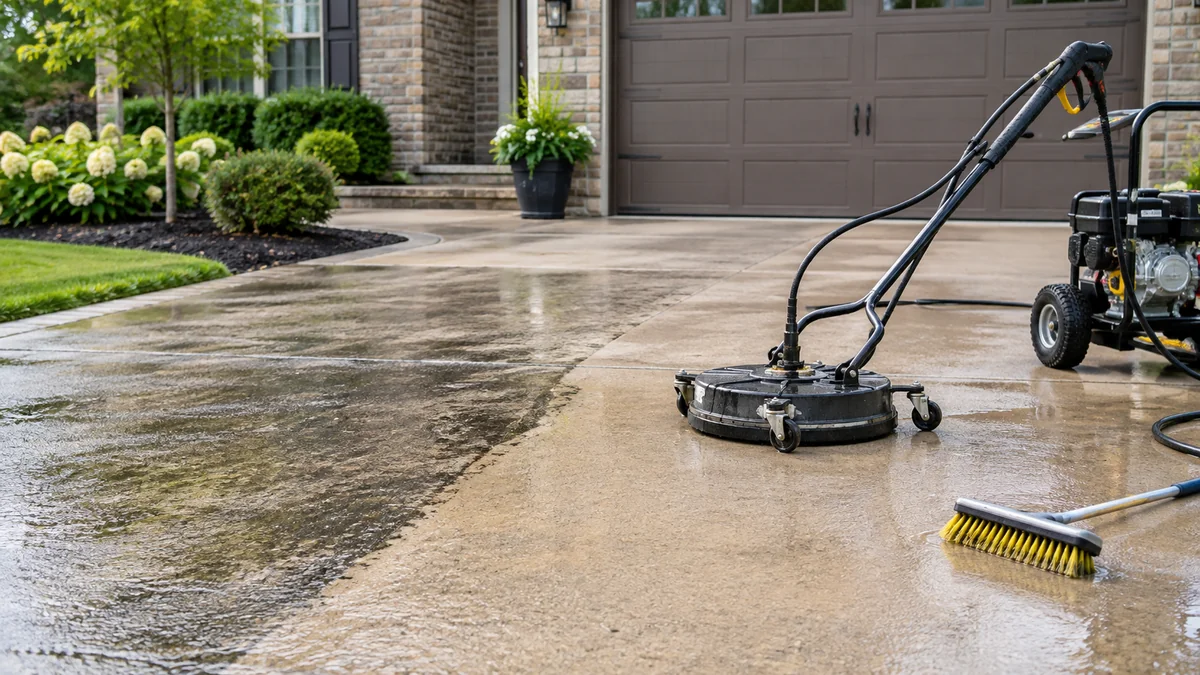
Pressure washing a driveway typically costs $100-$500, with many homeowners paying about $150-$250 for a standard 400-800-square-foot concrete driveway. Contractors may quote $0.10-$0.50 per square foot, a flat project price, or $50-$125 per hour. Oil removal, difficult access, delicate materials, and minimum service charges can raise the final bill.
Key Facts at a Glance
- A standard two-car concrete driveway usually costs $120-$240 to clean professionally.
- Driveway pressure washing commonly takes 45 minutes to 3 hours, depending on size, stains, preparation, and water flow.
- Concrete generally tolerates more pressure than asphalt, pavers, brick, or stamped concrete.
- A contractor’s minimum charge can make a small driveway cost more than square-foot math suggests.
- Hot-water cleaning is usually more effective than cold water for oil, grease, and chewing gum.
- DIY cleaning often costs $50-$150 for rental equipment, detergent, and accessories, before accounting for your time or potential repairs.
How Much Does Pressure Washing a Driveway Cost?
Professional driveway pressure washing costs $100-$500 nationally, while a typical residential job falls near $150-$250. The most useful estimate combines surface area, driveway material, stain severity, access, local labor rates, and whether the contractor must use hot water or specialty chemicals.
Angi, HomeGuide, and HomeAdvisor publish broad national ranges that overlap substantially, but local quotes can differ because these services are labor-intensive and commonly subject to minimum charges. A 250-square-foot driveway may still receive a $100-$150 quote when the provider must load equipment, travel, set up, protect landscaping, and dispose of wastewater.
A quote below the typical range is not automatically better. It may exclude degreasing, pretreatment, sealing, travel, or cleaning of the sidewalk and apron.
Typical Cost by Driveway Size
| Driveway size | Typical area | Professional price | Typical cleaning time |
|---|---|---|---|
| One-car driveway | 200-400 sq. ft. | $80-$160 | 45-90 minutes |
| Two-car driveway | 400-800 sq. ft. | $120-$240 | 1-2 hours |
| Three-car driveway | 800-1,200 sq. ft. | $200-$400 | 2-3 hours |
| Long or extra-large driveway | 1,200-2,000+ sq. ft. | $350-$600+ | 3-5 hours |
These figures describe typical residential cleaning, not concrete repair, oil remediation, sealing, or paint removal. A long driveway with a nearby outdoor faucet may cost less than a smaller surface that requires a long hose run, extensive plant protection, or wastewater control.
What Determines the Price of Driveway Cleaning?
Driveway cleaning prices depend primarily on area, material, contamination, access, local labor, and the service scope written into the quote. Square footage is the starting point, but stain treatment and setup often determine whether a job lands near the low or high end.
Square Footage and Minimum Charges
Many contractors calculate a rough production price of $0.10-$0.30 per square foot for ordinary concrete, then apply a minimum charge commonly ranging from $100-$150. Specialty work can reach $0.40-$0.60 per square foot.
For example, 600 square feet multiplied by $0.20 produces $120. If the contractor’s minimum is $150, the invoice will usually be $150 rather than $120. A 1,500-square-foot driveway may receive a lower unit price because setup time is spread over more cleaning area.
Measure length multiplied by average width. For an irregular driveway, divide the surface into rectangles and triangles, then add the areas. Include the concrete apron and sidewalk only if the quote covers them.
Material and Surface Condition
Material changes both the safe cleaning method and the labor required. A contractor who uses the same pressure setting on concrete and asphalt is ignoring a meaningful damage risk.
| Surface material | Typical cleaning price | Common safe approach | Main risk |
|---|---|---|---|
| Plain concrete | $0.10-$0.30/sq. ft. | Surface cleaner, detergent, 2,000-3,000 PSI when appropriate | Etching or streaks |
| Asphalt | $0.15-$0.35/sq. ft. | Lower pressure, controlled detergent application | Loose aggregate and binder damage |
| Brick or masonry | $0.20-$0.45/sq. ft. | Low pressure, wide spray, careful rinsing | Mortar erosion |
| Concrete pavers | $0.20-$0.45/sq. ft. | Moderate pressure and joint protection | Dislodged joint sand |
| Stamped or coated concrete | $0.20-$0.50/sq. ft. | Low-to-moderate pressure and testing | Pattern, dye, or sealer damage |
Stamped concrete deserves special caution. The surface may have a decorative release color and sealer that a strong nozzle can strip or expose unevenly. A contractor should test an inconspicuous area before cleaning the entire driveway.
Stains, Organic Growth, and Heavy Soil
Ordinary dust and mud usually fit the base price. Oil, rust, algae, moss, tire marks, paint, and chewing gum often require extra labor or chemicals.
| Contaminant | Likely treatment | Typical add-on | Expected difficulty |
|---|---|---|---|
| Light mud and dust | Detergent and surface cleaning | $0-$25 | Low |
| Algae or moss | Biocidal pretreatment and dwell time | $25-$75 | Moderate |
| Fresh oil | Degreaser, agitation, rinse | $25-$75 | Moderate |
| Old oil or grease | Repeated degreasing, hot water | $50-$150+ | High |
| Rust | Acid-based rust remover and controlled rinse | $30-$100 | Moderate-high |
| Chewing gum | Hot water, scraper, spot treatment | $25-$100 | Moderate |
| Paint or sealer | Specialized stripping process | $100-$500+ | High |
No cleaning process can guarantee complete removal of an old oil stain. Hydrocarbons can migrate through porous concrete, and repeated treatment may lighten rather than erase the mark.
Does Pressure Washing Cost More for Concrete or Asphalt?
Asphalt often costs slightly more to clean than plain concrete because it requires lower pressure and more careful technique. Concrete tolerates stronger cleaning when it is structurally sound, while asphalt can lose aggregate if excessive pressure or heat damages the binder.
The correct method depends on condition, not only material. New, intact asphalt can accept controlled cleaning, but cracked or weathered asphalt may need gentle detergent application and low-pressure rinsing. A contractor should avoid concentrating a narrow jet on exposed stones, cracks, edges, and repaired patches.
Concrete is harder but still vulnerable. A zero-degree nozzle, excessive dwell at one point, or uneven wand movement can permanently etch the cement paste. Surface cleaners reduce visible striping because rotating jets maintain a more consistent distance from the slab.
Pavers create a separate problem. Pressure can remove joint sand, expose voids, and destabilize the installation. After the surface dries, the joints may need replacement sand, and polymeric sand requires correct rewetting and curing conditions.
Which Cleaning Method Should You Choose?
Cold-water pressure washing is suitable for loose dirt and ordinary grime, hot-water power washing is better for oil and gum, and soft washing is safer for fragile or deteriorated surfaces. The best method is determined by the contaminant and substrate together.
| Method | Water or pressure profile | Best use | Main limitation |
|---|---|---|---|
| Cold-water pressure washing | Ambient water, often 1,500-3,500 PSI | Dirt, mud, light algae on sound concrete | Weak against embedded grease |
| Hot-water power washing | Heated water, commonly up to about 200°F | Oil, grease, gum, commercial flatwork | Higher equipment and service cost |
| Soft washing | Low pressure, often under 500 PSI, with chemicals | Aged asphalt, fragile masonry, organic growth | Chemicals require careful runoff control |
| Spot treatment | Chemical, brush, scraper, or steam treatment | Rust, gum, isolated oil spots | Uneven results if the whole surface is dirty |
“Power washing” and “pressure washing” are often used interchangeably in advertising, although power washing usually means heated water. Ask the contractor whether the quoted service includes heat, because hot water can justify a higher price for grease but adds little value for loose dust.
Why PSI and GPM Both Matter
PSI measures water pressure, while GPM measures water volume. PSI supplies impact, but GPM carries loosened soil away and determines how quickly a surface can be rinsed.
A small electric machine may advertise high PSI while delivering only 1.5-2.0 GPM. A professional machine may clean faster at a similar pressure because it supplies 4-8 GPM. Higher output does not automatically mean safer cleaning, however, because nozzle selection, distance, surface condition, and operator control remain decisive.
What Does a Professional Driveway Washing Job Include?
A professional driveway wash usually includes debris removal, plant protection, detergent or pretreatment, surface cleaning, edge work, spot treatment, and final rinsing. Chemical use and stain remediation should be identified separately because not every base-price service includes them.
Typical Professional Process
- Inspect the surface. The operator identifies cracks, loose aggregate, failing sealer, drainage paths, electrical hazards, and sensitive plants.
- Clear loose debris. Leaves, gravel, sticks, and toys are removed so they do not become projectiles.
- Protect nearby areas. Plants, doors, outlets, vehicles, and vulnerable siding receive covers or controlled rinsing.
- Apply pretreatment. Detergent, surfactant, or degreaser is applied at low pressure and allowed to dwell for about 5-15 minutes.
- Agitate difficult spots. Oil, rust, gum, and tire marks may require a brush, scraper, or specialty chemical.
- Clean the main surface. A rotary surface cleaner usually produces a more uniform result than a wand alone.
- Rinse edges and drainage areas. The operator removes loosened soil without directing contaminated runoff toward storm drains.
- Inspect and spot-treat. Remaining stains are assessed before the equipment leaves.
- Discuss drying and sealing. The surface may need 24-48 hours of drying before a sealer is applied.
A driveway should not be cleaned merely by waving a wand across the slab. That technique commonly creates “tiger striping,” which consists of alternating light and dark bands caused by inconsistent distance and overlap.
Is DIY Driveway Pressure Washing Cheaper?
DIY driveway pressure washing usually costs $50-$150 for a one-day rental, detergent, fuel, and accessories, compared with $100-$500 for professional service. DIY becomes financially attractive when the homeowner already owns a suitable machine, has a surface cleaner, and can safely manage runoff and delicate areas.
| DIY cost item | Typical price | Typical quantity or duration | Cost consequence |
|---|---|---|---|
| Electric pressure washer rental | $40-$80/day | 1 day | Lower output, longer work time |
| Gas pressure washer rental | $60-$120/day | 1 day | More output and fuel use |
| Surface cleaner rental | $20-$50/day | 1 attachment | Reduces striping |
| Detergent or degreaser | $10-$35 | 1-2 gallons | Necessary for many stains |
| Fuel and protective supplies | $10-$30 | 1 job | Adds to rental total |
| DIY total | $50-$150 | 2-6 hours | Excludes repair risk |
The most common DIY failure is using a narrow nozzle too close to concrete. It creates visible scars that cannot be removed by rinsing. A second failure is cleaning pavers or asphalt with a setting suitable for sound concrete.
Renting a surface cleaner is usually more valuable than renting a larger machine. Uniform contact distance improves appearance, while extra PSI can increase damage without improving soil removal.
How Can You Compare a Driveway Washing Quote?
Compare quotes by checking the included square footage, material-specific method, stain treatment, access assumptions, insurance, and final price. The lowest number is useful only when two contractors promise the same scope and use an appropriate process.
Ask each contractor these questions:
- What exact area is included, measured in square feet?
- Does the price include the sidewalk, apron, steps, and edges?
- Is pretreatment included?
- Are oil, rust, gum, or moss treatments separate charges?
- Will the contractor use a surface cleaner?
- What pressure or method will be used on asphalt, pavers, or stamped concrete?
- Is hot water included?
- How will runoff be controlled?
- Does the business carry general liability insurance?
- What happens if cleaning reveals failing sealer or loose aggregate?
- Will the contractor provide a written total rather than only an hourly rate?
A credible quote should identify exclusions. “Driveway wash, $175” is less useful than “600 square feet of plain concrete, pretreatment, rotary surface cleaning, edge rinse, oil treatment excluded, total $175.”
When Should You Hire a Professional?
Hire a professional when the driveway has valuable decorative concrete, extensive oil contamination, fragile masonry, major drainage concerns, or a surface large enough to make equipment handling impractical. Professional cleaning is also sensible when a mistake could cost more than the service.
DIY is reasonable for a small, sound concrete slab with light dirt, nearby water access, and an operator willing to practice on a hidden section. Professional service is more defensible for asphalt, stamped concrete, pavers, old slabs, or surfaces with visible cracking.
A licensed contractor may not be required for every residential washing job, and licensing rules vary by city and state. Insurance is still important because pressure water can damage siding, windows, vehicles, landscaping, and neighboring property.
How Do You Avoid Driveway Damage?
Avoid damage by matching pressure, nozzle, distance, chemical strength, and heat to the surface. Never begin with a zero-degree nozzle, and never assume a manufacturer’s maximum PSI is a safe operating setting for every driveway.
Use these practitioner rules:
- Keep the nozzle moving rather than pausing over one spot.
- Begin with a wider 40-degree nozzle and lower pressure.
- Test a hidden section for color change, etching, and aggregate loss.
- Use a rotary surface cleaner on broad, sound concrete.
- Avoid forcing water into cracks, expansion joints, garage thresholds, and wall bases.
- Prevent degreaser or bleach from drying on the surface.
- Protect plants before applying detergent.
- Keep people, pets, and vehicles away from the spray zone.
- Do not direct dirty water into a storm drain unless local rules permit it.
Pressure washing is not a repair method. It will not rebuild spalled concrete, restore missing asphalt binder, stabilize loose pavers, or repair a failed sealer. Cleaning can make those defects more visible.
What Should You Do After Cleaning?
Allow the driveway to dry completely before applying sealer, replacing joint sand, or judging the final color. Concrete may need approximately 24-48 hours of drying in favorable weather, while shaded, cool, or humid conditions can extend that period.
Sealing is a separate service. A typical residential concrete sealing project may cost about $0.50-$2.00 per square foot, depending on product, preparation, coats, and local labor. Sealing does not make oil stains disappear, and applying it over damp concrete can trap moisture or produce cloudy areas.
Pavers may require new joint sand after cleaning. Polymeric sand needs the manufacturer’s specified moisture and curing conditions, which can differ by product and weather. Ask for the sand replacement and sealing price before the cleaning begins.
Frequently Asked Questions
How often should a driveway be pressure washed?
Most residential driveways need cleaning every 1-3 years, but shaded, damp surfaces may need attention annually. Cleaning frequency depends on algae growth, tree cover, traffic, winter salt, oil drips, and local climate. Washing too often with aggressive pressure can wear the surface without solving the underlying moisture or drainage problem.
Can pressure washing remove all oil stains?
Pressure washing alone rarely removes every old oil stain from porous concrete. Fresh oil responds better to absorbent material and degreaser, while old contamination may require multiple treatments, hot water, agitation, and a microbial or solvent-based product. A contractor should describe likely improvement rather than guarantee complete removal.
How long does a pressure-washed driveway take to dry?
A cleaned driveway commonly dries within 24-48 hours, although direct sun, wind, temperature, humidity, surface porosity, and drainage change the result. The slab may look dry on top while retaining moisture in pores. Wait until the surface is uniformly dry before sealing or applying joint products.
Can pressure washing damage concrete?
Pressure washing can damage concrete through concentrated spray, excessive pressure, poor nozzle choice, or prolonged exposure at one point. Damage appears as etching, wand lines, exposed aggregate, or chipped edges. Sound concrete generally tolerates professional cleaning, but aged, cracked, or weak concrete requires lower pressure and testing.
Is driveway sealing worth the cost?
Driveway sealing can be worthwhile when the surface is sound, dry, and compatible with the selected product. Sealer may reduce water penetration, staining, and weathering, but it cannot repair structural cracks or reverse aggregate loss. Sealing a damp or contaminated driveway can lock in defects and create uneven appearance.
Do pressure-washing companies charge more in expensive cities?
Companies commonly charge more in high-cost cities because labor, insurance, travel, disposal, and business overhead are higher. Local competition, water restrictions, seasonal demand, and driveway access also affect pricing. Obtain at least two itemized local quotes rather than applying a national average directly to your property.
The Bottom Line
The answer to how much does it cost to pressure wash a driveway is usually $100-$500, with $150-$250 covering many ordinary two-car concrete driveways. Measure the area, identify the material, list every stain, and ask whether pretreatment, hot water, edges, sidewalks, and sealing are included. A fair quote matches the cleaning method to the surface, not merely the advertised PSI.