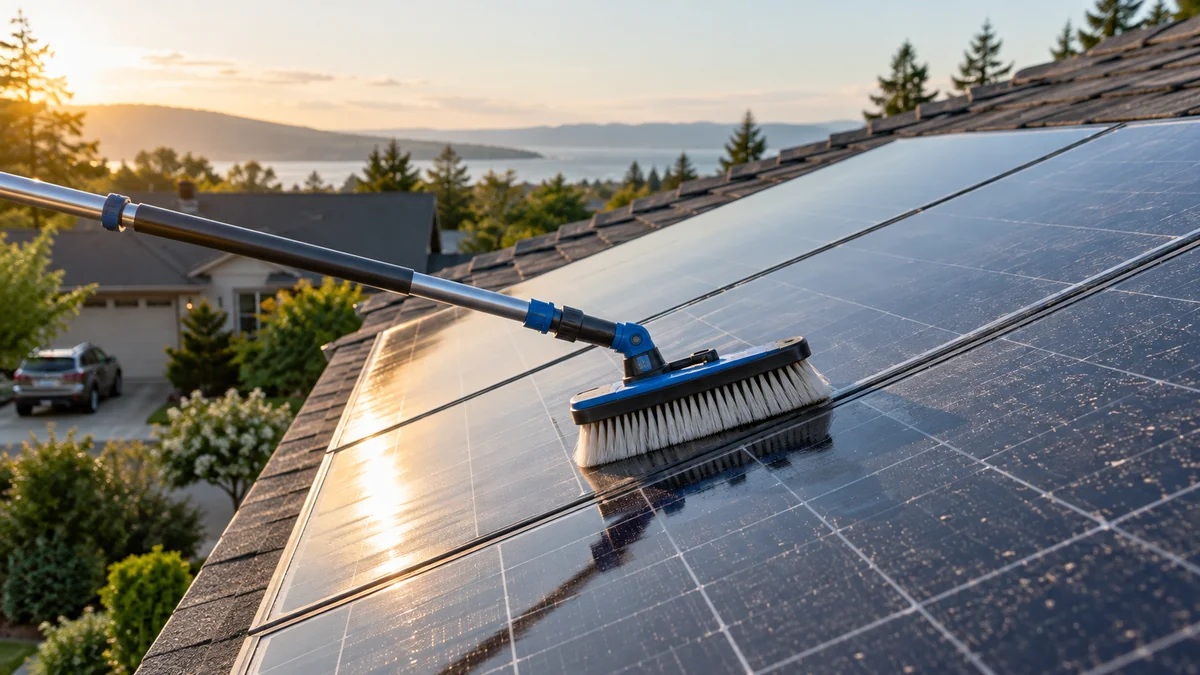
Professional solar panel cleaning typically costs $5-$30 per panel, but most residential customers pay a minimum service charge that makes the total more important than the unit rate. A 20-panel system commonly costs $150-$500 per visit, while easy-access one-story arrays may cost less and steep or multistory roofs may cost more.
Key Facts at a Glance
- Professional solar panel cleaning costs typically $5-$30 per panel for residential work.
- A 20-panel residential system commonly costs $150-$500 per visit, including labor minimums.
- One-story roofs usually cost $5-$15 per panel; multistory or difficult-access roofs often cost $15-$30.
- Commercial rooftop cleaning commonly costs $4-$10 per panel, while large ground arrays can fall below $3 per panel.
- A professional cleaner generally uses a soft brush, low-pressure water, and either deionized or properly filtered water.
- Cleaning is financially sensible when recoverable energy revenue exceeds the service price over the expected cleaning interval.
How Much Does Solar Panel Cleaning Cost per Panel?
Solar panel cleaning costs $5-$30 per panel for most residential systems, with a separate minimum charge of approximately $100-$250. The lower end applies to accessible one-story arrays with light dust; the upper end reflects steep roofs, multiple stories, heavy deposits, travel, safety equipment, or difficult access.
A per-panel quote can therefore be misleading. For example, a cleaner offering $8 per panel may still charge a $125 minimum, making a 10-panel visit cost $125 rather than $80. Conversely, a 40-panel system may receive a lower unit price because setup and travel are spread across more modules.
Typical Residential Prices by System Size
| Panel count | One-story total | Two-story total | Typical visit time |
|---|---|---|---|
| 10 panels | $100-$175 | $175-$300 | 45-90 minutes |
| 20 panels | $150-$300 | $300-$550 | 1-2.5 hours |
| 30 panels | $200-$425 | $425-$800 | 1.5-3 hours |
| 40 panels | $250-$550 | $550-$1,000 | 2-4 hours |
These figures are typical U.S. market planning ranges, not fixed national rates. Local labor costs, roof pitch, travel distance, panel layout, water access, and insurance requirements can move a quote outside them.
What Determines the Price per Panel?
Roof access, panel quantity, deposit severity, and local labor rates determine most solar cleaning prices. Panel count matters, but access usually matters more because technicians price fall protection, ladders, lifts, hose runs, and setup time into the job.
| Cost factor | Lower-cost condition | Higher-cost condition | Common price effect |
|---|---|---|---|
| Roof height | One story, ground ladder access | Three stories or lift required | +$50-$400 |
| Roof pitch | Low slope below 20 degrees | Steep slope above 35 degrees | +$75-$300 |
| Panel access | Clear roof paths | Obstructions or fragile roofing | +$50-$250 |
| Soiling | Light dust and pollen | Dried bird waste, ash, algae | +$2-$10 per panel |
| Water source | On-site hose connection | Purified-water transport | +$25-$150 |
| Travel | Local service area | Remote or rural property | +$25-$150 |
| Service frequency | Recurring contract | One-time booking | Often 10%-25% higher |
A practitioner rule of thumb is to request an all-in price rather than multiplying a headline panel rate. The all-in quote should state labor, minimum charge, travel, purified-water fees, roof-access equipment, tax, and any inspection fee.
Does Panel Size Change the Price?
Panel size can change labor slightly, but cleaners usually price by module count and access rather than wattage. A 400-watt module and a 300-watt module may have different dimensions, yet the technician still performs one handling and brushing cycle per panel.
Large commercial modules can alter the calculation because fewer modules may cover the same capacity. Commercial providers may price by square foot, megawatt, labor hour, or contract frequency instead of by panel.
Commercial and Automated Cleaning Prices
Commercial solar panel cleaning costs typically $4-$10 per panel for rooftop arrays and approximately $0.40-$3 per panel for very large ground-mounted projects. Large sites achieve lower unit prices because transport, water systems, robotic equipment, and trained crews are distributed across thousands of modules.
| Service type | Typical unit price | Minimum or setup charge | Typical duration |
|---|---|---|---|
| Residential, one story | $5-$15 per panel | $100-$150 | 1-1.5 hours |
| Residential, two or more stories | $15-$30 per panel | $150-$250 | 1.5-2.5 hours |
| Commercial rooftop | $4-$10 per panel | About $200 | 4 hours-2 days |
| Ground-mounted utility array | $0.40-$3 per panel | Site or megawatt pricing | Several days-weeks |
| Robotic commercial cleaning | $1-$9 per panel | $150-$1,000 setup | Site-dependent |
Robots are financially attractive on broad, regular, low-slope arrays where travel paths and panel spacing are predictable. Drone-based systems are more useful for inspection, thermal imaging, or specialized cleaning than for ordinary pitched residential roofs.
Automated cleaning is usually a poor fit for a typical home. A 20-panel roof does not provide enough scale to amortize mobilization, programming, equipment, or operator costs.
How Often Should Solar Panels Be Cleaned?
Most residential solar panels need cleaning every 6-12 months, but rainy suburban systems may need it less often while dusty agricultural or arid systems may need cleaning two or three times per year. Cleaning frequency should follow measurable soiling and production loss, not a fixed calendar alone.
| Environment | Typical interval | Main deposits | Practical trigger |
|---|---|---|---|
| Regular rainfall, low dust | 12-24 months | Pollen, light dust | Visible film or output trend |
| Suburban, moderate pollen | 6-12 months | Pollen, leaves, bird waste | Spring or fall inspection |
| Arid or agricultural area | 2-6 months | Dust, soil, crop residue | 3%-5% output decline |
| Coastal location | 6-12 months | Salt aerosol, bird waste | Salt film or bird activity |
| Wildfire or industrial area | After events, then 3-6 months | Ash, soot, particulate matter | Visible ash and monitoring drop |
| Commercial dusty site | 1-4 months | Road dust, construction dust | Contracted performance threshold |
Rain removes loose dust but often leaves concentrated mineral and biological residue as droplets evaporate. Rain also does not reliably remove dried bird droppings, sticky pollen, ash, or grease-like industrial deposits.
Does Cleaning Increase Solar Panel Output?
Cleaning can increase output when soiling blocks sunlight, but the gain is site-specific and may be too small to justify frequent service. A lightly dusty array after regular rain may recover little; a heavily soiled array beneath trees, near agriculture, or after ashfall can recover substantially more.
The National Renewable Energy Laboratory identifies soiling as a real performance variable and uses soiling ratio measurements to quantify energy loss. NREL’s framework is more reliable than assuming a universal 5%, 10%, or 25% loss because deposition differs by site and weather.
A practical estimate uses this formula:
Annual recovered value = annual solar production × estimated soiling loss × electricity value
Example:
- Annual production: 10,000 kilowatt-hours
- Estimated cleaning-recoverable loss: 5%
- Electricity value: $0.18 per kilowatt-hour
- Recovered value: 10,000 × 0.05 × $0.18 = $90 per year
A $250 cleaning visit would not pay back annually in that example. If the loss were 15%, the recovered value would rise to $270, making cleaning financially reasonable before considering equipment protection or local incentives.
Cleaning does not repair failed inverters, shaded modules, wiring faults, hail damage, degraded cells, or snow cover. A production decline is not proof that panels are dirty.
What Is the Safest Professional Cleaning Method?
The safest standard method is dry debris removal followed by low-pressure washing with purified water and a soft, non-abrasive brush. Professional cleaners usually schedule work during cool conditions, protect themselves from falls, avoid stepping on modules, and inspect the array after washing.
Typical Professional Procedure
- Review the system and roof. The technician identifies roof access, electrical equipment, fragile roofing, obstructions, nests, and visible module damage.
- Choose a cool work period. Early morning or late afternoon reduces rapid evaporation and makes the glass safer to handle. Cool water on a hot panel is not automatically guaranteed to shatter tempered glass, but extreme temperature differences should be avoided.
- Isolate equipment when required. The technician follows the inverter and manufacturer instructions. Homeowners should not open electrical enclosures or disconnect rooftop wiring.
- Remove dry debris first. A soft nylon brush or blower lifts leaves, grit, and loose dirt before wet cleaning.
- Wash with controlled water flow. Low-pressure water and a soft water-fed brush loosen deposits without abrading the glass or frame.
- Use purified water where residue matters. Deionized or reverse-osmosis water minimizes calcium and magnesium spots, especially in hard-water regions.
- Remove excess water. A soft rubber squeegee may reduce drying marks when the system and roof allow safe use.
- Inspect and document. The technician records cracks, delamination, loose connectors, damaged conduit, nests, and unusual staining.
The most important safety issue is often the roof rather than the panel. A fall can cause severe injury, while an improper brush or hard-water rinse can cause equipment damage and a lower energy yield.
Is DIY Solar Panel Cleaning Worth It?
DIY cleaning can cost $20-$100 for basic tools, but it is sensible only when the panels are safely reachable from the ground or a secure low-slope platform. Homeowners should not climb a steep or fragile roof to save a $150 service minimum.
| DIY item | Typical cost | Appropriate use | Main risk |
|---|---|---|---|
| Soft water-fed brush | $30-$100 | Ground-access cleaning | Scratches from trapped grit |
| Garden hose | $15-$50 | Light rinse with soft water | Mineral spotting |
| DI water cartridge | $60-$200 | Spot-free rinse | Consumable resin cost |
| Soft squeegee | $15-$40 | Controlled water removal | Edge or seal contact |
| Roof ladder equipment | $100-$500 | Specialized access | Fall exposure |
Use a soft brush designed for solar glass or vehicle surfaces, never a stiff household broom. Keep grit away from the glass, do not kneel on modules, and avoid pulling on module cables or connectors.
A ground-access rinse may be acceptable for loose dust when the manufacturer allows it. It is not a substitute for a roof inspection, and it may spread bird waste rather than remove it.
Which Cleaning Method Should You Choose?
Manual professional cleaning is the best general choice for pitched residential roofs, while ground-mounted arrays can justify owner maintenance or mechanical equipment. The right option depends on access, deposit severity, water hardness, system scale, and the cost of a production shortfall.
| Method | Best setting | Typical cost | Main advantage | Main limitation |
|---|---|---|---|---|
| Professional manual | Pitched residential roof | $5-$30 per panel | Safe access and inspection | Recurring labor cost |
| Ground-level DIY | Ground mount or low roof | $20-$100 equipment | Lowest cash cost | No professional inspection |
| Hose rinse | Soft-water, light dust | $0-$50 | Fast removal of loose dust | Water spots and limited cleaning |
| Robotic brush | Large flat commercial array | $1-$9 per panel | Consistent large-scale work | Poor residential economics |
| Drone-assisted service | Large or difficult commercial site | $4-$9 per panel | Reduced personnel exposure | Limited residential availability |
Detergent is not automatically better. Some soaps leave surfactant films, attract dust, or conflict with manufacturer instructions. Purified water and mechanical removal are usually preferable for ordinary mineral and dust deposits.
Common Mistakes That Damage Solar Systems
Using Hard Tap Water
Hard water can leave calcium and magnesium deposits as it dries. A single rinse may only create visible spots, but repeated mineral buildup can require specialized restoration and reduce light transmission.
Use filtered or deionized water when local tap water produces spotting. A water hardness test or existing faucet scale provides a useful warning.
Pressure-Washing the Modules
Pressure washers can force water toward seals, connectors, junction boxes, and roof penetrations. High pressure also increases the chance that grit will abrade coatings or glass.
Use low-pressure flow from a hose or water-fed pole. Pressure washing may be appropriate for surrounding hardscape, never as a default panel-cleaning method.
Walking or Kneeling on Panels
Walking on photovoltaic modules can flex cells and create microcracks that are difficult to see but can reduce output over time. Manufacturers commonly prohibit foot traffic on modules, and roof access should use designated walkways where available.
Scrubbing Dry Grit
Dry brushing can drag sand across the glass like abrasive paper. Pre-rinse loose grit or remove it with a soft blower before wet brushing.
Disconnecting Equipment Without Instructions
Turning off an inverter does not make every rooftop conductor harmless in daylight. Solar modules continue producing direct current when illuminated, so electrical isolation requires qualified procedures and manufacturer-specific controls.
What If Solar Production Falls After Cleaning?
A production drop after cleaning may indicate a monitoring issue, disconnected connector, shading change, water intrusion, inverter fault, or coincidental weather variation rather than dirty glass. Compare the affected array, inverter status, irradiance conditions, and previous daily output before booking another cleaning.
Check these items in order:
- Confirm the inverter displays normal operation.
- Compare production with the same weather and time from previous weeks.
- Identify whether the decline affects one string, one microinverter, or the whole array.
- Look for new shading from trees, construction, or seasonal sun position.
- Inspect only visible, ground-level wiring and conduit.
- Contact the installer or a qualified solar electrician for electrical abnormalities.
Do not remove connectors, open junction boxes, or climb onto the roof to investigate. A post-cleaning output problem can indicate a loose connection or pre-existing component failure that cleaning merely brought to attention.
How Can You Compare Solar Cleaning Quotes?
A useful solar cleaning quote identifies the total price, cleaning method, access assumptions, insurance, and documentation. Ask each provider the same questions so a low per-panel rate does not hide a high minimum or excluded safety charge.
Request these details in writing:
- Total number of panels included
- All-in price and minimum service fee
- Roof height, pitch, and access assumptions
- Water type, filtration method, and detergent policy
- Whether the quote includes a visual condition report
- Liability insurance and worker coverage
- Treatment of bird waste, ash, algae, or hard-water scale
- Rescheduling policy for unsafe weather
- Recurring-service discount and cancellation terms
- Photos or production notes after completion
A recurring contract may reduce the baseline price by approximately 10%-25%, but only when the selected frequency matches actual soiling. Quarterly service is wasteful for a clean, rainy site and inadequate for a dusty industrial location if the provider does not monitor results.
When Is Solar Panel Cleaning Not Worth the Cost?
Solar panel cleaning is usually not worth paying for when the array is lightly soiled, production is already near its weather-adjusted baseline, or the service requires expensive access equipment. Cleaning also cannot solve output loss caused by shade, inverter failure, snow, degradation, or wiring problems.
Use a simple threshold:
Maximum sensible cleaning price = expected recovered kilowatt-hours × electricity value
For a system expected to recover 400 kilowatt-hours at $0.18 per kilowatt-hour, the maximum annual energy value is $72. A $250 service may still be justified for safety inspection or heavy contamination, but energy recovery alone does not support it.
Expert rule: measure before cleaning whenever possible. A monitoring trend, soiling sensor, or before-and-after comparison produces a better decision than a visibly dusty panel alone.
Frequently Asked Questions
Does rain clean solar panels well enough?
Rain removes loose dust but often leaves mineral rings, pollen, bird droppings, ash, and sticky agricultural residue. Rain may be sufficient for a lightly soiled, tilted array in a wet climate, but visible deposits or a measured production decline justify a more deliberate inspection and cleaning.
Can I use dish soap on photovoltaic modules?
Dish soap is not the default choice because residue can remain on the glass and manufacturers may restrict cleaning chemicals. Use clean water and a soft brush unless the panel manufacturer specifically approves a compatible cleaner for the deposit being treated.
Should solar panels be cleaned in winter?
Winter cleaning is useful when snow, road salt, ash, or persistent grime blocks production, but freezing conditions create slip hazards and can turn rinse water into ice. Schedule cleaning during a safe above-freezing period and follow the installer’s access guidance.
How long does professional panel cleaning take?
A typical 20-panel one-story system takes about one to 1.5 hours, while a multistory or difficult-access system commonly takes 1.5-2.5 hours. Commercial arrays can require several hours to several days because crews must manage access, water logistics, and larger module counts.
Will cleaning remove bird droppings completely?
Fresh bird droppings usually respond well to soaking and soft brushing, while dried deposits may require several controlled passes. Abrasive scraping can scratch glass, and technicians should also check whether repeated bird activity indicates a nesting or cable-protection problem.
Does solar-panel cleaning void the warranty?
Cleaning does not normally void a warranty when performed according to the manufacturer’s instructions, but abrasive tools, unauthorized chemicals, pressure damage, or walking on modules can create disputes. Keep invoices, method details, photographs, and any documented pre-existing damage.
The Bottom Line
Solar panel cleaning cost per panel usually falls between $5 and $30, but the realistic residential total depends on minimum fees, roof access, deposit severity, and service frequency. A 20-panel system commonly costs $150-$500 per visit. Choose professional cleaning for steep or elevated roofs, use ground-level DIY methods only where access is genuinely safe, and calculate the expected recovered energy before committing to a recurring schedule.