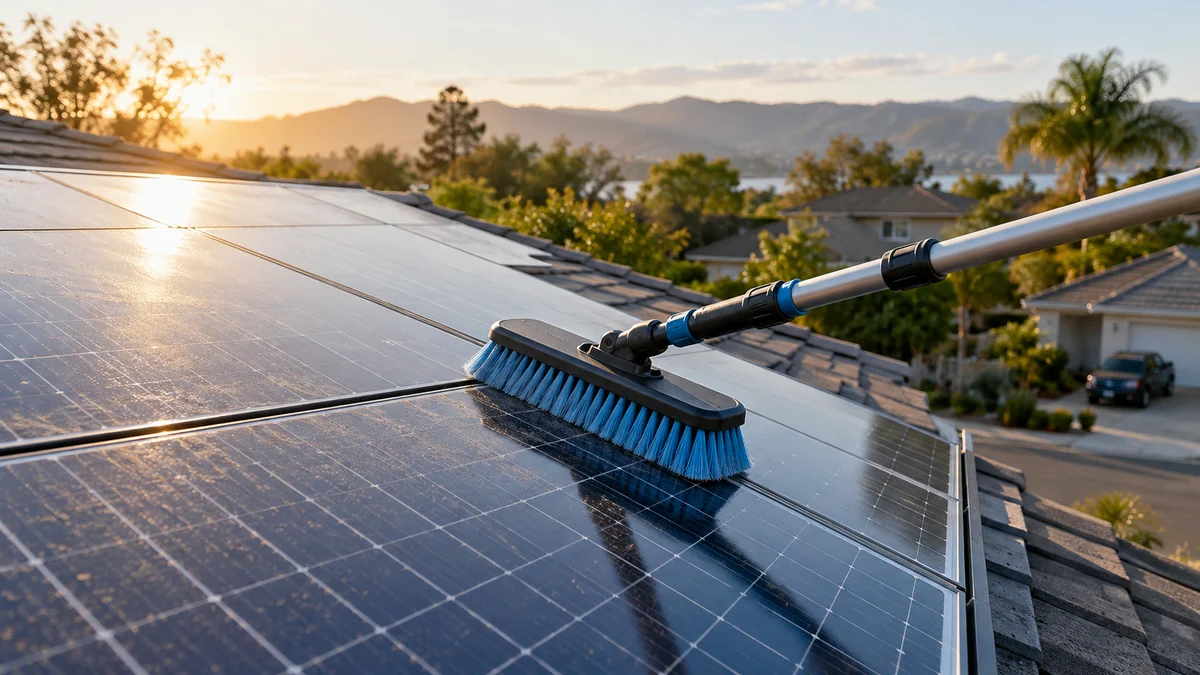
Solar panels should usually be cleaned once or twice per year, but dusty, agricultural, coastal, wildfire-prone, or heavily bird-populated locations may need cleaning every three to four months. The correct schedule depends on how quickly soiling reduces electricity production, not on a universal calendar rule. A safe roof and measurable output loss matter more than appearance alone.
Key Facts at a Glance
- Most residential solar-panel systems need manual cleaning one or two times yearly.
- Quarterly cleaning is more appropriate where dust, pollen, ash, salt, or bird droppings accumulate quickly.
- Rain removes loose dust, but it often leaves mineral deposits and does not reliably remove oily residue or hardened droppings.
- A typical 15-20-panel system takes 1-2 hours to clean manually.
- Typical professional residential cleaning costs $150-$350 per visit, while basic DIY supplies cost approximately $20-$50.
- Never walk on solar modules, use a pressure washer, scrub with abrasive materials, or spray cold water onto very hot glass.
How Often Should You Clean Solar Panels?
The best starting schedule is once annually, followed by a production check and a visual inspection. Increase cleaning to twice yearly when panels face heavy pollen, dust, bird activity, or nearby trees; use a quarterly schedule when repeated soiling causes visible buildup or a measurable decline in output.
Solar-panel cleaning is maintenance of the module’s front glass, not a replacement for electrical inspection. Cleaning removes dust, pollen, leaves, ash, salt film, and bird droppings that block or scatter sunlight before it reaches photovoltaic cells.
A calendar is only a starting point. A homeowner who tracks monthly kilowatt-hours can make a better decision by comparing similar weather and sunlight periods before and after cleaning. Seasonal changes, shading, inverter faults, snow, and utility-meter issues can resemble dirt-related losses.
What schedule fits each environment?
| Location or condition | Typical cleaning interval | Main contaminant | Practical trigger |
|---|---|---|---|
| Rainy suburban area | 12 months | Pollen and bird droppings | Visible spots or spring pollen |
| Dry urban area | 6-9 months | Dust and vehicle residue | Output trend falls 3%-5% after weather adjustment |
| Desert or construction zone | 3-4 months | Fine dust and sand | Dust layer visible from ground |
| Agricultural property | 3-6 months | Soil, fertilizer, pollen | Harvest or spraying season |
| Coastal property | 3-6 months | Salt aerosol and bird waste | Hazy film or white deposits |
| Wildfire-prone region | After major smoke or ash events | Ash and soot | Ash remains after rain |
These are typical maintenance intervals, not guaranteed performance thresholds. A steeply tilted array in a rainy location may stay clean for years, while a shallow array beneath a bird roost can require attention every few weeks.
Why Does Dirt Reduce Solar-Panel Production?
Dirt reduces solar-panel production by absorbing, scattering, or blocking light at the module surface. The effect is usually uneven: one bird dropping or a leaf can shade a small area far more severely than a thin layer of uniform dust, depending on the panel’s cell layout and bypass-diode design.
The often-repeated claim that dirty panels lose a fixed 5%-15% annually is too broad for universal use. Soiling losses vary with rainfall, tilt, particle size, module technology, pollutant chemistry, and cleaning intervals. The National Renewable Energy Laboratory has published research showing that soiling is a measurable performance factor, but the loss percentage must be evaluated for the specific site.
A useful field rule is to clean when the expected recovered electricity is worth more than the cleaning cost. Compare production under similar sunlight conditions, because a cloudy month cannot prove that dirt caused the decline.
How can you measure whether cleaning helped?
- Record seven to fourteen days of inverter production before cleaning.
- Note weather, shading, temperature, and system alerts.
- Clean the modules safely.
- Record another seven to fourteen days under comparable conditions.
- Compare daily kilowatt-hours per installed kilowatt, rather than raw household output.
A cleaning-related improvement should appear as a consistent production change after weather and shading are considered. A single high-output day is not reliable evidence.
Does Rain Clean Solar Panels?
Rain removes loose dust from solar panels, but rain alone is not a dependable cleaning system. Water can evaporate before carrying away residue, and hard-water minerals may remain as spots; bird droppings, oily pollution, ash, and sticky pollen usually need manual treatment.
Rain is more effective on panels with a moderate-to-steep tilt and low local pollution. Rain is less effective on nearly flat modules, where water pools and leaves concentrated deposits after evaporation. Dry climates may receive too little rainfall to control dust, while coastal rain can leave salt residue.
Do not schedule a cleaning immediately before a forecasted heavy rain if loose dust is the only problem. Manual cleaning becomes more valuable when visible film remains after rainfall or when production data shows a sustained decline.
What Factors Change the Cleaning Frequency?
Solar-panel cleaning frequency changes mainly with contaminant load, panel geometry, local weather, and safe access. Two arrays in the same city can require different schedules if one has a 35-degree roof tilt and the other sits nearly flat beneath trees.
Which site conditions increase soiling?
| Site condition | Effect on modules | Typical response |
|---|---|---|
| Low panel tilt, below 15 degrees | Holds water and dust | Inspect every 1-3 months |
| Nearby construction | Adds fine silica and cement dust | Clean after major work |
| Bird roost or chimney | Creates concentrated droppings and soot | Spot-clean promptly |
| Farm or unpaved road | Adds soil and organic particles | Clean every 3-6 months |
| Sea exposure | Deposits salt film | Rinse with suitable purified water |
| Trees over the array | Adds leaves, sap, and pollen | Inspect after storms and spring bloom |
A counterintuitive practitioner rule is that partial contamination deserves faster attention than uniform light dust. A small opaque dropping can create localized shading and hot-cell stress, so spot-cleaning may be worthwhile even when a full-system wash is not.
Can You Clean Solar Panels Yourself?
You can clean ground-level or low, safely accessible solar panels yourself, provided the system manufacturer permits it and you can work without stepping on the modules. A steep roof, fragile tiles, overhead electrical lines, or an unstable ladder changes the task from routine maintenance into a professional safety job.
Before starting, check the panel and inverter manuals for cleaning restrictions. Some manufacturers recommend plain water and a soft brush; others permit a small amount of mild, non-abrasive detergent. Warranty language can differ, especially for coatings and damage caused by chemicals.
What do you need before cleaning?
| Item | Typical quantity or specification | Purpose |
|---|---|---|
| Soft solar brush | 1, non-abrasive head | Loosens surface dirt |
| Extension pole | 2-6 metres | Reaches modules from a safe position |
| Low-pressure hose | 1 garden hose | Rinses without seal damage |
| Microfiber cloth | 2-4 cloths | Removes soft residue |
| Rubber squeegee | 1 soft-edged tool | Limits water spots |
| Purified or deionized water | 10-20 litres for 15-20 panels | Reduces mineral deposits |
| Mild approved soap | Small measured amount | Loosens oily residue |
Do not improvise with a pressure washer, abrasive kitchen sponge, razor blade, bleach, solvent, or concentrated laundry detergent. Those materials can scratch glass, attack seals, leave residue, or invalidate warranty support.
How Do You Clean Solar Panels Safely?
A safe solar-panel cleaning process takes about 1-2 hours for 15-20 residential modules and uses cool glass, soft tools, low-pressure water, and minimal detergent. The person cleaning the array should prioritize fall protection and electrical safety before improving appearance.
Step 1: Choose a cool, stable period
Clean early in the morning, late in the afternoon, or during cool overcast weather. Avoid strong wind, thunderstorms, freezing conditions, and hot midday glass.
Success checkpoint: The module surface feels cool and water will not evaporate immediately.
Common mistake: Spraying cold water on glass heated by direct sun, which can create thermal stress.
Step 2: Confirm system and roof safety
Read the inverter instructions and follow the manufacturer’s shutdown procedure. Keep water away from exposed connectors, damaged junction boxes, cracked modules, and electrical equipment.
Success checkpoint: The array is accessible without walking on modules or overreaching from a ladder.
Common mistake: Treating the AC disconnect as the only required shutdown control when the system also has a DC isolator.
Step 3: Inspect the modules
Look for cracked glass, delamination, loose frames, damaged wires, nesting material, and unusual dark patches. Do not wash a module with exposed conductors or a compromised junction box.
Success checkpoint: Damaged equipment is photographed and isolated from the cleaning task.
Common mistake: Using water to diagnose damage that should be assessed by a solar technician.
Step 4: Remove dry debris gently
Use a soft brush to remove leaves, twigs, loose dust, and sand. Brush in the direction that removes debris without grinding particles across the glass.
Success checkpoint: Loose material is gone before water and wiping begin.
Common mistake: Scrubbing dry sand into the anti-reflective surface.
Step 5: Rinse with low-pressure water
Rinse from the upper edge downward with a garden hose or a controlled stream. Avoid pressure-washer settings because force can damage seals, frames, connectors, or laminate layers.
Success checkpoint: Loose residue flows off without entering electrical housings.
Common mistake: Directing water at gaps, cable entries, or the underside of modules.
Step 6: Loosen remaining film
Use plain water first. If the manufacturer permits soap, dilute a small quantity of mild, biodegradable detergent and wipe gently with a soft brush or microfiber tool.
Success checkpoint: Bird droppings soften after several minutes of soaking rather than requiring scraping.
Common mistake: Applying bleach, ammonia, abrasive powder, or undiluted detergent.
Step 7: Rinse and remove mineral-prone water
Rinse thoroughly, then use purified or deionized water where local tap water is hard. A soft rubber squeegee can remove water from the glass without pressure on the module frame.
Success checkpoint: No visible soap film or white mineral spots remain after drying.
Common mistake: Leaving hard-water droplets to evaporate in a hot climate.
Step 8: Restore operation and monitor output
Return the system to its normal operating state according to the inverter manual. Check for fault codes and compare production over the next several days.
Success checkpoint: The inverter shows normal operation and no new alerts.
Common mistake: Assuming a production change came from cleaning without checking weather and shading.
Which Cleaning Method Is Best?
Professional cleaning is the best option for high or steep roofs; careful DIY cleaning is usually the lowest-cost option for ground-level arrays. Automated sprinklers and robots make sense only when recurring soiling, labor, water availability, and array size justify their added equipment.
| Method | Typical cost | Typical time or setup | Best fit | Main limitation |
|---|---|---|---|---|
| DIY manual cleaning | $20-$50 supplies | 1-2 hours per 15-20 panels | Safe low roofs | Fall and electrical risks |
| Professional service | $150-$350 per visit | 1-3 hours onsite | Steep or multi-story roofs | Recurring service cost |
| Purified-water service | $5-$15 per panel, typical | 1-2 hours for small arrays | Hard-water regions | Minimum service fees |
| Automated sprinkler | Hundreds to several thousand dollars installed | Permanent installation | Remote dusty arrays | Water use and deposits |
| Cleaning robot | Often several thousand dollars | Repeated automated cycles | Large commercial arrays | High purchase and maintenance cost |
The cheapest method is not always the least expensive choice. A fall, cracked module, or water-damaged connector can cost more than years of professional cleaning.
When Is Professional Cleaning Worth the Cost?
Professional solar-panel cleaning is usually worth the cost when roof access is hazardous, the array has persistent contamination, or recovered production can reasonably exceed the service fee. A $200 cleaning that recovers only $40 of annual electricity value is not a sound financial decision unless it prevents damage or protects a warranty requirement.
Estimate the value of recovered energy with:
Expected annual gain in kilowatt-hours × electricity value per kilowatt-hour = potential annual benefit.
For example, recovering 150 kWh at $0.25 per kWh produces $37.50 of annual value. That result does not justify quarterly $200 cleaning by itself, although heavy contamination, commercial production losses, and safety considerations may change the calculation.
Ask a service provider whether the quote includes purified water, roof access, system shutdown, visual inspection, travel, and post-cleaning photographs. Regional labor rates and minimum fees make national price ranges approximate.
What Should You Do About Special Contaminants?
Special contaminants need different responses because water alone may not remove them. Bird droppings should be soaked and wiped, salt film should be rinsed thoroughly, and ash or oily industrial residue may require professional cleaning approved by the module manufacturer.
| Contaminant | Recommended response | Avoid |
|---|---|---|
| Bird droppings | Soak 5-10 minutes, then wipe softly | Dry scraping |
| Pollen | Rinse, then use a soft brush | Aggressive dry brushing |
| Wildfire ash | Remove promptly with low-pressure water | Blowing ash across modules |
| Salt film | Rinse with purified water and squeegee | Leaving evaporated salt |
| Tree sap | Soften with manufacturer-approved cleaner | Solvent or razor blades |
| Cement dust | Brush loose particles, then rinse carefully | Grinding dry powder into glass |
Ash and cement dust deserve prompt attention because both can form stubborn films. If residue remains after gentle washing, stop rather than escalating to harsh chemicals.
What Are the Common Cleaning Mistakes?
The most damaging solar-panel cleaning mistakes are unsafe roof access, abrasive tools, excessive water pressure, hot-glass washing, and unapproved chemicals. These errors can create scratches, microcracks, seal failures, mineral deposits, or personal injury while producing little additional electricity.
- Walking on modules: Weight can cause microcracks that remain invisible but reduce long-term output.
- Using a pressure washer: High pressure can force water past seals and damage connectors.
- Cleaning during peak sun: Rapid temperature changes can stress tempered glass.
- Using hard tap water: Calcium and magnesium deposits can remain as opaque spots.
- Scraping droppings: Blades and rigid tools can scratch the glass coating.
- Ignoring an inverter error: A fault after washing may indicate pre-existing damage or water intrusion; shut down and call a qualified technician.
A useful professional rule is to distinguish cleaning from repair. Cleaning cannot fix cracked glass, delamination, failed bypass diodes, shading from new construction, or an inverter fault.
What If Solar Production Does Not Improve?
If solar production does not improve after cleaning, dirt may not be the cause of the original decline. Compare inverter alerts, shading, weather, seasonal sun angle, module temperature, utility-meter data, and production from individual strings before arranging another wash.
Check these conditions in order:
- Inverter status: Record any error code and its time.
- Monitoring data: Look for one weak string or one unusually low optimizer.
- New shade: Inspect for tree growth, structures, or seasonal shadows.
- Weather: Compare irradiance and cloud cover, not just calendar dates.
- Physical damage: Look for cracks, hot spots, discoloration, or loose wiring.
- Metering: Confirm that the inverter and utility meter report consistently.
A clean surface does not guarantee normal electrical output. Electrical diagnosis belongs to a qualified solar professional, especially when connectors, roof wiring, or direct-current equipment are involved.
How Should You Handle Snow, Winter, and Freezing Weather?
Do not climb onto a snowy or icy roof to clean solar panels. Light snow often slides off tilted modules or melts naturally, while heavy snow may require a manufacturer-approved roof-level tool or professional service that avoids scraping the glass.
Never pour hot water onto frozen modules. Thermal shock, ice expansion, and slippery access create unnecessary risks. In regions with regular snowfall, schedule a visual inspection after storms and use the system’s monitoring data to identify whether snow is materially reducing production.
FAQ
Do solar panels need cleaning if they are tilted?
Tilted solar panels usually need less frequent cleaning because rain can carry loose particles downhill. Tilt does not prevent buildup from bird droppings, pollen, salt, ash, or oily pollution, and low-angle arrays often need inspections every one to three months.
Can dirty solar panels damage the modules?
Dirty solar panels do not usually cause immediate damage, but concentrated bird droppings, leaves, and persistent residue can create localized shading and hot spots. Dirt also makes it harder to notice cracks or delamination. Prompt spot-cleaning is more important than frequent full-array washing.
Should I use vinegar to clean solar panels?
Do not use vinegar unless the solar-panel manufacturer explicitly permits it. Acidic household cleaners can affect coatings, seals, frames, or warranty coverage. Plain water, purified water, and a manufacturer-approved mild detergent are safer choices for most modules.
How often should commercial solar panels be cleaned?
Commercial solar panels often need cleaning every three to six months in dusty, agricultural, industrial, or coastal locations. Operators should use site production data, soiling sensors where available, water costs, labor rates, and lost-energy value to set the interval.
Is solar-panel cleaning tax deductible?
Solar-panel cleaning may be a business maintenance expense for a commercial system, but household tax treatment depends on jurisdiction and the system’s use. Keep invoices and ask a qualified tax professional rather than assuming residential cleaning qualifies for an energy credit.
Should you clean solar panels at night?
Night cleaning is generally unnecessary and can increase slip, visibility, and electrical hazards. Early morning or late afternoon provides cooler glass and better visibility, making those periods safer than midday while avoiding the risks of working in darkness.
The Bottom Line
Clean residential solar panels once or twice per year as a starting point, then adjust the schedule using climate, panel angle, contaminants, roof access, and monitored production. Dusty, agricultural, coastal, smoky, and bird-prone sites may need quarterly service, while rainy sites with steep panels may need less. For how often should you clean solar panels, the most defensible answer is the interval that removes meaningful soiling without creating more safety or financial risk than the recovered electricity justifies.