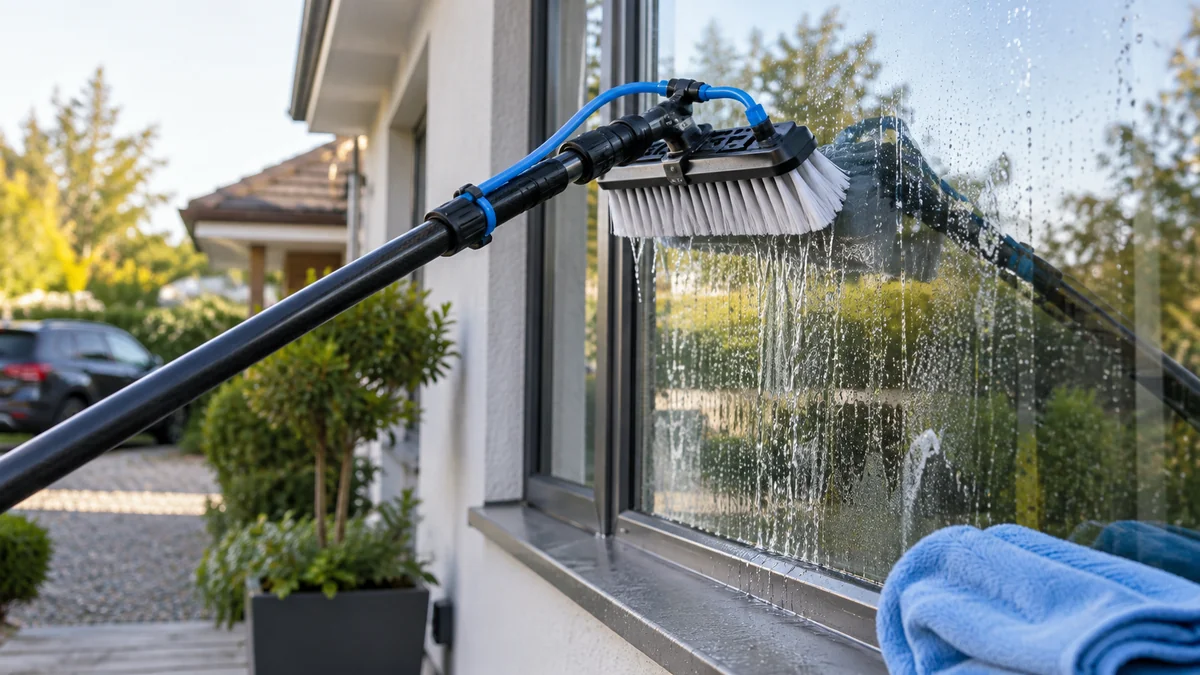
A waterfed pole for window cleaning is a telescoping pole with a brush and water jets that delivers purified water to exterior glass from the ground. The brush loosens soil, while mineral-free water rinses away residue and dries without spots. System performance depends mainly on water purity, brush technique, reach, and safe site access.
Key Facts at a Glance
- A water-fed pole system normally uses reverse osmosis, deionization, or both to reduce dissolved minerals before cleaning glass.
- A TDS reading of 0-10 ppm is a practical operating threshold, but 0 ppm provides the greatest spotting margin.
- Typical single-operator water use is 1.5-3.0 liters per minute, depending on jets, pump pressure, and rinse technique.
- Carbon-fiber poles reduce fatigue and flex compared with aluminum or fiberglass, especially above 30 feet.
- Pure-water cleaning is primarily an exterior method; indoor use requires controlled low-flow tools and protection from runoff.
- A first clean can take twice as long when frames contain grease, pollen, oxidized sealant, or years of trapped dirt.
What Is a Waterfed Pole?
A waterfed pole is a telescoping window-cleaning tool that combines a lightweight pole, a bristle brush, water jets, hose, pump, and purification system. The operator remains on the ground while the brush scrubs glass, frames, sills, and some exterior cladding.
Unlike traditional cleaning, the system does not depend on soap to leave a lubricated surface or on a squeegee to remove water. Purified water dissolves and carries mineral-free dirt away. When the final rinse contains little or no dissolved solid, evaporation leaves no mineral ring.
A complete setup includes more than the pole. The water path usually contains a tap connection, sediment and carbon filters, an RO membrane, DI resin, a TDS meter, a pump or pressure regulator, and a storage tank or hose reel. Small domestic jobs may use a compact DI vessel, while commercial crews often use an RO/DI trolley or van-mounted system.
How Pure Water Cleans Glass
Pure water has a strong capacity to absorb soluble contamination because it contains very few dissolved ions. Mechanical agitation still does most of the work on bird droppings, traffic film, pollen, and grime, so pure water is not a substitute for brushing.
The cleaning cycle has four parts:
- Purification: Tap water passes through RO, DI, or both.
- Agitation: The brush loosens dirt from glass, seals, frames, and sills.
- Rinsing: Jets carry suspended soil down the pane.
- Drying: Mineral-free droplets evaporate without ordinary hard-water spotting.
Pure water does not reliably remove silicone, paint, construction debris, heavy grease, or baked-on mineral scale. Those contaminants may need a scraper used correctly, a compatible detergent, a restoration chemical, or a separate traditional cleaning method.
How Do You Use a Waterfed Pole?
Use a water-fed pole from the highest accessible window downward, clean frames before glass, scrub with overlapping passes, and rinse slowly until no dirty water remains. A typical residential window takes 2-5 minutes after setup, while a first clean with neglected frames may take twice that time.
Step 1: Inspect the Site
Check window type, loose seals, screens, vents, balconies, fragile trim, overhead cables, pedestrian traffic, and runoff routes. Keep carbon-fiber poles away from electrical lines because carbon fiber conducts electricity.
Confirm that the ground is stable and that the pole will not strike vehicles, masonry, roof edges, or people. Wind above roughly 20-25 mph can make long poles difficult to control, although the safe limit depends on pole length, building exposure, and local procedures.
Step 2: Test the Water
Measure purified output with a calibrated TDS meter before starting. Aim for 0 ppm; 1-10 ppm can work on some surfaces, but spotting risk increases as dissolved solids rise.
Test water again if spotting appears or if the resin has processed an unusually large volume. A DI cartridge that suddenly rises from 0 ppm to 20 ppm is no longer polishing water adequately.
Step 3: Clean Frames and Sills
Start with the top frame, then the side frames, bottom frame, sill, and glass. Frame dirt often hides behind seals and can bleed onto clean glass after the operator leaves.
Use repeated passes on corners, drainage channels, and lower sills. The brush should physically move contamination, not merely wet it.
Step 4: Scrub the Glass
Work in overlapping vertical or horizontal passes. Use more pressure and slower movement on bird droppings, insect residue, and traffic film, but avoid excessive force on old seals or loose glazing beads.
Keep the brush moving across the entire pane. Partial scrubbing creates clean-looking bands beside untreated soil.
Step 5: Rinse Slowly
Lift the brush slightly from the glass and move the jets from the top downward. A slow rinse allows the water sheet to collect suspended dirt and carry it below the sill.
Pay particular attention to the top gasket. Dirty water trapped there can create vertical brown lines hours after the job.
Step 6: Let the Pane Dry
Leave the glass wet after the final pure-water rinse. Do not use a squeegee or towel unless a specific surface condition requires it, because touching the pane can reintroduce lint, detergent, or minerals.
You will know the rinse worked when the pane dries clear and no downward trails appear at the frame. Inspect the glass from two angles after drying.
Which Pole Material Should You Choose?
Carbon fiber is the best general choice for frequent professional work because it offers lower weight and greater stiffness at reach. Aluminum costs less but becomes tiring and flexible quickly, while fiberglass occupies a budget middle ground with more weight and less precise control.
| Pole material | Typical practical reach | Typical weight for a 30-foot setup | Flex at height | Best fit |
|---|---|---|---|---|
| Aluminum | 15-20 feet | 8-12 lb | High | Occasional ground-floor work |
| Fiberglass | 20-30 feet | 7-11 lb | Moderate to high | Budget residential use |
| Hybrid carbon-glass | 25-40 feet | 5-8 lb | Moderate | Light professional work |
| Standard carbon fiber | 35-60 feet | 3-7 lb | Low to moderate | Daily residential and commercial work |
| High-modulus carbon fiber | 50-80 feet | 3-6 lb | Low | Tall commercial buildings |
Manufacturers measure sections differently, so published pole length is not the same as usable window height. A pole rated at 40 feet may clean a 40-foot wall only under favorable ground conditions, with limited brush pressure and little wind.
Practical Reach and Working Height
A practical rule is to select a pole whose maximum length exceeds the highest glass by 10-20 percent. The extra length accommodates sloped ground, parapets, setbacks, and the need to hold the base away from the building.
Longer is not always better. A 60-foot pole may reach a third-floor window, but a 30-foot pole usually offers better control, faster setup, and less fatigue when the building does not require maximum extension.
Which Purification System Fits Your Water?
DI-only purification is usually cheapest to buy and simplest to transport, while RO/DI purification usually costs less to operate in hard-water areas. The correct choice depends on tap TDS, annual water volume, available pressure, and whether portability matters more than resin cost.
| System | Typical purchase range | Output | Main consumable | Suitable water condition |
|---|---|---|---|---|
| DI-only single vessel | $150-$450 | 0 ppm when resin is fresh | DI resin, $70-$180 refill | Low TDS or occasional use |
| DI-only twin vessel | $350-$800 | 0 ppm with staged resin | DI resin, $120-$300 refill | Medium TDS and mobile work |
| Compact RO/DI cart | $600-$1,500 | 0-5 ppm after polishing | Membranes, filters, resin | Regular residential work |
| Powered RO/DI system | $1,200-$3,500 | 0-5 ppm at higher flow | Filters, membrane, resin | Commercial or low-pressure sites |
| Van or trailer system | $3,000-$10,000+ | 0-5 ppm with storage | Full filtration service | Multi-operator operations |
Reverse Osmosis
An RO membrane commonly removes approximately 95-98 percent of dissolved minerals when operated within its pressure and temperature specifications. Sediment and carbon prefilters protect the membrane, while a DI vessel removes the remaining ions.
RO wastes some water to drain, often at a ratio near 1:1 to 4:1 depending on membrane design, water temperature, pressure, and restrictor setup. The waste stream can sometimes supply vehicle washing or landscaping where local rules permit.
Deionization
DI resin exchanges dissolved ions and can produce 0 ppm immediately when correctly sized and fresh. It does not remove every type of suspended contaminant, so prefiltration remains useful.
DI consumption rises sharply with tap TDS. For example, 300 ppm tap water places a much larger mineral load on resin than 50 ppm tap water. A TDS meter is therefore more useful than a calendar reminder for deciding when to replace resin.
Testing TDS Before and During Work
Place the meter in purified output, not only in the tap supply. Rinse the meter with the sample, wait for a stable reading, and keep a written record when operating commercially.
| Output TDS | Spotting risk | Operating decision | Recommended action |
|---|---|---|---|
| 0 ppm | Lowest | Preferred for all glass | Continue normal work |
| 1-5 ppm | Low | Usually acceptable | Monitor on dark glass |
| 6-10 ppm | Moderate | Conditional | Recheck and plan resin service |
| 11-20 ppm | High | Avoid on sensitive glass | Replace or regenerate resin |
| Above 20 ppm | Very high | Stop pure-water work | Diagnose filtration immediately |
The 10 ppm limit is a practical field threshold, not a universal scientific guarantee. Glass composition, temperature, evaporation rate, frame contamination, and local mineral chemistry can cause spotting below that number.
What Does a Water-Fed Pole System Cost?
A homeowner can typically assemble a basic system for $300-$900, while a professional residential setup commonly costs $1,500-$4,000 and a powered commercial system may exceed $10,000. Pole length, carbon-fiber grade, purification capacity, pump equipment, storage, and transport create most price differences.
| User profile | Typical equipment | Startup range | Typical replacement costs |
|---|---|---|---|
| Homeowner, occasional use | 20-25 ft pole and DI vessel | $300-$900 | $70-$180 resin |
| Solo residential cleaner | 30-40 ft carbon pole and RO/DI | $1,500-$4,000 | $150-$500 annually for filters and resin |
| Small commercial crew | 40-60 ft poles, pump, storage | $4,000-$10,000 | $400-$1,500 annually |
| High-reach contractor | 60-80 ft pole and powered RO/DI | $8,000-$20,000+ | $800-$3,000 annually |
Actual operating cost depends more on tap TDS and water volume than on the purchase price. A homeowner cleaning four times per year may reasonably choose DI because resin lasts a long time. A daily operator in a 300-500 ppm area usually saves money with RO before DI polishing.
Where Does a Water-Fed Pole Work Best?
A water-fed pole works best on exterior residential glass, commercial storefronts, conservatory roofs, frames, sills, and upper windows where ladders would require frequent repositioning. The system is less suitable for indoor work, heavy restoration, inaccessible roof areas, and surfaces with unknown coatings.
Exterior Glass and Frames
The brush can clean glass and adjacent PVC, aluminum, and painted frames in one operation. It also reaches transoms, skylights, fascia, and some cladding without repeated ladder movement.
Hydrophobic glass treatments can change rinse behavior. Water may bead rather than sheet, so the operator may need lower flow, extra rinsing, or a compatible traditional method.
First Cleans and Construction Soil
A first clean often takes longer because old frames release dirt after the glass appears clean. Construction dust, silicone, cement, paint, and adhesive residue may require specialized tools and chemical compatibility testing.
Never assume pure water removes every construction contaminant. Scrapers can scratch glass if used over grit or on unsuitable coated surfaces.
Indoor Windows
A standard high-flow water-fed pole is generally inappropriate indoors because water can damage flooring, drywall, furnishings, electrical equipment, and finished timber. Indoor pure-water tools use low-flow spray, microfiber pads, controlled collection, or purified water applied in very small quantities.
Water-Fed Pole Versus Traditional Methods
A water-fed pole usually wins on upper-floor exterior productivity and ladder-risk reduction, while a squeegee remains better for controlled indoor work, heavy restoration, and situations where water cannot run freely. The methods are complementary rather than interchangeable.
| Criterion | Water-fed pole | Ladder and squeegee | Pure-water trolley | Boom or lift access |
|---|---|---|---|---|
| Typical working height | 20-80 feet | 10-25 feet | 15-40 feet | 50-150+ feet |
| Setup time per location | 5-20 minutes | 10-30 minutes | 5-15 minutes | 30-90 minutes |
| Interior suitability | Low | High | Low to moderate | Low |
| Chemical use | Usually none | Detergent commonly used | Usually none | Usually none |
| Best site type | Exterior multi-story glass | Interior and detailed restoration | Small mobile jobs | Tall or obstructed façades |
| Main limitation | Wind, water access, flex | Fall exposure and repositioning | Limited tank capacity | Cost and access permits |
Water-fed equipment reduces climbing but does not remove all hazards. Operators still manage slips, hoses, falling tools, overhead services, vehicle movement, unstable ground, and public access.
What Problems Cause Spotting and Poor Results?
Most spotting comes from mineral contamination, incomplete rinsing, or frame dirt that drains after the operator leaves. Low flow usually results from a kinked hose, blocked jets, weak pump supply, clogged filters, or insufficient source pressure.
| Symptom | Likely cause | Immediate correction | Prevention |
|---|---|---|---|
| White spots after drying | TDS above target | Test output and rewash | Check TDS every job |
| Brown vertical trails | Dirty top frame or seal | Reclean and rinse top edge | Scrub frame before glass |
| Central vertical line | Incomplete brush overlap | Repeat overlapping passes | Maintain consistent pattern |
| Weak brush flow | Kink, blocked jet, low pressure | Straighten hose and clean jets | Inspect hose before setup |
| Water beads instead of sheets | Coating, wax, or contamination | Increase rinse and assess coating | Identify surface treatment |
| Dirty lower sill | Rinse water trapped below frame | Flush sill and drain paths | Rinse bottom edge last |
A fine needle can clear a blocked pencil jet, but never enlarge the jet opening. Enlarging it changes flow balance and may reduce pressure at other brush outlets.
Maintenance and Storage
Flush the system with clean water when appropriate, protect DI resin from drying, and store filters according to the manufacturer’s instructions. Keep the TDS meter clean and replace its battery before readings become unreliable.
Inspect pole clamps, section locks, hose connectors, brush bristles, and pump wiring weekly for commercial work. A small crack in a pole section can become a failure under extension load.
Which Setup Should You Choose?
Occasional Homeowner
Choose a 20-25-foot fiberglass or aluminum pole with a compact DI vessel if you clean a few times annually and tap TDS is moderate. Avoid paying for a powered RO/DI cart that will sit unused for most of the year.
Residential Professional
Choose a 30-40-foot standard carbon-fiber pole and RO/DI purification when completing several jobs per week. This combination balances transport, fatigue, reach, and resin cost.
Commercial Contractor
Choose interchangeable 40-60-foot carbon sections, a powered pump, storage tank, and RO/DI filtration when daily flow, repeatability, and crew productivity matter. Add a shorter pole for low windows because the longest pole is rarely the fastest choice.
Tall or Obstructed Buildings
Choose high-modulus carbon fiber only when the site genuinely requires it. If trees, roofs, setbacks, or wind prevent controlled ground operation, a lift, scaffold, or specialist access method may be safer than extending a pole to its theoretical limit.
Expert Rules That Prevent Expensive Mistakes
- Buy for working height, not advertised length. A pole that reaches the glass but cannot be controlled produces slower and less consistent work.
- Treat frame rinsing as part of glass cleaning. Most delayed streaks originate above the visible mark, especially at the top gasket.
- Use water quality data to control cost. Tap TDS and liters processed predict resin consumption better than the number of jobs alone.
- Keep a traditional kit available. Pure water is poor at certain construction residues, interior work, and heavy mineral restoration.
- Do not interpret clear water as clean water. A transparent output stream can still contain enough dissolved mineral to spot glass after evaporation.
FAQ
Can I Use Tap Water With a Water-Fed Pole?
You can use tap water to supply the filtration system, but direct tap water usually leaves mineral spots as it dries. Test the purified output with a TDS meter before cleaning. Hard-water areas may require RO/DI filtration, while low-TDS water and occasional use can make DI-only equipment practical.
How Long Does Water-Fed Pole Water Take to Dry?
Most exterior panes dry in approximately 5-20 minutes under warm, dry, lightly windy conditions. Cold temperatures, shade, high humidity, coatings, and heavy rinse volume extend drying time. A pane that dries with trails usually needs another rinse, not a towel wipe.
Can a Water-Fed Pole Remove Hard-Water Stains?
A water-fed pole can remove loose mineral contamination but usually cannot remove established calcium or silica scale by itself. Restoration may require a glass-safe acidic or abrasive process selected for the glass and coating. Test chemicals in an inconspicuous area before broad application.
How Much Water Does a Water-Fed Pole Use?
A typical single-operator system uses about 1.5-3.0 liters per minute. Actual consumption depends on jet size, pump pressure, hose length, brush technique, and whether the operator keeps water flowing between panes. Slow, deliberate rinsing can use less water than repeated corrective washing.
Are Carbon-Fiber Water-Fed Poles Safe Near Power Lines?
No. Carbon fiber conducts electricity, and an extended pole can contact or arc toward overhead lines. Survey the work area before extending any section, maintain the clearance required by local electrical-safety rules, and use a different access plan when safe separation cannot be guaranteed.
Is a Water-Fed Pole Better Than a Ladder?
A water-fed pole is generally better for exterior upper windows that can be reached from stable ground, because it reduces climbing and repositioning. A ladder can be better for indoor glass, heavy restoration, tight obstructions, or detailed work where water cannot run safely. The site determines the safer method.
The Bottom Line
A waterfed pole for window cleaning is a ground-based exterior system that combines purified water, mechanical brushing, and controlled rinsing. Select the pole by real working height and stiffness, select filtration by tap TDS and water volume, and verify output water before every job. For most frequent professional users, a carbon-fiber pole paired with RO/DI purification offers the strongest balance of control, fatigue reduction, and operating cost.