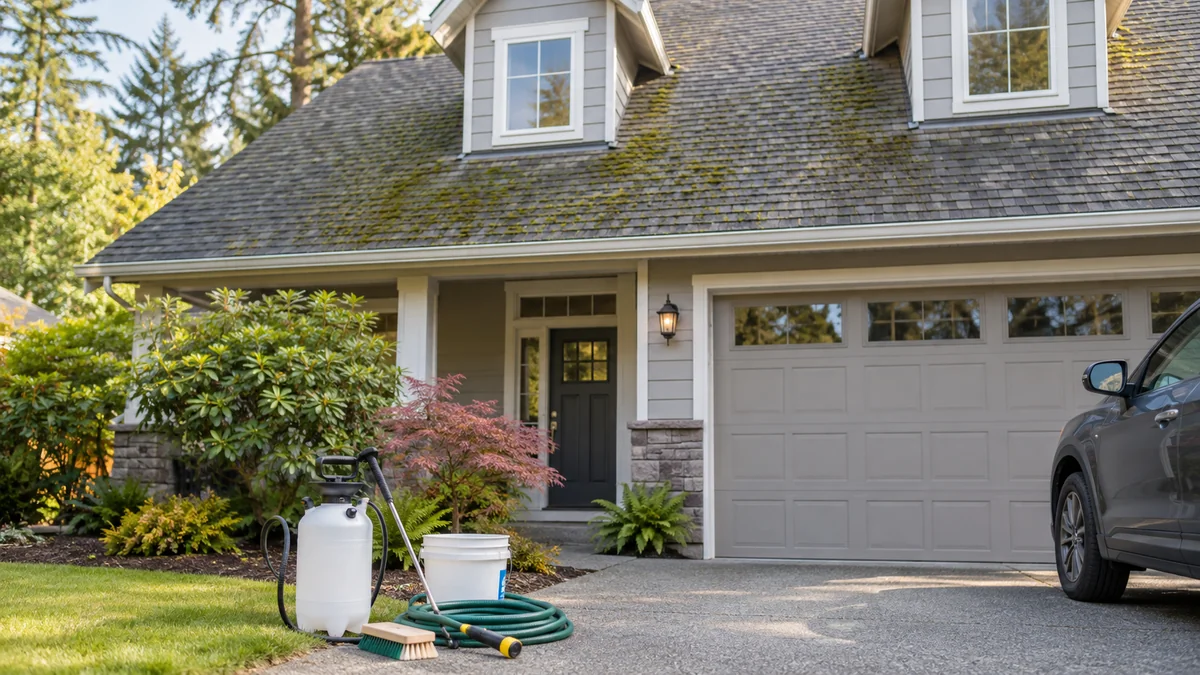
The safest homemade moss killer for roof surfaces is usually a mild oxygen-based cleaner or a carefully diluted household treatment approved for the specific roofing material, not a 50/50 bleach mixture. For light growth, physical removal followed by a low-strength treatment can work; dense moss, steep roofs, damaged shingles, and sensitive landscaping call for a professional or labeled roof biocide.
Key Facts at a Glance
- Moss removal works best when treatment is combined with gentle top-down debris removal and moisture control.
- A 50/50 chlorine bleach solution can discolor roofing, corrode metal, damage plants, and create hazardous runoff.
- Vinegar can kill exposed moss but may damage plants, soil biology, painted metal, and some roofing components.
- Baking soda is comparatively mild, but it is slower, less reliable on thick moss, and can still affect soil and freshwater systems.
- Never mix bleach with vinegar, ammonia, acids, or other cleaners because toxic gases can form.
- Roof moss commonly returns when shade, trapped moisture, leaves, and overhanging branches remain unchanged.
What Is a Homemade Moss Killer for a Roof?
A homemade roof moss killer is a household chemical mixture used to dry, weaken, or remove moss from roofing. The treatment does not repair lifted shingles, replace missing granules, seal leaks, or correct the damp conditions that allow moss to return.
Moss is a nonvascular plant that absorbs water across its surface rather than through a conventional root system. Its rhizoids anchor the plant to the roof, so spraying may kill green tissue while leaving a dry mat attached for days or weeks.
Roof algae and lichen are different problems. Black streaks on asphalt shingles are often algae, while pale crusts or branching growth may be lichen. A mixture that affects moss may not remove established lichen, and aggressive scraping can damage the roof before the growth is gone.
The practical goal is therefore controlled biological die-off, not instant cosmetic stripping. A successful treatment leaves the roofing intact, allows dead growth to release naturally, and reduces the moisture and shade that caused the infestation.
Which Homemade Roof Treatment Is Safest?
For a sound asphalt-shingle roof with light moss, a mild, low-runoff treatment is safer than concentrated chlorine bleach, vinegar with salt, or powdered laundry detergent. No homemade mixture is universally safe because roof coatings, metals, plants, water systems, and local regulations vary.
| Treatment | Typical household mixture | Approximate result time | Main risk |
|---|---|---|---|
| Baking soda | 3 tablespoons per 1 liter of water | 1-4 weeks | Runoff changes soil or freshwater chemistry |
| White vinegar | 1 part vinegar to 3 parts water | 1-7 days | Plant injury and metal or coating damage |
| Chlorine bleach | Avoid 50/50; use only label-compatible dilution | Hours to several days | Corrosion, discoloration, toxic runoff |
| Laundry detergent | Not recommended as a default roof treatment | Days to weeks | Slippery residue, surfactant pollution, streaking |
| Oxygen-based cleaner | Label-directed dilution | Several days | Coating or plant damage if misapplied |
These are practical ranges, not guarantees. Temperature, shade, moss thickness, roof porosity, and rainfall change the outcome substantially.
Why a 50/50 Bleach Mixture Is a Poor Default
A 50/50 bleach solution is unnecessarily aggressive for many residential roofs and should not be treated as a universal recipe. Chlorine bleach can degrade or discolor asphalt-shingle surfaces, corrode fasteners and flashing, injure vegetation, and contaminate stormwater when runoff is uncontrolled.
Manufacturers and roofing contractors commonly recommend avoiding high-pressure cleaning and using only compatible cleaning solutions. The correct concentration depends on the product’s sodium hypochlorite percentage, the roof manufacturer’s guidance, and the label directions. Household bleach products vary, so “one part bleach” does not represent one consistent chemical strength.
If bleach is used at all, protect plants, control runoff, use the lowest effective label-compliant dilution, and never allow the mixture to dry on the roof. A labeled roof-cleaning product is easier to dose than an improvised 50/50 formula.
Does Vinegar Kill Roof Moss?
Diluted white vinegar can damage exposed moss, but vinegar is not a permanent roof solution and is not harmless to surrounding landscaping. Acetic acid desiccates plant tissue on contact, while the moss mat, spores, shade, and trapped moisture remain.
A practical low-strength test mixture is one part household white vinegar to three parts water, applied only to a small inconspicuous area first. Avoid adding salt. Salt increases the risk of plant injury, soil salinity, metal corrosion, and persistent runoff without solving the moisture problem.
Vinegar is especially unsuitable near vegetable beds, ponds, rain gardens, painted metal, copper, zinc, and sensitive stone. Do not use it on a roof when runoff cannot be collected or diluted safely.
Can Baking Soda Kill Moss on a Roof?
Baking soda can weaken light moss when applied during a dry weather window, but it is a slow and inconsistent treatment for thick roof growth. Sodium bicarbonate raises surface alkalinity and dries exposed tissue, although it does not reliably penetrate a dense, established mat.
Dissolve approximately 3 tablespoons of baking soda in 1 liter of water and test the mixture on a small area. A dry application may remain on damp moss, but wind and rain can move the powder into gutters and soil. Avoid heavy applications near ponds, streams, rain barrels, or salt-sensitive plants.
Baking soda is best viewed as a mild treatment for small patches, not a guaranteed moss eradicator. It also does not remove the physical mat, so dead material may remain attached until gentle weathering or later manual removal.
Which Treatment Fits Each Roof and Site?
Roof material and runoff exposure matter more than the cheapest recipe. Asphalt shingles tolerate less abrasion than many people assume, metal can corrode, and historic materials may lose value after a single unsuitable chemical treatment.
| Roof or site condition | Preferred approach | Avoid | Reason |
|---|---|---|---|
| Asphalt shingles, light moss | Gentle brushing plus mild labeled cleaner | Pressure washing and wire brushing | Granules and shingle edges are vulnerable |
| Painted or galvanized metal | Material-approved cleaner and immediate rinsing | Vinegar, salt, strong bleach | Acids and oxidizers can attack coatings or metal |
| Clay or concrete tile | Low-pressure rinse and tile-compatible treatment | Walking on unsupported tiles | Tiles crack under concentrated foot loading |
| Wood shakes | Professional assessment first | Bleach, vinegar, aggressive brushing | Wood absorbs chemicals and can split |
| Slate | Slate-roof specialist | Household chemical experimentation | Slate, flashing, and historic fasteners vary |
| Roof above a pond or rain barrel | Physical removal or professional treatment | Any uncontrolled chemical runoff | Aquatic systems are highly sensitive |
| Steep or high roof | Ground-based professional service | DIY ladder or roof walking | Fall risk exceeds chemical savings |
How Much Treatment Do You Need?
A typical homeowner uses about 1 gallon of diluted solution per 150-250 square feet when wetting a mossy surface without flooding it. Porous tile, thick growth, wind, and low-pressure sprayers can increase consumption.
| Project size | Typical diluted volume | Household material cost | Application time |
|---|---|---|---|
| 100 square feet | 0.5-1 gallon | $3-$12 | 30-60 minutes |
| 250 square feet | 1-2 gallons | $5-$20 | 1-2 hours |
| 500 square feet | 2-4 gallons | $8-$35 | 2-4 hours |
| 1,000 square feet | 4-8 gallons | $15-$60 | 4-8 hours |
These figures exclude fall-protection equipment, tarps, replacement nozzles, gutter cleaning, and professional disposal. A professional roof-cleaning visit commonly costs more than household materials because access, insurance, runoff control, and roof inspection are part of the service.
How Do You Apply a Homemade Moss Killer Safely?
The safest DIY process has six stages: inspect, protect, remove loose growth, apply a compatible treatment, rinse gently, and prevent recurrence. Plan for roughly 2-6 hours for a small accessible roof, plus several days or weeks for dead moss to release.
Before You Start
Prepare a pump sprayer, garden hose with a gentle nozzle, soft-bristle brush, gloves, eye protection, tarps, gutter tools, and a stable ground ladder. Use a roof harness only with an appropriate anchor system and training; a harness without a rated anchor does not prevent a fall.
Do not proceed if shingles are brittle, curled, loose, cracked, or missing. Do not climb a wet, moss-covered roof. From the ground, inspect for sagging roof planes, exposed underlayment, damaged flashing, electrical hazards, and branches that make access unsafe.
Choose a cool, overcast, low-wind day with at least 24 hours without heavy rain. Avoid hot sun because the treatment may evaporate before reaching the moss mat.
Step 1: Protect Plants and Control Runoff
Water nearby plants thoroughly before work, cover sensitive vegetation with breathable tarps for the application period, and place collection material beneath concentrated downspout outlets. Do not seal plants under plastic in hot sunlight.
Disconnect downspout extensions only if the discharge can be safely redirected. Never route contaminated runoff toward a pond, storm drain, vegetable bed, neighboring property, or rainwater tank.
Success checkpoint: runoff remains contained and no spray reaches windows, siding, vehicles, pets, or fish habitat.
Common mistake: covering plants but ignoring the gutter outlet, where the most concentrated chemical flow usually occurs.
Step 2: Remove Loose Moss From the Ground or a Secure Position
Use a soft-bristle brush or a long-handled tool and work from the ridge toward the eaves. Top-down movement follows the shingle overlap and reduces the chance of lifting shingle tabs.
Do not scrape upward, pry under shingle edges, or use a metal rake. Never remove firmly attached moss by force when doing so would strip granules or crack roofing.
Success checkpoint: loose clumps are removed while shingle surfaces remain covered and intact.
Common mistake: trying to make the roof look clean before applying treatment, which often causes more mechanical damage than the moss caused.
Step 3: Mix and Test the Treatment
Follow the product label when using a commercial cleaner. For a mild homemade test, prepare 3 tablespoons of baking soda per liter of water, or one part white vinegar to three parts water when the roof material and surrounding site permit it.
Do not combine ingredients. In particular, never mix bleach with vinegar, ammonia, toilet cleaner, acids, or other household products. Chlorine gas and related toxic vapors can form rapidly.
Spray a small hidden section and wait 24-48 hours. Check for color change, coating damage, corrosion, granule loss, or plant injury before treating the full area.
Success checkpoint: the test area shows no discoloration or surface change after drying.
Common mistake: measuring by “splash” or “capful,” which creates an unknown concentration and makes the result impossible to reproduce.
Step 4: Wet the Moss Without Flooding the Roof
Apply enough solution to wet the moss evenly, but stop before liquid streams across the roof. Work in sections of approximately 25-50 square feet so the surface does not dry before the treatment reaches the growth.
Keep the nozzle close enough to control overspray, but never use pressure that drives water beneath shingle laps. Do not walk across wet moss because the surface becomes exceptionally slippery.
Success checkpoint: the moss appears uniformly damp, with no gutter overflow or visible liquid entering wall cavities.
Common mistake: applying a large volume at once, which increases runoff without improving penetration.
Step 5: Respect the Dwell Time
Allow a mild vinegar or oxygen-based treatment to remain for the label or test-directed period, commonly 10-30 minutes. Baking soda may require repeated dry-weather exposure over 1-4 weeks.
Do not let bleach-based solutions dry on roofing. If the surface begins drying before the stated dwell time, stop and rinse according to the product directions rather than repeatedly increasing concentration.
Success checkpoint: treated moss loses its green color and becomes dull, yellow, brown, or gray over the expected timeframe.
Common mistake: assuming immediate color change proves that the rhizoids and embedded material are gone.
Step 6: Rinse and Clean the Gutters
Rinse with a normal garden hose using low pressure, moving from the ridge toward the eaves. Direct the rinse water into a controlled collection or safe vegetated area only after the chemical has been sufficiently diluted.
Remove moss fragments from gutters by hand or with a scoop, then flush the gutters with clean water. Rinse nearby plants thoroughly after removing tarps.
Success checkpoint: no concentrated residue remains in gutters, downspouts, valleys, or roof-wall junctions.
Common mistake: using a pressure washer to save time. The U.S. Environmental Protection Agency and roofing manufacturers warn against uncontrolled chemical discharge, while high-pressure cleaning can remove protective granules and force water under roofing components.
What Should You Use Instead of a Homemade Mixture?
A labeled roof-moss product is often the better choice when the infestation is widespread, the roof is valuable, or runoff is difficult to manage. Registered products provide an application rate, permitted surfaces, first-aid information, storage directions, and disposal instructions that kitchen recipes lack.
| Option | Typical cost | Speed | Best use | Main limitation |
|---|---|---|---|---|
| Baking soda mixture | $3-$10 | 1-4 weeks | Small light patches | Weak on dense mats |
| Diluted vinegar | $5-$15 | 1-7 days | Isolated growth away from plants | Acid runoff |
| Labeled roof cleaner | $15-$45 | 1-14 days | Known roof material | Must follow label |
| Professional soft wash | $250-$900 typical | 1-7 days | Steep, large, or fragile roofs | Higher upfront cost |
| Physical removal only | $0-$30 in tools | Several days | Tiny accessible patches | Does not address regrowth |
The most economical choice is not always the lowest purchase price. A $10 chemical treatment that damages flashing or landscaping can cost more than a $300 controlled service.
How Do You Prevent Moss From Returning?
Moss prevention depends primarily on drying the roof, not on repeatedly increasing chemical strength. Trim branches that shade the roof, clear leaves from valleys and gutters, improve blocked drainage, and keep roof penetrations watertight.
Copper or zinc strips near the ridge can release small quantities of metal ions during rainfall and suppress new growth on the downslope surface. Strips do not remove established moss, do not cover every roof geometry, and may create metal runoff that affects plants or aquatic systems.
A roof inspection is appropriate when moss returns within three months, because rapid recurrence may indicate persistent shade, poor drainage, trapped debris, or a leak. Repeated treatment without correcting those conditions usually produces a short cosmetic improvement.
Common Problems and How to Fix Them
Dead Moss Remains Attached
Dead moss can remain bonded to shingles for several weeks because the rhizoids and dried mat do not disappear when the green tissue dies. Allow several dry-weather cycles, then use a soft brush from the ridge downward.
Do not pressure-wash the residue. If removal requires force, the roof may need professional cleaning or partial replacement.
Moss Returns Quickly
Fast regrowth usually indicates shade, moisture, leaf accumulation, or untreated growth in adjacent roof sections. Prune overhanging limbs, clean valleys, and inspect gutters before applying another treatment.
Shingles Look Pale After Cleaning
Pale areas may indicate granule loss, chemical discoloration, or pre-existing weathering. Stop work, photograph the surface, and consult the shingle manufacturer or roofer rather than applying a stronger cleaner.
Plants Turn Brown
Chemical runoff can burn foliage even when the roof itself appears undamaged. Rinse plants immediately with clean water, remove contaminated mulch if necessary, and prevent further discharge. Salt-containing mixtures create a longer-lasting soil problem than vinegar alone.
The Roof Still Leaks
Moss treatment cannot repair a leak. Water may enter through lifted shingles, failed flashing, cracked tiles, damaged underlayment, or blocked valleys. Arrange a roof inspection before any further cleaning.
When Should You Hire a Professional?
Hire a professional when the roof is steep, more than one story high, older than approximately 20 years, visibly damaged, made from slate or wood shake, or located above a pond, rain barrel, or sensitive garden. Professional service is also appropriate when moss covers more than roughly 25% of the roof plane.
A contractor should identify the roof material, explain the cleaning chemistry, protect landscaping, control runoff, avoid high pressure, and provide evidence of insurance. Ask whether the proposed treatment complies with the roofing manufacturer’s maintenance guidance.
DIY treatment is reasonable only when the roof is low, sound, dry, accessible, and small enough to work without walking on active moss. Chemical savings never justify an avoidable fall.
FAQ
Is dish soap a good surfactant for roof moss treatment?
Dish soap can help a liquid spread, but it does not reliably kill established roof moss and may create slippery runoff or foam in gutters. Use only a small amount when a compatible product label permits it, and never assume extra soap improves biological control.
Can I use hydrogen peroxide on roof moss?
Hydrogen peroxide can oxidize organic material, but household concentrations and roof compatibility vary. Uncontrolled application may bleach surfaces or harm plants. Test a small area first, follow a roof-specific product label, and avoid mixing peroxide with vinegar, bleach, or other cleaners.
Can rain wash away a homemade moss killer?
Rain can dilute or remove a treatment before it affects the moss, particularly baking soda powder and lightly applied vinegar. Choose a forecast with a dry interval, but do not postpone rinsing a chemical that the label says must not dry on the roof.
How often should I treat roof moss?
Inspect the roof twice a year, typically in spring and autumn, and treat only when growth is present and the roof material permits the chosen method. Preventive pruning, gutter cleaning, and debris removal are usually more valuable than routine chemical spraying.
Can I use a pressure washer after the moss dies?
Pressure washing is unsafe for most asphalt shingles and can strip granules, lift shingle edges, crack tiles, and force water under roofing. Use low-pressure hose rinsing and soft brushing from the ridge downward, or hire a contractor familiar with the roof material.
Does roof moss mean the roof needs replacement?
Roof moss does not automatically mean replacement. Moss becomes evidence for replacement when it accompanies widespread granule loss, brittle or curled shingles, exposed underlayment, leaks, structural sagging, or roof age beyond the material’s expected service life.
The Bottom Line
The best homemade moss killer for roof maintenance is the least aggressive method that matches the roof material and controls runoff. Start with inspection and gentle top-down removal, test a mild treatment on a hidden area, avoid 50/50 bleach and salt mixtures, and correct shade and moisture conditions so moss does not return. If the roof is steep, fragile, damaged, or above sensitive water or landscaping, use a qualified professional instead.