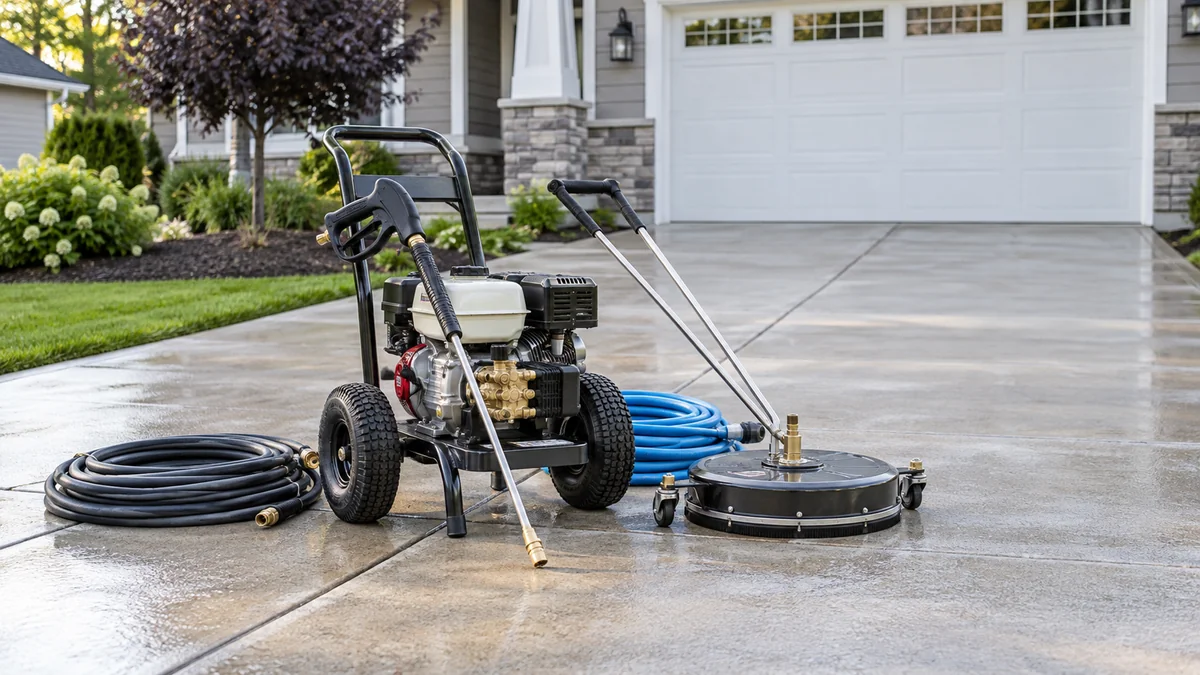
The power washing vs pressure washing difference is water temperature: pressure washing normally uses unheated water, while power washing adds a heating system to the same high-pressure spray process. Hot water dissolves oil, grease, and some waxes faster, but cold-water pressure washing is usually the safer, cheaper choice for routine residential dirt, vehicles, siding, brick, and patios.
Key Facts at a Glance
- Pressure washing uses ambient-temperature water; power washing uses heated water, commonly about 140-200°F at the machine.
- PSI measures water pressure, while GPM measures water volume; cleaning performance depends on both, not PSI alone.
- Hot water is especially useful for petroleum, cooking grease, gum, and heavy industrial soil.
- Heat does not automatically sanitize a surface or eliminate every mold spore; chemical treatment and adequate dwell time may still be necessary.
- A 0-degree nozzle can damage concrete, wood, paint, skin, and masonry even when the machine is used briefly.
- Typical residential pressure-washer rental costs are $40-$100 per day; hot-water units commonly cost $150-$250 per day.
What Is the Difference Between Power Washing and Pressure Washing?
Power washing and pressure washing use the same basic force-generation system, but power washing includes a burner or heating coil. A motor or engine drives a pump, the pump pressurizes incoming water, and a nozzle converts that pressure into a selected spray pattern.
Cold-water pressure washing is effective against loose dirt, mud, dust, algae residue, and some flaking paint. Power washing adds thermal energy, which lowers the viscosity of oily contaminants and speeds their separation from concrete, metal, and other heat-tolerant materials.
The terminology is not perfectly standardized. Some contractors use “power washing” and “pressure washing” interchangeably, even when their machines use cold water. Ask whether the proposed service uses heated water, the expected temperature, the pressure range, the flow rate, and the cleaning chemical before comparing quotes.
How Do the Machines Work?
A pressure washer draws water through a garden hose or supply line and sends it through a positive-displacement or axial-style pump. The pump raises pressure, and the nozzle controls the spray angle, impact concentration, and approximate flow restriction.
A hot-water power washer adds a fuel-fired burner after the pump or within the high-pressure water path. Diesel, kerosene, propane, or another approved fuel heats the water through a coil. The operator must maintain both the pump system and the burner system, so hot-water equipment is heavier, more expensive, and more maintenance-intensive.
How PSI, GPM, and Temperature Work Together
PSI means pounds per square inch and describes pressure. GPM means gallons per minute and describes water volume. Cleaning units, often expressed as PSI multiplied by GPM, provide a rough comparison, but the figure does not account for nozzle distance, spray angle, detergent, surface texture, or water temperature.
| Equipment category | Typical PSI | Typical GPM | Typical water temperature |
|---|---|---|---|
| Electric residential washer | 1,500-2,300 | 1.2-2.0 | 50-70°F |
| Gas residential washer | 2,500-3,400 | 2.3-3.5 | 50-70°F |
| Professional cold-water washer | 3,000-4,000 | 3.0-5.0 | 50-70°F |
| Commercial hot-water washer | 3,000-4,000+ | 4.0-5.5+ | 140-200°F |
A 2,000 PSI machine flowing 2 GPM produces approximately 4,000 cleaning units. A 3,000 PSI machine flowing 4 GPM produces approximately 12,000 cleaning units, but the second machine also consumes twice as much water and can damage fragile surfaces more quickly.
Which Method Cleans Better?
Power washing cleans oil and grease better because heat changes the physical behavior of petroleum-based and animal-fat residues. Heated water can soften adhesive deposits, road film, chewing gum, and commercial kitchen buildup before the operator applies detergent and rinses.
Pressure washing cleans ordinary exterior soil effectively when the contaminant is water-soluble or loosely attached. For green growth, the machine often removes visible staining without killing the underlying organism, so a suitable biocide or detergent may be needed.
Hot water is not automatically the best treatment for every stain. Rust, mineral scale, efflorescence, and certain paint residues may require an acid-safe cleaner, mechanical treatment, or professional restoration method rather than higher temperature.
Which Nozzle Should You Use?
Nozzle angle determines how widely water spreads and how intensely it strikes a point. A narrow nozzle increases impact and surface risk, while a wide nozzle distributes force over a larger area.
| Nozzle color and angle | Typical spray use | Common application | Main risk |
|---|---|---|---|
| Red, 0° | Pencil-point stream | Industrial spot cleaning on sound concrete | Gouging, cutting, severe injury |
| Yellow, 15° | Narrow stripping fan | Heavy soil on durable masonry or steel | Paint and mortar removal |
| Green, 25° | General cleaning fan | Concrete, brick, fences, equipment | Etching from close distance |
| White, 40° | Wider rinse fan | Vehicles, siding, windows at safe pressure | Water intrusion |
| Black, 65° | Low-pressure detergent spray | Soap and chemical application | Poor cleaning if detergent dries |
A 0-degree tip is rarely appropriate for residential work. Professional operators usually begin with the widest effective pattern, test an inconspicuous area, and reduce distance only when the surface tolerates the impact.
Which Method Fits Each Surface?
Surface type should determine the combination of temperature, pressure, nozzle, distance, and chemical. The same hot-water machine that cleans an oil-soaked loading dock can blister paint, warp vinyl, or destroy a softwood deck.
| Surface or material | Preferred method | Typical starting approach | Avoid |
|---|---|---|---|
| Sound concrete driveway | Cold or hot water | 2,000-3,500 PSI, 15°-25° tip | Holding the wand stationary |
| Oil-stained concrete | Hot water | 140-200°F with degreaser | Expecting water alone to remove old oil |
| Brick and mortar | Cold water | 500-1,500 PSI, 25°-40° tip | Direct spray into soft mortar joints |
| Vinyl siding | Cold water | Low pressure, 40° tip, top-down rinse | Spraying behind overlapping panels |
| Wood deck | Cold water | Low pressure, 40° tip, 12-18 inches away | 0° or 15° tip close to boards |
| Vehicle paint | Cold water | 800-1,200 PSI, 40° tip | Hot water, concentrated spray, wheel bearings |
| Asphalt shingles | Neither high pressure nor hot water | Use low-pressure soft washing | Wand cleaning, which removes granules |
| Natural soft stone | Low-pressure cold water | Test first with a neutral cleaner | Heat, narrow tips, acidic chemicals |
Power washing asphalt shingles is a common service error. Roofing manufacturers generally favor low-pressure chemical cleaning because high-pressure water can remove protective granules and force water beneath shingles.
Is Hot Water Safe for Vinyl, Wood, and Glass?
Hot water is conditionally safe on some hard, heat-tolerant surfaces, but it increases risk on thin vinyl, painted materials, old glazing, and wood. Thermal shock can occur when a hot stream strikes cold glass, while heat can soften coatings, distort vinyl, or accelerate water movement into joints.
Wood damage usually comes from concentrated hydraulic force rather than temperature alone. A wide fan, low pressure, steady movement, and adequate distance matter more than using a hot or cold label.
What Are the Advantages and Limitations?
Pressure washing has lower equipment cost, lower fuel consumption, and fewer maintenance points. Electric models are practical for short residential jobs, while gas models provide greater flow for driveways, fences, patios, and farm equipment.
Power washing reduces labor on grease-heavy surfaces because heat softens contamination before rinsing. The trade-offs include burner fuel, exhaust, greater weight, more expensive repairs, fire risk, and stricter control of runoff containing dissolved oil.
| Decision factor | Cold-water pressure washing | Hot-water power washing |
|---|---|---|
| Best contaminant | Dirt, mud, loose algae residue | Grease, oil, gum, road film |
| Typical rental price | $40-$100 per day | $150-$250 per day |
| Startup complexity | Electric or gasoline engine | Engine, pump, burner, fuel system |
| Residential portability | 35-100 pounds | Often 200-500+ pounds with trailer |
| Fuel or energy use | Electricity or gasoline | Gasoline or diesel plus burner fuel |
| Surface risk | Impact and water intrusion | Impact plus heat and water intrusion |
| Maintenance burden | Pump, hose, engine | Pump, hose, engine, burner, coil |
An important practitioner rule is that more pressure is not a substitute for better chemistry. Degreaser, dwell time, heat, agitation, and rinsing often outperform a pressure increase that damages the substrate.
How Much Does Each Method Cost?
A typical homeowner spends $40-$100 per day to rent an electric or light-duty gas pressure washer and about $150-$250 per day to rent a commercial hot-water unit. Professional exterior cleaning commonly ranges from $0.15-$0.40 per square foot, although access, soil severity, height, chemicals, wastewater controls, and regional labor rates change the final quote.
| Project | Typical DIY time | Typical professional price | Method often selected |
|---|---|---|---|
| Two-car concrete driveway | 1-2 hours | $150-$300 | Cold water, hot water for oil |
| 2,000-square-foot siding wash | 2-4 hours | $300-$600 | Low-pressure cold water |
| 300-square-foot deck | 1-2 hours | $150-$350 | Low-pressure cold water |
| Small commercial grease area | 2-6 hours | $300-$1,000+ | Hot water and degreaser |
A quote should state whether the price includes detergent, stain treatment, plant protection, surface sealing, ladder or lift access, and wastewater management. “Power washing” alone does not prove that hot water will be used.
Safe Operating Sequence
A typical residential cleaning job takes 1-4 hours, uses a pressure washer, appropriate nozzle, hose, detergent, eye protection, gloves, and surface-specific settings, and succeeds when the operator controls impact rather than maximizing it. Water supply, chemical choice, and wand distance determine the result more than the machine’s advertised PSI.
Step 1: Inspect and Protect the Site
Remove furniture, toys, fragile decorations, and loose objects. Cover outdoor electrical receptacles, HVAC controls, delicate plants, and openings where water could enter, then pre-wet nearby vegetation before applying detergent.
Do not rely on plastic sheeting around a running electrical device as complete protection. Turn off or isolate vulnerable equipment when the manufacturer permits it.
Step 2: Connect Water Before Starting
Connect the supply hose, high-pressure hose, gun, and selected tip before starting the engine or motor. Turn the water fully on and squeeze the trigger until trapped air leaves and the stream becomes steady.
Running a pump without adequate water can damage it within seconds. A kinked hose, restricted spigot, inadequate flow, or clogged inlet screen can cause pressure fluctuation.
Step 3: Test Pressure and Chemical Compatibility
Test a hidden area using the widest suitable nozzle from at least 12 inches away. Confirm that paint, mortar, wood fibers, and coatings remain intact before increasing pressure or moving closer.
Apply detergent from the lowest effective pressure, commonly through a black 65-degree soap tip or downstream injector. Follow the product label, keep dwell time within its stated range, and prevent the chemical from drying.
Step 4: Wash in Controlled Passes
Work from the top down with overlapping horizontal or vertical passes. Keep the wand moving, maintain a consistent distance, and use the lowest pressure that removes the contaminant.
For siding, avoid directing water upward beneath laps. For concrete, a surface cleaner attachment usually produces more uniform results than a narrow wand because rotating jets reduce striping.
Step 5: Rinse and Manage Runoff
Rinse with clean water until detergent, loosened soil, and oily residue are gone. Do not allow concentrated degreaser, paint chips, or oily wastewater to enter storm drains.
Municipal rules vary, but stormwater systems commonly discharge directly to waterways without treatment. Use berms, wet vacuums, drain covers where permitted, collection mats, or a professional wastewater-recovery system for commercial work.
DIY, Rental, or Professional Service?
DIY cold-water pressure washing makes sense for a homeowner cleaning a patio, vehicle, furniture, or small driveway with clear access and modest staining. Renting a gas machine suits larger areas, but the user must transport, fuel, start, and control equipment that can cause expensive damage.
Professional service is usually preferable for roofs, multi-story siding, historic masonry, oil-contaminated commercial areas, delicate stone, wastewater-sensitive sites, or any job requiring a lift. A trained operator can select soft washing, hot water, surface cleaning, or chemical treatment instead of using high pressure for every problem.
Ask a contractor these questions:
- Will you use hot water, cold water, or low-pressure soft washing?
- What PSI, GPM, temperature, and nozzle will you use on this material?
- Which detergent will you apply, and how will you protect plants?
- How will you prevent runoff from entering a storm drain?
- Are stain treatment, access equipment, and repairs included in the quote?
When Is Soft Washing the Better Alternative?
Soft washing is better than either conventional high-pressure method for roofs, delicate painted surfaces, some stucco, and biological growth that requires chemical treatment. Soft washing uses low mechanical pressure with a cleaning solution, followed by a controlled rinse.
Soft washing is not a universal substitute. It will not replace hot-water degreasing on a restaurant loading dock, and poorly handled sodium hypochlorite can damage plants, metals, fabrics, and finishes. Chemical concentration, dwell time, neutralization, and runoff control must match the surface and product label.
Troubleshooting and Failure Modes
| Symptom | Likely cause | Safe correction |
|---|---|---|
| Pulsing pressure | Kinked hose, low supply flow, air in pump | Open spigot, inspect hose, purge air |
| Motor runs but spray is weak | Worn nozzle or blocked inlet screen | Relieve pressure, clean or replace parts |
| No spray from tip | Clogged orifice | Shut down, trigger gun, clear with tip tool |
| Stripes on concrete | Wand overlap or uneven distance | Use a surface cleaner and consistent passes |
| White residue remains | Detergent or mineral deposits | Rinse longer and adjust chemical concentration |
| Burner will not heat | Low fuel, blocked filter, ignition fault | Stop operation and follow service manual |
Never remove a nozzle or fitting while the system is pressurized. Never place a hand over a suspected leak because high-pressure injection injuries can force water beneath the skin and require urgent medical treatment.
Ladders are another avoidable hazard. Kickback can shift a ladder when the trigger is pulled, so use ground-based extension tools, scaffolding, or a professional lift rather than operating a pressure washer from an unstable ladder.
Which Should You Choose?
Choose Pressure Washing for Routine Home Cleaning
Select cold-water pressure washing for brick paths, concrete patios, fences, outdoor furniture, vehicles, and ordinary seasonal dirt. A residential electric washer around 1,800-2,000 PSI and 1.2-2.0 GPM is usually sufficient when the operator uses a wide nozzle and reasonable distance.
Choose Power Washing for Grease and Oil
Select hot-water power washing for oil-stained concrete, commercial kitchens, loading docks, fleet equipment, gum, and heavy road film. Heat improves removal speed, but a degreaser, recovery plan, and surface test remain necessary.
Choose Soft Washing for Roofs and Delicate Exteriors
Select low-pressure soft washing for asphalt shingles, biological roof staining, and fragile painted surfaces. High pressure can remove granules, force water behind cladding, and create damage that a cleaner may not notice immediately.
Choose a Professional for High-Risk Work
Hire a professional when the work involves a roof, height, historic masonry, industrial grease, electrical exposure, wastewater restrictions, or uncertain surface condition. The lowest rental price is not the lowest total cost if one damaged panel or mortar joint requires replacement.
FAQ
Does power washing remove mold better than pressure washing?
Power washing can remove visible mold residue faster because heated water improves soil release, but heat alone does not guarantee mold control. A labeled antimicrobial or bleach-based treatment, correct dwell time, and thorough rinsing may be required, especially when growth has penetrated porous masonry or wood.
Is 4,000 PSI better than 2,000 PSI for a driveway?
A 4,000 PSI machine is not automatically better for a driveway. Flow rate, nozzle pattern, surface condition, detergent, and operator distance also determine cleaning performance. High pressure can etch concrete, expose aggregate, or create visible wand marks, so begin with the lowest effective setting.
Can I use hot water in a regular pressure washer?
Do not use hot water in a cold-water pressure washer unless the manufacturer explicitly permits the temperature. Seals, pump components, hoses, and inlet fittings may have lower temperature ratings. A dedicated hot-water power washer has a burner, thermal relief system, and components designed for heated operation.
How long should detergent sit before rinsing?
Many exterior detergents require approximately 5-10 minutes of dwell time, but the product label controls. Keep the surface wet and prevent drying, particularly in direct sun or warm weather. Longer dwell is not always better because concentrated chemicals can discolor finishes or harm plants.
Can pressure washing damage concrete?
Pressure washing can damage concrete through surface etching, aggregate exposure, pitting, and uneven striping. Risk rises with a narrow nozzle, short distance, high PSI, deteriorated concrete, and stationary passes. A surface-cleaner attachment and a test area usually produce a safer, more uniform result.
Conclusion
The power washing vs pressure washing difference is heated water, not a completely different cleaning principle. Choose cold-water pressure washing for most residential dirt and hardscape maintenance, hot-water power washing for oil and grease, and soft washing for roofs or delicate surfaces. Match PSI, GPM, temperature, detergent, nozzle, and runoff controls to the material rather than selecting the most powerful machine.