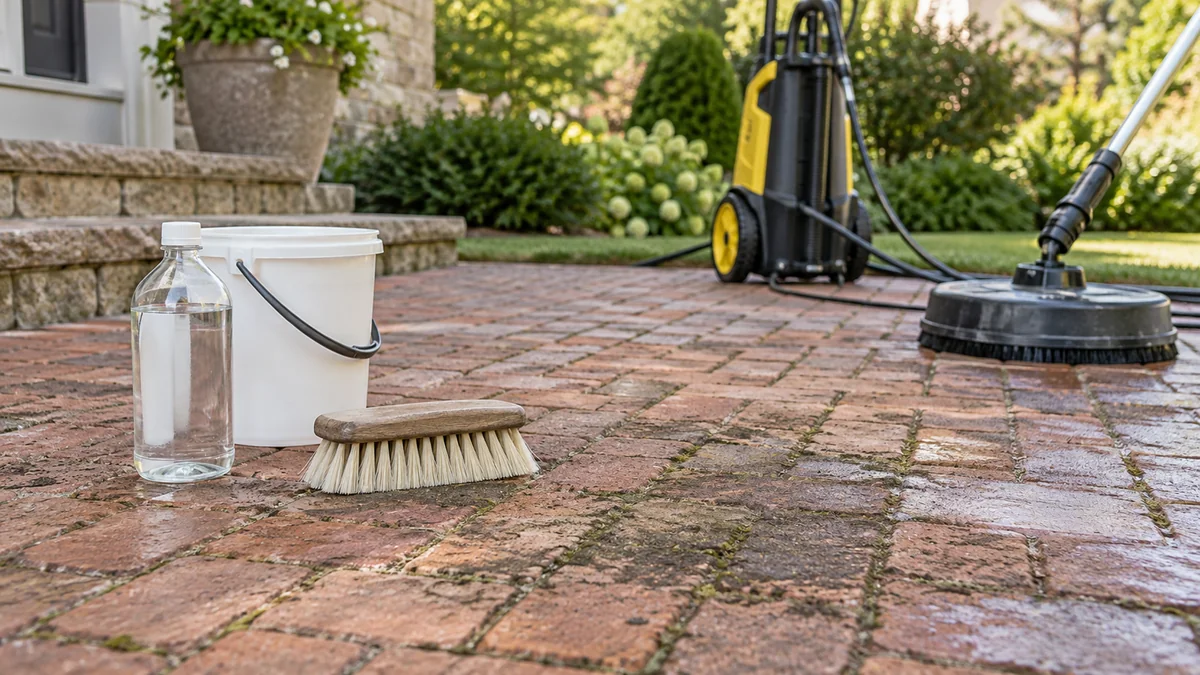
To clean brick pavers with vinegar, sweep and pre-rinse the surface, test diluted 5% white vinegar, apply it for 5-10 minutes, scrub with a nylon brush, and rinse thoroughly before the solution dries. Vinegar works best on light mineral residue, algae, and surface grime, but it can damage sealers, plants, natural stone, and some colored concrete pavers.
Key Facts at a Glance
Standard household vinegar contains approximately 5%-6% acetic acid.
A practical starting mix is 1 part white vinegar to 1 part water for unsealed, durable masonry.
Vinegar should remain wet for about 5-10 minutes, not dry on the pavers.
Vinegar is acidic and can dull sealers, etch cement-based materials, and injure plants.
A stiff nylon brush is safer than a wire brush for brick and concrete pavers.
A typical 400-square-foot patio takes 1-3 hours to clean, excluding sealing or joint-sand replacement.
Is Vinegar Suitable for Brick Pavers?
Vinegar is suitable for light organic growth, mild grime, and some surface mineral deposits on unsealed clay brick pavers, but it is not a universal paver cleaner. The safest approach is to identify the paver material, determine the stain type, and test a hidden area before treating the entire patio.
Household white vinegar contains acetic acid, which lowers surface pH and reacts with some alkaline mineral residues. That reaction can loosen calcium-based deposits, while scrubbing removes dirt and dead organic material. Vinegar does not reliably remove oil, paint, deeply embedded rust, or every type of efflorescence.
The word “brick” creates a practical hazard. Outdoor pavers may be kiln-fired clay, molded concrete, limestone, bluestone, or concrete colored with surface pigments. These materials respond differently to acid. Clay brick usually tolerates a brief, diluted application better than cement-based concrete, while limestone and other calcareous stones can visibly etch.
What Vinegar Does to Paver Stains
Vinegar can dissolve or loosen alkaline deposits and help remove surface algae, mildew residue, and general dirt when mechanical scrubbing follows the application. Acetic acid is less effective against nonpolar substances such as motor oil, grease, and many sealants.
Vinegar also has limits against rust. It may loosen a small, fresh iron stain, but severe rust often needs an oxalic-acid or manufacturer-approved masonry product. Never assume a stronger vinegar concentration is automatically safer or more effective.
What Should You Check Before Cleaning?
Before cleaning brick pavers with vinegar, check the material, sealer, joint sand, drainage, weather, and nearby vegetation. A five-minute inspection prevents the most expensive failures, especially faded color, cloudy sealer, dissolved joint sand, and dead grass along the patio edge.
Before-You-Start Checklist
| Item | Typical requirement | Why it matters |
|---|---|---|
| Cleaning area | 50-100 square feet per section | Keeps vinegar wet during scrubbing |
| Household vinegar | 1-2 gallons per 400 square feet | Covers light applications with runoff |
| Water | 5-10 gallons per 400 square feet | Dilutes and flushes dissolved residue |
| Brush | 16-24 inch stiff nylon broom | Reaches joints without metal transfer |
| Weather | 50-85°F, no rain for 4-6 hours | Prevents rapid drying or immediate dilution |
| Labor time | 1-3 hours per 400 square feet | Includes setup, scrubbing, and rinsing |
Do not begin if rain will carry acidic runoff into a garden bed, if the pavers are hot enough to dry the solution immediately, or if the surface has an unknown decorative coating. Move furniture and planters away from the work area. Wet nearby grass and ornamental plants with clean water, then cover delicate foliage where practical.
How Can You Tell Whether Pavers Are Sealed?
A simple water test can indicate whether a sealer is present. Place several drops of water on a clean, dry paver and observe them for 5-10 minutes. Rapid darkening or absorption suggests an unsealed or worn surface; persistent beads suggest a sealer or naturally low-absorption material.
The water test is not definitive. Some penetrating sealers do not bead strongly, and some dense clay pavers absorb water slowly without a coating. If the pavers look glossy, have a wet-look finish, or were sealed within the last several years, treat vinegar as a coating risk and use a pH-neutral cleaner first.
Which Vinegar Concentration Should You Use?
Use 5% household white vinegar diluted 1:1 with water as the starting solution for durable, unsealed clay or concrete pavers. Avoid 10%-30% vinegar for routine patio cleaning unless the product label specifically permits masonry use, because high-acid solutions increase the chance of etching, color loss, plant injury, and joint deterioration.
| Product | Acetic acid | Starting use | Main risk |
|---|---|---|---|
| Distilled white vinegar | 5%-6% | Dilute 1:1 with water | Surface dulling with long dwell time |
| Cleaning vinegar | 6%-10% | Follow label, usually dilute | Faster etching and plant damage |
| Horticultural vinegar | 20% | Weed-control product, not routine masonry cleaner | Severe skin, eye, and vegetation hazard |
| Industrial vinegar | 30% | Professional or labeled specialty use | High corrosion and material-damage risk |
Do not add dish soap automatically. A small amount of unscented detergent may improve wetting, but soap can leave a film and complicate rinsing. For a patio, plain diluted vinegar is easier to control and evaluate.
Never mix vinegar with bleach, ammonia, hydrogen peroxide, or commercial cleaners. Acid can release hazardous chlorine gas from bleach, while other combinations can create irritating or unpredictable chemical reactions.
How Do You Clean Brick Pavers With Vinegar?
Cleaning brick pavers with vinegar requires six controlled steps: diagnose the stain, dry-sweep the surface, test the solution, apply a small section, scrub while wet, and rinse until no residue remains. The most important control is preventing the acidic mixture from drying on the pavers or entering planted areas.
Step 1: Identify the Stain and Clear the Patio
Remove furniture, toys, grills, leaves, and loose containers. Photograph or mark oil spots, rust marks, white deposits, and organic growth separately, because one vinegar mixture should not be used for every stain.
Sweep with a stiff broom. Remove weeds from joints by hand where possible, and inspect for loose sand or cracked pavers before adding water.
You will know this step worked when: loose soil no longer smears under the broom and each stain type is visible.
Common mistake: treating a black oil stain as mildew. Vinegar rarely dissolves oil and can waste time while the stain spreads through wet pores.
Step 2: Test a Hidden Area
Mix 1 part 5% white vinegar with 1 part water. Apply the solution to an inconspicuous area of approximately 1 square foot, keeping it wet for 5 minutes. Scrub with a nylon brush, rinse thoroughly, and wait until the paver dries completely, which can take 2-24 hours depending on weather.
Check for color change, chalkiness, roughness, white rings, or a cloudy sealer. If any appears, stop using vinegar and switch to a pH-neutral masonry cleaner or contact the paver manufacturer.
You will know this step worked when: the test area has the same color, texture, and sheen as the surrounding pavers after drying.
Common mistake: judging the result while the paver is wet. Water temporarily darkens most masonry and can hide permanent fading.
Step 3: Pre-Wet the Pavers and Surrounding Plants
Lightly wet the pavers with clean water, then saturate nearby grass and plants. Pre-wetting reduces immediate absorption into porous masonry and dilutes accidental runoff on vegetation.
Do not flood the joints. Excess water can mobilize loose sand before the cleaning solution is applied.
You will know this step worked when: the surface is damp but not covered by standing water.
Common mistake: spraying plants only after vinegar runs into the soil. Pre-wetting is preventive; it does not make concentrated vinegar safe for foliage.
Step 4: Apply Vinegar to a Manageable Section
Apply the 1:1 vinegar solution with a plastic pump sprayer, watering can, or bucket. Work in sections of approximately 25-100 square feet, depending on sun, wind, and surface absorption.
Keep the solution wet for 5-10 minutes. Reduce the dwell time to 2-5 minutes on hot, highly absorbent, colored concrete pavers. Do not exceed 10-15 minutes without a product-specific reason and close observation.
You will know this step worked when: the grime softens and the solution remains visibly wet until brushing begins.
Common mistake: applying the entire patio at once. The far side will dry before you can scrub it, leaving concentrated acid and redeposited minerals.
Step 5: Scrub With a Nylon Brush
Scrub along the face of each paver and across the joints with a stiff nylon broom. Use overlapping passes, applying extra pressure to algae films and traffic lanes rather than increasing vinegar strength.
A wire brush can shed iron particles that later oxidize into orange specks. It can also scratch softer clay, remove color from concrete, and disturb polymeric sand.
You will know this step worked when: the surface film lifts into a diluted slurry and the original paver texture remains intact.
Common mistake: using a pressure washer instead of agitation. Water pressure can remove joint sand while leaving bonded stains untouched.
Step 6: Rinse and Flush the Residue
Rinse each section immediately with a garden hose and a broad spray pattern. Push dirty water toward a suitable drain or permeable gravel area, not into a planted bed, pond, or storm drain where local rules prohibit chemical discharge.
A pressure washer can be used cautiously on durable pavers, but begin with a wide fan tip, low pressure, and a test area. Keep the wand moving and avoid directing a concentrated jet into joints. Manufacturer guidance matters more than a universal PSI number; many patios are damaged well below 1,500 PSI when the nozzle is held too close.
Repeat the rinse until water runs clear and no slippery or soapy residue remains.
You will know this step worked when: the surface has no foam, acidic odor, loose slurry, or cloudy film after rinsing.
Common mistake: allowing dissolved minerals to dry on the surface. Drying can redeposit salts and make efflorescence appear worse.
How Should You Handle Different Stains?
Stain diagnosis determines whether vinegar is appropriate. Vinegar is a reasonable first test for light algae, mild mineral residue, and general grime, but oil, paint, tannin, and severe rust require different chemistry.
| Stain | Vinegar result | Better first treatment | Typical dwell or process |
|---|---|---|---|
| Light algae | Often improves surface film | Diluted vinegar and nylon scrubbing | 5-10 minutes |
| Moss in joints | Removes visible growth temporarily | Hand removal, joint-sand repair | 15-30 minutes manual work |
| White efflorescence | May dissolve surface carbonate | Dry brushing, then masonry cleaner | 1-3 dry-brush passes |
| Fresh rust | Sometimes lightens | Oxalic-acid masonry product | Follow label, often 5-15 minutes |
| Motor oil | Poor result | Absorbent granules and alkaline degreaser | 30 minutes to overnight |
| Leaf tannin | Limited result | Oxygenated or manufacturer-approved cleaner | 10-30 minutes |
| Latex paint | Poor result | Scrape, then compatible paint remover | Product-specific |
| Hard-water scale | Variable | Mild descaler approved for masonry | Product-specific |
How Do You Remove Efflorescence?
For dry, powdery white efflorescence, brush the pavers dry first with a stiff nylon broom and vacuum or sweep up the powder. Water and vinegar can dissolve surface salts, but they may also move dissolved minerals into nearby pores, where the white haze returns after evaporation.
Efflorescence is usually caused by moisture carrying soluble salts through cement-based materials. Cleaning treats the visible deposit, not the moisture source. Repeated recurrence may require correcting drainage, irrigation overspray, subsurface moisture, or newly installed concrete pavers that are still releasing salts.
Avoid sealing active efflorescence. A sealer can trap moisture and produce a cloudy or uneven appearance.
Does Vinegar Remove Moss and Algae?
Vinegar can kill or loosen exposed algae and some surface moss, but it does not reliably eliminate material embedded deep in damp joints. Recurrence is usually driven by shade, moisture, poor drainage, and organic debris rather than insufficient vinegar strength.
After cleaning, remove dead growth, allow the joints to dry, and replace missing sand if necessary. Improve sunlight and drainage where possible. Polymeric sand can reduce weed and moss growth when installed correctly, but it cannot compensate for constant water exposure.
Can Vinegar Damage Pavers or Sealer?
Vinegar can damage pavers by etching cement paste, fading surface color, dulling acrylic sealer, weakening some joint materials, and injuring plants exposed to runoff. Damage risk increases with acid concentration, dwell time, heat, porosity, repeated applications, and mechanical pressure.
Clay brick pavers are generally more acid-tolerant than limestone, but no material should be treated without a patch test. Concrete pavers contain cement-based components that react with acids, even when the surface appears dense.
Baking soda is sometimes recommended for neutralization. A solution of approximately 1 cup baking soda in 1 gallon of water can neutralize residual acidity, but it also creates salts and does not replace thorough rinsing. For routine 5% vinegar use, abundant clean-water flushing is usually the more useful final step. For stronger acids, follow the product label or consult the manufacturer.
Vinegar Compared With Other Paver Cleaners
Vinegar is inexpensive and accessible, but commercial cleaners can be safer when matched to the stain and surface. Muriatic acid should not be a casual upgrade because hydrochloric acid can cause severe burns, corrosion, toxic fumes, and rapid masonry damage.
| Cleaner | Typical cost | Best use | Main limitation |
|---|---|---|---|
| 5% white vinegar | $3-$8 per gallon | Light grime, algae, mild residue | Slow and weak on oil or deep rust |
| Oxygenated cleaner | $10-$25 per container | Organic stains and tannin | Requires rinsing and dwell time |
| Alkaline degreaser | $15-$40 per gallon | Oil and grease | Can harm plants and some coatings |
| Commercial paver cleaner | $20-$60 per gallon | Manufacturer-matched cleaning | Higher cost and label restrictions |
| Muriatic acid | $10-$20 per gallon | Limited professional masonry work | Severe hazard and etching risk |
| Chlorine bleach | $4-$10 per gallon | Certain biological stains | Plant injury, fumes, and discoloration |
Bleach may lighten mold rapidly, but it can damage vegetation and discolor some pavers. Muriatic acid may remove severe mineral deposits faster than vinegar, yet the safety and surface risks make professional handling preferable.
A pH-neutral cleaner is the better first choice for sealed pavers, decorative concrete, natural stone, and surfaces with unknown coatings.
What Are the Most Common Cleaning Failures?
Most vinegar-cleaning failures come from incorrect stain diagnosis, excessive concentration, drying solution, poor rinsing, or uncontrolled runoff. Recovery depends on the failure, and some color or sealer damage cannot be reversed by another cleaning treatment.
- Pavers look faded: Stop acid use, rinse thoroughly, and allow the surface to dry. Permanent etching cannot be washed away; a compatible tinted sealer may improve appearance after the pavers are fully clean and dry.
- White haze returns: Dry-brush first, improve drainage, and avoid sealing active efflorescence. Repeated vinegar applications can move rather than remove salts.
- Joint sand disappears: Stop pressure washing, let the area dry, and replace compatible joint sand. Re-sanding is usually necessary before sealing.
- Plants turn brown: Rinse foliage and soil immediately with clean water. Vinegar is a nonselective acid and is not plant-safe merely because it is household-strength.
- Rust specks appear: Stop using metal brushes. Treat isolated rust with a masonry-approved rust remover after a test patch.
- Sealer turns cloudy: Do not apply more acid or solvent. Contact the sealer manufacturer, because stripping and recoating may be required.
How Much Time and Money Does the Job Require?
A typical 400-square-foot patio costs $5-$30 for a vinegar-based cleaning, takes 1-3 hours of active work, and needs at least several hours of dry weather before furniture returns. Re-sanding or sealing adds separate time and material costs.
| Patio size | Vinegar quantity | Active cleaning time | Typical DIY material cost |
|---|---|---|---|
| 100 square feet | 0.5-1 gallon | 30-60 minutes | $5-$12 |
| 200 square feet | 1-1.5 gallons | 45-90 minutes | $8-$18 |
| 400 square feet | 1-2 gallons | 1-3 hours | $12-$30 |
| 800 square feet | 2-4 gallons | 2-5 hours | $25-$55 |
Let the pavers dry for approximately 24 hours before replacing furniture when weather permits. Wait at least 48 hours before re-sanding, and follow the joint-sand or sealer manufacturer’s moisture requirement rather than relying only on a clock.
Which Cleaning Method Should You Choose?
Choose diluted vinegar for light algae, ordinary dirt, and mild residue on tested, unsealed masonry. Choose a pH-neutral cleaner for sealed or valuable pavers, an alkaline degreaser for oil, an approved rust remover for iron stains, and professional treatment for severe efflorescence or hazardous acids.
For Routine Patio Maintenance
Use 5% vinegar diluted 1:1, scrub with nylon, and rinse thoroughly once or twice yearly. Remove leaves and standing water between cleanings so organic growth does not establish in the joints.
For a Newly Installed Concrete Paver Patio
Avoid acid unless the manufacturer permits it. New concrete pavers may have active efflorescence, and vinegar can interfere with the intended surface appearance. Dry brushing and a compatible efflorescence cleaner are safer starting points.
For a Sealed or Decorative Patio
Use a pH-neutral cleaner and test the sealer first. Vinegar can reduce gloss, create cloudy spots, or alter the appearance of tinted coatings.
For Heavy Moss or Weeds
Remove growth mechanically, correct moisture conditions, and repair the joints. Vinegar may kill exposed foliage, but it will not solve shade, drainage, or deep-root problems.
FAQ
Will straight vinegar clean brick pavers faster?
Straight 5% vinegar may act faster than a diluted mixture, but the added acidity also raises the risk of color change, etching, plant injury, and sealer damage. Diluting vinegar 1:1 with water provides a safer starting point. Longer scrubbing is preferable to increasing concentration.
Can I use apple cider vinegar on pavers?
Apple cider vinegar is not recommended for paver cleaning because its color, sugars, and organic compounds can leave residue or discolor porous masonry. Distilled white vinegar is more predictable, less likely to stain, and usually less expensive per gallon.
Should I pressure-wash after applying vinegar?
You can pressure-wash durable pavers cautiously after vinegar treatment, but a garden hose is safer for most patios. Use a wide fan pattern, keep the wand moving, avoid direct joint impact, and test pressure first. Pressure washing can remove stabilizing sand even when the paver faces look unharmed.
How often should I clean brick pavers with vinegar?
Clean unsealed brick pavers with vinegar only when visible grime or organic growth requires it, commonly once or twice per year. Frequent acid applications can gradually dull surfaces and affect cement-based materials. Regular sweeping and prompt leaf removal reduce the need for chemical cleaning.
Can vinegar remove white powder from concrete pavers?
Vinegar can loosen some surface calcium deposits, but dry brushing is usually the first treatment for efflorescence. If white powder returns, investigate moisture and drainage rather than repeatedly applying acid. A manufacturer-approved efflorescence cleaner is more appropriate for persistent deposits.
When should I avoid vinegar completely?
Avoid vinegar on limestone, marble, polished stone, unknown decorative coatings, recently sealed pavers, and surfaces with manufacturer warnings against acids. Also avoid it when runoff could reach ponds, sensitive plants, or storm drains. A tested pH-neutral cleaner is the safer default.
The Bottom Line
To clean brick pavers with vinegar, use a 1:1 solution of 5% white vinegar and water, treat small sections for 5-10 minutes, scrub with nylon, and rinse before drying. Vinegar is a low-cost option for light grime, algae, and some mineral residue, but it is not suitable for every stain or surface. Test first, protect vegetation, preserve joint sand, and use a material-specific cleaner when sealer, oil, rust, natural stone, or recurring efflorescence is involved.