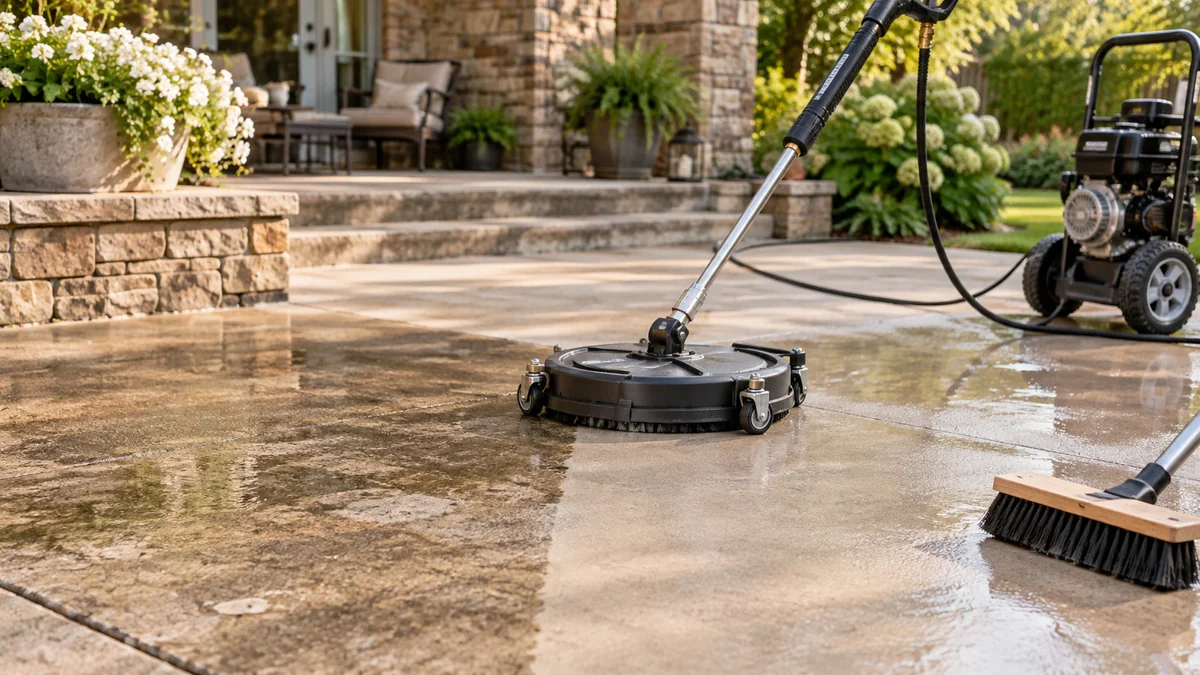
To pressure wash a concrete patio, remove loose debris, pre-treat stains, clean with a 25-degree nozzle or surface cleaner at controlled pressure, then rinse completely. A typical 200-square-foot patio takes 1-2 hours, and the result depends more on steady overlapping passes, correct detergent dwell time, and runoff control than maximum PSI.
Key Facts at a Glance
- A typical residential concrete patio cleans effectively at 2,000-3,000 PSI, provided the surface is sound and the operator maintains a safe distance.
- A 25-degree green nozzle is the general-purpose choice; a 0-degree red nozzle can permanently etch concrete.
- A surface cleaner produces more uniform results than a handheld wand and reduces visible striping.
- Concrete detergent loosens organic grime, but oil usually requires a dedicated degreaser or absorbent poultice before pressure washing.
- New, damaged, painted, sealed, stamped, or exposed-aggregate concrete requires a lower-risk test area before full cleaning.
- Keep dirty or chemical runoff away from storm drains, ponds, and sensitive vegetation.
Before You Start
A 200-square-foot patio usually requires 1-2 hours, $20-$50 in consumables, and moderate physical effort. Prepare the water supply, drainage path, machine, nozzle, cleaner, protective equipment, and a small test area before applying pressure to the whole surface.
Tools and materials
| Item | Typical quantity or specification | Purpose |
|---|---|---|
| Pressure washer | 2,000-3,000 PSI, 1.8-4.0 GPM | Main cleaning |
| Surface cleaner | 12-15 inches, machine-compatible | Uniform floor cleaning |
| Green nozzle | 25-degree fan | Wand cleaning and edges |
| White nozzle | 40-degree fan | Broad rinsing |
| Concrete cleaner | 1 gallon or label-specified amount | Dirt and organic grime |
| Stiff nylon brush | 1 brush, non-metal bristles | Spot scrubbing |
| Garden hose | 50-100 feet, unrestricted flow | Water supply and rinsing |
| Safety equipment | Goggles, boots, gloves, hearing protection | Debris, noise, and chemical protection |
Do not rely on the washer’s advertised PSI alone. A small electric machine may display 2,300 PSI but deliver only 1.2-1.5 gallons per minute, making it slower with a surface cleaner than a 2,800 PSI gas machine producing 3.0 GPM.
Inspect the concrete first
Pressure washing is appropriate for sound, unpainted concrete with no major delamination. Stop and reassess when the slab has flaking cream, exposed aggregate, wide cracks, loose joint sand, peeling paint, soft repair patches, or a brittle decorative coating.
Test a hidden 2-by-2-foot area. Let it dry fully, because wet concrete hides light etching and color differences. If the test area becomes noticeably lighter, rougher, or patchier, reduce pressure, increase distance, change the chemical approach, or hire a contractor experienced with decorative concrete.
How Pressure Washing Concrete Works
Pressure washing concrete combines water pressure, flow, spray angle, distance, and chemical dwell time. PSI controls impact force, GPM controls rinsing speed, and detergent reduces the force needed to release biological growth and soil from the pores.
Cleaning units are calculated as PSI multiplied by GPM. For example, a 2,500 PSI machine at 2.5 GPM produces 6,250 cleaning units, while a 2,000 PSI machine at 4.0 GPM produces 8,000. The second machine may remove loose soil faster because its higher flow carries suspended dirt away, even though its pressure is lower.
Maximum pressure is not the same as best cleaning. Excessive pressure can remove the thin surface cream, expose aggregate, widen weak cracks, and create bright wand marks that become obvious after drying.
Which Pressure Washer Should You Use?
A 2,000-2,300 PSI electric washer suits a small patio with light soil, while a 2,500-3,100 PSI gas washer is faster for larger areas or heavy organic growth. Hot-water machines are generally unnecessary for ordinary patio dirt and make sense mainly for commercial grease or industrial contamination.
| Machine type | Typical PSI | Typical GPM | Best patio use | Main limitation |
|---|---|---|---|---|
| Compact electric | 1,500-2,000 | 1.1-1.6 | Small patio, light dirt | Slow rinsing |
| Strong electric | 2,000-2,300 | 1.5-2.0 | Small or medium patio | Cord and water-flow limits |
| Residential gas | 2,500-3,100 | 2.5-4.0 | Large patio, algae, moss | Noise and exhaust |
| Commercial gas | 3,000-3,500 | 3.5-5.0 | Frequent or heavy cleaning | Higher cost and risk |
| Hot-water unit | 3,000-4,000+ | 3.5-5.0+ | Grease and commercial work | Heavy, expensive, excessive for most homes |
Match the surface cleaner to the machine’s flow rating. A 12-inch cleaner commonly works with roughly 2.0-3.0 GPM, whereas a 15-inch model performs better at approximately 3.0-4.0 GPM. An oversized attachment on a low-flow electric washer can move slowly and leave inconsistent cleaning.
Which nozzle should you use?
The green 25-degree nozzle is the safest general-purpose nozzle for sound concrete. The correct nozzle depends on spray angle, distance, surface condition, and the operator’s movement, so color alone does not guarantee a safe result.
| Nozzle color | Angle | Typical use | Patio risk |
|---|---|---|---|
| Black | 65 degrees | Low-pressure soap application | Usually low |
| White | 40 degrees | General rinsing | Low at normal distance |
| Green | 25 degrees | Concrete cleaning and edges | Moderate if held close |
| Yellow | 15 degrees | Small, stubborn spots | High if stationary |
| Red | 0 degrees | Avoid on patio slabs | Very high etching risk |
A turbo nozzle rotates a concentrated jet and can remove stubborn residue quickly, but it is not automatically safer than a fan nozzle. Keep it for isolated spots, never hold it still, and test it away from visible areas. Do not use a red nozzle to “speed up” the job.
Step 1: Clear and Protect the Patio
Remove furniture, rugs, grills, planters, toys, and loose decorations. Sweep or blow away leaves, grit, pine needles, and loose soil before connecting the washer.
Pre-wet grass, shrubs, and garden beds with clean water. Water-filled plant tissue absorbs less chemical runoff, although pre-wetting does not make concentrated bleach or degreaser harmless. Cover delicate plants only when the covering will not trap hot sunlight or be struck by spray.
Close windows and doors. Cover outdoor electrical outlets, low vents, lighting fixtures, and vulnerable wall openings with suitable plastic covers, but never operate a combustion engine in an enclosed area.
You will know preparation is complete when the patio is bare, loose debris is removed, water can flow toward an approved drainage area, and no person or pet can enter the work zone.
Common mistake: Blocking the only drainage route with furniture or plastic. Plan the runoff path before applying detergent.
Step 2: Apply Cleaner and Treat Stains
Apply a labeled concrete detergent with a low-pressure soap nozzle, pump sprayer, or garden sprayer. Work in sections of approximately 50-100 square feet so the solution remains wet during its dwell period.
For ordinary soil and algae, follow the product label and allow approximately 5-10 minutes of dwell time. Do not let cleaner dry on the slab. If evaporation begins, mist the area lightly with clean water rather than adding an uncontrolled second chemical dose.
Sodium hypochlorite can kill algae and mildew, but concentration, ventilation, plant exposure, and runoff control matter. Never mix bleach with acids, ammonia, vinegar, or other cleaners. A labeled outdoor cleaner is easier for most homeowners to measure safely.
Treat oil separately. Spread an absorbent such as clay-based oil absorbent over a fresh spill, allow it to draw out liquid, sweep it up, then use a concrete degreaser according to its label. Pressure alone often spreads oil rather than removing it.
You will know pretreatment worked when organic film softens, green growth loses color, and surface dirt releases during a light rinse.
Common mistake: Applying detergent from the highest point downward and allowing dirty chemistry to run across untreated sections. Apply manageable sections and control the flow.
Step 3: Clean the Edges and Corners
Use the 25-degree nozzle for walls, steps, corners, joints, and the narrow strip that a round surface cleaner cannot reach. Hold the tip approximately 12 inches away at first, then adjust only after observing the test area.
Keep the spray angled across the surface rather than driving water directly into cracks, joints, siding, door thresholds, or mortar. Move continuously. A stationary spray can create a circular mark within seconds on soft or weathered concrete.
Clean the perimeter before the central field if edge grime is heavy. This prevents dark strips from remaining around the cleaner’s path.
You will know the edges are ready when the boundary is visibly free of dark soil without exposed aggregate, gouges, or water forced behind adjacent materials.
Common mistake: Pointing the nozzle into expansion joints. High-pressure water can wash out joint filler and drive moisture beneath coatings.
Step 4: Clean the Main Patio
Attach a compatible surface cleaner and begin at the highest practical point, working toward the drainage outlet. Move at a steady walking pace with overlapping passes, similar to mowing a lawn.
Keep the attachment flat. Do not pivot sharply, stop over one spot, or lift the housing while the trigger is engaged. A typical 12-15-inch cleaner covers a 200-square-foot patio in roughly 20-40 minutes, depending on flow, soil, and required passes.
Without a surface cleaner, use the green 25-degree nozzle 12-18 inches from the slab. Keep the wand at a consistent height, sweep in controlled overlapping strokes, and overlap each pass by about 50 percent. Clean 5-by-5-foot sections so you can compare wet and dry areas.
You will know the main cleaning is consistent when adjacent passes have similar color and no dark, curved, or straight bands appear as the surface dries.
Common mistake: Moving faster over visibly dirty areas and slower over clean areas. That creates uneven dwell and pressure, commonly called tiger striping.
Step 5: Rinse the Patio and Surroundings
Rinse from the highest area toward the drainage route with the white 40-degree nozzle or the surface cleaner without detergent. Flush suspended soil away rather than allowing dirty water to dry in place.
Use enough water to remove detergent residue from pores, joints, steps, and nearby walls. Inspect the lowest edge, because concentrated soil and chemical residue collect there.
Rinse nearby plants, walls, and equipment with clean water. Direct runoff toward a vegetated area only when the cleaner is approved for that use and the volume will not erode soil. Never intentionally send bleach, degreaser, or oily water into a storm drain, pond, stream, or neighboring property.
You will know rinsing is complete when no foam remains, the water leaving the patio is substantially clearer, and no slippery detergent film remains underfoot.
Common mistake: Rinsing only the visible center. Edges, steps, and low points often retain the most concentrated residue.
Step 6: Evaluate, Dry, and Protect the Surface
Allow the patio to dry for 12-24 hours before replacing heavy furniture or judging the final color. Wet concrete can appear uniformly clean while dry areas reveal stripes, stains, efflorescence, or coating failure.
Do not apply a sealer immediately unless the product specifies a shorter interval and the slab is fully dry. Many sealers require clean, dry concrete and several days without rain. A moisture meter gives better information than appearance alone when the slab is shaded or dense.
Sealing can reduce water and stain absorption, but it cannot repair a damaged surface or prevent every algae recurrence. Choose a breathable exterior concrete sealer compatible with the slab, climate, and finish. Test for color darkening or gloss in an inconspicuous location.
You will know aftercare is successful when the slab dries evenly, furniture does not trap standing water, and the chosen sealer forms the intended finish without whitening or peeling.
Surface-Specific Safety Rules
Pressure washing plain, sound concrete is substantially different from cleaning decorative or deteriorated concrete. Identify the surface before selecting pressure, nozzle, and chemical treatment.
| Surface condition | Starting approach | Primary risk | Safer decision |
|---|---|---|---|
| Sound plain concrete | 2,000-2,500 PSI, green nozzle | Etching from close spray | Test and maintain distance |
| Stamped concrete | Low pressure, fan spray | Pattern and sealer damage | Confirm sealer compatibility |
| Painted concrete | Low pressure, wide fan | Paint lifting | Use coating-safe cleaner |
| Exposed aggregate | Low pressure, surface cleaner | Aggregate loosening | Avoid turbo and red nozzle |
| Cracked or spalled slab | Gentle rinse, spot treatment | Further material loss | Repair or refer first |
| Fresh concrete | No pressure washing | Surface weakness | Wait for full cure and coating guidance |
A common practitioner rule is to clean the least aggressive way that achieves the result. Chemical softening, warm water, a wider fan, slower passes, and better rinsing usually outperform simply increasing PSI.
Common Mistakes and How to Fix Them
The patio has stripes after drying
Striping usually results from inconsistent wand distance, uneven speed, insufficient overlap, or a dirty surface-cleaner nozzle. Reclean the affected section with a surface cleaner or slow, parallel passes, blending beyond the visible stripe.
The concrete looks lighter or rougher
Etching or removal of the surface cream has occurred when the washer was too close, the nozzle was too narrow, or the operator paused. Pressure washing cannot restore removed cement paste. Stop increasing pressure, allow the area to dry, and consult a concrete-finishing professional about color matching or resurfacing.
The machine surges or loses pressure
Check for a kinked supply hose, inadequate household flow, a blocked inlet screen, air in the pump, or a partially closed faucet. The water supply should exceed the machine’s required GPM. A 4.0 GPM washer connected to a restricted 1.5 GPM supply will not perform as advertised.
Oil remains after washing
Cold water and ordinary detergent often fail to emulsify old petroleum stains. Repeat with a labeled concrete degreaser, an absorbent poultice, or hot-water cleaning by a professional. Do not scrub oil into a larger wet halo.
White powder returns
Efflorescence is soluble salt migrating through concrete as moisture moves. Repeated pressure washing may expose more salt. Brush the dry deposit away, reduce moisture sources where possible, and use a compatible efflorescence cleaner only after testing.
Moss returns quickly
Moss and algae indicate recurring moisture, shade, poor drainage, or organic debris. Remove leaves, improve drainage, trim obstructing vegetation, and use a compatible preventative treatment rather than relying on stronger pressure each year.
How Much Time and Money Does Patio Cleaning Take?
A homeowner typically spends $40-$95 to rent a pressure washer, $20-$50 on cleaner and protective supplies, or $150-$450 to purchase a suitable washer and basic surface cleaner. Professional cleaning commonly costs $0.20-$0.45 per square foot, with a minimum service charge often making a 200-square-foot patio cost approximately $150-$300.
| Project size | DIY active time | Setup and drying | Typical professional price |
|---|---|---|---|
| 100 square feet | 30-60 minutes | 1 hour plus 12-24 hours drying | $100-$175 |
| 200 square feet | 45-90 minutes | 1 hour plus 12-24 hours drying | $150-$300 |
| 400 square feet | 2-3 hours | 1 hour plus 12-24 hours drying | $200-$450 |
| 800 square feet | 4-6 hours | 1-2 hours plus drying | $350-$800 |
Annual cleaning is a reasonable starting interval for shaded or damp patios, but high-traffic, sunny slabs may need less frequent washing. Clean when organic growth is beginning, not after thick moss has established deep roots.
What Are the Alternatives to Pressure Washing?
Manual scrubbing is the lowest-equipment method, while low-pressure chemical cleaning is gentler on fragile concrete. Neither alternative is universally superior: chemical treatment kills biological growth, whereas mechanical cleaning removes soil, mud, and loose residue more directly.
| Method | Typical equipment | Best for | Limitation |
|---|---|---|---|
| Manual scrubbing | Cleaner, nylon brush, hose | Small patio, light grime | High labor |
| Low-pressure soft wash | Pump sprayer, labeled solution, hose | Algae and mildew | Requires chemical control |
| Pressure washing | 2,000-3,000 PSI washer | Soil, growth, general restoration | Can etch surfaces |
| Hot-water cleaning | 3,000+ PSI heated unit | Grease and oil | Professional-level cost |
| Professional service | Contractor equipment | Fragile or large patios | $150-$800 typical range |
Choose manual cleaning for a tiny balcony, soft washing for biological growth on delicate concrete, and professional hot-water treatment for extensive petroleum contamination. A pressure washer is a poor solution when the slab is already delaminating.
When Should You Hire a Professional?
Hire a professional when the patio contains extensive oil, uncertain coatings, widespread spalling, drainage complications, large decorative areas, or runoff that cannot be safely contained. Professional equipment does not eliminate risk, but an experienced operator can select lower pressure, heated water, recovery methods, and compatible treatments.
Ask for the proposed PSI, GPM, nozzle or surface-cleaner method, chemical name, runoff plan, and a test-area procedure. A contractor who promises that maximum PSI guarantees a better result is showing poor process control.
FAQ
Can you pressure wash concrete with a regular garden hose?
A garden hose can rinse loose soil but cannot match the impact or flow control of a pressure washer. For a small lightly soiled patio, apply cleaner, scrub with a stiff nylon brush, and rinse repeatedly. Deep algae, embedded dirt, and oil usually require pressure or professional treatment.
How long should concrete dry before sealing?
Concrete should generally dry for at least 24 hours after washing, although shaded slabs, humid weather, dense concrete, and sealers with strict moisture limits may require longer. Follow the sealer manufacturer’s moisture and weather instructions, and test for darkening or whitening in a hidden area.
Can pressure washing remove old black stains?
Pressure washing can remove surface dirt and some biological staining, but old black marks may be mildew embedded in pores, oxidized organic residue, or petroleum contamination. Use an appropriate cleaner first. If the stain remains after chemical treatment and controlled rinsing, stronger pressure may damage the slab without removing the discoloration.
Is bleach safe for a concrete patio?
Diluted sodium hypochlorite can treat algae and mildew, but bleach is not automatically safe. Concentration, dwell time, ventilation, plant protection, runoff, and chemical compatibility control the result. Never mix bleach with acids or ammonia, and use a labeled concrete or outdoor cleaner when measurement and disposal are uncertain.
How often should a concrete patio be cleaned?
Many patios need cleaning once a year, particularly in shaded, damp climates. A sunny, well-drained patio may remain acceptable for two or more years, while a tree-covered slab may need seasonal maintenance. Remove leaves promptly because trapped organic matter holds moisture and feeds algae.
Can pressure washing damage concrete?
Pressure washing can damage concrete by etching the surface cream, loosening aggregate, stripping sealer, widening weak cracks, or removing paint. Damage risk rises with narrow nozzles, short distance, stationary spray, high pressure, and deteriorated concrete. Test first and use the lowest effective force.
The Bottom Line
To pressure wash concrete patio surfaces safely, use controlled pressure, adequate water flow, a 25-degree nozzle or compatible surface cleaner, and detergent matched to the stain. Prepare plants and drainage, clean in overlapping sections, rinse until residue is gone, and allow the slab to dry before sealing or replacing furniture. A slower, consistent process produces a cleaner patio than maximum PSI.