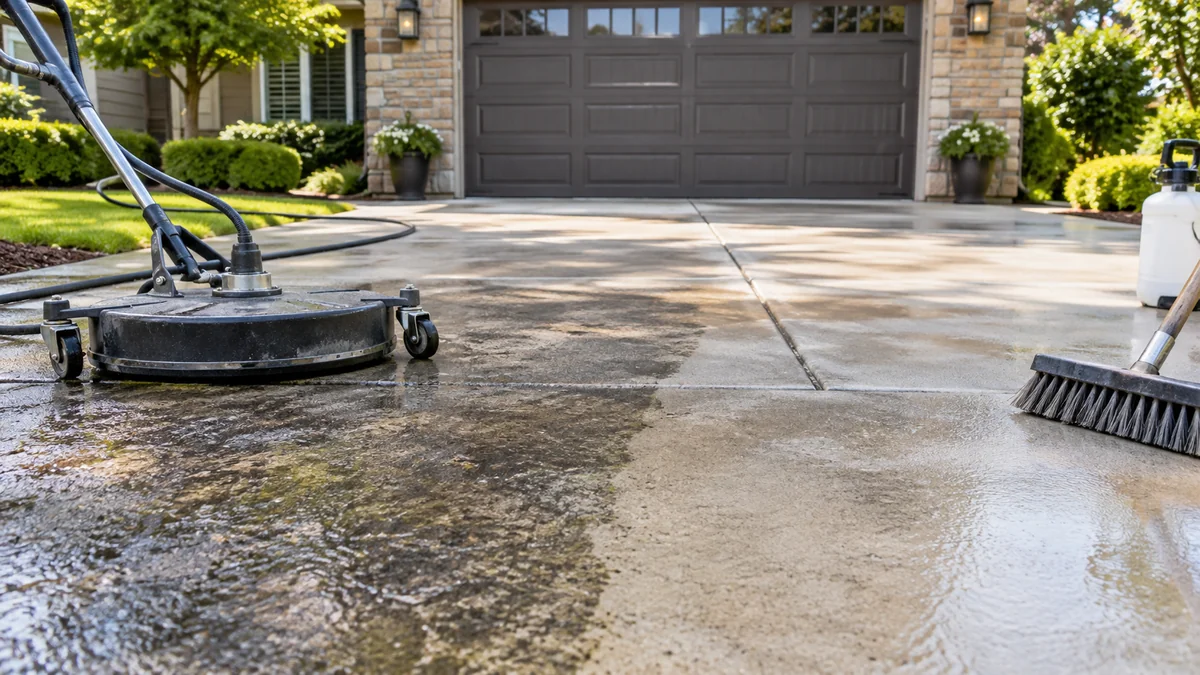
Driveway cleaning and sealing services remove embedded dirt, oil, algae, rust, and organic growth, repair suitable minor defects, then apply a material-compatible protective treatment. A typical residential package costs about $350-$850 for a 400-600 square-foot driveway, but surface condition, access, repairs, sealer type, and local labor rates can change the quote substantially.
Key Facts at a Glance
- Professional driveway cleaning and sealing commonly costs $0.50-$1.10 per square foot when cleaning and sealing are bundled.
- Concrete, asphalt, pavers, stamped concrete, and natural stone require different preparation and sealer chemistry.
- A driveway should be visibly clean and sufficiently dry before sealing; 24 hours is a common minimum after washing, but dense or shaded surfaces may need longer.
- Penetrating silane or siloxane sealers preserve a natural appearance, while acrylic coatings create a more noticeable satin or glossy film.
- Pressure-washing PSI is not a universal specification; nozzle distance, flow rate, surface age, and operator technique also determine damage risk.
- Structural potholes, moving cracks, severe scaling, and unstable pavers require repairs before cosmetic cleaning and sealing.
What Do Driveway Cleaning and Sealing Services Include?
Driveway cleaning and sealing services combine surface assessment, debris removal, stain treatment, washing, drying, minor preparation, sealer selection, application, and curing control. The service is intended to improve appearance and reduce water, ultraviolet, salt, oil, and biological intrusion, not to rebuild a failed pavement structure.
A competent contractor begins by identifying the driveway material and its condition. Concrete may have exposed aggregate, scaling, efflorescence, or a previous acrylic film. Asphalt may show oxidation, raveling, edge failure, or oil-softened areas. Pavers may have missing joint sand, differential settlement, or white mineral deposits.
Cleaning usually includes dry sweeping, treatment of oil and grease, spot treatment for rust or organic staining, and controlled pressure washing. Sealing follows only after the surface has dried and repairs or joint resanding have been completed. Preparation often takes longer than application because contamination, moisture, and weak material determine whether the new sealer bonds.
What Does a Standard Service Visit Cover?
| Service stage | Typical action | Typical duration | Quality checkpoint |
|---|---|---|---|
| Inspection | Identify material, damage, drainage, old coatings | 15-30 minutes | Written scope separates repairs from cleaning |
| Dry preparation | Sweep, edge, remove weeds and loose debris | 20-45 minutes | No loose grit remains in joints or cracks |
| Stain treatment | Apply degreaser, rust remover, or biocide | 20-60 minutes | Stains lighten without damaging the substrate |
| Washing | Use surface cleaner and controlled rinsing | 45-120 minutes | No zebra stripes, exposed aggregate, or asphalt tearing |
| Repairs | Fill suitable cracks, resand pavers, prime oil spots | 30-180 minutes | Repairs are stable and compatible with sealer |
| Sealing | Apply specified product at manufacturer coverage | 30-120 minutes | Uniform film or absorption without puddles |
| Curing | Restrict walking and vehicle traffic | 2-72 hours | Surface is dry, firm, and free from tracking |
Why Should You Clean and Seal a Driveway?
Sealing reduces liquid-water entry and surface contamination, but it cannot correct poor drainage, unstable subgrade, or active structural movement. The practical benefit is greatest when the driveway is sound, porous, and exposed to freeze-thaw cycles, deicing salts, ultraviolet radiation, or repeated vehicle-fluid contamination.
Concrete and masonry absorb water through capillary pores. When that water freezes, expansion can contribute to scaling and cracking, especially where existing defects allow deeper saturation. A penetrating silane or siloxane treatment can reduce water absorption while preserving vapor movement, although it will not hide stains or restore spalled concrete.
Asphalt sealers slow oxidation and provide a more uniform appearance. They do not replace resurfacing where aggregate is loose across broad areas, nor do they repair potholes caused by base failure. The Federal Highway Administration treats pavement preservation as distinct from structural rehabilitation, a distinction homeowners should apply to driveway quotes.
When Is Sealing a Poor Investment?
Sealing is usually a poor investment when the driveway has widespread structural cracks, active settlement, major potholes, severe concrete delamination, or drainage that repeatedly leaves standing water. A coating may make the surface darker temporarily while trapping defects beneath the finish.
A contractor should recommend repair or replacement instead of selling a cosmetic treatment when more than isolated areas are failing. Ask for photographs, repair measurements, and a written explanation of what the sealer cannot fix.
How Do Professionals Clean Different Driveway Materials?
Professionals adjust chemistry, pressure, dwell time, and equipment to the substrate. Concrete tolerates more mechanical cleaning than aged asphalt, while pavers require protection against joint-sand loss and natural stone may react badly to acidic cleaners.
Concrete and Stamped Concrete
Concrete cleaning commonly uses an alkaline detergent for oil, a surface cleaner for uniform washing, and a low-pressure rinse around joints and edges. A penetrating silane or siloxane is suitable when the owner wants water resistance without color change. Acrylic sealer is more appropriate when stamped patterns or exposed aggregate need color enhancement.
Stamped concrete requires extra care because aggressive cleaning can expose release-agent irregularities or damage decorative texture. A film-forming acrylic may improve color, but wet slip resistance should be tested, particularly on sloped entrances.
Asphalt and Blacktop
Asphalt requires flexible treatment and conservative washing. Excessive pressure, close nozzle distance, or hot-water misuse can dislodge aggregate and create raveling. Asphalt emulsion is a common residential option because it remains relatively flexible, while coal-tar products may face local restrictions and odor concerns.
Oil-softened asphalt needs evaluation before sealing. A dark patch that remains tacky or deforms under a screwdriver is not ready for a cosmetic coating. Absorbent treatment, removal of contaminated material, or localized repair may be necessary.
Interlocking Pavers
Paver cleaning must preserve joint integrity. After washing, the joints may need to dry fully before polymeric sand is installed, compacted, and activated according to the sand manufacturer’s instructions. Sealing too soon can lock moisture or haze into the system.
Pavers that have settled or spread should be lifted and reset before sealing. A sealer cannot stabilize a failing base. Efflorescence should also be treated cautiously because a film may make recurring mineral deposits more visible.
Natural Stone
Natural stone needs a product labeled for the specific stone, such as limestone, sandstone, bluestone, or granite. Acidic cleaners can etch carbonate stones, and some film-forming products can darken porous stone unevenly. A test patch in an inconspicuous area is mandatory.
Which Driveway Sealer Is Best for Each Surface?
The best driveway sealer depends on substrate, desired appearance, moisture conditions, traffic, and local environmental rules. Penetrating silane or siloxane is generally the safest appearance-neutral choice for sound concrete, while flexible asphalt emulsion is a common residential choice for sound blacktop.
| Sealer category | Compatible surfaces | Finish and mechanism | Typical service life | Main limitation |
|---|---|---|---|---|
| Silane or siloxane | Concrete, brick, some stone | Invisible hydrophobic penetration | 5-10 years | Does not hide stains or add color |
| Acrylic polymer | Stamped concrete, pavers, exposed aggregate | Satin to gloss topical film | 1-3 years | Can become slippery without aggregate |
| Asphalt emulsion | Residential asphalt | Matte darkening, flexible surface coating | 1-3 years | Lower resistance to gasoline spills |
| Coal-tar emulsion | Some asphalt and industrial uses | Dense black topical barrier | 3-5 years | Odor, VOC concerns, and local restrictions |
| Polyurethane or specialty resin | Selected decorative concrete | Hard, high-build film | 3-7 years | Requires strict moisture and application control |
Product labels control application rates, allowable moisture, temperature, and recoat intervals. A contractor who cannot identify the product, coverage rate, and technical data sheet should not receive an unconditional approval.
Is a Glossy Sealer Better Than a Penetrating Sealer?
A glossy sealer is better only when color enhancement and visual uniformity matter more than natural appearance, vapor tolerance, and easy maintenance. Penetrating sealers are usually more forgiving on exterior concrete because they do not create a continuous surface film that can peel.
Film-forming acrylics can improve faded stamped concrete and help stabilize color, but they may blush, whiten, or wear in tire paths. Anti-slip additive improves wet traction, yet it also changes texture and may collect dirt. Ask for a cured sample rather than judging a wet coating.
How Is a Driveway Prepared Before Sealing?
Driveway preparation normally includes inspection, sweeping, stain treatment, controlled washing, drying, crack or joint work, and a final moisture check. Preparation frequently consumes 60%-70% of the labor time because sealer cannot compensate for oil, dust, loose aggregate, trapped water, or unstable repairs.
- Inspect the substrate. Mark potholes, moving cracks, scaling, raveling, standing-water zones, and previous coatings.
- Remove loose contamination. Sweep the entire area, clear weeds, and protect garage doors, walls, drains, plants, and vehicles.
- Treat stains separately. Use an alkaline degreaser for oil, an appropriate rust remover for iron staining, and a labeled biocide for algae or moss.
- Wash with controlled equipment. A rotating surface cleaner usually produces a more consistent result than a wand alone.
- Repair compatible defects. Fill narrow, stable cracks with a product suited to concrete or asphalt; do not bridge active structural movement with cosmetic filler.
- Restore paver joints. Replace missing polymeric sand only after the joints and bedding area are dry and stable.
- Allow complete drying. Dense concrete, shaded edges, and deep joints can retain water beyond a nominal 24-hour period.
- Apply the sealer at the specified coverage. Thin, even coats are safer than a thick layer that puddles or remains soft.
- Control access. Keep people, pets, bicycles, and vehicles away for the product’s stated cure period.
Pressure washing deserves a correction to the common PSI rule. Concrete may tolerate equipment in the 2,500-3,000 PSI range under controlled conditions, but old, scaled, painted, or decorative concrete can be damaged at lower pressure. Asphalt often requires less pressure, frequently below 2,000 PSI, but nozzle distance and flow are equally important.
A zero-degree nozzle is a poor choice for most driveway cleaning because its concentrated jet can gouge concrete and dislodge asphalt aggregate. Surface cleaners reduce striping, but operators still need to slow down around edges, joints, cracks, and fragile areas.
How Much Do Driveway Cleaning and Sealing Services Cost?
Driveway cleaning and sealing services typically cost $0.50-$1.10 per square foot for a combined residential package, placing a 400-600 square-foot two-car driveway around $350-$850. Cleaning alone commonly costs $0.20-$0.60 per square foot, while sealing alone often costs $0.25-$0.50 per square foot before repairs and minimum service charges.
| Project type | Typical area | Typical price | Typical active labor |
|---|---|---|---|
| Cleaning only, light soil | 400-600 sq. ft. | $100-$300 | 1-2 hours |
| Cleaning only, heavy oil or growth | 400-600 sq. ft. | $250-$500 | 2-4 hours |
| Clean and seal, sound asphalt | 400-600 sq. ft. | $350-$700 | 3-6 hours |
| Clean and seal, concrete | 400-600 sq. ft. | $400-$850 | 4-8 hours |
| Paver cleaning, resanding, sealing | 400-600 sq. ft. | $600-$1,200 | 6-12 hours |
| Crack or pothole repairs | 10-100 linear feet | $75-$600 additional | 1-4 hours |
Small driveways may cost more per square foot because contractors apply a minimum mobilization charge. Heavy oil, rust, difficult access, extensive edging, multiple coats, paver resanding, and old coating removal also increase the estimate.
A quote should state square footage, cleaning chemistry, repairs, product name, number of coats, coverage rate, traffic restrictions, runoff controls, and warranty exclusions. “Seal driveway” without those details is not a sufficiently defined scope.
How Long Does Cleaning and Sealing Take?
A typical residential service requires 4-8 hours of active labor spread across one or two days, followed by a cure period of 2-4 hours for limited foot traffic and 24-72 hours for vehicle traffic, depending on the product and weather. Humidity, shade, substrate porosity, and rain risk can extend every window.
| Condition | Typical minimum | Safer planning allowance | Reason |
|---|---|---|---|
| After pressure washing before sealing | 24 hours | 36-48 hours in shade | Residual moisture in pores and joints |
| Light foot traffic, water-based product | 2-4 hours | 6 hours | Surface film must stop transferring |
| Passenger vehicles, water-based asphalt product | 24-36 hours | 48 hours | Tires can imprint soft coating |
| Vehicle traffic, solvent or heavy film | 48 hours | 72 hours | Slower evaporation and harder cure |
| Rain after application | Product-specific | 24-48-hour dry forecast | Uncured coating can wash or haze |
| Recoat interval | 4-24 hours | Product label | Prevents solvent or moisture entrapment |
Most exterior sealers perform best when the substrate and air are within the manufacturer’s temperature range, often approximately 50-90°F. Direct hot sun can cause flashing and lap marks, while cool, humid weather slows evaporation.
What Causes Driveway Sealer to Fail?
Driveway sealer most often fails because the substrate was dirty, damp, unstable, overcoated, or incompatible with the product. Peeling, whitening, tire tracking, sticky patches, and streaks usually reveal a preparation or application problem rather than an unavoidable property of sealing.
| Failure symptom | Likely cause | Corrective action |
|---|---|---|
| Milky white haze | Moisture trapped under a film | Allow cure; consult product maker before solvent treatment |
| Peeling sheets | Poor bond, contamination, or excessive film thickness | Remove loose coating and re-prepare |
| Tire marks | Vehicle access before cure | Restrict traffic; abrade or recoat only after assessment |
| Dark and light bands | Uneven coverage or overlapping wet edges | Use consistent passes and specified spread rate |
| Blisters | Vapor pressure or damp substrate | Remove failed areas and identify moisture source |
| Returning oil spots | Deep petroleum contamination | Absorb, clean, prime, or replace contaminated material |
| Slippery wet surface | Smooth acrylic film without aggregate | Add compatible traction treatment or remove coating |
Xylene is sometimes used by trained professionals to reflow or soften compatible acrylic films, but it is not a universal cure for blushing. Solvents create fire, inhalation, and material-compatibility hazards, so homeowners should not apply them without the product manufacturer’s written guidance.
Can Sealing Hide Cracks and Potholes?
Sealing can visually reduce minor hairline defects but cannot repair structural cracks or potholes. Wide cracks, recurring cracks, depressed areas, and cracks that change with seasonal movement need flexible repair, localized reconstruction, improved drainage, or a new pavement section.
The contractor should photograph defects before work and identify which areas receive filler, patching, joint replacement, or no repair. A coating warranty should not imply protection against substrate movement.
Should You Hire a Professional or Do It Yourself?
Professional service is usually worthwhile for oil-contaminated surfaces, decorative concrete, paver restoration, large driveways, steep grades, drainage problems, or any project requiring coating removal. DIY cleaning can work on a small, sound concrete driveway when the owner can control runoff, protect adjacent surfaces, and follow the product data sheet exactly.
| Situation | Professional service | DIY suitability | Main risk |
|---|---|---|---|
| 500 sq. ft. sound concrete | Moderate value | High | Wand marks or uneven sealer |
| Aged asphalt with raveling | High value | Low | Aggregate loss and premature failure |
| Stamped concrete | High value | Moderate | Slippery or cloudy acrylic film |
| Pavers with missing sand | High value | Moderate | Joint washout and settlement |
| Heavy oil saturation | High value | Low | Persistent bleed-through |
| Commercial parking area | Very high value | Low | Traffic coordination and liability |
A professional quote should include proof of liability insurance, product documentation, surface-specific preparation, runoff management, cure instructions, and references for the same material. Request a test patch when color, gloss, or stone darkening matters.
What Should You Ask a Driveway Sealing Company?
Ask the contractor six practical questions before signing:
- What material and defects did you identify?
- Which exact sealer will you apply, and what is its coverage rate?
- How will you treat oil, rust, algae, and previous coatings?
- How long will the driveway remain closed to vehicles?
- What preparation and failures does the warranty exclude?
- How will wash water and chemical runoff be controlled?
A responsible contractor will not promise that one product lasts the same number of years on every driveway. Service life depends on traffic, climate, substrate condition, drainage, product thickness, and maintenance.
How Often Should a Driveway Be Cleaned and Sealed?
Clean visible contamination as needed, inspect the surface annually, and reseal according to material condition rather than a fixed calendar. Sound asphalt commonly needs attention every 1-3 years, while penetrating concrete treatments may remain effective for 5-10 years, although severe climates and vehicle-fluid exposure shorten those intervals.
Sweep leaves and grit before organic growth develops. Remove oil promptly because petroleum can soften asphalt and penetrate porous concrete. Do not apply a new film merely because the surface looks dull; test adhesion and inspect for peeling first.
Frequently Asked Questions
Can I seal a driveway after one day of drying?
Sometimes, but one day is not automatically sufficient. Dense concrete, shaded edges, deep paver joints, high humidity, and cool temperatures can retain moisture after 24 hours. Seal only when the substrate meets the product’s moisture and temperature requirements, and extend drying to 36-48 hours when conditions are uncertain.
Will driveway sealing stop weeds from growing?
Driveway sealing can reduce water entry and close some surface pores, but it will not reliably stop weeds rooted in cracks, paver joints, or edge gaps. Remove vegetation, repair the joint or crack, and correct drainage before sealing. Weed growth that returns through a moving crack indicates a maintenance or structural issue.
Can oil stains be completely removed before sealing?
Deep oil stains cannot always be completely removed from porous concrete or asphalt. Degreasers, absorbents, enzymatic treatments, and repeated cleaning may lighten the mark, but residual petroleum can bleed through a new coating. Severe contamination may require a compatible primer, localized removal, or replacement of the affected material.
Is coal-tar sealer legal everywhere?
No. Coal-tar products face restrictions in some jurisdictions because of polycyclic aromatic hydrocarbon concerns and related environmental exposure. Confirm local rules before specifying coal-tar emulsion, and ask the contractor whether a water-based asphalt emulsion or another approved product provides adequate performance.
Can I park on a newly sealed driveway overnight?
Overnight parking may be acceptable only when the product label permits vehicle traffic after that period and the weather supports curing. Many water-based products need 24-36 hours, while some solvent-based or heavy film systems need 48-72 hours. Turning stationary tires sharply is especially likely to mark a soft coating.
Is driveway cleaning and sealing worth the cost?
Driveway cleaning and sealing services are worthwhile when the substrate is structurally sound and the treatment matches the material. Cleaning improves appearance and removes contaminants, while a compatible sealer reduces moisture or oxidation exposure. The service is poor value when it covers active settlement, severe spalling, failed drainage, or widespread pavement failure.
The Bottom Line
Driveway cleaning and sealing services work best as preventive maintenance for a sound, properly drained surface. Choose a penetrating silane or siloxane for natural-looking concrete protection, a compatible acrylic for selected decorative surfaces, and a flexible asphalt product for suitable blacktop. Require material-specific preparation, a named product, realistic curing instructions, and a written scope before approving the work. Use that process to compare local driveway cleaning and sealing services rather than choosing the lowest square-foot price.