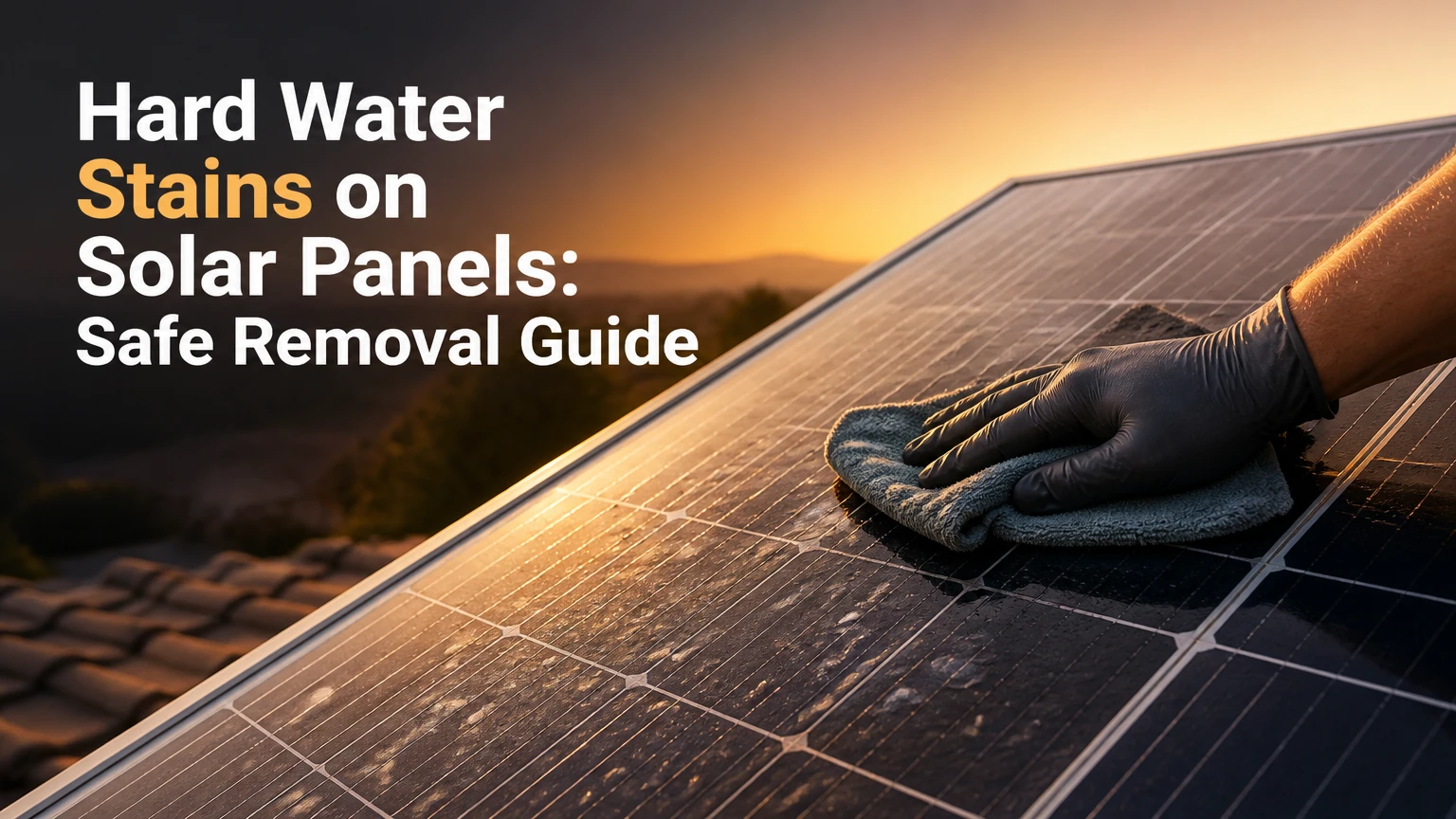
Hard water stains on solar panels are mineral deposits, usually calcium carbonate and related calcium or magnesium salts, left behind when irrigation, tap, or well water evaporates on the glass. Remove light deposits with cool-panel cleaning, a mild compatible descaler, soft agitation, and deionized or reverse-osmosis rinsing; thick scale or etched glass requires professional assessment.
Key Facts
Calcium carbonate scale forms when mineral-rich water dries on photovoltaic glass.
A 50:50 mixture of ordinary white vinegar and purified water can loosen light deposits, but it may not remove thick or etched scale.
Tap-water rinsing can recreate spots when dissolved minerals remain in the rinse water.
Clean modules when the glass is cool, never walk on them, and follow the panel manufacturer’s cleaning instructions.
Hard-water staining does not automatically create hotspots or reduce module life by a fixed number of years.
Pure-water cleaning prevents new mineral residue more reliably than repeated detergent washing.
What Are Hard-Water Stains on Solar Panels?
Hard-water stains on solar panels are dried mineral deposits that form when water containing calcium, magnesium, bicarbonate, silica, or other dissolved solids evaporates on the module surface. The visible result ranges from isolated white dots to a cloudy film or rough, cement-like crust.
The United States Geological Survey describes hard water as water containing dissolved calcium and magnesium, and states that “hard water is not a health risk.” That definition concerns household water use, not photovoltaic performance. On solar glass, repeated evaporation can leave deposits that scatter light, retain dust, and become difficult to remove.
Hard water is different from ordinary dust. Dust usually lifts with pure water and a soft brush; mineral scale may need acid-assisted dissolution. Hard water is also different from glass etching, where prolonged chemical exposure permanently alters the surface and cannot be reversed by washing.
What causes white spots on photovoltaic modules?
Irrigation overspray is the most common residential cause because sprinkler water repeatedly lands on hot glass and dries in small droplets. Well water, borehole water, hose water, cooling-tower drift, and runoff from concrete or masonry can create the same pattern.
The deposit may contain more than calcium carbonate. Silica, iron, sodium salts, and fertilizer residue can change the color and cleaning response. A white, chalky ring usually suggests carbonate scale, while orange-brown spotting indicates iron and a greasy film may indicate airborne pollution or sealant residue.
Why Does Mineral Scale Stick to Solar Glass?
Mineral scale adheres because dissolved ions become concentrated at the shrinking edge of each evaporating droplet, where they crystallize and interlock with earlier deposits. Heat speeds evaporation, but calcium carbonate does not need to form a special chemical bond with the silicon dioxide in glass to become difficult to remove.
Solar modules generally use tempered, low-iron glass with an antireflective coating. Calcium carbonate can mechanically anchor to microscopic surface irregularities, while repeated wetting and drying creates layered deposits. Acid dissolves carbonate minerals, but acid will not restore glass that has already been etched.
Does heat make hard-water spotting worse?
Yes. Hot glass increases evaporation speed and reduces the time available for water to run off before minerals remain behind. A panel exposed to irrigation at midday can develop a dense ring around each droplet, particularly in dry climates such as Arizona, Nevada, inland Australia, and the Middle East.
Heat is not itself evidence of damage. The practical hazard is cleaning a hot module with cold water or allowing a cleaning chemical to dry on the surface. Healthy tempered glass normally tolerates ordinary outdoor temperature changes, but thermal shock risk increases when a very hot surface receives a sudden stream of much colder water, especially if the glass already has damage.
How Can You Tell Scale From Permanent Glass Damage?
Mineral scale usually feels slightly rough, looks white or gray, and becomes less visible when wetted with clean water. Etching remains visible when wet and may appear as a uniform haze, crescent-shaped marks, or dull patches that do not respond to a mild descaler.
Use this diagnosis sequence:
- Photograph the area before cleaning.
- Wet a small corner with purified water.
- Check whether the haze temporarily disappears.
- Test a small area with diluted vinegar on a cloth, not a broad spray.
- Rinse completely and inspect under oblique light.
- Stop if the surface remains dull, develops rainbow colors, or shows coating irregularity.
A deposit that softens after two or three short applications is probably removable scale. A surface that stays cloudy after mineral removal may have been chemically etched or scratched.
| Appearance or texture | More likely cause | Small-area test | Suitable response |
|---|---|---|---|
| White dots with chalky texture | Calcium carbonate scale | Diluted vinegar softens residue | Mild descaler and pure-water rinse |
| Orange or brown rings | Iron-rich well water | Vinegar may lighten deposit | Solar-safe iron or mineral cleaner |
| Dark granular film | Dust, soot, or pollen | Pure water lifts particles | Soft brush and pure-water wash |
| Rainbow or oily haze | Sealant, detergent, or pollution film | Water beads unusually | Manufacturer-approved cleaner |
| Uniform dull patch after cleaning | Etching or abrasion | Remains visible when wet | Professional glass assessment |
Before You Remove the Deposits
Prepare the work area before applying any liquid. A typical residential array of 8-12 modules requires 1-2 hours for a careful first cleaning, excluding roof access and setup.
| Requirement | Typical specification | Why it matters |
|---|---|---|
| Cleaning temperature | Cool glass, preferably below 35°C / 95°F | Slows rapid drying |
| Vinegar concentration | 1 part 5% white vinegar to 1 part purified water | Limits acid exposure |
| Dwell time | 2-5 minutes, kept wet | Loosens carbonate deposits |
| Water for final rinse | DI, RO, or distilled water | Reduces new mineral spots |
| Brush type | Soft nylon or microfiber solar brush | Limits coating abrasion |
| Pressure | Low-pressure hose flow, never concentrated jetting | Protects seals and surfaces |
| Roof access | Stable ground equipment or qualified operator | Reduces fall and electrical risk |
Turn off or isolate the system only according to the equipment manufacturer’s procedure. Photovoltaic modules still produce electricity in daylight, even when an inverter disconnect is open. Never disconnect rooftop connectors, remove module covers, or walk on the glass.
How Do You Remove Hard Water Stains on Solar Panels?
Remove light and moderate mineral deposits in six controlled steps: remove dry grit, pre-wet the cool glass, apply a mild compatible descaler, agitate gently while wet, rinse with pure water, and remove remaining droplets with a clean squeegee. The final rinse quality determines whether new spots appear.
Step 1: Remove Loose Dry Debris
Use a clean, soft-bristled brush or dry microfiber tool to sweep away leaves, sand, and loose dust. Work from the upper edge downward without pressing grit across the glass.
You will know this step worked when loose particles no longer slide ahead of the brush. The common mistake is wetting a dusty panel first, which turns abrasive particles into a slurry that can scratch the antireflective surface.
Step 2: Pre-Wet the Cool Module
Apply a light flow of purified water to the section you will clean. Do not begin on sun-heated glass if the rinse water is substantially colder, and do not flood a roof where water can enter damaged junction boxes or conduit penetrations.
You will know the surface is ready when the glass is evenly wet and the panel remains cool to the touch. The common mistake is cleaning one hot section while the rest of the array dries, creating uneven chemical dwell and streaking.
Step 3: Apply a Mild Descaler
For light carbonate scale, mix equal parts ordinary 5% white vinegar and purified water in a labeled container. Apply it to a microfiber cloth or soft pad for a small test area before treating the full module.
A solar-compatible descaler may be preferable for thick deposits, but its label, safety data sheet, and module manufacturer instructions control the dilution. Do not combine vinegar with bleach, chlorine products, ammonia, or other cleaners.
You will know the solution is working when the chalky edge softens and the cloth picks up a slippery mineral residue. The common mistake is spraying a large area that dries before it can be rinsed.
Step 4: Keep the Surface Wet and Agitate
Let the solution dwell for 2-5 minutes while keeping the area visibly wet. Gently move a soft nylon brush or nonabrasive solar pad in short overlapping passes, using minimal pressure.
Repeat the application rather than increasing force when scale remains hard. You will know agitation worked when the rough texture becomes smooth under a wet fingertip, provided the glass is safe to touch and free of sharp damage. The common mistake is using a razor, scouring pad, melamine sponge, steel wool, or stiff wire brush.
Step 5: Rinse With Pure Water
Flood the treated section with deionized, reverse-osmosis, or distilled water until no acidic odor, foam, or visible film remains. A garden hose is acceptable for initial rinsing only when its water quality is known to be low in dissolved minerals and the panel will receive a final pure-water rinse.
You will know the rinse is complete when water sheets cleanly and no white trails reappear as the surface drains. The common mistake is using softened water and assuming it is mineral-free. Water softeners replace calcium with sodium; they reduce hardness but do not reliably produce spot-free rinse water.
Step 6: Squeegee or Allow a Verified Pure-Water Finish
Use a clean, soft rubber squeegee with overlapping strokes if the rinse water contains measurable dissolved solids. Pull from the upper edge downward, wiping the blade after each pass.
High-quality DI or RO water can dry spot-free on clean glass, although droplets should still be removed where runoff may dry on frames. You will know the job worked when the dry module has no rings, streaks, or cloudy film under low-angle light.
Which Cleaning Method Should You Choose?
The best method depends on deposit thickness, water quality, roof access, and whether the glass is etched. Vinegar is the lowest-cost option for light carbonate deposits; a solar-safe descaler suits moderate scale; professional mechanical treatment is safer for thick scale or suspected surface damage.
| Method | Typical material or service cost | Suitable deposit | Typical labor time | Main limitation |
|---|---|---|---|---|
| Vinegar and purified water | $5-$20 | Light carbonate spotting | 1-2 hours per 10 panels | Slow on layered scale |
| Solar-compatible descaler | $25-$60 per gallon | Moderate mineral scale | 1-2 hours per 10 panels | Requires label-compliant rinsing |
| DI water cleaning | $250-$600 equipment rental or purchase | Prevention and light deposits | 30-90 minutes per 10 panels | Resin capacity depends on TDS |
| RO water cleaning | $500-$2,000 equipment setup | Repeated commercial cleaning | 30-90 minutes per 10 panels | Membrane and wastewater management |
| Professional cleaning | $150-$450 typical residential visit | Roof arrays or heavy scale | 2-4 hours including setup | Recurring service cost |
| Glass polishing | $300-$1,000 or more | Residual mineral etching | Several hours | Can alter coating or optical finish |
Is vinegar safe for photovoltaic glass?
Diluted white vinegar is generally reasonable for a small, controlled test on mineral scale, but vinegar is not automatically safe for every module, frame, seal, coating, or warranty condition. Use the weakest effective mixture, keep contact brief, prevent drying, and rinse thoroughly.
Vinegar performs poorly against silica-rich deposits, iron staining, oily films, and permanent etching. Stronger acids such as hydrochloric or muriatic acid create unnecessary risks to aluminum frames, roof materials, skin, and drainage systems. Household detergents can also leave surfactant films that attract dust.
Are RO or DI systems better than tap water?
DI water usually produces the most convenient spot-free rinse because ion-exchange resin removes charged minerals at the point of use. RO systems remove approximately 95-99% of many dissolved constituents under suitable operating conditions, but the exact result depends on membrane condition, pressure, temperature, and feed-water chemistry.
DI resin exhausts faster as feed-water TDS rises. For example, a 400-ppm water supply consumes resin substantially faster than a 100-ppm supply. A handheld TDS meter can identify when a DI system is approaching exhaustion, although TDS is not a complete measure of every contaminant.
What Water Quality Prevents New Spots?
No universal TDS or hardness number guarantees staining because droplet size, evaporation rate, panel angle, contamination, and cleaning frequency also determine residue. Water hardness above approximately 120 milligrams per liter as calcium carbonate, often described as hard by USGS-style classifications, increases scaling potential, but it is not a precise solar-cleaning cutoff.
TDS measures the total concentration of dissolved substances, while hardness measures primarily calcium and magnesium. A 120-ppm TDS reading does not necessarily mean 120 ppm of hardness, and low-hardness water can still leave residue from silica or other salts.
Measure feed water with a calibrated TDS meter and obtain a laboratory hardness test when irrigation or well water repeatedly causes deposits. For a spot-free final rinse, professional cleaners commonly target very low conductivity or near-zero TDS after DI treatment, following their equipment manufacturer’s specification.
Can Hard-Water Scale Reduce Solar Output?
Yes, mineral scale can reduce light reaching photovoltaic cells, but the loss is site-specific and cannot be assigned a reliable universal percentage. A transparent film may cause a small reduction, while opaque crust, combined with dust, can produce a much larger local loss.
The International Energy Agency Photovoltaic Power Systems Programme, particularly its work on PV soiling, documents that dust and deposits reduce photovoltaic yield and that losses vary by climate, rainfall, surface properties, and cleaning intervals. Published soiling studies do not support a blanket claim that hard-water stains always reduce output by 15-25% or block 40% of sunlight.
Mineral deposits do not automatically create hotspots. Hotspots usually involve electrical mismatch, shaded cells, bypass-diode behavior, cracked cells, or other module faults. A deposit can contribute to uneven illumination, but an output decline should be confirmed through inverter data, string comparison, or infrared inspection rather than guessed from appearance.
When is cleaning financially worthwhile?
Cleaning is financially worthwhile when the recovered energy value exceeds the cost of labor, water, access, and risk. A simple estimate is:
Annual recoverable value = annual electricity production × estimated loss × electricity price
For example, a 6-kilowatt system producing 8,000 kilowatt-hours annually, with a suspected 5% recoverable loss and electricity valued at $0.20 per kilowatt-hour, has a theoretical recovery value of $80 per year. A $200 cleaning may not pay back in one year unless the loss estimate is higher or cleaning prevents recurring deposits.
Compare inverter production with the same months from the previous year, weather-adjusted production, and an unaffected nearby string. Visual whiteness alone does not prove a large financial loss.
What Should You Never Use on Solar Modules?
Avoid abrasive tools, concentrated acids, bleach, ammonia, strong solvents, unapproved detergents, and high-pressure jets. These materials can scratch glass, damage antireflective coatings, corrode anodized aluminum, attack seals, or force water into electrical components.
The most damaging mistakes are often mechanical rather than chemical:
- Scrubbing dry grit across the glass.
- Using a razor blade or abrasive pad.
- Letting vinegar or descaler dry on a hot module.
- Rinsing with mineral-rich hose water and leaving droplets to evaporate.
- Pressure-washing edges, junction boxes, cable glands, or cracked glass.
- Walking on modules or leaning ladders against the array.
- Mixing cleaning chemicals.
- Ignoring bird droppings that conceal cracks or hot areas.
- Polishing before determining whether the haze is removable scale.
A pressure washer’s nominal rating, such as 1,500 psi, does not make it suitable for photovoltaic modules. The concentrated jet can damage seals at much lower practical risk thresholds, and manufacturer instructions differ. Low-pressure flow through a soft water-fed brush is the safer default.
How Do You Prevent Hard-Water Deposits?
Prevent hard-water deposits by stopping mineral-rich spray from reaching the array, cleaning before deposits layer, and using purified water for the final rinse. Irrigation redesign usually prevents more staining than increasing cleaning frequency.
Use these controls:
- Redirect sprinklers away from the modules and roof.
- Repair leaking hose bibs, evaporative coolers, and roof drains.
- Install a DI or RO rinse system where frequent cleaning is unavoidable.
- Clean after construction dust, wildfire smoke, or unusual contamination.
- Use a soft brush that does not push grit across the surface.
- Inspect the array quarterly in hard-water regions.
- Record inverter output before and after cleaning.
- Replace exhausted DI resin when the measured output quality rises.
| Site condition | Inspection interval | Typical cleaning interval | Preferred prevention |
|---|---|---|---|
| Rainy, low-dust region | Every 6 months | Annually or as needed | Keep gutters and trees clear |
| Urban home with moderate dust | Every 3 months | 6-12 months | Pure-water final rinse |
| Well-water irrigation overspray | Monthly | Every 1-3 months until corrected | Redirect sprinklers first |
| Desert or high-dust site | Monthly | 2-8 weeks during dry season | RO or DI water system |
| Coastal location | Monthly | 2-6 months | Remove salt film with pure water |
| Commercial array near industry | Monthly | Based on string monitoring | Documented water-quality program |
Automated sprinklers do not solve mineral staining unless their supply water is treated. A short untreated spray cycle can add scale every night. Automation improves consistency, but filtration and nozzle direction determine whether it prevents or accelerates deposits.
When Should a Professional Clean the Array?
Hire a professional when modules are roof-mounted above a hazardous surface, deposits are thick and multilayered, glass appears etched, the array has cracks, or cleaning requires chemical handling at height. Professional service is also appropriate when inverter data shows a persistent unexplained output decline.
Ask for proof of insurance, fall-protection procedures, water-treatment specifications, and a written description of chemicals and tools. Confirm that the company will not walk on modules or use a pressure washer against module edges.
A professional cleaner should distinguish removable scale from etched glass. Polishing with cerium oxide may improve some mineral damage, but rotary abrasion can change the antireflective coating, create optical distortion, or invalidate manufacturer support. Module replacement may be more appropriate when etching is widespread or glass integrity is uncertain.
Troubleshooting Common Cleaning Failures
Why does a white haze remain after vinegar?
A remaining white haze usually means the deposit is too thick, contains silica or iron, dried during treatment, or has etched the glass. Repeat one controlled application on a small area for up to 5 minutes, keep it wet, agitate gently, and rinse with pure water; stop if the haze remains unchanged when wet.
Why are streaks visible after the panel dries?
Streaks usually contain dissolved minerals, detergent residue, dirty squeegee rubber, or exhausted DI resin. Rewash a cool module with purified water, use a clean microfiber sleeve or squeegee, and test the rinse water with a TDS meter before treating the full array.
Can rain remove hard-water scale?
Rain may remove loose dust but rarely dissolves established calcium carbonate crust. Acidic rain can slowly alter some deposits, yet relying on rainfall leaves irrigation rings and layered scale untreated, particularly in arid regions where rainfall is infrequent and evaporation is rapid.
What if the panel has cracks?
Do not apply liquid directly to visibly cracked glass, exposed cell areas, damaged junction boxes, or loose frame sections. Isolate the area according to the manufacturer’s procedure, photograph the damage, and contact a qualified solar technician because moisture intrusion can create electrical and insulation hazards.
FAQ
Can I clean solar panels with a garden hose?
A garden hose can remove loose dust, but mineral-rich hose water may dry into new spots. Use the hose only for controlled pre-rinsing when appropriate, then finish with DI, RO, or distilled water and remove droplets from frames and low points.
How often should solar panels be cleaned with hard water?
Inspect panels monthly when irrigation overspray or well water reaches the array. After correcting the spray source, many residential systems need cleaning every 2-6 months in dry hard-water climates, while rainfall-dominated sites may need only annual inspection and occasional cleaning.
Does a water softener prevent panel stains?
A conventional water softener reduces calcium and magnesium hardness by exchanging them for sodium, but it does not remove all dissolved solids. Softened water can still leave visible residue, so a DI or RO final rinse is more suitable for spot-free photovoltaic cleaning.
Will distilled vinegar damage solar panels?
A diluted 50:50 solution of 5% white vinegar and purified water is commonly used as a small-area test for carbonate scale, but vinegar can affect some adjacent materials if left in contact. Keep it off electrical components, prevent drying, and rinse thoroughly.
Are hard-water stains covered by a solar-panel warranty?
Cosmetic mineral deposits and cleaning damage are commonly treated as maintenance issues, while coating failure, delamination, cracked glass, or defective materials may fall under different warranty terms. Read the module manufacturer’s cleaning and warranty documents before using chemicals or abrasive polishing.
Should I replace a panel with permanent mineral haze?
Replace a panel only after confirming that the haze is permanent, performance is materially affected, and professional cleaning or approved restoration is not economical. A visual haze without measured electrical loss may cost less to monitor than to replace, while widespread etching deserves a formal assessment.
The Bottom Line
Hard water stains on solar panels are usually removable calcium or mixed-mineral deposits, not proof of immediate cell failure. Clean cool modules with dry debris removal, a mild tested descaler, soft agitation, and a DI or RO final rinse; correct irrigation overspray before increasing the cleaning schedule.
Do not assume every white mark causes a fixed 15-40% production loss, creates hotspots, or shortens module life by three to five years. Compare inverter data before and after cleaning, test water quality, and use a qualified professional when roof access, thick scale, cracked glass, or suspected etching makes DIY work unsafe.