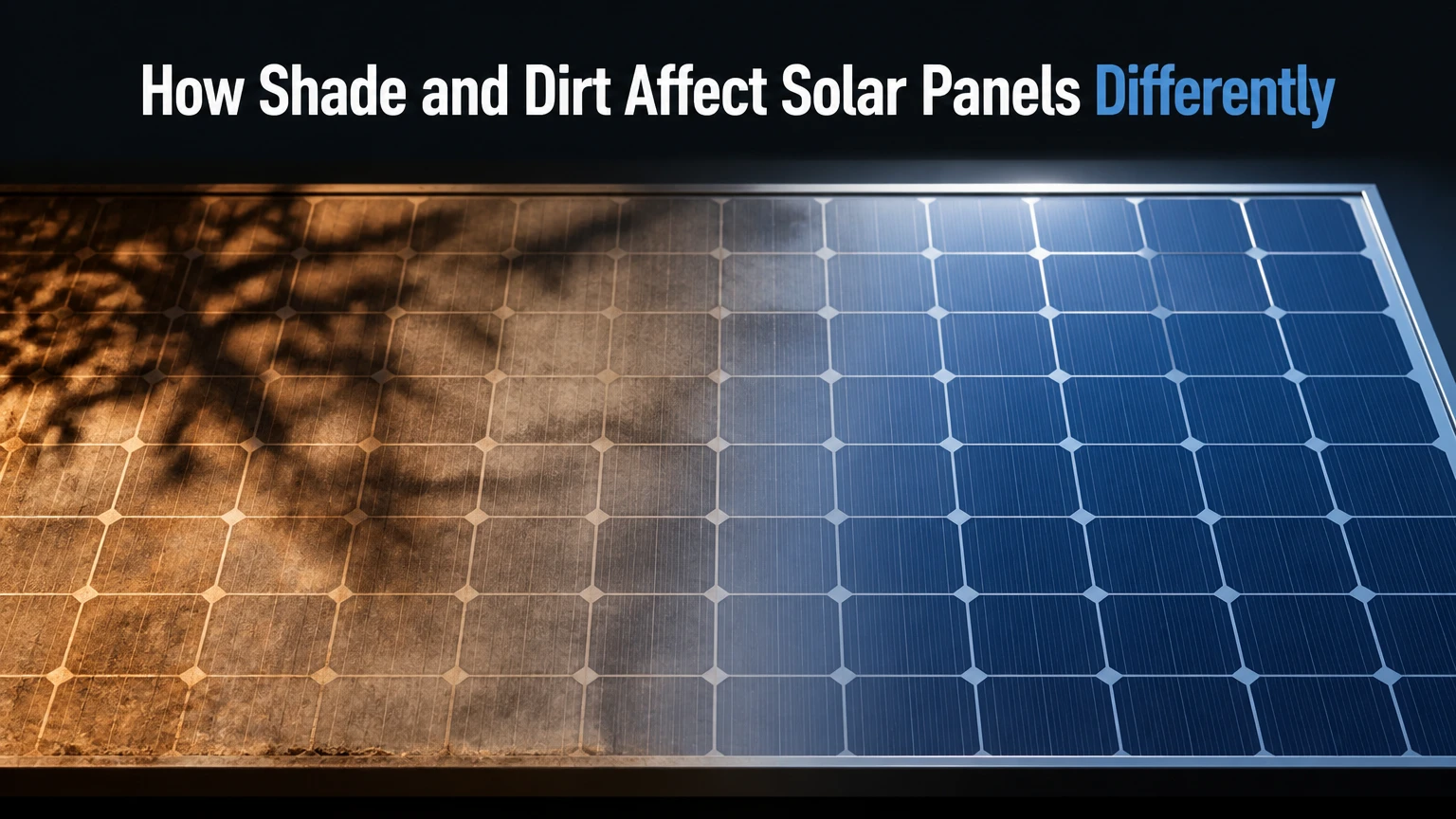
Shade reduces solar-panel output by blocking irradiance over specific cells or substrings, while dirt, technically called soiling, usually reduces the light transmitted across a broader glass area. Shade creates electrical mismatch and can cause bypass-diode operation or localized hotspot stress; uniform dirt mainly lowers photocurrent and energy yield gradually. The remedy differs: redesign or electrical isolation addresses shade, while cleaning addresses soiling.
Key Facts at a Glance
Shading is usually a spatial and time-dependent electrical mismatch; soiling is usually an optical transmission loss.
A shaded cell does not automatically reduce an entire module to the lowest cell’s output, because bypass diodes can isolate cell substrings and modern modules use different layouts.
Uniform dust commonly reduces current more than voltage, but severe or uneven deposits can create mismatch, localized heating, and bypass-diode activation.
Hard shade can cause immediate losses during specific hours, whereas soiling often produces a persistent reduction that grows between rain or cleaning events.
Microinverters and power optimizers can limit mismatch losses from shade, but they cannot remove the photons blocked by an object.
Cleaning is worthwhile only when recovered energy and reduced risk exceed labor, water, access, and equipment costs.
What Is the Difference Between Shade and Dirt on Solar Panels?
Shade is an external object or atmospheric condition that blocks or reduces sunlight before it reaches particular cells. Dirt is a material layer on the module surface that absorbs, scatters, or reflects part of the incoming light before it reaches the cell.
The distinction matters because photovoltaic cells respond to both light intensity and current balance. A chimney shadow crossing one substring can force current through poorly illuminated cells, while a thin, even dust film generally lowers the available current across most cells at once. Both reduce watt-hours, but the shape of the loss, the damage risk, and the correct intervention differ.
| Attribute | Shade | Uniform soiling | Localized soiling |
|---|---|---|---|
| Primary cause | Tree, building, vent, cloud | Dust, pollen, ash, salt film | Bird dropping, leaf, mud spot |
| Irradiance pattern | Localized or moving | Broad and diffuse | Highly localized |
| Typical onset | Seconds to minutes | Days to months | One deposition event |
| Main electrical effect | Current mismatch and possible bypass | Lower photocurrent | Local mismatch and possible hotspot |
| Main remedy | Remove, redesign, isolate | Wash or wait for effective rain | Prompt spot removal |
A useful practitioner rule is simple: shade follows solar geometry, while dirt follows weather, land use, and maintenance history. If the loss appears at the same clock time and moves with the season, suspect shade. If output improves after rain across the whole array, suspect soiling.
How Does Shading Affect Solar-Panel Output?
Shading reduces the current available from affected cells, and series-connected cells or substrings then create an electrical mismatch. The unshaded portion cannot always operate independently, so a module may lose the affected substring’s voltage, trigger a bypass diode, or experience reverse-bias heating in a shaded cell before protection operates.
Most crystalline-silicon modules connect cells in series within substrings. A conventional module may contain three bypass-diode-protected sections, but the exact count and cell architecture vary. Half-cut modules commonly use split current paths and multiple protected substrings, so a shadow over one region does not reliably produce a fixed one-third loss.
When a shaded cell cannot supply the operating current demanded by the rest of its series path, the cell can become reverse-biased. The cell then dissipates electrical power as heat. Bypass diodes provide an alternate path around a substring, reducing stress at the cost of lost voltage from that section.
The widely repeated claim that any 10% shadow causes a 33.3% module loss is not an engineering rule. Loss depends on the shadow’s shape, cell layout, bypass-diode boundaries, irradiance, inverter operating point, and whether the shadow crosses one or several substrings.
Why Can Shade Create Hotspots?
A hotspot forms when a shaded or damaged cell dissipates power while neighboring cells continue delivering current. Bird droppings can create the same mechanism as hard shade when the deposit covers a small, opaque region rather than the whole panel.
Hotspot severity depends on reverse-bias voltage, current, cell quality, deposit geometry, and duration. Repeated heating can damage encapsulant, solder bonds, backsheets, or the cell itself. A bypass diode limits some conditions, but it cannot guarantee that every cell remains cool, and a failed diode removes an important protection path.
Hotspots are not inevitable from ordinary tree shade. Diffuse cloud cover and broad low irradiance usually reduce production without producing the concentrated reverse-bias condition associated with a small opaque obstruction.
How Does Dirt Affect Solar-Panel Output?
Dirt reduces the irradiance transmitted through the module glass, so uniformly distributed dust usually lowers short-circuit current and maximum power without the severe cell mismatch associated with hard shade. Soiling losses accumulate over time and are removed by sufficiently strong rain, washing, or specialized cleaning.
Dust particles scatter light away from the cell and can absorb selected wavelengths. A clean photovoltaic module already loses some light through reflection, so a deposit can reduce the effective irradiance reaching the anti-reflective glass and silicon surface. The result is normally a lower current-producing capability across many cells.
Open-circuit voltage changes less than current because silicon voltage responds logarithmically to irradiance. The maximum-power voltage can still shift, especially with temperature and nonuniform deposits, so “dirt only reduces current and never voltage” is too absolute. The practical energy loss is often close to proportional for light, uniform soiling, but heavy or uneven soiling breaks that simplification.
The National Renewable Energy Laboratory’s PV Performance Modeling Collaborative treats soiling as a time-varying irradiance loss that should be represented with a soiling ratio, rather than a universal fixed percentage. That approach is more useful than assuming every dusty array loses the same amount.
Which Types of Soiling Are Most Harmful?
Uniform dust is usually less hazardous than a small opaque deposit, but caked mud, bird droppings, leaves, salt crust, wildfire ash, and agricultural residue can produce sharply uneven transmission. Uneven soiling can therefore behave electrically more like shade than like a uniform optical filter.
| Soiling type | Typical pattern | Typical response | Main concern |
|---|---|---|---|
| Fine dust | 1-5% loss after a light deposition cycle | Rain or soft-water rinse | Recurring energy loss |
| Pollen film | 2-10% seasonal loss | Rinse after dry removal | Sticky surface film |
| Cemented mud | 5-20% local or array loss | Controlled washing | Abrasion and glass residue |
| Bird dropping | Near-zero transmission at spot | Prompt spot cleaning | Reverse bias and hotspot |
| Salt aerosol | 3-15% coastal loss | Frequent low-mineral rinse | Corrosive residue |
| Ash or soot | 5-25% possible loss | Professional assessment | Fine particles and contamination |
These are typical field ranges, not universal guarantees. Climate, module tilt, rainfall intensity, particle chemistry, and cleaning quality can move the result substantially.
Which Causes More Energy Loss, Shade or Dirt?
Shade usually causes the larger instantaneous loss and the greater hardware risk, while dirt more often causes the larger cumulative maintenance loss across an entire array. A small winter shadow can remove most of one module’s useful output for several hours, whereas moderate dust may reduce the full array by 2-10% for weeks.
| Decision criterion | Shade | Uniform dirt | Localized dirt |
|---|---|---|---|
| Common residential loss | 5-40% during affected hours | 2-10% between cleaning events | 0.5-15% depending on coverage |
| Commercial or arid-site range | 10-60% in affected circuits | 5-25% in severe seasons | 1-20% at affected modules |
| Time pattern | Hourly and seasonal | Gradual and weather-driven | Sudden and persistent |
| Damage potential | Medium to high | Low for uniform deposits | Medium to high |
| Reversibility | Removal or redesign required | Rain or cleaning | Spot cleaning required |
| Typical remedy duration | Permanent design change | 15-60 minutes per accessible array section | Minutes to one service visit |
The largest financial mistake is comparing percentages without duration. A 20% shade loss for two winter hours daily may produce less annual energy loss than a 7% soiling loss lasting four dry months.
Does Shade Matter More in Winter?
Shade often matters more in winter because the sun travels lower across the sky, extending shadows from trees, parapets, and neighboring buildings. The same obstruction can miss a panel in June and cover a substring in December.
Solar designers use tools such as PVsyst, Aurora Solar, HelioScope, and Solmetric SunEye to model horizon obstructions and shade at different dates. A tree that is 8 meters from a roof can cast a much longer shadow when solar elevation falls, while deciduous trees may lose leaves and partially change the result.
Annual shade assessment should include leaf-on and leaf-off conditions, morning and afternoon angles, roof setbacks, future tree growth, and nearby construction. A single noon observation is inadequate.
How Can You Tell Whether Shade or Dirt Is Causing Low Production?
Monitoring data distinguishes shade from dirt when the comparison uses time, neighboring modules, weather, and system topology. Shade produces repeatable peaks or gaps at particular times, while broad soiling usually suppresses the clear-sky production curve across many modules until rain or cleaning changes the level.
Use this diagnostic sequence:
- Compare clear-sky days. Look for a repeatable loss at the same solar time, not merely the same clock time.
- Compare adjacent modules. One low module suggests local shade, a deposit, a failed optimizer, or wiring trouble; uniform array loss suggests weather or soiling.
- Check after rain. A sudden recovery across the array supports soiling, but light rain can redistribute mud instead of removing it.
- Inspect safely from the ground. Look for tree shadows, parapets, vent shadows, bird droppings, frame-edge dust, and snow.
- Review inverter and optimizer data. Module-level systems can reveal one affected unit, while string systems may hide its location.
- Use professional electrical or thermal testing. An infrared image can locate a hotspot, but a warm module alone does not prove dirt or shade.
A thermal camera should not be treated as a standalone diagnosis. Irradiance, wind, module temperature, electrical loading, and camera angle affect readings, and thermal scanning requires appropriate electrical safety procedures.
| Monitoring signature | More likely cause | Confirmation |
|---|---|---|
| Loss begins at 08:30 daily | Fixed morning shade | Sun-path inspection |
| Loss shifts later each month | Seasonal obstruction | Shade model |
| Whole array improves after rain | Uniform soiling | Before-and-after production |
| One module stays low all day | Spot deposit or hardware fault | Visual and module-level test |
| Jagged mismatch during moving cloud | Dynamic shade or cloud edge | Irradiance comparison |
| One string has a fixed voltage deficit | Bypass diode or substring issue | Qualified IV-curve test |
Which Fix Works Best for Shade and Dirt?
Shade requires an obstruction or system-design response, while dirt requires a cleaning or maintenance response. Microinverters and power optimizers can reduce electrical coupling between shaded modules, but they cannot restore sunlight blocked by a tree or building.
| Problem | First-choice fix | Secondary option | What the fix cannot do |
|---|---|---|---|
| New tree shade | Prune or relocate panels | Microinverter or optimizer | Recover blocked irradiance |
| Building or parapet shade | Redesign layout or tilt | Module-level electronics | Remove the building shadow |
| Uniform dust | Rain or safe cleaning | Automated cleaning plan | Prevent new deposition |
| Bird droppings | Spot clean promptly | Bird deterrence | Repair existing hotspot damage |
| Row-to-row shade | Wider row spacing | Tracker backtracking | Remove land-use constraints |
| Failed bypass diode | Qualified replacement | Module replacement | Cure the original obstruction |
Microinverters convert each module independently, and optimizers condition module output before a string inverter receives it. These architectures can prevent one shaded module from pulling down an entire string, but they add electronics, failure points, and cost. They are most defensible when shade is unavoidable and substantial, not when a clean roof would eliminate the problem.
The U.S. Department of Energy’s PV system guidance emphasizes shade-free design because prevention avoids both lost irradiance and added balance-of-system complexity. Hardware is a mitigation layer, not a substitute for a proper solar access assessment.
When Is Solar-Panel Cleaning Worth the Cost?
Cleaning is financially justified when the value of recovered electricity exceeds the fully loaded cleaning cost, including access, labor, water, safety, and potential glass damage. For a simple decision, multiply expected recovered annual kilowatt-hours by the electricity value, then compare that amount with cleaning and inspection costs.
Example: a 6-kilowatt residential system producing 8,000 kWh per year loses 8% from persistent soiling. Recovering half of that loss means about 320 kWh. At $0.20 per kWh, the gross recovery is $64, so a $150 cleaning is not financially attractive unless it also removes a hotspot-risk deposit or the loss is higher than estimated.
Typical residential cleaning costs range from $100-$300 per visit for accessible arrays and $250-$600 for steep, obstructed, or difficult roofs. Commercial cleaning may be priced per module, per kilowatt, or by route, with waterless robotic systems requiring a separate capital and maintenance analysis.
A soiling sensor or reference module improves decisions at larger sites. The sensor measures the performance difference between a clean reference surface and the exposed array, allowing operators to schedule cleaning when recovered revenue crosses the service cost.
Should You Clean Panels With Tap Water?
Use a soft brush or approved squeegee with clean, low-mineral water, and follow the module manufacturer’s instructions. Avoid abrasive pads, pressure washing, harsh detergents, and hot glass contact because scratches, mineral scale, seal damage, and thermal shock can reduce future performance.
Clean during cool conditions, such as early morning, and never step on modules. Roof access creates a greater injury risk than the cleaning task itself, so steep, high, or fragile roofs require qualified professionals.
Rain is not automatically an effective cleaner. Heavy, clean rain can remove loose dust, but light rain may create spotting or cement dust into a residue. Coastal salt, bird droppings, pollen, and industrial soot often require intervention even in rainy climates.
What Problems Are Commonly Misdiagnosed?
The most common diagnostic error is blaming uniform dirt for a module-level electrical fault or blaming shade for a gradual array-wide decline. Inverter clipping, snow, degraded connectors, failed optimizers, a tripped circuit, and communication errors can imitate either condition.
Check these failure modes before paying for equipment or tree work:
- Inverter clipping: A flat power ceiling near rated output is normal at high irradiance and is not shade.
- Snow cover: Snow can block the entire module and may remain at the lower frame even after the roof looks clear.
- Failed bypass diode: A persistent voltage deficit on one substring needs qualified testing, not cleaning.
- Frame-edge deposits: Dust collecting at the lower edge can cover only the bottom cell rows.
- New construction or plant growth: A recent production change may match a new obstruction rather than a weather cycle.
- Cloud transients: Rapid changes on partly cloudy days are not proof of module mismatch.
One counterintuitive field rule is that a clean but shaded module can look healthier in a visual inspection than a dirty module producing less annual energy. Visual severity and financial severity are different measurements.
How Do Commercial and Agricultural Arrays Differ?
Commercial and agricultural arrays often experience more soiling because exposed sites receive tractor dust, harvest residue, unpaved-road particles, and livestock-related contamination. Large arrays also make a small percentage loss financially material, so monitoring and cleaning economics matter more than household visual inspection.
Agricultural sites should schedule inspections around planting, harvest, irrigation changes, and dry windy periods. Ground-mounted rows need analysis of both external shade and self-shading, particularly when row spacing, tracker angle, or low winter sun changes.
For utility-scale systems, operators commonly combine string monitoring, irradiance sensors, soiling stations, drone inspection, and IV-curve testing. Robotic or waterless cleaning can reduce recurring labor and water use, but abrasive contact or poorly selected brushes can damage coatings and increase replacement costs.
Half-cut modules and multiple bypass-diode paths can improve shade tolerance, yet no cell architecture makes a panel immune to a dense opaque deposit. Design still begins with solar access, row spacing, and a maintenance route.
What Should a System Owner Do First?
Start with production evidence, then perform a safe visual check, and only afterward choose cleaning, pruning, redesign, or electrical testing. The lowest-cost effective sequence is usually monitoring comparison, rain or cleaning confirmation, shade mapping, and professional fault diagnosis.
Use this decision path:
- Array-wide gradual decline: compare weather and rainfall records, then measure soiling.
- Same-hour recurring decline: map seasonal shade and inspect tree or building geometry.
- One module or string below peers: inspect for bird droppings, leaves, snow, optimizer faults, or diode failure.
- Hotspot indication: stop treating the issue as ordinary dirt and arrange qualified inspection.
- High unavoidable shade at design stage: compare module-level electronics against layout changes using annual energy, not nameplate power.
- Difficult roof access: price professional cleaning and roof safety before attempting a hose or ladder solution.
An honest limitation matters here: monitoring apps rarely identify shade and dirt with certainty on their own. Weather normalization, module mismatch, inverter clipping, sensor error, and degradation can overlap, so a final diagnosis may require on-site testing.
Frequently Asked Questions
Can dirty solar panels cause hotspots?
Localized opaque dirt, especially bird droppings or wet leaves, can cause hotspots by shading individual cells and forcing reverse-bias operation. Uniform fine dust usually causes lower output without severe localized heating. Promptly remove concentrated deposits using safe methods, and have a technician inspect any module showing discoloration, cracking, or persistent thermal anomalies.
Do solar panels lose voltage when they get dirty?
Solar panels usually lose more current than voltage when uniform dust reduces irradiance. Open-circuit voltage changes logarithmically, so a moderate soiling layer may leave voltage nearly stable while maximum power falls. Heavy, uneven deposits, high temperature, and bypass-diode operation can produce larger voltage changes at the module or string level.
Do microinverters solve shading problems?
Microinverters reduce the way one shaded module affects neighboring modules because each module tracks its own maximum power point. Microinverters cannot restore sunlight blocked by a tree, eliminate hotspot risk from every opaque deposit, or make an unsuitable roof orientation productive. Their value is highest when unavoidable shade is localized and recurring.
Can rain remove all solar-panel dirt?
Rain removes loose dust more effectively than pollen, salt film, bird droppings, oily soot, or cemented mud. Light rain can leave mineral spots or turn dust into a crust. Compare production after a substantial rainfall with a clean reference or prior clear-sky days before deciding that natural cleaning is sufficient.
How often should solar panels be cleaned?
Many residential arrays need no scheduled cleaning in rainy, low-dust climates, while dusty, agricultural, coastal, and arid sites may require one to four cleanings per year. Measure soiling or compare pre-cleaning and post-cleaning yield before setting a schedule. Cleaning frequency should follow recovered energy value and safety cost.
Does shade damage solar panels permanently?
Shade alone does not guarantee permanent damage, but small opaque shadows and repeated reverse-bias heating can damage cells, encapsulant, solder connections, or bypass diodes. A broad cloud or temporary diffuse shade generally causes production loss without comparable physical stress. Persistent hotspots require qualified inspection rather than waiting for sunlight conditions to change.
The Bottom Line
How shade and dirt affect solar panels differently comes down to location, time pattern, and electrical consequence. Shade blocks selected cells and creates mismatch, while uniform soiling attenuates light across the module and usually reduces current gradually. Diagnose recurring hourly patterns as shade, array-wide post-rain recovery as dirt, and concentrated opaque deposits as a higher-risk form of localized shading. Choose cleaning for measurable soiling, obstruction removal or layout changes for shade, and module-level electronics only when unavoidable shade makes the added cost worthwhile.