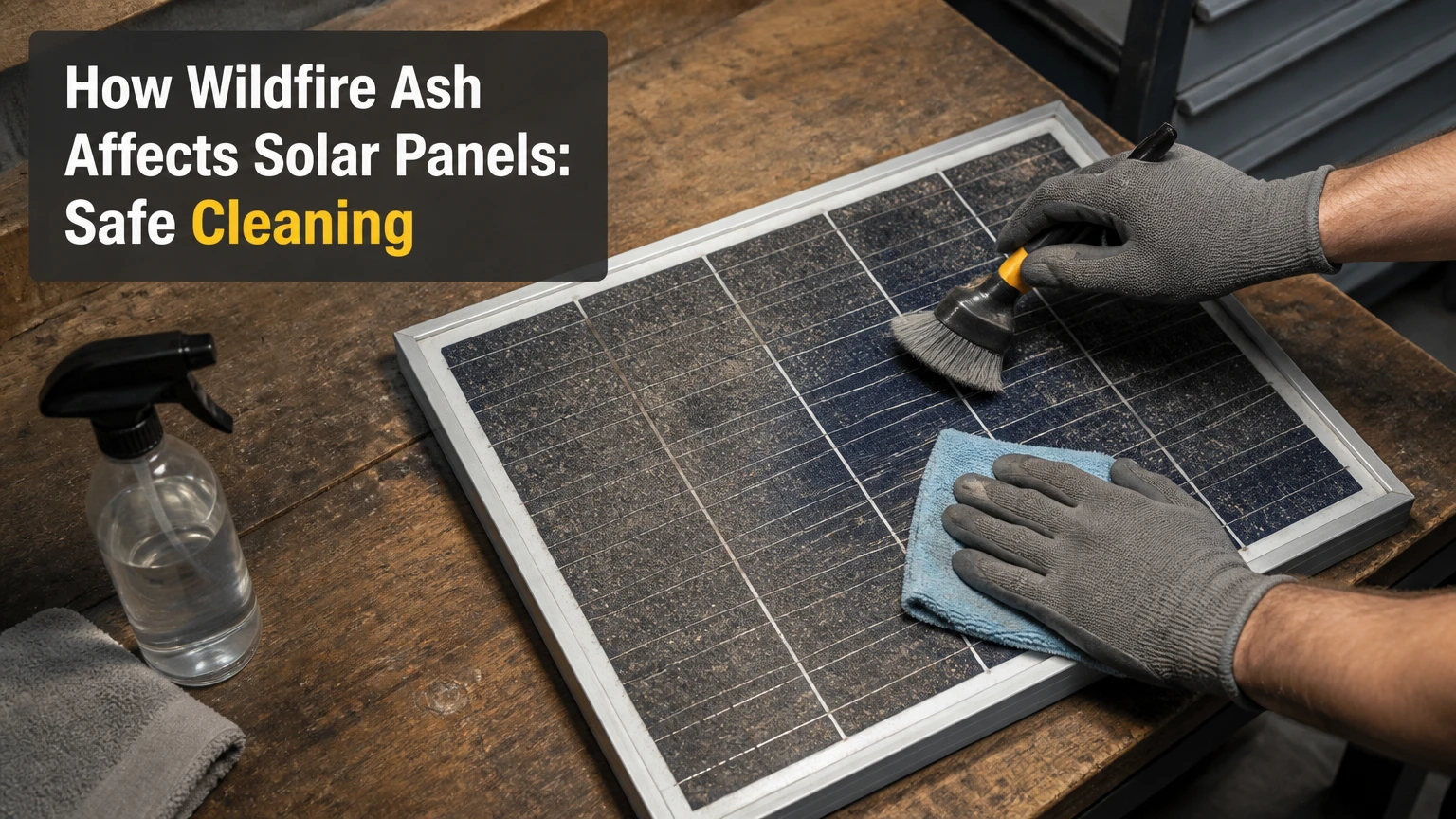
Wildfire ash affects solar panels in two ways: smoke reduces sunlight reaching the array, while settled ash creates a soiling layer that blocks light at the module surface. Dry deposits usually cause a temporary production loss, but ash mixed with dew or light rain can harden into residue that is harder to remove and may abrade or stain the glass.
Key Facts at a Glance
- Wildfire smoke can reduce photovoltaic output before any ash reaches the panels because airborne particles scatter and absorb sunlight.
- Surface ash reduces output by blocking photons, creating uneven shading, and lowering the current produced by affected cells.
- There is no universal wildfire-ash loss percentage; actual loss depends on deposit thickness, array tilt, irradiance, module layout, and weather.
- Dry ash should be removed without dry brushing because silica-bearing particles can scratch anti-reflective glass coatings.
- Heavy rain can remove loose ash, while drizzle or dew can bind ash to glass and create a persistent film.
- Homeowners should avoid roof access during active fires, hazardous air quality, unstable smoke conditions, or wet and slippery roof conditions.
What Is Wildfire Ash?
Wildfire ash is the mineral and carbon-rich residue left after vegetation, soil, buildings, vehicles, or other materials burn. Its composition is not fixed: wood ash commonly contains alkaline calcium and potassium compounds, while structural fires can add glass, concrete, metals, plastics, insulation, and synthetic residues.
Wildfire ash differs from ordinary household dust in particle size, chemistry, and abrasiveness. Some deposits are soft and powdery; others contain angular mineral fragments that can scratch glass when dragged across its surface. Soot and very fine particulate matter may also form a dark film that behaves differently from coarse gray ash.
The National Renewable Energy Laboratory defines the broader PV-soiling problem this way: “Soiling is the accumulation of dust and other particulate matter on the surface of PV modules.” Wildfire ash is a particularly disruptive form of soiling because it can arrive with smoke, settle unevenly, and change physically after exposure to moisture.
Ash does not automatically destroy a photovoltaic module. Most surface contamination causes a reversible optical loss if removed correctly. Permanent damage becomes more likely when abrasive particles are scrubbed across hot glass, when residue remains bonded for long periods, or when the fire itself exposes modules, wiring, and inverters to heat.
How Wildfire Ash Affects Solar Panels
Wildfire ash affects solar panels through atmospheric attenuation and surface soiling. Smoke changes the sunlight available above the array, while deposited ash reduces the light entering the module after sunlight reaches the site.
Smoke Loss Versus Ash Loss
Smoke loss occurs in the atmosphere; ash loss occurs on the panel. The distinction matters because cleaning cannot restore irradiance absorbed or scattered by a smoke plume, and a clear sky does not prove that the array is clean.
Smoke contains fine particles and gases that alter direct and diffuse irradiance. A solar system can continue generating under smoky skies, but its power curve may fall because less total sunlight reaches the cells and the balance between direct and diffuse light changes. Tracking systems, fixed-tilt systems, and systems with different module technologies may respond differently.
Surface ash produces a second loss after particles settle. The layer reflects, absorbs, or scatters incoming light before it reaches the silicon cells. Uneven deposits can also shade part of a cell or module, which creates a larger electrical effect than an equally thick, uniform film.
| Condition | Physical location | Typical observable effect | Cleaning response |
|---|---|---|---|
| Dense smoke overhead | Atmosphere above array | Lower irradiance and flatter midday curve | Cleaning does not remove the loss |
| Fine soot film | Module glass | Gray or brown optical haze | Gentle wet cleaning after air improves |
| Loose dry ash | Glass and frame edges | Patchy soiling and lower current | Remove with low-abrasion wet method |
| Ash plus dew | Glass surface | Bonded spots or alkaline film | Requires longer soaking or technician |
| Ash plus heavy rain | Glass and roof runoff paths | Variable rinsing and streaks | Inspect after surfaces dry |
A useful diagnostic rule is simple: compare production with a nearby irradiance sensor or a clear-sky model. If both irradiance and output fall together, smoke may dominate. If irradiance is near normal but output remains low, surface soiling, shading, or equipment damage deserves inspection.
How Does Ash Reduce Output?
Ash reduces photovoltaic output by lowering the light reaching solar cells and by creating uneven shading across electrically connected cell groups. The immediate effect is usually a reduction in current, while voltage changes are generally smaller until temperature or electrical faults become significant.
A uniform coating can reduce the optical transmission of module glass across the array. A clump over one region can be more serious because cells within a series-connected string must carry similar current. The shaded cell may operate differently from neighboring cells, and the module’s bypass diode can activate when the mismatch becomes large enough.
Bypass diodes protect modules from some reverse-bias conditions, but they do not restore lost energy. Repeated or severe mismatch can produce localized heating, called a hot spot, especially when ash combines with leaves, bird droppings, or a physical module defect. Modern modules are designed with protective features, so hot spots are a risk to investigate, not an automatic consequence of ashfall.
Panel tilt changes the outcome. A steep roof can shed loose particles more effectively than a low-slope roof, but wind can still leave deposits along frame edges and lower borders. Flat commercial roofs often retain more ash because gravity provides less assistance, and roof parapets can create sheltered accumulation zones.
Can Ash Overheat a Panel?
Ash can contribute to heating by reducing optical transmission, but the claim that every ash layer acts as a major thermal insulator is too broad. Dark soot may absorb sunlight and alter module temperature, while a light, thin mineral layer may have little measurable thermal effect compared with ambient temperature, wind, and irradiance.
Module temperature matters because crystalline-silicon power typically falls as cell temperature rises. A common planning coefficient is approximately minus 0.3% to minus 0.5% of maximum power for each 1°C increase above the rated reference condition, although the exact coefficient appears on the module datasheet.
That temperature effect is usually secondary to lost light during ordinary ash soiling. Operators should not diagnose thermal stress from ash appearance alone. Infrared inspection, current-voltage testing, and module-level monitoring provide stronger evidence than surface color.
How Much Output Can Be Lost?
Wildfire ash can cause anything from a barely measurable reduction to a severe localized production loss. The loss cannot be predicted responsibly from a single percentage because ash thickness, composition, coverage, tilt, rainfall, smoke density, and the array’s electrical design all vary between events.
Published PV-soiling research, including work from NREL and Sandia National Laboratories, consistently treats soiling losses as site-specific. The often-repeated claims that wildfire ash universally causes 40-58% loss, 66% loss, or 10-30% smoke loss are not dependable operating rules without a defined test site, irradiance reference, time period, and deposit condition.
The following figures are practical diagnostic ranges, not guaranteed wildfire statistics. They describe what an operator might investigate, not what every array will experience.
| Observed production change on a comparable day | More likely explanation | Immediate interpretation | Recommended action |
|---|---|---|---|
| 0-10% below modeled output | Light smoke, light soiling, or normal model error | Low-confidence ash signal | Compare several days and inspect from ground |
| 10-30% below irradiance-adjusted expectation | Smoke, moderate ash, or mixed conditions | Meaningful but not conclusive | Check glass, strings, and local air data |
| 30-50% below expectation | Heavy soiling, shading, or string issue | Strong maintenance signal | Schedule safe inspection and electrical review |
| More than 50% below expectation | Severe deposit, inverter fault, outage, or fire damage | Do not assume ash alone | Check alarms, strings, disconnects, and fire exposure |
Annual energy loss can be much smaller than a dramatic single-day loss if a cleaning crew removes deposits promptly. Conversely, a moderate daily loss can accumulate when access is delayed for weeks. Commercial owners should compare the value of recovered kilowatt-hours with mobilization, water, labor, and safety costs.
Why Wet Ash Is Harder to Remove
Wet ash is harder to remove because moisture can dissolve alkaline salts and bind fine particles into a film or crust. Dew, fog, drizzle, and brief showers can therefore make a previously loose deposit adhere more tightly to module glass.
The chemistry depends on the burned material. Calcium-rich ash can create alkaline residues, while salts and carbon particles may remain as streaks after evaporation. These residues do not necessarily etch tempered solar glass immediately, but prolonged contamination can stain surfaces, obstruct visual inspection, and increase the abrasion risk during later cleaning.
The safest sequence is to soften and flush the deposit before any contact cleaning. Dry wiping is usually the wrong first action because it turns loose mineral particles into abrasive paste against the glass.
Should You Wait for Rain?
Waiting for rain is reasonable only when a substantial, clean rainfall is likely and the array is safely accessible for later inspection. Light drizzle is a poor cleaning strategy because it can leave streaks, activate soluble ash, and produce a bonded residue after drying.
Rain also cannot be treated as a guaranteed panel wash. Wind-driven rain may rinse exposed upper glass while leaving ash behind frames, on low-slope modules, and in drainage channels. Runoff from roofs or nearby burned structures can introduce additional sediment.
| Weather or site condition | Waiting for rain | Preferred decision |
|---|---|---|
| Heavy rain forecast within 24 hours, loose ash, steep tilt | Reasonable | Inspect after the array dries |
| Drizzle or fog, bonded gray film | Poor choice | Arrange controlled cleaning |
| Flat roof, thick ash, no rain forecast | Poor choice | Use a qualified maintenance crew |
| Active smoke or hazardous AQI | Unsafe to clean | Wait for safe air and roof conditions |
| Fire-damaged wiring or melted components | Inappropriate | Isolate system and request inspection |
How to Inspect and Clean Safely
A safe residential cleaning process starts from the ground and avoids roof exposure. The correct method uses cool modules, low-pressure water, soft non-abrasive materials, and the module manufacturer’s maintenance instructions.
Before You Start
| Requirement | Typical value or specification |
|---|---|
| Best working temperature | Early morning, before direct sun heats glass |
| Residential cleaning time | 1-2 hours for 20-30 modules |
| DIY equipment cost | Approximately $30-$150 for hose, soft brush, and extension |
| Professional residential visit | Commonly $150-$350, depending on access and region |
| Water preference | Clean, low-mineral water; RO or DI water reduces spotting |
| Roof prerequisite | Safe access, dry surface, acceptable AQI, no active fire |
Step 1: Check Fire and Air Conditions
Confirm that the fire authority has lifted evacuation or access restrictions, then check local air-quality data before approaching the array. Smoke exposure can harm workers even when the panels themselves appear undamaged.
You will know this step is complete when the property is accessible, the roof is dry, and conditions allow outdoor work without respiratory protection being used as a substitute for postponement.
The common mistake is cleaning because the sky looks temporarily brighter while the smoke plume remains nearby.
Step 2: Review Monitoring Data
Compare the array’s output with the previous clear day, a clear-sky model, or a nearby irradiance measurement. Check inverter alerts and, where available, string or module-level data before touching the system.
You will know the comparison is useful when the weather, time of day, and irradiance are similar enough to separate smoke loss from surface soiling.
The common mistake is comparing a smoky day with a sunny historical maximum and assigning the entire difference to ash.
Step 3: Photograph and Inspect From Ground Level
Photograph deposits, frame edges, roof runoff, broken glass, melted conduit, and visible discoloration. Do not walk on modules, and do not open energized equipment unless you are qualified and the system has been isolated according to manufacturer instructions.
You will know the inspection is sufficient when you can classify the array as loose-soiled, bonded-soiled, physically damaged, or electrically abnormal.
The common mistake is using a dry broom to test whether ash is loose.
Step 4: Flush Loose Ash With Cool Water
Use a garden hose or low-pressure water feed from a safe location. Let water flow across the module from the upper edge, avoiding concentrated jets and avoiding cold water on glass heated by sun or nearby fire.
You will know the flush worked when loose particles leave the surface without streaks or visible dragging marks.
The common mistake is using a pressure washer. High pressure can damage seals, frames, coatings, and electrical components.
Step 5: Clean Bonded Residue With a Soft Method
If the manufacturer permits contact cleaning, use clean water and a soft, non-abrasive solar brush or microfiber applicator. Keep the surface wet, use minimal pressure, and rinse frequently so captured particles do not remain under the tool.
You will know the cleaning worked when the glass is uniformly clear after drying and no gritty residue remains at the lower frame.
The common mistake is applying household detergent, abrasive powder, razor blades, or hard-bristle brushes.
Step 6: Recheck Production
After the array dries and smoke conditions improve, compare output with irradiance-adjusted expectations. A recovery of only part of the missing production indicates that smoke, shading, inverter faults, hot spots, or fire damage may remain.
You will know the job is complete when the array’s current and power behavior return to a range consistent with its weather-adjusted baseline.
The common mistake is assuming clean glass proves healthy wiring and modules.
What Not to Do
Several popular cleaning actions create more risk than benefit after wildfire ash. The highest-risk combination is hot glass, abrasive particles, forceful water, and roof access.
- Do not dry-brush or dry-wipe ash. Silica-bearing particles can create micro-scratches that permanently reduce optical transmission.
- Do not use a pressure washer. Concentrated pressure can damage module seals, junction boxes, cable connections, and roof flashing.
- Do not spray cold water onto fire-heated or sun-heated glass. Tempered glass can crack from rapid temperature change.
- Do not use bleach, solvents, abrasive cleaners, or ordinary household soap unless the module manufacturer specifically permits the product.
- Do not climb onto a roof during active smoke, poor visibility, wet conditions, or unstable roofing.
- Do not disconnect or restart equipment repeatedly to clear an unexplained production alarm.
- Do not rinse ash into gutters without checking whether contaminated runoff can enter rainwater tanks or sensitive drainage areas.
Can Ash Damage Solar Equipment?
Ash can damage solar equipment directly when fire heat, corrosive residue, moisture intrusion, or abrasive cleaning affects modules and balance-of-system components. Deposited ash alone more commonly causes temporary optical loss than immediate module failure.
Inspect the entire photovoltaic system, not only the glass. Smoke and ash can enter inverter cooling paths, collect around vents, contaminate connectors, and obscure evidence of melted insulation. Firefighters’ water, roof debris, and falling branches can create additional faults unrelated to soiling.
| Component | Ash-related concern | Diagnostic sign | Required response |
|---|---|---|---|
| Module glass | Abrasion or bonded residue | Haze, scratches, persistent spots | Controlled cleaning or module inspection |
| Bypass diode | Repeated mismatch stress | Module or substring drops out | Qualified electrical testing |
| DC connectors | Contamination or heat damage | Discoloration, alarm, odor | De-energize and inspect |
| Inverter | Dust, ash, or heat exposure | Fault code, derating, shutdown | Manufacturer or electrician review |
| Rooftop wiring | Fire, abrasion, or melted insulation | Brittle, exposed, or deformed cable | Isolate system immediately |
A sharp output drop on a clear day, especially when one string performs differently from its neighbors, warrants electrical diagnosis. Ash is one possible cause, not proof of a hot spot or failed bypass diode.
How to Diagnose a Production Drop
Diagnose a wildfire-related production loss by separating irradiance, surface condition, and equipment status in that order. Monitoring data becomes useful only when the comparison uses similar weather and accounts for normal temperature and inverter behavior.
- Check local air quality and sky visibility. Dense haze points toward atmospheric attenuation.
- Compare irradiance-adjusted output. Use a site pyranometer, satellite-based irradiance estimate, or a reliable clear-sky model.
- Inspect module surfaces from the ground. Look for gray film, dark soot, edge deposits, streaks, and uneven patches.
- Compare strings or module groups. One abnormal string suggests localized soiling, shading, connector trouble, or a damaged module.
- Review inverter alarms and temperature data. Repeated trips or thermal derating require qualified service.
- Retest after cleaning and clearer air. Failure to recover indicates that smoke was not the only cause.
Aerial or satellite aerosol optical depth data can help utility operators forecast smoke-related irradiance loss, but it cannot prove whether ash has settled on a specific rooftop. Ground inspection and electrical measurements remain necessary.
When Should You Hire a Professional?
Hire a professional when panels are on a steep or multi-story roof, ash is bonded, fire damage is possible, the array is commercial, or monitoring shows a persistent string-level fault. Professional service is also appropriate when warranty terms require approved maintenance methods.
Residential cleaning commonly costs about $150-$350 per visit in the United States, with regional variation from access, roof pitch, array size, and minimum service fees. Commercial work often uses a per-panel or per-megawatt rate, with typical quoted ranges near $3-$6 per panel for larger accessible arrays, though remote or heavily soiled sites can cost more.
Professional crews may use soft rotating brushes, low-pressure systems, and RO or DI water. The value is not simply cleaner glass. A competent crew can document module condition, identify cracked glass, photograph cable damage, and provide before-and-after production evidence.
No cleaning company can guarantee a return to pre-fire output if smoke remains overhead or modules suffered heat damage. That limitation should appear in the service agreement.
Costs, Time, and Recovery
Cleaning recovery depends on whether the loss came from ash, smoke, or equipment damage. A normal residential wash can restore most of the recoverable soiling loss, but it cannot restore energy lost during the smoke event or repair a failed inverter.
| Array type | Typical cleaning duration | Typical cost range | Main constraint |
|---|---|---|---|
| 20-30 residential modules | 1-2 hours | $150-$350 | Roof access and safety |
| 30-60 residential modules | 2-3 hours | $225-$500 | Array size and water spotting |
| Small commercial roof | 4-8 hours | $500-$2,000 | Parapets, drains, and scheduling |
| Utility-scale block | 1-5 days | Site-specific contract | Water logistics and fire access |
The best financial decision compares expected recovered energy with cleaning cost. For example, a 10-kilowatt residential array losing 30% of a 25-kilowatt-hour clear day loses about 7.5 kilowatt-hours that day. The value of recovery depends on the electricity rate, export credit, and how long the deposit remains.
Cleaning within several days is a sensible operational target when ash is dry and access is safe. It is not a universal deadline for preventing “irreversible pitting.” Glass damage depends on chemistry, exposure, abrasion, and manufacturer construction, so bonded residue should trigger inspection rather than an automatic damage claim.
Situational Guidance
Steep Residential Roofs
Do not climb a steep roof to save a cleaning fee. Inspect from the ground, use monitoring data, and hire a solar maintenance professional when deposits are visible or output remains depressed after smoke clears.
Ground-Mounted Arrays
Ground-mounted modules provide safer access, but workers still need protection from sharp debris, contaminated runoff, and energized DC circuits. Isolate equipment according to the system design, keep tools soft and clean, and avoid walking between modules where ash has hidden broken glass.
Commercial and Agricultural Systems
Commercial operators should define a cleaning trigger before fire season. A practical trigger compares modeled loss, energy price, labor, water, and access costs, while a maintenance contract reduces delays when regional demand rises.
Agricultural arrays may receive extra dust from dry soil, harvest activity, and ash-covered vegetation. Separate wildfire soiling from ordinary agricultural dust by comparing pre-fire soiling rates with post-fire measurements.
Utility-Scale Plants
Utility operators should combine plant-level irradiance sensors, string monitoring, weather data, and aerosol forecasts. Robotic dry cleaning can be useful for ordinary dust, but abrasive wildfire ash may require a wet or specially validated process that does not drag mineral particles across glass.
Warranty, Insurance, and Documentation
Wildfire ash may be treated as a maintenance issue, while direct fire, heat, smoke, falling debris, or firefighting damage may fall under property insurance. The distinction depends on the policy, exclusions, local law, and the documented cause of loss.
Before cleaning, record production data, inverter alarms, air-quality conditions, photographs, and the date of ash deposition. Ask the installer or module manufacturer whether the proposed method complies with warranty instructions, especially when the glass has an anti-reflective coating.
Do not clean away evidence of melted connectors, cracked modules, charred roofing, or heat discoloration before an adjuster or qualified inspector documents the condition. Safety takes priority if energized components or structural fire damage are present.
Frequently Asked Questions
Does wildfire smoke permanently reduce solar-panel output?
Wildfire smoke usually causes a temporary irradiance loss rather than permanent module degradation. Output should improve as the plume clears, unless ash remains on the glass or heat, debris, moisture, or electrical faults damaged the system. Compare output with irradiance after air quality returns to normal.
Can I use a leaf blower on wildfire ash?
A leaf blower may remove loose ash from a ground-mounted array when the manufacturer permits it, but it is a poor choice for roof-mounted panels and can spread contaminated dust. Never use a blower if it forces particles across the glass, threatens nearby people, or disturbs damaged wiring.
Will wildfire ash block solar panels completely?
A thick, opaque deposit can reduce production severely, but complete blockage is uncommon unless ash is mixed with mud, soot, leaves, or other debris. A partial loss can still be financially significant because series-connected cells and bypass diodes respond to uneven deposits.
Are solar panels safe after a nearby wildfire?
Solar panels are not automatically safe or unsafe after a nearby wildfire. Inspect modules, mounting hardware, DC cables, connectors, inverters, and the roof for heat or debris damage. A qualified electrician should isolate and test any system with melted insulation, cracked glass, fault codes, or a sudden unexplained shutdown.
Does solar-panel rain cleaning remove ash?
Heavy rainfall can remove loose ash from steep, exposed modules, but light rain, fog, or dew may bind ash into streaks and crust. Inspect the array after it dries, then compare production with irradiance data rather than assuming rainfall restored full performance.
How often should panels be cleaned in wildfire-prone areas?
Cleaning frequency should follow measured soiling rather than a fixed calendar. In wildfire-prone areas, monitor production continuously, inspect after each significant ash event, and arrange cleaning when recoverable energy loss exceeds the service cost or when residue begins bonding to the glass.
The Bottom Line
How wildfire ash affects solar panels depends on two separate exposures: smoke lowers sunlight in the atmosphere, while ash on the module glass blocks light and can create uneven electrical loading. Measure the loss against irradiance, inspect from the ground, avoid dry abrasion and pressure washing, and use a qualified technician whenever roof access, bonded residue, fire damage, or abnormal string behavior is involved.