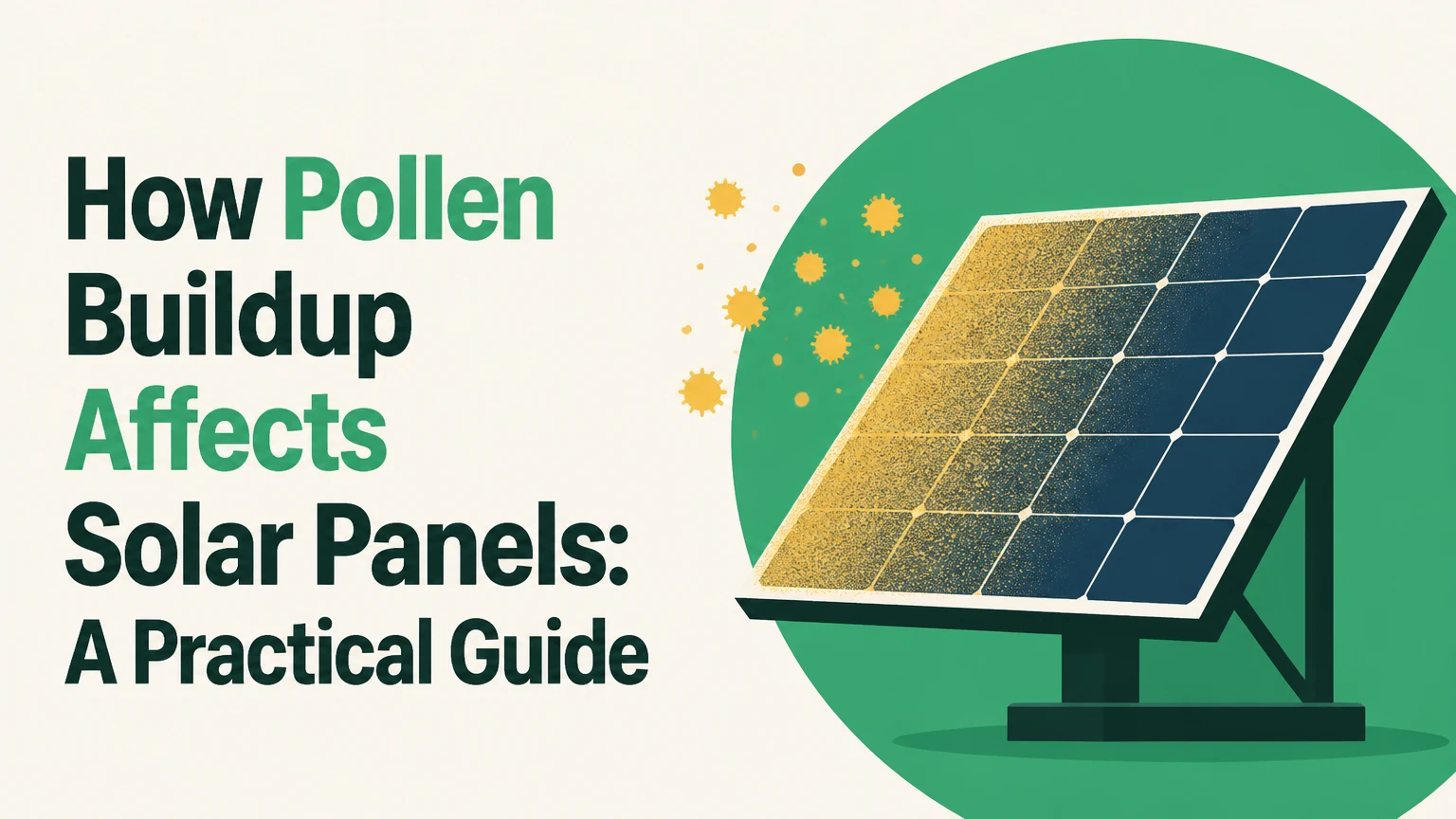
Pollen buildup affects solar panels by creating an organic soiling layer that absorbs, scatters, and blocks sunlight before it reaches photovoltaic cells. The resulting loss usually appears first as lower current and energy production, while voltage remains comparatively stable. Dew, light rain, dust, and heat can turn loose pollen into a tenacious residue that ordinary weather does not remove.
Key Facts
Pollen is organic soiling, and its effect depends on coverage, thickness, moisture, pollen chemistry, and the panel’s angle.
Uniform pollen usually reduces irradiance reaching the cells, so operating current falls before voltage changes substantially.
Light rain may redistribute pollen into a sticky film instead of cleaning the module surface.
Published loss figures vary by site; a 5%-15% seasonal reduction is a practical warning range, not a universal result.
Cool, soft-brush cleaning with low-mineral water is safer than midday washing, abrasive tools, or household chemicals.
Cleaning is financially justified when recovered electricity value exceeds the fully loaded cost of the service.
How Pollen Buildup Affects Solar Panels
Pollen buildup affects solar panels through optical obstruction, surface adhesion, and uneven shading. Pollen grains absorb some incoming radiation, scatter other light away from the cell surface, and form a translucent or opaque film when deposits overlap. The electrical consequence is usually a reduction in photocurrent, because fewer usable photons reach the semiconductor junction.
Solar modules still generate power through the photovoltaic effect. Photons enter the glass and encapsulant, reach semiconductor material such as crystalline silicon, and create charge carriers. A layer of pollen changes the light intensity and spectrum at the cell. It does not normally disable the silicon cells or immediately damage the wiring.
The size and structure of pollen vary widely. Many airborne grains fall within roughly 10-100 micrometres, although species outside that range exist. Pine pollen, grass pollen, ragweed pollen, oak pollen, and agricultural pollen differ in waxes, proteins, surface texture, and moisture response. Those differences affect whether a deposit blows away, beads water, or forms a residue.
A useful distinction is between irradiance loss and thermal damage. A clean module can lose output because pollen blocks light without developing a dangerous temperature rise. A thick, uneven deposit can create local hot areas, especially when it combines with leaves, bird droppings, dust, or a shaded frame edge.
Why Does Pollen Stick to Photovoltaic Glass?
Pollen sticks to photovoltaic glass because the grains have textured outer walls, electrostatic attraction, and moisture-sensitive organic material. Dew or light rain softens deposits, while later evaporation concentrates sugars, proteins, oils, and mineral particles at the glass surface. The resulting film adheres more strongly than dry airborne pollen.
Panel glass is smooth, but it is not perfectly non-stick. Anti-reflective textures, microscopic surface defects, frame channels, sealant edges, and existing dust provide anchoring points. Wind may remove isolated dry grains, but a dense deposit has many contact points and receives protection from the module frame.
A typical buildup sequence looks like this:
- Settling: Plants release pollen during flowering, and wind transports grains onto upward-facing module glass.
- Retention: Low wind, electrostatic attraction, surface texture, and accumulated dust keep grains in place.
- Moisture exposure: Overnight dew, fog, humidity, or light rain hydrates the deposit.
- Residue formation: Evaporation leaves concentrated organic and mineral material behind.
- Compounding: New pollen lands on the residue, increasing optical density and cleaning difficulty.
The timeline is site-dependent. In a heavily wooded or agricultural location, visible deposits can form within several days. Cemented residue may develop after repeated wetting and drying, not necessarily after a fixed 14-day period. Temperature, humidity, module tilt, wind, and rainfall pattern matter more than a universal calendar.
How Much Electricity Can Pollen Cost?
Pollen can reduce solar production by less than 5% on a lightly affected array or by 15% or more during severe, persistent soiling. No single percentage applies to every system, because output also changes with clouds, irradiance, module temperature, inverter clipping, shading, and seasonal sun position.
The National Renewable Energy Laboratory reported in 2023 that rain was not sufficient to remove pollen from tested solar panels, a finding summarized by the title “Rain Not Enough to Wash Pollen from Solar Panels.” The result supports cleaning after pollen events, but it does not establish a universal 15% loss for every array.
The following figures are practical planning ranges rather than guaranteed outcomes:
| Surface condition | Typical production effect | Common duration | Maintenance implication |
|---|---|---|---|
| Sparse dry pollen | 0.5%-3% | 1-7 days | Monitor before cleaning |
| Continuous yellow film | 3%-10% | 5-21 days | Compare cleaning cost with energy value |
| Wet pollen mixed with dust | 8%-20% | 1-6 weeks | Clean before residue hardens |
| Thick uneven deposits | 15%-30% locally | Several weeks | Inspect for hotspots and mismatch |
| Pollen plus bird droppings or leaves | More than 20% locally | Days to months | Remove obstructions promptly |
Uniform soiling generally reduces current across affected cells. Uneven soiling can create a more complicated problem because cells connected in series receive different light levels. Modern modules use bypass diodes to limit damage from shaded substrings, but bypass diodes do not restore the energy that blocked cells could have produced.
A production loss also has a financial dimension. A 6-kilowatt residential system that normally produces 700 kilowatt-hours in a month loses about 70 kilowatt-hours at a 10% soiling rate. At an electricity value of $0.20 per kilowatt-hour, that month’s gross production value is approximately $14 lower, before considering export credits or tariff rules.
Can Rain Remove Pollen From Solar Panels?
Rain can remove loose pollen, but light rain often fails to clean a pollen-coated solar panel and may make the deposit harder to remove. Water dissolves or mobilizes organic material, then gravity carries the slurry toward the lower frame edge, where it dries into a concentrated band.
Rain performance depends on rainfall intensity, duration, droplet impact, wind direction, panel tilt, and the age of the deposit. A strong storm after fresh dry pollen may improve the surface substantially. A short shower after several damp days can leave streaks, rings, and a sticky film.
The lower edge deserves special attention. Frame channels can retain wet pollen, dust, and leaf fragments. When the material dries, it may shade a narrow strip of cells or obstruct drainage. A visible yellow-green line along the bottom edge is a useful inspection clue, but it does not measure the exact energy loss.
Do not treat rainfall as a cleaning schedule. Compare monitored output with irradiance and historical performance after a storm. If the array remains below its expected specific yield, inspect the glass at ground level and arrange a safe wash if the recovered energy justifies it.
Which Sites Face the Highest Pollen Risk?
Solar arrays near forests, grassland, orchards, farms, and dense landscaping face the highest pollen risk. Risk increases when vegetation is upwind, flowering overlaps with dry weather, and modules have a shallow tilt that retains water and particles.
| Site condition | Relative pollen exposure | Typical trigger | Recommended inspection |
|---|---|---|---|
| Urban roof, limited vegetation | Low to moderate | Nearby street trees | Monthly during local bloom |
| Suburban roof with mature trees | Moderate to high | Pine, oak, birch, or grass bloom | Every 1-2 weeks |
| Orchard or crop-adjacent array | High | Crop flowering and field dust | Weekly during bloom |
| Forest-edge installation | High | Windborne tree pollen | Weekly after dry windy days |
| Utility site in open grassland | Moderate to high | Grass and weed pollen | After visible seasonal deposition |
Local pollen calendars can help predict demand, but they do not replace visual and performance data. Two homes in the same city may have different exposure because one array sits beneath trees while the other receives clean airflow from a paved roof.
Tilt changes the outcome. Steeper modules shed water and loose particles more readily, while low-tilt commercial roofs often retain slurry along the lower frame. Tracking systems can also create unusual deposition patterns when modules spend time at shallow morning or evening angles.
How Should You Clean Pollen From Solar Panels?
Clean pollen from solar panels with a cool, soft, low-abrasion wash using deionized or low-mineral water. Remove loose particles first, avoid pressure that can drive grit across the glass, and work from the upper edge toward the frame without walking on modules.
Before you start
| Requirement | Residential array | Commercial array |
|---|---|---|
| Typical active cleaning time | 30-90 minutes | 4-16 crew-hours |
| Water requirement | 10-30 litres per panel group | 0.5-2 litres per panel with efficient systems |
| Brush type | Soft nylon or water-fed boar-hair brush | Soft rotary brush or approved robotic brush |
| Safe access | Ground pole or qualified professional | Insured roof crew or robotic equipment |
| Water quality | Low mineral, preferably deionized | Deionized or tested softened water |
Step 1: Check conditions and access
Clean in the early morning or late afternoon when the module glass is cool. Check the manufacturer’s maintenance instructions, roof access, electrical equipment, weather forecast, and fall-protection requirements.
You will know the conditions are suitable when the glass is cool to the touch, wind is low, and no person needs to step on the modules. The common mistake is treating a roof-mounted array like a ground-level window.
Step 2: Remove dry debris without scrubbing
Use a soft brush or gentle water flow to remove loose pollen, leaves, and grit. Do not use a dry abrasive pad on dusty glass because mineral particles can create fine scratches.
The success checkpoint is a surface free of loose particles before wet agitation begins. The common mistake is pressing harder when a second rinse would remove the grit more safely.
Step 3: Wash with low-mineral water
Apply clean water from the top of the module and use a soft brush with light, overlapping passes. Avoid household dish soap unless the panel manufacturer specifically permits it, because surfactant residue can attract dust and create streaks.
The success checkpoint is a uniform wet surface without visible yellow trails or trapped grit. The common mistake is using untreated well water that dries into calcium or magnesium deposits.
Step 4: Rinse and inspect the frame edge
Rinse the upper glass, side edges, and lower frame channel. Concentrated pollen often remains at the bottom edge even when the center appears clean.
The success checkpoint is clear runoff with no yellow slurry emerging from the frame. The common mistake is stopping after the first pass and leaving the most concentrated residue in the drainage channel.
Step 5: Let the array dry naturally
Allow the surface to air-dry when low-mineral water is available. If mineral content is uncertain, use a final deionized-water rinse rather than wiping the glass with a household towel.
The success checkpoint is a spot-free surface under oblique sunlight. The common mistake is using a squeegee with trapped grit, which can score the glass or damage seals at the edges.
Cleaning does not require bleach, solvent, abrasive powder, wire brushes, or high-pressure jets. Pressure washing can force water toward connectors and seals, while harsh chemicals may degrade polymers or invalidate maintenance guidance. Professional cleaners should carry liability insurance and state exactly what water, brushes, and equipment they use.
Which Cleaning Method Fits the Array?
Manual soft-brush washing is usually the best option for a small, accessible residential array, while robotic equipment becomes more economical on large or hazardous sites. Fixed sprinklers and surface coatings can reduce labor, but they do not eliminate water-quality, residue, inspection, or equipment-maintenance requirements.
| Method | Typical purchase or service cost | Water use | Best fit | Main limitation |
|---|---|---|---|---|
| Manual professional wash | $8-$25 per panel | 10-30 litres per panel group | 10-40 residential panels | Roof labor and access risk |
| Water-fed extension pole | $100-$500 equipment | 10-25 litres per panel group | Ground-accessible homes | Limited reach and pressure |
| Robotic crawler | $5,000-$30,000 equipment | 0.1-1 litre per panel | Large commercial roofs | Training and capital cost |
| Fixed sprinkler system | $2,000-$20,000 installation | 1-5 litres per panel cycle | Repetitive utility cleaning | Overspray and mineral residue |
| Hydrophobic coating | $2-$8 per square foot installed | Reduces later wash demand | New or majorly serviced arrays | Reapplication and product variation |
Costs are typical planning ranges in the United States and can vary substantially by roof height, travel, access, water treatment, array density, and local labor rates. A low quoted price may exclude water purification, fall protection, frame cleaning, or post-service inspection.
Robotic brushes are not automatically gentler. A robot moving grit across the surface can scratch glass if its brush, wheel, or water system is contaminated. Require documented compatibility with the module manufacturer and a cleaning protocol for abrasive particles.
Sprinklers are also not a universal solution. Midday cold water on hot glass is an avoidable thermal-stress risk, and repeated hard-water spraying can leave mineral scale. Automation works best when the site has clean water, suitable drainage, reliable controls, and a measured soiling threshold.
When Should Panels Be Cleaned?
Panels should be cleaned when measured production loss exceeds the cost of cleaning, or sooner when deposits create hotspots, obstruct drainage, or include corrosive contaminants. For many pollen-exposed residential systems, one cleaning near the end of peak bloom is a reasonable starting point, followed by inspection rather than an automatic second visit.
A fixed twice-yearly schedule can work in regions with distinct spring and autumn deposition, but it can waste money in dry, low-pollen areas. Conversely, an array beside a pine stand or crop field may need several inspections during one flowering period.
Use this decision model:
- Estimate recoverable energy from the monitored production gap.
- Multiply recovered kilowatt-hours by the avoided electricity or export value.
- Add safety, water, and service costs.
- Clean when expected net value is positive.
- Clean immediately if hotspots, bird droppings, or blocked drainage are present.
For example, a 10-kilowatt system losing 8% during a 30-day high-irradiance month may forgo 90-120 kilowatt-hours, depending on location and weather. At $0.15-$0.30 per kilowatt-hour, the gross value is approximately $14-$36. A $200 service would not pay back in that month alone, but several months of persistent soiling or a larger commercial system could justify intervention.
How Can You Confirm Pollen Soiling?
Confirm pollen soiling by combining monitoring data, visual inspection, weather comparison, and electrical evidence. A production decline alone is insufficient because clouds, inverter clipping, shading, grid curtailment, and equipment faults can produce the same symptom.
Use the following workflow:
| Diagnostic signal | What to check | Pollen interpretation | Important limitation |
|---|---|---|---|
| Monitoring app | Specific yield in kWh/kW | Gradual decline after bloom | Weather must be normalized |
| Ground inspection | Yellow film, lower-edge bands | Strong visual evidence | Cannot quantify loss precisely |
| Inverter data | Current versus voltage | Current decline supports optical loss | Firmware may report aggregate values |
| Reference sensor | Plane-of-array irradiance | Separates weather from soiling | Sensor itself needs cleaning |
| Thermal imaging | Localized warm areas | Uneven deposits may appear | Requires correct operating conditions |
Compare the affected array with a clean reference string if available. A string-level current mismatch is more informative than total household energy because household demand can hide generation changes.
Thermal imaging is useful for large systems, but pollen does not always produce a distinctive thermal signature. A hotspot can also indicate a cracked cell, connector problem, diode failure, or persistent bird dropping. A qualified technician should investigate abnormal thermal patterns rather than assuming every warm patch is dirt.
Can Pollen Cause Permanent Damage?
Pollen alone usually causes reversible optical loss, not immediate permanent panel damage. Permanent problems become more plausible when residue traps abrasive dust, retains moisture, supports biological growth, or combines with aggressive agricultural, industrial, or coastal contaminants.
Claims of a routine irreversible 1%-3% efficiency loss from pollen are not a general engineering rule. Anti-reflective coatings can be scratched, chemically attacked, or abraded, but pollen residue itself should not be described as automatically etching glass. Damage depends on the coating chemistry, contaminant mixture, cleaning method, and exposure duration.
Potential long-term failure modes include:
- Fine scratches from dry scrubbing over quartz or soil particles.
- Mineral scale from repeated hard-water drying.
- Seal or frame stress from improper pressure washing.
- Localized heating from persistent uneven obstructions.
- Corrosion risk where contaminated moisture reaches damaged connectors.
- Coating wear after repeated abrasive or chemically incompatible cleaning.
The most counterintuitive maintenance rule is that aggressive cleaning can create more durable loss than pollen. A scratched anti-reflective surface may scatter light permanently, whereas a properly removed pollen film would have caused only temporary production loss.
Are Anti-Soiling Coatings Worth Considering?
Anti-soiling coatings can reduce particle adhesion and improve water runoff, but they do not make solar panels maintenance-free. Coating value depends on the local deposit type, rainfall pattern, module warranty, application quality, and the cost of routine cleaning.
Hydrophobic behavior is not the same as self-cleaning performance. A water-repellent surface may cause droplets to bead and roll, yet pollen can remain where droplets evaporate. Some coatings also lose performance under ultraviolet exposure, abrasion, repeated washing, or incompatible detergents.
Consider a coating when:
- The array has high labor or access costs.
- Pollen and dust persist for months.
- Water availability is limited.
- The product has documented module compatibility.
- The expected reduction in cleaning visits exceeds application and renewal costs.
Do not apply a coating over dirty glass or assume a generic automotive product is suitable. Obtain written confirmation about optical transmittance, adhesion, warranty compatibility, expected service life, and approved cleaning chemicals.
What Does Pollen Cleaning Cost?
Solar panel pollen cleaning typically costs $150-$300 for a small residential visit, $4-$8 per panel for many commercial arrays, and approximately $0.50-$2 per panel for efficient utility-scale operations before mobilization and specialized equipment. Actual pricing depends more on access and safety than on pollen alone.
| Array type | Typical panel count | Typical service time | Typical cost |
|---|---|---|---|
| Small residence | 10-25 panels | 30-90 minutes | $150-$300 per visit |
| Large residence | 26-60 panels | 1-3 hours | $250-$600 per visit |
| Commercial roof | 100-1,000 panels | 1-2 business days | $4-$8 per panel |
| Utility solar farm | 10,000 or more panels | Several days to weeks | $0.50-$2 per panel, plus mobilization |
These are typical ranges, not guaranteed quotes. A steep roof, fragile roof membrane, restricted parking, deionized-water production, or required shutdown can materially increase the invoice.
Ask for itemized pricing. The quote should identify panel washing, frame and lower-edge cleaning, water treatment, access equipment, safety controls, travel, tax, and any electrical inspection. A contractor who promises a fixed percentage output increase without measuring irradiance and baseline production is making a claim the service may not support.
Common Mistakes and How to Fix Them
Relying on rain alone
Problem: Light rain spreads pollen into streaks and frame-edge slurry.
Fix: Inspect after the next dry period and clean when the residue remains visible or monitored loss exceeds the economic threshold.
Washing hot glass
Problem: A large temperature difference can increase thermal stress in glass, cells, seals, and frames.
Fix: Wash cool modules in the morning or evening, and avoid spraying cold water onto sun-heated glass.
Using abrasive tools
Problem: Wire brushes, scouring pads, and dry towels can scratch the glass when grit is present.
Fix: Pre-rinse, use soft approved brushes, and replace contaminated brush heads.
Applying household chemicals
Problem: Bleach, strong detergents, and solvents may leave films or attack seals and coatings.
Fix: Follow the module manufacturer’s instructions and use plain low-mineral water unless an approved cleaner is specified.
Using hard water
Problem: Calcium and magnesium remain after evaporation as white scale.
Fix: Use deionized water for the final rinse or test local water hardness before choosing a cleaning process.
Climbing on modules
Problem: Foot pressure can damage glass, cells, and internal connections even when no crack is visible.
Fix: Use ground-based tools or a trained, insured service with appropriate roof-access procedures.
The Bottom Line
How pollen buildup affects solar panels depends on deposit density, moisture, tilt, local vegetation, and the time the residue remains on the glass. Pollen usually causes reversible optical soiling, but rain may fail to remove it, and careless cleaning can create permanent scratches or mineral scale.
Use monitoring data and a ground-level inspection together. Clean cool modules with a soft brush and low-mineral water, avoid chemicals and pressure washing, and schedule service when recovered production value exceeds the cost. For large arrays, automated equipment and soiling sensors can improve economics, but only when water quality, brush condition, and safety controls are managed.
Frequently Asked Questions
Does pollen affect monocrystalline and polycrystalline panels differently?
Pollen can reduce output from both monocrystalline and polycrystalline silicon panels because both technologies need light to reach their cells. The practical difference usually comes from module layout, glass texture, tilt, cell interconnection, and baseline efficiency rather than the silicon category. Thin-film modules can also suffer optical loss from pollen.
Will pollen damage a solar panel warranty?
Pollen normally does not void a solar panel warranty, but improper cleaning can. Manufacturers commonly exclude damage caused by abrasive tools, unauthorized chemicals, pressure washing, or physical impact. Keep maintenance records, use approved procedures, and ask the installer or manufacturer whether a coating or cleaning product is warranty-compatible.
Should pollen be cleaned from panels before a storm?
Clean before a storm when pollen has already formed a sticky film, especially on a shallow-tilt roof. A strong storm may remove fresh dry pollen, but light rain can redistribute older deposits. If severe weather is imminent, safety takes priority and cleaning should wait until the roof and equipment are safe to access.
Can a leaf blower remove pollen from solar panels?
A leaf blower can remove loose leaves and some dry pollen from ground-mounted panels, but it will not remove bonded or wet residue. High airflow may also move grit across the glass or force debris into frame channels. Use a gentle setting from a safe distance, then inspect the surface before deciding whether a wet wash is needed.
How can homeowners measure the benefit of cleaning?
Homeowners can compare normalized production before and after cleaning using the inverter app, a nearby irradiance reference, or the same weather conditions from previous years. Allow several clear days for comparison. A post-cleaning increase is meaningful only after accounting for cloud cover, shading, inverter clipping, grid limits, and seasonal sun angle.