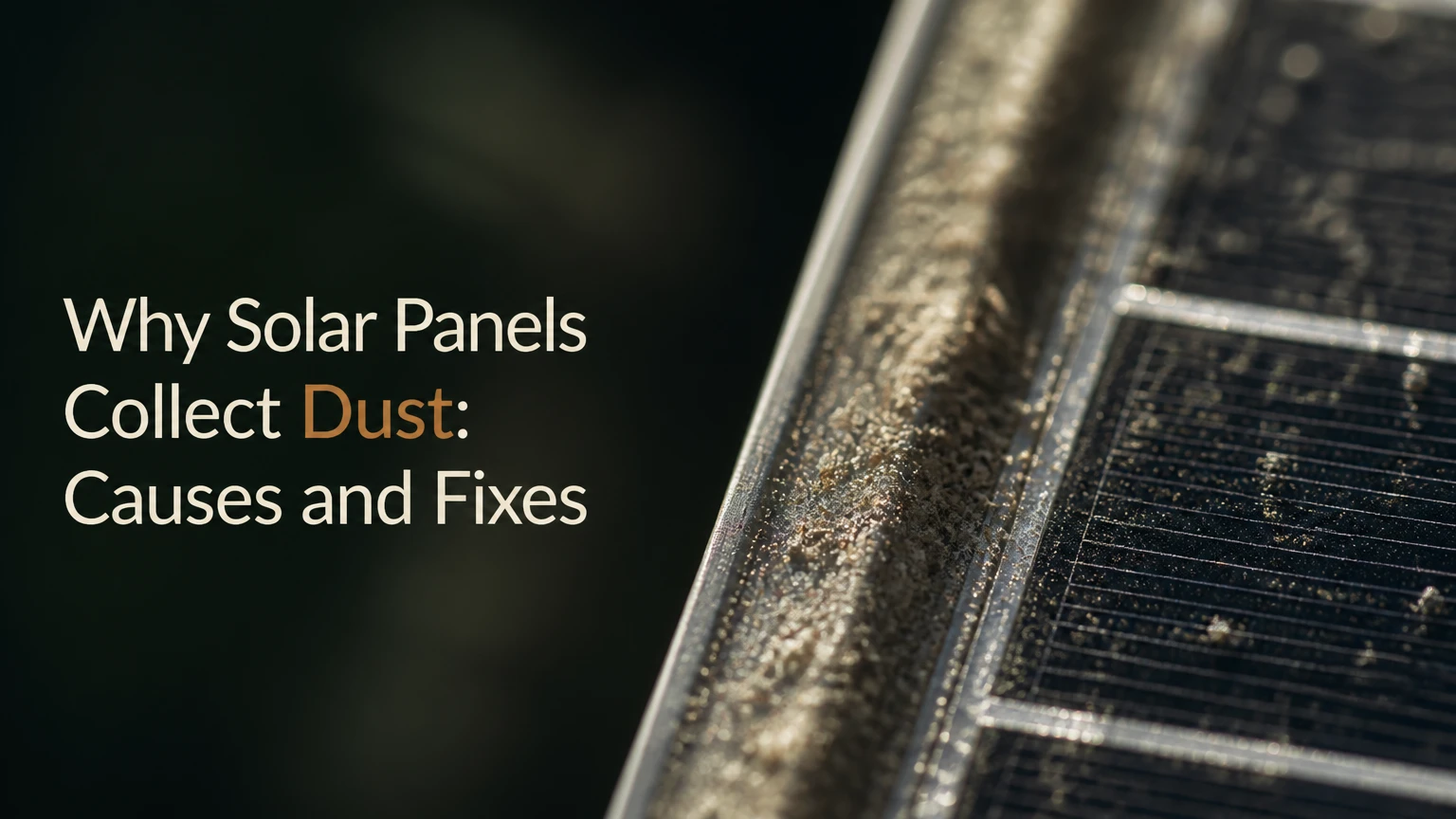
Solar panels collect dust because airborne mineral, biological, and combustion particles settle on exposed glass and adhere through gravity, surface forces, static charge, moisture, and dried mineral residues. The resulting soiling layer scatters or absorbs sunlight before it reaches photovoltaic cells, reducing electricity production; the rate depends on climate, tilt, particle type, wind, rain, and nearby dust sources.
Key Facts at a Glance
- Photovoltaic soiling means dust and other particulate deposits covering a module’s light-facing surface.
- Fine clay, soot, pollen, and salt usually adhere more strongly than coarse, dry sand.
- Dew and light rain can cement dust to glass when dissolved minerals dry into a residue.
- Rain cleans panels only when it has enough volume, speed, and runoff to remove the deposit.
- A visible dirty surface does not prove a specific percentage loss; production data or before-and-after testing gives a better estimate.
- Cleaning is economically justified when recovered electricity is worth more than the service, water, and equipment costs.
What Does Solar-Panel Dust Mean?
Solar-panel dust is usually called photovoltaic soiling, a broad term covering dust, ash, pollen, soot, salt, bird droppings, and other deposits on module glass. Soiling creates optical loss because the deposit absorbs, reflects, or scatters part of the sunlight that would otherwise enter the cell.
The National Renewable Energy Laboratory describes soiling as the accumulation of dust and other particulate matter on PV-module surfaces. The term matters because ordinary “dust” describes only one material, while a sticky pollen film or bird dropping can reduce output more severely than an equal mass of loose sand.
Soiling is different from shading. A nearby tree blocks sunlight before it reaches the module, whereas soiling forms on the module itself. Soiling is also different from degradation, which is a long-term change in the module, and from inverter clipping, which occurs when array power exceeds inverter capacity.
Where do the particles come from?
Common sources include unpaved roads, agricultural fields, construction sites, fireplaces, industrial stacks, vehicle traffic, exposed soil, rooftops, trees, and bird activity. A roof beside a gravel driveway can soil faster than a roof in a dry desert if local wind repeatedly transports coarse and fine material toward the array.
| Source | Typical deposit | Common setting | Removal difficulty |
|---|---|---|---|
| Exposed soil | Clay, silica, silt | Farms, deserts, construction sites | Moderate to high |
| Vehicle traffic | Soot, tire dust, road grit | Highways, urban roofs | High when oily |
| Trees and crops | Pollen, sap, leaf fragments | Rural and suburban roofs | Moderate |
| Sea air | Sodium chloride salt | Coastal installations | High after drying |
| Birds | Organic, opaque droppings | Roofs, poles, trees | High and localized |
| Wildfire or heating | Ash and carbon | Fire-prone or cold regions | Moderate to high |
How Do Dust Particles Stick to Solar-Panel Glass?
Dust reaches solar-panel glass by wind transport and settles when air movement near the surface cannot keep a particle suspended. Adhesion then depends on particle size, humidity, surface roughness, electrostatic charge, and the chemical composition of both the particle and the glass.
Airflow over a module forms a near-surface boundary layer. The boundary layer is slower than the free stream, but it does not automatically trap every particle. Turbulence, wind direction, particle inertia, and the panel’s leading edge often matter more than a simple smooth-air settling model.
Fine particles have a low settling speed and can remain airborne for long periods. Clay and soot can therefore travel farther and enter small surface irregularities. Coarse sand settles quickly, but wind can also roll or bounce it across the glass, producing abrasion if cleaning equipment drags it over the surface.
Van der Waals attraction operates at very small distances. Electrostatic attraction may contribute when particles and surfaces carry charge, but static charge is not a universal or dominant explanation at every installation. Moisture, oily organic material, and dissolved salts frequently determine whether a deposit remains loose or becomes bonded.
Why Does Dust Become Hard to Remove?
Dust becomes difficult to remove when humidity, dew, fog, or light rain dissolves soluble compounds and then evaporation leaves them behind as a mineral bond. This process is often called cementation, and it can turn a removable powder into a crust or translucent film.
Morning dew is especially important in dry climates. A dry deposit absorbs a small amount of water overnight, then sunlight warms the module and evaporates that moisture. Sodium, calcium, magnesium, and other soluble compounds can recrystallize around particles and attach them to the glass.
Light rain can worsen appearance when it wets the array without producing enough runoff. Water carries dirt downward, then leaves streaks along the lower frame. Repeated cycles create a band of residue that may require deionized water, a soft brush, or professional cleaning.
Pollen adds another pathway. Its biological oils and surface structure help fine mineral particles attach, creating a yellow or green film after spring moisture. Soot and traffic residue can behave similarly because carbonaceous particles may contain oily compounds.
Which Materials Collect on Solar Modules?
Solar modules collect several deposit types, and each has a different optical and cleaning behavior. Fine mineral dust primarily scatters light, dark soot absorbs it, salt forms crystalline haze, pollen creates a binder-like film, and bird droppings cause concentrated opaque blockage.
| Deposit | Optical effect | Seasonal or local trigger | Practical response |
|---|---|---|---|
| Silica sand | Reflection and scattering | Arid wind, unpaved roads | Soft dry removal or low-mineral wash |
| Clay and silt | Film formation and scattering | Farms, construction, dry soil | Wet soft wash before crusting |
| PM2.5 soot | Absorption and dark film | Traffic, combustion, industry | Frequent professional washing |
| Pollen and sap | Film and particle binding | Spring, trees, crops | Clean after pollen season |
| Sea salt | Haze and crystalline deposits | Coastal wind and spray | Rinse with low-mineral water |
| Bird droppings | Localized opaque blockage | Roosting birds and overhead wires | Spot-clean promptly |
| Ash | Scattering and chemical residue | Wildfire or solid-fuel heating | Remove gently before wetting |
Why are bird droppings more serious than ordinary dust?
Bird droppings can create a localized electrical problem even when most of the panel is clean. A shaded cell or group of cells may operate hotter, and bypass diodes or module-level electronics can respond to the mismatch.
Bird droppings are not always corrosive enough to damage glass immediately, but their salts and acids can stain surfaces and attack some surrounding materials over time. Remove them promptly with cool water and a soft tool, without scraping dried material across the module.
How Much Power Does Soiling Cost?
Soiling losses commonly range from less than 1% in rainy, clean environments to more than 10% during extended dry periods, while desert, agricultural, and polluted sites can experience substantially higher losses without maintenance. A universal daily loss figure is unreliable because weather can remove deposits or change the accumulation rate overnight.
The AI Overview’s quoted daily range of 0.05%-0.2% is a plausible planning range for some dry sites, not a dependable rule for every array. A 0.1% daily decline would equal about 3% over 30 days if losses accumulated linearly, but rainfall, dew, wind, and deposit composition rarely produce a perfectly linear curve.
NREL and the International Energy Agency Photovoltaic Power Systems Programme have both treated soiling as a site-specific performance variable requiring measurement. Utility operators commonly use a soiling ratio, which compares a dirty reference module or sensor with a cleaned reference under similar irradiance conditions.
| Installation condition | Typical uncleaned loss range | Main driver | Measurement priority |
|---|---|---|---|
| Rainy suburban roof | 0%-3% between washes | Pollen, bird deposits | Visual check and annual comparison |
| Dry inland home | 2%-8% seasonally | Soil, dust, low rainfall | Monthly production trend |
| Farm or gravel-road roof | 5%-15% seasonally | Clay, road grit, harvest dust | Soiling reference or cleaning test |
| Coastal array | 3%-12% seasonally | Salt, humidity, bird activity | Conductance and visual inspection |
| Desert utility plant | 5%-20% or more | Fine dust, dew cementation | Continuous soiling monitoring |
These ranges are typical planning values, not guarantees. Module orientation, cleaning history, rainfall intensity, and the value of exported electricity determine whether a cleaning is financially sensible.
Does Panel Angle Change Dust Retention?
Panel angle changes dust retention because steeper modules shed loose particles and drain rainwater more effectively, while shallow modules allow deposits and dirty runoff to remain near the lower frame. Tilt helps, but it does not eliminate soiling in dry or polluted environments.
A module installed below roughly 10-15 degrees often retains more residue than one mounted near 25-35 degrees under the same weather conditions. The exact difference is site-specific, and the claim that low-tilt panels always retain four times more dust should not be treated as a general engineering constant.
Roof geometry introduces another issue. Aluminum frame edges can create a dam where dirty water accumulates. The bottom row may therefore look substantially worse than the center of the array, even when the overall panel angle is adequate.
Tracking systems have different exposure patterns. Single-axis trackers change orientation during the day, which can alter wind deposition and rain runoff. Stow positions may reduce wind loading, but they do not guarantee better cleaning.
Will Rain Clean Solar Panels?
Rain cleans solar panels only when rainfall is heavy enough to wet the full surface, move particles downhill, and carry residue beyond the module edge. Light showers can instead create spots, streaks, and cemented deposits, especially where dust was already present.
Rain is most effective on modules with a moderate slope and a clean drainage path. A rainfall event of several millimeters may remove loose dust, but the result depends on droplet intensity, wind, dust chemistry, and whether the water dries before reaching the frame.
Rain does not reliably remove bird droppings, oily soot, salt crust, or pollen film. It can also spread a dropping across a larger area. After a dry season, inspect the array after the first meaningful rain rather than assuming the glass is clean.
How Should Solar Panels Be Cleaned Safely?
Solar panels should be cleaned with cool or lukewarm low-mineral water and a clean, soft, non-abrasive tool, preferably when the modules are cool. A typical residential cleaning takes 30-90 minutes and costs about $100-$350 when performed by a professional, although roof access and local labor rates change the total.
Manufacturers’ instructions control because module glass, frames, seals, and coatings vary. Deionized water reduces mineral spotting, while a soft microfiber applicator or brush loosens deposits without dragging grit aggressively across the surface.
A safe cleaning sequence
- Check the manufacturer’s manual. Confirm approved water temperature, detergents, brushes, and access rules.
- Inspect from the ground. Look for cracked glass, loose wiring, nests, damaged frames, and unsafe roof conditions.
- Choose a cool period. Early morning is usually safer than washing a hot module with cold water.
- Rinse loose grit first. Use low-pressure water so abrasive particles do not get rubbed across the glass.
- Agitate gently. Use a clean soft brush or microfiber tool with plain water, applying minimal pressure.
- Rinse completely. Remove loosened residue and detergent before it dries.
- Prevent mineral spots. Use deionized or softened water, or dry according to the manufacturer’s instructions.
- Verify production later. Compare similar irradiance periods after cleaning, not two cloudy days.
Cold water on a hot module is not automatically guaranteed to fracture tempered glass, but severe temperature differences can increase thermal stress. The safer rule is simple: avoid washing hot panels.
High-pressure washing is also inappropriate. It can damage seals, frames, wiring, and coatings, but it does not automatically cause an inverter short circuit. Keep water away from electrical connectors and follow the module and inverter manufacturer’s limits.
| Cleaning method | Typical residential cost | Water use | Best use | Main limitation |
|---|---|---|---|---|
| Natural rainfall | $0 | 0 liters purchased | Rainy climates, moderate tilt | Light rain leaves residue |
| DIY soft wash | $10-$40 in supplies | 20-80 liters | Accessible ground arrays | Fall and electrical hazards |
| Professional wash | $100-$350 per visit | 10-50 liters with treated water | Rooftops and stubborn deposits | Recurring labor cost |
| Robotic dry cleaning | Rarely economical at home | Near-zero | Large desert arrays | Capital cost and abrasion risk |
| Water-fed pole service | $80-$250 per visit | 10-40 liters | Low-rise commercial roofs | Needs trained operator |
How Often Should Panels Be Cleaned?
Most residential arrays need inspection twice a year and cleaning only when production data or visible deposits show a meaningful loss. Dry, dusty, coastal, agricultural, or bird-heavy locations may require monthly inspection and cleaning two to six times annually.
A fixed calendar is less reliable than a performance threshold. Commercial operators often trigger cleaning when measured soiling causes roughly 3%-5% energy or revenue loss, provided the cost of service is lower than the value of recovered generation.
A practical calculation is:
Cleaning value = recovered kilowatt-hours × electricity value
For example, a 6-kilowatt system producing 750 kWh per month might lose 8%, or 60 kWh, to soiling. At $0.25 per kWh, the lost value is $15. A $200 cleaning would not make financial sense every month, although a larger annual loss, higher electricity price, or self-cleaning labor could change the decision.
Which sites need more frequent cleaning?
- Homes within roughly 100 meters of an unpaved road often receive more road dust.
- Farms can experience sharp deposition during tilling, harvest, and fertilizer application.
- Coastal arrays may need rinsing after salt spray or prolonged dry weather.
- Roofs beneath utility wires, trees, or nesting locations need spot cleaning.
- Construction sites can produce fine cement and silica dust that bonds quickly.
Which Dust-Removal Strategy Fits Each Array?
Manual soft washing is usually the best value for accessible residential systems, while automated waterless equipment becomes more attractive for large desert arrays where labor, water transport, and lost production are expensive. Anti-soiling coatings can help, but their performance depends on product durability and installation quality.
| Strategy | Typical cost or scale | Expected benefit | Suitable situation | Important drawback |
|---|---|---|---|---|
| Natural rain | $0 | Removes loose dust | Wet climate, tilt above 15 degrees | Does not remove crust or droppings |
| Manual cleaning | $100-$350 home visit | Often restores most removable loss | Small rooftop array | Roof and labor risk |
| Anti-soiling coating | About $2-$5/m² residential application | Often a modest yield improvement | High-humidity or pollen sites | UV wear and maintenance limits |
| Dry robot | $10,000-plus utility equipment | Frequent waterless cleaning | Large desert plant | Capital cost and brush wear |
| Electrostatic system | Specialized commercial equipment | Potential active particle control | Research or high-value sites | High complexity and limited deployment |
The AI Overview’s claim that coatings provide a permanent 2%-5% yield boost is too broad. Coatings can reduce adhesion or improve runoff, but the result is product-specific, may decline under ultraviolet exposure and abrasion, and does not replace cleaning after bird droppings or heavy soot.
Can Dust Damage Solar Panels?
Dust alone usually reduces energy production before it physically damages a module. Damage becomes more likely when abrasive particles are rubbed across the glass, corrosive deposits remain wet, bird droppings create hot cells, or aggressive cleaning harms the anti-reflective surface.
Fine dust can enter frame drainage paths, while coarse sand can scratch glass if dragged during dry wiping. Scratches increase scattering and may give later deposits more places to lodge. Never use scouring pads, powdered cleaners, or stiff abrasive brushes.
Localized deposits deserve special attention. A leaf, dropping, or thick mud patch can shade only part of a cell, producing electrical mismatch and heat. Infrared inspection can identify abnormal hot areas, but a qualified technician should interpret thermal images and isolate electrical faults.
Solar modules are tested for outdoor exposure, but durability testing does not make them immune to poor maintenance. The panel glass is strong; the connectors, seals, coatings, and human access conditions remain vulnerable.
How Can You Tell Whether Dust Is Causing Lower Output?
Dust is the likely cause when production declines gradually during a dry period, the array shows a uniform haze or lower-edge residue, and output improves after a safe cleaning under comparable sunlight. A sudden drop points more strongly toward inverter, wiring, shading, protection, or equipment failure.
Use a diagnostic sequence rather than relying on appearance:
- Compare daily or weekly production with irradiance and weather data.
- Check whether every string or microinverter shows a similar decline.
- Inspect the array from ground level at a shallow viewing angle.
- Look for deposits concentrated along frame edges, corners, and bird perches.
- Compare output before and after cleaning on similar clear days.
- Investigate faults if only one string falls sharply or the inverter reports an error.
Temperature also matters. Hot weather lowers module voltage, and inverter clipping can flatten midday output. Snow, new shade, smoke, haze, and a failed optimizer can resemble soiling. Production software alone cannot identify dust with certainty.
What Are the Most Common Soiling Mistakes?
The most expensive mistakes involve cleaning when the benefit is smaller than the risk, using mineral-rich water, and treating every visible deposit as ordinary dust. A site-specific measurement and a manufacturer-approved method outperform aggressive cleaning.
- Dry wiping dusty glass: Loose silica can scratch the surface. Rinse first.
- Using hard tap water: Calcium and magnesium can dry into white scale. Use treated water where practical.
- Cleaning in strong sun: Rapid drying creates streaks, and hot glass increases thermal stress.
- Using a pressure washer: High pressure can damage seals, frames, and wiring.
- Assuming rain solved the problem: Inspect after light rainfall because runoff may redistribute dirt.
- Walking on modules: Foot traffic can cause cell and glass damage. Use safe roof access.
- Cleaning without shutting down as instructed: Follow the system owner’s manual and use a qualified professional for electrical isolation.
The Bottom Line
Solar panels collect dust because wind transports particles onto exposed glass, where gravity, airflow, surface attraction, moisture, and dried minerals hold them in place. Fine dust, pollen, soot, salt, and bird droppings behave differently, so climate and nearby sources matter more than a universal cleaning schedule.
For most homes, inspect twice yearly and clean when deposits cause measurable output loss. Use a cool, low-pressure, non-abrasive method with low-mineral water. For commercial and desert systems, compare recovered kilowatt-hours with labor and water costs, then trigger cleaning when soiling crosses an economic threshold.
The answer to why solar panels collect dust is therefore environmental exposure plus surface adhesion, not a defect in photovoltaic technology. Clean only when the recovered generation justifies the work and risk.
Frequently Asked Questions
Do solar panels attract dust?
Solar panels do not generally attract dust as a deliberate electrical or magnetic effect. Exposed glass collects particles because wind carries them across the array, the surface slows near-surface airflow, and moisture or electrostatic charge can increase adhesion. Local sources such as roads, farms, chimneys, and trees usually explain high accumulation.
Are black solar panels dirtier than blue solar panels?
Black and blue photovoltaic modules can collect similar amounts of material because dust deposition depends mainly on exposure, surface properties, tilt, and weather. Black modules may make pale deposits more visible, while optical design, glass texture, and anti-reflective coatings can affect how strongly a deposit reduces light transmission.
Can I use vinegar or soap on solar panels?
Use vinegar or soap only if the module manufacturer permits it. Plain low-mineral water is often sufficient for loose dust, while unsuitable detergents can leave films or damage coatings. Never combine household chemicals, and rinse completely so dried surfactant does not create another optical layer.
Do solar panels work when covered in dust?
Dust-covered solar panels still produce electricity unless sunlight is completely blocked, but their output falls as the deposit absorbs and scatters light. A thin uniform film may cause a small loss, while opaque bird droppings or thick clay can create severe localized mismatch and heating.
Is dust worse on flat solar panels?
Dust is usually worse on nearly flat panels because gravity and rainfall provide less downhill movement. Flat arrays also retain dirty runoff along frame edges. However, wind turbulence, local sources, and cleaning access can outweigh tilt, so production data should confirm whether the angle is causing a meaningful loss.
Should solar panels be cleaned before or after rain?
Clean solar panels after a meaningful rain if the array still shows haze, streaks, salt, pollen, or bird deposits. Cleaning immediately before rain wastes effort unless the forecasted rainfall is too light to rinse the surface. Inspecting after rain reveals whether the event actually removed or merely redistributed the soil.