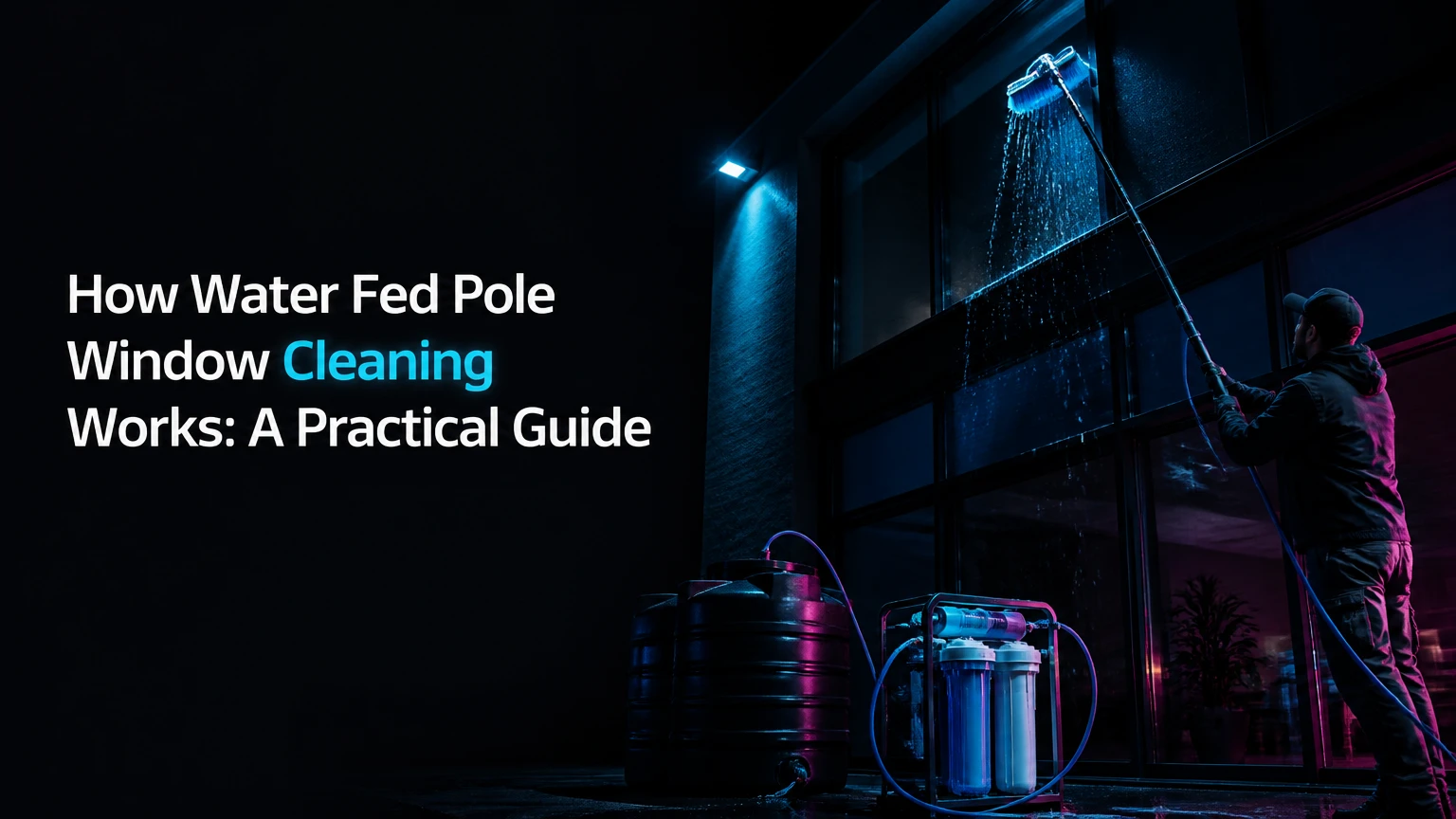
Water-fed pole window cleaning uses a telescopic pole, soft brush, and purified water to scrub and rinse exterior glass from the ground. Reverse osmosis and deionization remove mineral ions that would otherwise dry as spots, while brush agitation releases dirt; the final pure-water rinse leaves the pane to air-dry without a squeegee.
Key Facts at a Glance
- A water-fed pole system normally delivers purified water through brush jets at about 1.5-3.0 liters per minute.
- A TDS reading of 0-5 parts per million is a practical target for spot-free exterior glass.
- Reverse osmosis removes most dissolved minerals before deionization polishes the water.
- Water-fed poles clean glass, frames, sills, screens, conservatories, and some solar panels from ground level.
- Brush agitation performs most of the cleaning; pure water does not replace physical scrubbing.
- Water-fed pole cleaning is poor at removing cured paint, silicone, mortar, and thick construction debris without specialist tools.
What Is a Water-Fed Pole System?
A water-fed pole system, also called reach-and-wash equipment, is an exterior cleaning method that pumps low-mineral water through a telescopic pole to a brush head. The operator scrubs the glass and frame, then rinses the loosened soil away while remaining on the ground.
The system usually contains a water source, purification filters, a 12-volt pump, battery, hose reel, telescopic pole, brush, and water jets. Pole lengths range from approximately 18 feet for residential work to more than 60 feet for specialist commercial access, although wind and pole flex reduce practical control at maximum reach.
The method changes the cleaning chemistry. Ordinary tap water contains calcium, magnesium, silica, sodium, and other dissolved solids. When tap water dries on glass, those solids can remain as white deposits. Purified water contains far fewer dissolved ions, so evaporation leaves little or no mineral residue.
How does pure water remove dirt?
Pure water helps dissolve and carry away water-soluble soil, but the brush supplies the main mechanical action. The common phrase “hungry water” describes water with low dissolved-mineral content, not a special detergent-like chemical that bonds aggressively to every contaminant.
A brush loosens dust, pollen, insect residue, traffic film, and oxidized dirt from the glass and surrounding frame. The flowing water suspends that material and carries it down the pane. A final rinse must displace dirty water from the surface rather than merely wetting it again.
Soap is usually unnecessary for routine exterior maintenance because detergent can leave surfactant residue. That residue may attract dust or cause sheeting behavior that complicates rinsing. Pure water also cannot dissolve every contaminant, so paint flecks, bird-bomb residue, construction dust, and mineral scale may require a scraper, solvent, abrasive pad, or traditional detailing process.
What Equipment Does a System Require?
A functional water-fed pole setup combines purification, delivery, reach, and agitation. A missing or undersized component affects the entire process, because low flow at the brush can reduce rinsing even when the water quality is perfect.
| Component | Typical specification | Primary function | Common failure |
|---|---|---|---|
| Sediment filter | 5-micron cartridge | Removes suspended particles | Blocked cartridge lowers flow |
| Carbon filter | 10-inch or 20-inch housing | Reduces chlorine and protects RO membrane | Chlorine damages membrane |
| RO membrane | 1812 or 4040 format | Removes about 95-98% of dissolved minerals | Poor rejection raises DI use |
| DI vessel | 6-30 liter resin tank | Removes remaining ions | Exhausted resin causes spots |
| Pump | 12 V, 60-100 psi typical | Moves water through hose and pole | Low voltage reduces pressure |
| Hose | 1/4-inch or 5/16-inch microbore | Delivers water to brush | Kinks restrict flow |
| Pole | 18-60 feet working range | Provides ground-level access | Flex reduces brush control |
| Brush head | 10-16 inches, 2-4 jets | Agitates and rinses glass | Blocked jets create dry areas |
A domestic setup may use a garden-hose supply and a portable DI canister. A daily commercial operator generally benefits from sediment and carbon prefiltration, an RO membrane, DI polishing, a 12-volt battery, and a tank or van-mounted delivery system.
Is RO or DI better for window cleaning?
DI-only purification costs less initially and works efficiently where tap-water TDS is low. RO/DI costs more and produces wastewater, but reverse osmosis removes most dissolved solids before the DI resin, which makes the resin last much longer in hard-water areas.
| Purification method | Suitable input TDS | Typical equipment cost | Operating trade-off |
|---|---|---|---|
| DI only | Below 100 ppm | $150-$500 | Fast setup, high resin use in hard water |
| RO only | 200-600 ppm | $300-$900 | Lower TDS, rarely reaches reliable zero |
| RO plus DI | 200-1,000+ ppm | $500-$2,000 | Lowest DI consumption, slower production |
| Portable prefilled pure water | Any tested supply | $0.05-$0.20 per liter typical | No equipment, recurring delivery cost |
Tap-water hardness varies by location, and TDS does not identify every contaminant. A TDS meter measures conductivity-related dissolved solids, not whether the glass is clean or whether bacteria are present. Test both the source water and the water leaving the DI stage.
How Pure Must the Water Be?
Water-fed pole water should generally measure 0-5 ppm TDS at the brush for consistent spot-free drying. Many operators prefer 0-2 ppm, especially on dark glass, conservatories, or windows exposed to strong sunlight.
A reading above 5 ppm does not guarantee visible spotting on every pane, while a reading of 0 ppm does not correct poor technique. Dirty frames, contaminated brush fibers, windblown dust, and incomplete rinsing can still create marks. TDS is a control measurement, not a substitute for process discipline.
The US Geological Survey classifies water hardness by calcium carbonate concentration, with 121-180 milligrams per liter considered hard and more than 180 milligrams per liter very hard. Harder source water normally consumes DI resin faster, particularly when the RO membrane is missing, damaged, or operated at inadequate pressure.
Which Pole Material and Height Fit the Job?
Carbon fiber provides the best stiffness-to-weight ratio for repeated commercial work, while fiberglass costs less but becomes tiring and flexible at longer lengths. A pole’s advertised reach is not the same as its effective working height, because brush control declines with wind, side loading, and the operator’s stance.
| Pole material | Typical working height | Approximate weight at 30 feet | Best fit |
|---|---|---|---|
| Fiberglass | 15-25 feet | 6-10 lb | Ground-floor and occasional DIY work |
| Hybrid glass-carbon | 25-40 feet | 4-7 lb | Regular residential cleaning |
| Standard carbon fiber | 35-55 feet | 3-6 lb | Daily residential and commercial work |
| High-modulus carbon | 50-85 feet | 2-5 lb | Tall commercial façades and specialist access |
Choose a pole by the highest window you can control accurately, not the highest window the manufacturer lists. A 40-foot pole may reach a third-floor sill, but a 30-foot pole can be faster if it remains rigid enough to position the brush precisely.
Carbon fiber conducts electricity. Fiberglass is electrically nonconductive in some designs, but no pole should be treated as safe near overhead power lines. Maintain a generous separation distance, identify electrical hazards before setup, and follow local utility and occupational-safety requirements.
How Water Fed Pole Window Cleaning Works in Practice
The cleaning sequence has six essential actions: prepare the water, wet the upper frame, scrub the frame and glass, rinse from the top, inspect the result, and allow the pane to dry. A typical residential exterior job takes 10-25 minutes per property once equipment is deployed, while first-time setup may add 15-30 minutes.
Before You Start
| Requirement | Typical value |
|---|---|
| Working time | 10-25 minutes per small home |
| Difficulty | Moderate, due to pole control and water testing |
| Water use | 1.5-3.0 L/min at the brush |
| TDS target | 0-5 ppm |
| Startup cost | $200-$500 DIY, $1,200-$3,000 professional |
| Required tools | TDS meter, hose, brush, pole, pump, battery |
| Weather check | Avoid strong wind, freezing conditions, and storms |
Inspect the glass for cracked panes, failed seals, loose glazing beads, fragile leaded glass, and coatings that may react poorly to aggressive brushing. Secure the hose so pedestrians, vehicles, and doors cannot catch it.
Step 1: Test the Water
Measure the purified-water TDS before cleaning. Confirm that the meter is calibrated or checked according to its manufacturer’s instructions, and test the source water when diagnosing rapid resin exhaustion.
Success checkpoint: The water leaving the purification system reads 0-5 ppm.
Common mistake: Starting work with an exhausted DI cartridge because the operator tested only the tap water.
Step 2: Set the Brush Above the Glass
Extend the pole gradually and position the brush on the upper frame or top edge of the pane. Keep the pole sections clean and fully locked, because grit inside a clamp can damage the section during extension.
Success checkpoint: The brush reaches the top frame without leaning the pole against fragile trim.
Common mistake: Extending the pole beyond controllable reach, which causes the brush to twist and miss the edges.
Step 3: Scrub the Frames and Sill
Turn on water flow and scrub the top frame first, then the side frames, lower frame, sill, and glass. The upper frame matters because trapped dirt and detergent can release later and drip over an apparently clean pane.
Use several deliberate passes on insect residue and traffic film. Do not grind abrasive grit across coated or delicate glass. For heavy deposits, stop and use a suitable hand tool rather than increasing brush pressure.
Success checkpoint: Frame corners no longer release visible dirt during the rinse.
Common mistake: Cleaning only the glass and allowing dirty top-frame water to recontaminate it.
Step 4: Agitate the Glass
Move the brush in overlapping vertical and horizontal passes, keeping bristles in contact with the surface. Brush pressure should be enough to flex the bristles, not enough to bow the pole or drag grit aggressively across the pane.
Pure water dissolves some soluble soil, but the brush must release bonded particles. Spend more time on lower panes near roads, shaded panes with algae, and windows with insect marks.
Success checkpoint: The glass has received uniform brush coverage from edge to edge.
Common mistake: Making one fast pass and assuming continuous water flow has removed traffic film.
Step 5: Rinse From the Top Down
Lift the brush slightly away from the glass or reduce contact pressure, then rinse the pane from its upper edge downward. Maintain enough flow to create a continuous sheet of water rather than isolated droplets.
The top-down rinse carries loosened soil toward the sill. Rinse frames and the lower edge again when dirty water collects there. On large panes, work in controlled sections while keeping the upper section wet until the lower section is ready.
Success checkpoint: The rinse water sheets evenly and leaves no visible dirt trails.
Common mistake: Rinsing from the middle, which leaves contaminated water above the rinse path.
Step 6: Let the Window Air-Dry
Stop touching the glass after the final rinse and allow pure water to evaporate. Drying commonly takes 5-30 minutes, depending on temperature, humidity, wind, shade, and water volume.
Do not judge the finish while the pane is still wet. Check the glass after drying from several angles, then repeat only the affected area if a mark remains.
Success checkpoint: The pane dries clear without mineral rings or vertical trails.
Common mistake: Using a towel on the glass after rinsing, which can introduce lint, detergent, or mineral contamination.
What Are the Main Operating Specifications?
Flow, pressure, water quality, and reach must work together. Increasing pump pressure cannot compensate for a blocked jet, kinked hose, exhausted resin, or excessively long pole.
| Operating factor | Typical range | Practical effect | Adjustment |
|---|---|---|---|
| Brush flow | 1.5-3.0 L/min | Controls rinse coverage | Reduce only when water is scarce |
| Pump pressure | 60-100 psi | Supports delivery through pole | Check voltage before raising pressure |
| Pure-water TDS | 0-5 ppm | Limits mineral spotting | Replace or regenerate resin |
| Small residential job | 20-60 liters | Covers routine exterior glass | Use controlled brush flow |
| Large commercial job | 100-500+ liters | Supports multiple operators | Use tank and RO/DI production |
Water use is often lower than people expect because the brush works with a thin moving film, but a high-flow rinse left running between windows wastes water and battery capacity. Close the valve while walking between panes.
Is Water-Fed Pole Cleaning Better Than a Squeegee?
Water-fed pole cleaning is usually safer and faster for exterior windows above ground level, while traditional bucket-and-squeegee cleaning provides better control for interior glass, detailed edges, and stubborn contamination. The appropriate method depends on height, surface condition, access, and finish requirements.
| Criterion | Water-fed pole | Ladder and squeegee | Best choice |
|---|---|---|---|
| Second- and third-floor access | Ground-based, 25-55 feet typical | Ladder repositioning required | Water-fed pole |
| Interior windows | Poor fit, water overspray risk | Precise and controlled | Squeegee |
| Routine exterior speed | 10-25 minutes per small property | 20-45 minutes typical | Water-fed pole |
| Construction debris | Limited without extra tools | Better spot treatment | Squeegee plus scraper |
| Startup cost | $200-$3,000 typical | $50-$300 basic kit | Squeegee |
| Operator fall exposure | Lower when correctly deployed | Higher near ladders | Water-fed pole |
| Frame and sill cleaning | Integrated with brush | Separate detailing | Water-fed pole |
A ladder is not automatically unsafe, and a water-fed pole is not automatically risk-free. Long poles create overhead hazards, hose trip risks, fatigue, and loss of control in wind. Ground-based access reduces fall exposure but does not remove the need for a site risk assessment.
What Does a Water-Fed Pole System Cost?
A basic DIY system typically costs $200-$500, a professional portable setup costs about $1,200-$3,000, and a high-volume van-mounted system commonly costs $5,000-$15,000 or more. Regional taxes, pole length, purification capacity, tank size, and battery equipment produce wide price differences.
| Setup type | Typical purchase price | Typical capacity | Suitable user |
|---|---|---|---|
| DI starter kit | $200-$500 | 20-100 liters per job | Occasional homeowner |
| Portable RO/DI cart | $700-$2,000 | 100-300 liters per day | Part-time or growing operator |
| Professional trolley system | $1,200-$3,000 | 250-500 liters per day | Residential window cleaner |
| Van-mounted system | $5,000-$15,000+ | 500-1,000+ liters per day | Multi-job commercial contractor |
Consumable costs include sediment filters, carbon cartridges, DI resin, RO membranes, pump batteries, brush parts, and hose repairs. DI resin is the variable expense most affected by source-water TDS. In hard-water locations, RO prefiltration often lowers long-term cost even though the initial system price is higher.
What Mistakes Cause Spots or Poor Results?
Most spotting problems come from contaminated water, dirty frames, incomplete rinsing, or contaminated equipment rather than from the basic concept of water-fed cleaning. Diagnose the process in that order before buying a stronger pump or a larger brush.
- Water measures above 5 ppm: Replace exhausted DI resin, check the RO membrane, and retest at the brush.
- Dirty top-frame drips appear later: Scrub and rinse the upper frame before completing the glass.
- The final rinse is too brief: Repeat a continuous top-down rinse until runoff is visibly clear.
- Brush fibers carry detergent: Wash the brush thoroughly and reserve separate tools for soap-based work.
- Hose flow is weak: Remove kinks, clear jet nozzles, inspect connectors, and measure battery voltage.
- Glass remains marked at zero ppm: Look for paint, silicone, hard-water scale, failed seals, or external contamination that pure water cannot dissolve.
A counterintuitive practitioner rule is that more water does not always produce a cleaner window. Excess flow can spread dirty runoff across frames and drain a battery faster, while correct agitation and a controlled sheet rinse produce a cleaner result.
Can a Water-Fed Pole Clean Every Exterior Surface?
A water-fed pole suits routine glass, uPVC or vinyl frames, aluminum frames, sills, screens, conservatory roofs, and many solar panels, but surface compatibility must be checked first. Delicate coatings, loose seals, cracked panes, and heavy bonded contaminants require a slower inspection or a different method.
Solar panels require special care. Use manufacturer-approved procedures, avoid abrasive brushes, do not walk on panels, and recognize that water-fed cleaning removes dust and bird residue but does not repair damage or improve a failing electrical connection.
Water-fed cleaning is especially useful in these situations:
- Multi-story residential windows where ladder repositioning is slow.
- Commercial façades with repeated panes and predictable access.
- Buildings where ladder contact could damage landscaping or cladding.
- Solar arrays with safe ground-level reach and a compatible brush.
- Maintenance programs performed every 4-12 weeks.
Traditional detailing remains preferable for interior glass, first cleans with heavy buildup, paint overspray, cement splashes, and edges requiring a dry polished finish.
How Should You Handle Weather and Special Conditions?
Avoid water-fed pole work during freezing weather, strong gusts, lightning, or conditions that prevent safe pole control. Water can freeze on glass, hoses, fittings, and walkways, while wind can turn a long carbon pole into an uncontrolled lever.
Cold-weather operators should insulate or drain equipment, protect the pump, and prevent standing water from freezing inside filters and hoses. Hot sun can accelerate drying before the rinse is complete, so clean shaded elevations first or use smaller working sections.
Hard-water areas require more frequent TDS checks. If a property has old soap residue, the first pure-water clean may need repeated frame scrubbing because previous detergent deposits can continue to bleed out during drying.
How Do You Troubleshoot a Failed Clean?
Start with water quality, then inspect flow, brush condition, technique, and the glass itself. This sequence avoids replacing expensive equipment when the actual problem is a blocked jet or a dirty upper frame.
| Symptom | Likely cause | Corrective action | Verification |
|---|---|---|---|
| White spots after drying | TDS above 5 ppm | Replace DI resin and retest | Water reads 0-5 ppm |
| Vertical dirty trails | Incomplete top-down rinse | Rewash upper frame and pane | Runoff sheets clear |
| Low brush flow | Kinked hose or blocked jet | Straighten hose, clean jets | Continuous water film |
| Pump pulses | Low battery or air leak | Charge battery, tighten fittings | Stable pump sound |
| Slow drying | Shade, humidity, or excess flow | Reduce working area and wait | Pane dries uniformly |
| Marks at zero TDS | Paint, scale, silicone, or seal failure | Use specialist spot treatment | Contaminant removed safely |
Never scrape unknown glass contamination aggressively. A razor can damage certain coatings, films, and soft deposits if the surface is dry or gritty. Identify the contaminant and use the tool approved for that surface.
Which Setup Fits Your Situation?
A homeowner cleaning one property monthly can usually choose a 20-30-foot hybrid pole with a DI canister if source-water TDS is modest. A residential professional working daily will usually reduce operating cost with a 30-40-foot carbon pole and portable RO/DI system.
A high-volume contractor needs capacity as much as reach. A 50-foot or longer high-modulus carbon pole, a 500-liter or larger tank, reliable 12-volt pump controls, and separate hose reels support repeated commercial work, but the equipment also requires vehicle storage, maintenance, and formal safety procedures.
Do not buy maximum reach first. Measure the highest frame, account for setback from the building, assess wind exposure, and select the shortest pole that provides safe, rigid control.
Frequently Asked Questions
Does water-fed pole cleaning work in hard-water areas?
Yes, water-fed pole cleaning works in hard-water areas when RO and DI purification reduce output TDS to approximately 0-5 ppm. DI-only systems can become expensive because high source-water mineral content exhausts resin quickly. Test source and output water regularly, especially after changes in flow or filter condition.
How long do water-fed pole windows take to dry?
Exterior glass typically dries within 5-30 minutes after a proper pure-water rinse. Sun, wind, humidity, shade, pane size, and water flow change the drying time. A window can appear hazy while wet and still dry clear, so inspect the finished pane only after evaporation is complete.
Can you use tap water through a water-fed pole?
Tap water can be used for an initial wash, but it should not be the final rinse unless its mineral content is extremely low and verified. Most tap water contains enough dissolved solids to leave spots after evaporation. A TDS meter provides the relevant operating check.
Why do windows look dirty after water-fed cleaning?
Windows can look dirty while wet because runoff, loosened soil, and water sheeting obscure the glass. If marks remain after drying, check TDS, upper-frame contamination, brush coverage, final-rinse quality, and bonded deposits such as paint or silicone.
Is a water-fed pole safe around electrical wires?
A water-fed pole is unsafe near overhead electrical wires unless required clearance and local safety rules are fully satisfied. Carbon fiber conducts electricity, and fiberglass does not eliminate site hazards. Survey the work area first, keep hoses controlled, and postpone the job when safe separation cannot be guaranteed.
Does pure water remove hard-water stains?
Pure water rarely removes established mineral scale by itself. Pure water prevents new mineral spotting, while existing scale may require a compatible acidic treatment, abrasive process, or specialist restoration. Test a small area first because coatings and soft glass can be damaged by unsuitable chemicals or tools.
The Bottom Line
How water fed pole window cleaning works is straightforward: purification removes spot-forming minerals, a pump sends the water through a telescopic pole, brush agitation releases dirt, and a controlled top-down rinse carries contamination away. The most reliable results depend on 0-5 ppm water, clean frames, sufficient flow, correct pole control, and enough drying time.