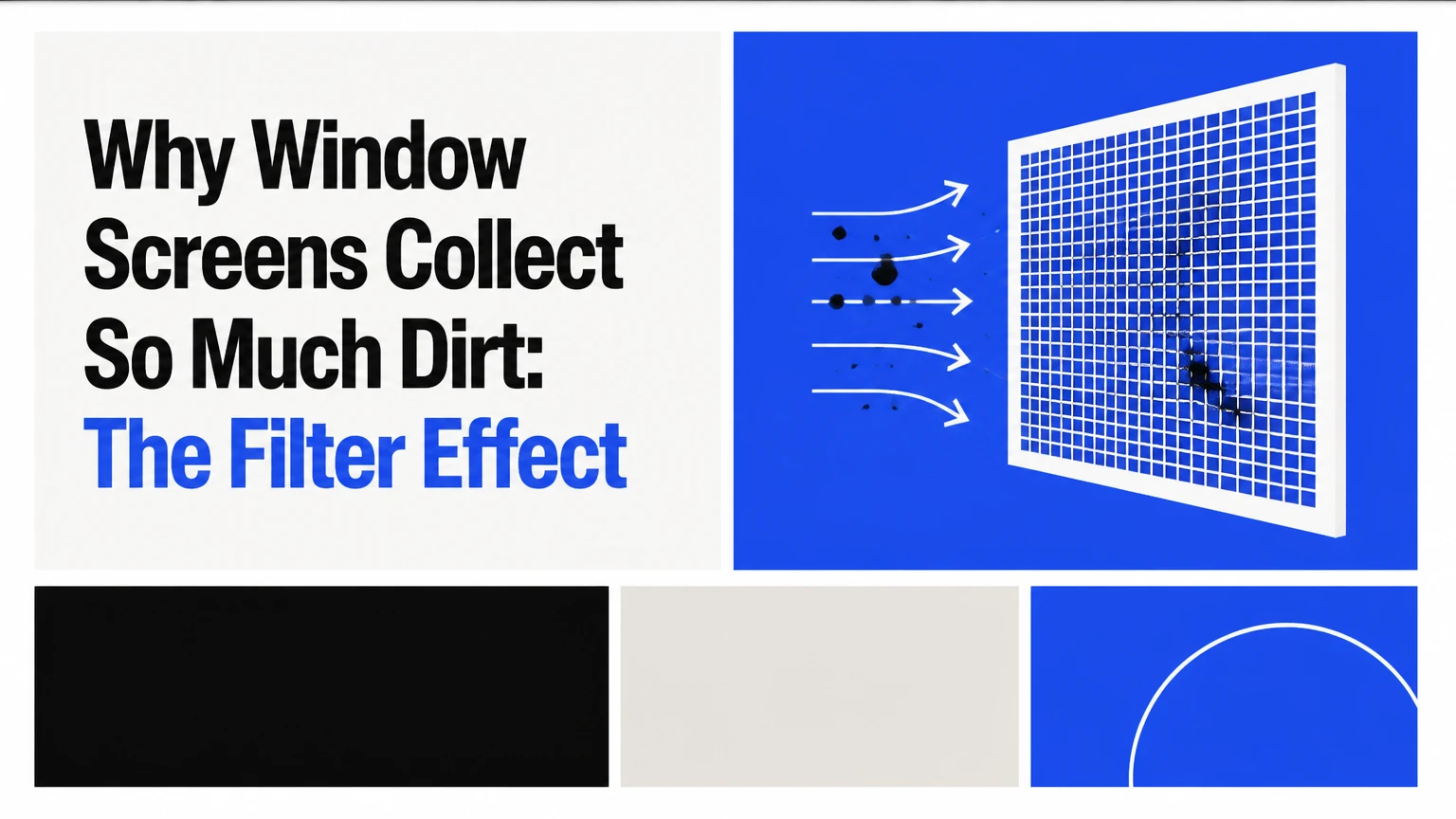
Window screens collect so much dirt because a window screen is an outdoor-facing particle collector: moving air carries pollen, dust, soot, fibers, and moisture into its mesh, where fibers intercept particles and wet residue dries in place. Screen geometry creates far more catching surface than flat glass, so screens can look dirty even when nearby windows appear clear.
Key Facts at a Glance
- A window screen is an insect barrier, not a certified HVAC air filter, but its mesh still captures airborne particles.
- Wind, turbulent airflow, pollen, road dust, and nearby vegetation usually contribute more dirt than static electricity alone.
- Fibers catch particles by interception and impaction; mesh openings also block particles larger than the openings.
- Rain and dew make dust adhere more strongly, while sunlight dries residue into a harder film.
- Fine pollen mesh catches smaller particles but usually clogs faster and reduces airflow more than standard mesh.
- Most residential screens need cleaning once or twice yearly, while construction, traffic, pollen, and coastal exposure can require monthly cleaning.
Why Do Window Screens Collect So Much Dirt?
Window screens collect dirt because they combine constant particle exposure with a rough, porous surface. Every breeze that enters through an open window carries outdoor material toward the screen, while the screen fibers interrupt that air stream and retain some of its contents.
Flat glass has a smooth surface, so dust often remains loose until rain or condensation moves it. Fiberglass, aluminum, and polyester screens contain thousands of intersecting strands, creating edges, corners, and small depressions where particles can lodge. A screen therefore accumulates material through several mechanisms at once.
A screen also sits at the boundary between indoor and outdoor air. Outdoor dust reaches the exterior face, while indoor lint, cooking aerosols, skin flakes, and textile fibers can move toward the interior face when air reverses direction. The same screen may collect different residues on opposite sides.
How Does Airflow Trap Dust?
Airflow traps dust when particles moving with wind cannot follow the air stream around a screen fiber. Larger particles collide with the strand, while smaller particles may contact a fiber through inertia, turbulence, or ordinary interception as the air bends through the opening.
The effect is strongest when wind approaches directly, when the screen is dirty enough to have a rough surface, or when nearby surfaces create turbulent eddies. A screen behind a projecting sill may collect a different pattern from one exposed on a windy upper floor.
Window screens do not remove particles with the efficiency of a pleated furnace filter. Their openings are relatively large, airflow is uncontrolled, and the screen is not sealed around its frame. The screen collects whatever happens to contact its fibers rather than filtering a measured volume of air to a stated efficiency.
Does Static Electricity Make Synthetic Screens Dirtier?
Static electricity can increase the attraction of some dry particles to synthetic screen fibers, but static charge is not the sole or always dominant explanation. Fiberglass is vinyl-coated glass fiber, polyester is a synthetic polymer, and both can develop charge through friction and dry airflow; humidity, particle composition, surface age, and grounding change the effect.
The Google Overview’s description of synthetic mesh as actively pulling in airborne dust is directionally plausible but too absolute. Ordinary household screens are not designed electrostatic precipitators, and a screen’s visible dirt load usually reflects exposure, fiber area, moisture, and maintenance history more than a measurable static rating.
Static attraction matters most in dry conditions with lightweight material such as lint, fine dust, and pollen fragments. A damp screen can instead retain particles because water creates a sticky film, regardless of electrical charge.
Which Screen Features Increase Dirt Accumulation?
Screen material, strand thickness, mesh density, surface condition, orientation, and exposure determine how quickly residue appears. A thick or tightly woven screen has more fiber surface in the airflow, while a damaged or oxidized surface gives particles more places to lodge.
Mesh labels also require care. An “18 x 16” screen generally means 18 strands per inch in one direction and 16 in the other, but strand diameter changes the actual opening size and open-area percentage. Two screens with the same count can therefore provide different airflow and particle capture.
| Screen type | Typical construction | Dirt behavior | Main trade-off |
|---|---|---|---|
| Fiberglass | Vinyl-coated glass fiber, often 18 x 16 mesh | Moderate pollen and dust retention; flexible surface | Low purchase cost, easier tearing |
| Aluminum | Bare or coated metal wire, commonly 18 x 16 mesh | Less electrostatic attraction; oxidation can roughen surface | Durable, but dents and corrosion are possible |
| Polyester pet screen | Thick vinyl-coated polyester, commonly heavier than standard mesh | High fiber area and strong lint, pollen, and fur retention | Tear resistance, with reduced airflow |
| Fine pollen mesh | Dense synthetic or specialty woven mesh, often 20 x 20 to 30 x 20 | Captures more small particles and clogs sooner | Better allergen exclusion, greater pressure drop |
| Stainless steel specialty mesh | Metal wire with corrosion-resistant alloy | Low static behavior and strong dimensional stability | Higher material cost and limited residential use |
Does a Fine-Mesh Screen Always Stay Cleaner?
A fine-mesh screen usually becomes visibly dirty sooner because its smaller openings intercept more pollen and dust and provide more material around each opening. Fine mesh can reduce the amount of outdoor debris entering a room, but it cannot guarantee allergy control because unsealed window gaps and open doors still admit air.
A dense screen also creates more resistance to airflow. If an exhaust fan or natural ventilation depends on an open window, a high-density screen can slow air exchange enough to change comfort and condensation patterns. The correct choice depends on whether insect exclusion, airflow, pollen reduction, pet resistance, or visibility has priority.
How Do Weather and Location Change Screen Dirt?
Weather changes the adhesive behavior of residue, while location changes the particle supply. A screen beside a gravel driveway may collect mineral dust, a screen under trees may collect pollen and sap, and a screen near traffic may receive soot and road dust.
Rain does not reliably clean a screen. Light rain can dissolve soluble material and leave a film, while wind-driven rain can push soil against the mesh. Dew and high humidity allow particles to bond to wet fibers; later sunlight evaporates the water and hardens the remaining solids.
| Exposure condition | Common residue | Typical cleaning interval | Practical response |
|---|---|---|---|
| Low-traffic suburban area | Household dust, lint, seasonal pollen | Every 6-12 months | Vacuum and wash in spring and autumn |
| Heavy tree pollen | Yellow-green pollen, leaf fragments | Every 1-3 months during season | Dry-brush before wet washing |
| Urban or high-traffic road | Soot, tire dust, mineral grit | Every 3-6 months | Rinse gently before wiping |
| Construction or gravel road | Silica-rich dust, mud, cement residue | Monthly during active work | Remove screens and rinse promptly |
| Coastal environment | Salt aerosol, sand, organic film | Every 1-3 months | Fresh-water rinse and inspect corrosion |
| Outdoor grill or smoking area | Grease aerosol, smoke residue | Every 1-3 months | Use diluted dish detergent, not solvent |
Trees can produce unusually persistent buildup. Pollen is lightweight and adhesive, and sap or insect honeydew can bind it to the mesh. Screens located beneath roof edges may also receive concentrated runoff containing dust from shingles, fascia, and gutters.
Why Are Some Screens Dirtier at the Bottom?
The lower part of a screen often becomes dirtier because runoff, splashback, and gravity move particles downward. Window sills and tracks can also hold soil that is lifted back onto the lower mesh whenever the sash moves or wind passes through the opening.
A dirty sill can create a false cleaning problem. If the screen is washed but the track remains full of grit, the next opening cycle redistributes that material. Cleaning the frame, sill, weep holes, and track is part of controlling screen buildup.
Is Screen Dirt Coming From Outside or Inside?
Most visible screen dirt comes from outside, but indoor sources can contribute, especially on the room-facing surface. Outdoor contributions include soil, pollen, soot, salt, insects, and plant fragments; indoor contributions include lint, cooking grease, smoke, and settled household dust.
The direction of air movement provides a useful clue. A screen facing a dusty road usually shows heavier exterior contamination, while a kitchen window may develop a tacky film from cooking aerosols. A bathroom screen can retain mineral residue where humid air repeatedly condenses and dries.
The U.S. Environmental Protection Agency explains that indoor particle levels are affected by outdoor air, indoor sources, and ventilation conditions. That distinction matters because opening a window can improve ventilation while also introducing outdoor particles. A screen reduces some large debris but does not replace source control or a properly sized HVAC filter.
Can Dirty Screens Make Indoor Air Worse?
A dirty screen can reduce airflow and shed loose particles when disturbed, but a window screen does not normally create significant indoor pollution by itself. The larger issue is that opening a contaminated window allows outdoor air to enter, and a clogged screen can make occupants open the window wider.
Window screens are not equivalent to MERV-rated filters. ASHRAE Standard 52.2 evaluates particle removal by HVAC filtration under specified test conditions, whereas ordinary insect screens have no comparable efficiency rating. People with severe allergies should use source control, closed-window filtration, and appropriately rated HVAC or portable air-cleaner systems rather than relying on mesh alone.
How Should You Clean a Dirty Window Screen?
Clean a removable screen with a soft vacuum brush, cool water, a small amount of mild dish detergent, and a soft nylon brush. A typical residential screen takes 15-25 minutes to wash and dry, although baked grime may need a 20-30 minute soak.
Before You Start
| Requirement | Typical specification |
|---|---|
| Time | 15-25 minutes per standard screen, excluding severe drying delays |
| Tools | Vacuum with brush attachment, hose, bucket, soft nylon brush |
| Cleaning solution | 1 teaspoon mild dish detergent per 1 gallon cool or lukewarm water |
| Work area | Flat, clean surface with towels underneath |
| Water pressure | Ordinary garden-hose flow, not a pressure washer |
| Inspection | Check spline, corners, tears, loose coating, and frame distortion |
Step 1: Remove and Label the Screen
Open the window, release the retaining clips or springs, and lift the screen out without flexing its corners. Mark the top edge with removable tape if the frame is asymmetrical or the clips differ by side.
You will know the step worked when the screen lies flat without a bowed frame or displaced spline. A common mistake is pulling one corner sharply, which can stretch fiberglass mesh or loosen the rubber spline.
Step 2: Remove Loose Dust While Dry
Lay the screen on a towel and vacuum both faces using a soft brush attachment. Work from the frame toward the center with light pressure, because aggressive brushing can push dry grit deeper into the weave.
You will know the step worked when loose dust no longer falls from the screen during a gentle tap. Wetting a heavily dusty screen first turns loose soil into mud and makes the final wash harder.
Step 3: Wash With Diluted Detergent
Rinse the screen gently from the cleanest side toward the dirtiest side. Dip a soft nylon brush in the detergent solution and brush along the mesh direction with short, light strokes.
You will know the step worked when the water runs mostly clear and the mesh openings are visible. A wire brush, abrasive pad, bleach, solvent, or concentrated degreaser can remove coatings, discolor aluminum, or weaken aged fiberglass.
Step 4: Rinse, Dry, and Inspect
Rinse away all detergent, then stand the screen vertically or lay it flat on towels in shade. Do not reinstall the screen while the frame or mesh remains wet, especially against a painted sill.
You will know the screen is ready when no suds remain, the mesh is open, and the frame has retained its shape. Direct high heat or prolonged intense sun can accelerate aging in vinyl-coated fiberglass.
| Condition after washing | Likely cause | Correct action |
|---|---|---|
| White haze on aluminum | Oxidation or mineral deposits | Try a small area with diluted white vinegar, then rinse |
| Cloudy, brittle fiberglass | UV-aged vinyl coating | Replace the mesh rather than scrubbing harder |
| Brown sticky film | Grease, sap, or smoke residue | Repeat with mild detergent and a longer soak |
| Mesh remains blocked | Embedded soil or excessive surface damage | Soak 20-30 minutes, then replace if openings stay closed |
| Frame will not sit square | Bent frame or loose spline | Re-square and rescreen, or replace the frame |
What Cleaning Mistakes Damage Screens?
High-pressure washing, wire-brush scrubbing, harsh solvents, and washing in the installed position cause most avoidable screen damage. Pressure can stretch mesh or push screens from their frames, while wire bristles score aluminum and abrade vinyl coatings.
Avoid these common errors:
- Using a pressure washer: A low-pressure hose removes residue more safely than concentrated spray.
- Scrubbing dry grit: Vacuum first, because dry mineral particles act like abrasive powder.
- Ignoring the sill and track: Clean these areas after the screen so loose soil does not return.
- Using bleach or strong acids: These chemicals can degrade coatings and accelerate corrosion.
- Cleaning in direct hot sun: Detergent dries quickly and leaves a concentrated film.
- Pushing on the center of the mesh: Support the frame instead of stretching the screen fabric.
A practical rule is to replace rather than rescue a screen when the mesh has multiple tears, permanent distortion, brittle coating, widespread corrosion, or openings blocked after gentle cleaning. A clean but structurally weak screen will fail during the next removal.
Which Screen Material Needs the Least Cleaning?
Aluminum usually retains less dry dust than synthetic mesh because metal does not develop the same polymer surface charge, but oxidation can create a rough, chalky surface that holds grime. Fiberglass is easy to handle and inexpensive, while polyester attracts more residue because its thicker fibers provide greater contact area.
No material is universally cleanest. Coastal salt air can corrode aluminum, pet claws can destroy fiberglass, and pollen can clog fine synthetic mesh regardless of its static behavior.
| Material | Typical DIY roll price | Typical residential life | Best environment | Main limitation |
|---|---|---|---|---|
| Fiberglass | $5-$15 | 6-8 years | Humid or coastal areas with routine rinsing | Tears and UV aging |
| Aluminum | $15-$30 | 10-15 years | Dry urban areas with heavy dust | Dents, oxidation, salt corrosion |
| Polyester pet mesh | $25-$60 | 5-10 years | Homes with dogs or cats | Higher dust retention and cost |
| Fine pollen mesh | $30-$60 or more | 3-8 years | High-pollen rooms with controlled ventilation | Faster clogging and reduced airflow |
These are typical retail and service ranges, not fixed national prices. Frame size, brand, coating, local labor, stainless hardware, and specialty weave can change the final cost substantially.
Should You Replace Standard Mesh With Pollen Mesh?
Choose pollen mesh when reducing outdoor allergen entry matters more than maximum airflow and the window can be maintained frequently. Do not choose it solely because the existing screen looks dirty, since a dense weave may collect more visible material and can make ventilation less effective.
A pollen screen can be a poor choice for a bedroom that depends on natural cooling, a weak bathroom exhaust system, or a window already exposed to heavy construction dust. In those situations, standard mesh plus a portable HEPA air cleaner or better HVAC filtration may provide a more balanced result.
How Can You Keep Screens Cleaner for Longer?
Keep screens cleaner by reducing particle exposure, removing loose dust before moisture bonds it, and cleaning the surrounding frame. The most effective routine is dry vacuuming at the start of pollen season, prompt rinsing after dusty events, and washing before residue bakes onto the mesh.
Use these maintenance decisions:
- Keep windows closed during peak pollen or wildfire-smoke events when practical.
- Run kitchen and bathroom exhaust fans so indoor grease and humidity do not reach nearby screens.
- Repair leaking gutters and overhanging roof runoff that splash soil onto lower mesh.
- Wash screens after construction dust settles, rather than waiting for the project to finish.
- Rinse coastal screens with fresh water to remove salt before it crystallizes.
- Store removed seasonal screens vertically with cardboard between frames.
- Replace torn mesh promptly because enlarged openings catch irregular clumps of dirt.
Hydrophobic screen sprays may reduce wetting temporarily, but performance depends on surface preparation, compatibility, UV exposure, and reapplication. Such products cannot compensate for a clogged weave, contaminated sill, or a screen installed beside a direct dust source.
When Is Replacement Better Than Cleaning?
Replacement is better than cleaning when fiberglass has become brittle, aluminum has deep pitting, polyester has permanent distortion, or the screen no longer seals its frame. A screen with several tears also fails its primary insect-control function even if its surface looks clean.
For a small standard window, DIY rescreening often costs approximately $10-$30 in mesh, spline, and tools. Professional rescreening commonly costs more because of travel, frame repair, specialty material, and minimum service charges. Measure the existing frame and spline channel before purchasing material.
FAQ
Do Window Screens Protect Against Dust?
Window screens block insects and larger debris, but they do not provide a certified dust-removal rating. Fine particles can pass through ordinary mesh, while larger dust, pollen clumps, and fibers may strike and remain on the strands. Closed windows, HVAC filtration, and portable air cleaners provide more predictable particle control.
Why Do Screens Get Dirty Faster After Rain?
Rain can make screens dirtier because water dissolves soluble residue, carries soil from nearby surfaces, and leaves particles attached as the mesh dries. Light rain may rinse some loose dust, but wind-driven rain and runoff often create a sticky film that sunlight later hardens.
Should I Vacuum or Wash Window Screens First?
Vacuum window screens before washing them. Dry vacuuming removes loose grit without creating mud, while washing first can spread soil through the weave and onto the frame. Use a soft brush attachment and light pressure, then rinse and wash with diluted mild detergent.
Are Black Screens Dirtier Than Gray Screens?
Black screens are not necessarily dirtier, but dark mesh makes pale pollen and dust easier to see. The actual buildup depends more on material, strand diameter, exposure, humidity, and cleaning frequency than on color. Black coatings can also show chalking when aging begins.
Can I Clean Screens Without Removing Them?
You can lightly vacuum an installed screen, but thorough washing is safer after removal. Cleaning in place can push dirty water into the window track, stain the sill, and leave residue on the glass. Remove the screen whenever the frame design permits safe access.
How Often Should Window Screens Be Cleaned?
Clean most window screens once or twice each year, typically in spring and autumn. Monthly cleaning may be necessary during heavy pollen, construction, coastal salt, or roadway-dust exposure. The correct interval is reached when airflow falls, openings look blocked, or residue transfers to a fingertip.
The Bottom Line
Why window screens collect so much dirt has a practical answer: screens sit in moving air and use rough, intersecting fibers to intercept particles, while moisture turns loose dust into adhesive residue. Airflow, pollen, location, mesh density, and screen condition usually matter more than static electricity alone.
Vacuum first, wash with mild detergent, clean the sill and track, and avoid pressure washers or abrasive tools. Choose standard mesh for airflow, aluminum for dry dusty exposure, fiberglass for corrosion-prone environments, and fine pollen mesh only when its lower airflow and higher maintenance burden fit the room.