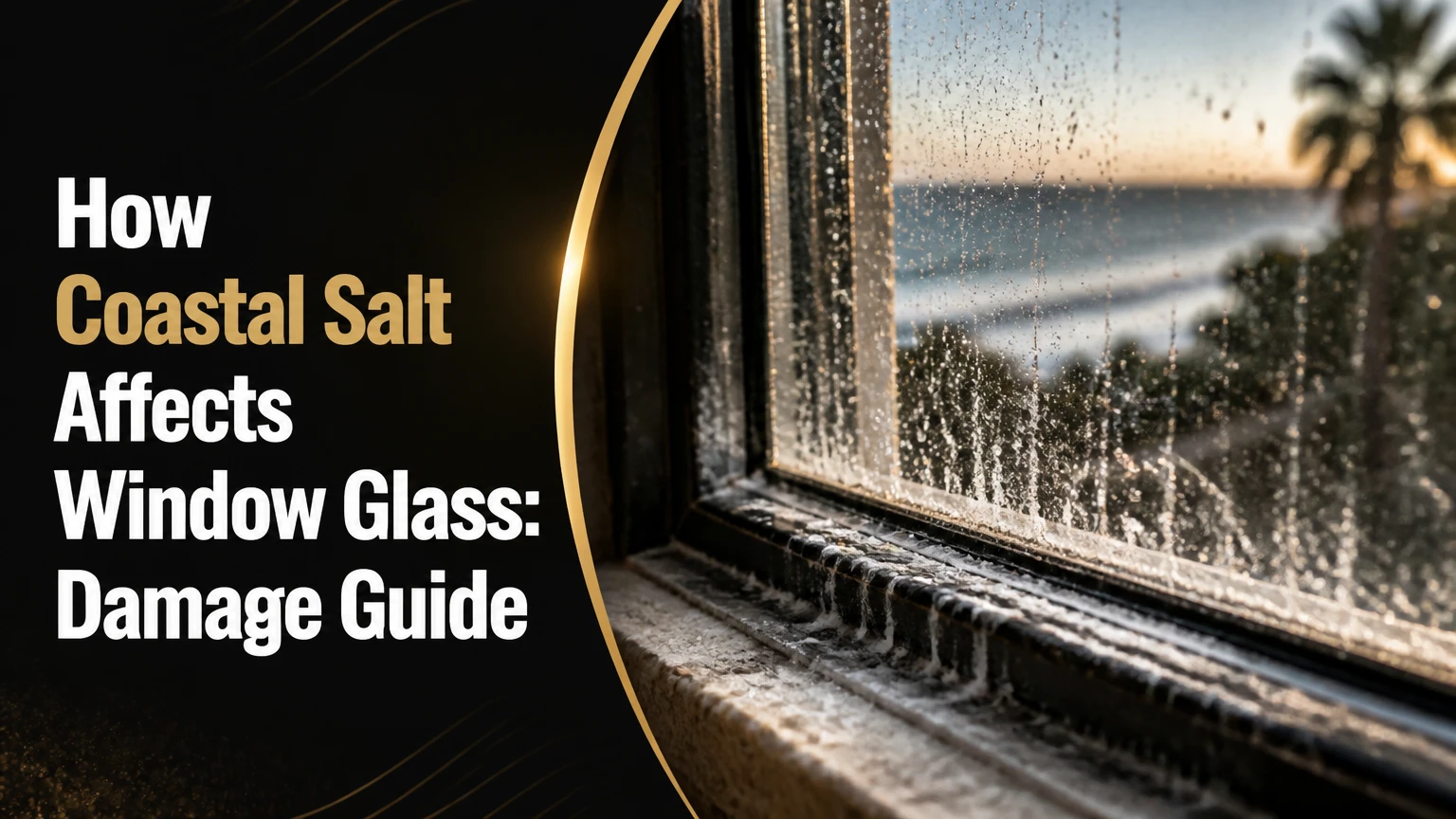
Coastal salt affects window glass mainly by leaving hygroscopic salt and mineral deposits that retain moisture against the pane, while salt-laden water corrodes frames, hardware, coatings, and insulated glass unit seals. The glass surface can become spotted or etched, but many cloudy windows are actually suffering from removable scale or moisture trapped between panes.
Key Facts at a Glance
- Sodium chloride does not rapidly dissolve the silica network in ordinary architectural glass under normal outdoor exposure.
- Salt residue attracts moisture, creating repeated wet-dry cycles that concentrate alkaline and mineral contaminants on the surface.
- Aluminum frames, steel hardware, spacer bars, sealants, and drainage channels usually fail before the glass substrate itself.
- Cloudiness between insulated glass panes indicates seal failure, not a surface salt film, and cleaning the exterior will not remove it.
- Freshwater rinsing every 2-4 weeks is a typical coastal maintenance interval, but wind exposure and site distance can require weekly cleaning.
- Hurricane and coastal windows need project-specific design-pressure and impact ratings, not a generic wind-speed label.
What Does Coastal Salt Do to Window Glass?
Coastal salt creates three distinct problems: surface deposits, permanent surface alteration, and failure of the surrounding window assembly. Salt spray dries into chloride residue, attracts atmospheric moisture, and holds a conductive film against glass, aluminum, fasteners, seals, and drainage channels.
The glass pane is usually the most chemically stable part of the window. Soda-lime glass contains silica, sodium oxide, calcium oxide, and other modifiers; prolonged contact with alkaline moisture can leach mobile ions from the surface and roughen the silica-rich layer. The damage develops faster when salt combines with hard-water minerals, dust, alkaline construction residue, bird deposits, or runoff from corroding metal.
Coastal exposure is uneven. A building 50 meters from breaking surf can receive far more spray than one 200 meters inland behind a windbreak, while a high-rise facade may collect salt on upper windward elevations despite its distance from the beach.
How Does the Damage Mechanism Work?
Coastal window deterioration follows a repeating deposition, hydration, concentration, and drying cycle rather than a single reaction. Wind deposits salt particles and droplets; humid air dissolves them; evaporation then leaves a more concentrated residue that can attack vulnerable surfaces.
- Deposition: Sea spray and airborne particles settle on the exterior pane and frame.
- Hydration: Relative humidity or rain dissolves sodium chloride into a thin conductive film.
- Concentration: Sun and wind evaporate water, increasing the concentration of salts and minerals.
- Reaction: Moisture extracts mobile ions from susceptible glass surfaces and corrodes nearby metals.
- Drying: Carbonate and mineral deposits remain as spots, scale, or crust.
- Repetition: New wet-dry cycles enlarge deposits and expose fresh surface area.
The often-repeated claim that coastal salt directly “eats” the silica network is too simple. Chloride ions primarily accelerate corrosion in metals and help maintain a wet electrolyte film; glass attack depends on pH, temperature, exposure duration, glass composition, surface defects, and contaminants.
Is a White Salt Film the Same as Glass Etching?
A white film is not automatically etched glass. Removable salt or mineral scale sits on top of the pane, while etching changes the glass surface and remains visible after proper cleaning.
Salt deposits usually appear as granular spots, streaks, or a haze that changes when the pane is wetted. Hard-water scale may contain calcium carbonate or other minerals, particularly where irrigation, rainwater, or cleaning water dries on the window. Corrosion runoff can add iron, aluminum, or zinc compounds with brown, gray, or white coloration.
Etching appears as a fixed translucent haze, rainbow-like patch, or irregular matte area. The appearance remains after the glass is wet and after a qualified cleaner removes surface contamination. A scratch, coating defect, or chemical stain can resemble etching, so diagnosis should precede polishing or replacement.
Which Window Components Does Salt Damage First?
Salt usually damages the window assembly before it visibly damages the central glass area. The most vulnerable parts are exposed fasteners, unprotected aluminum cut edges, sliding tracks, drainage holes, hardware, and IGU perimeter seals.
| Component | Typical coastal failure | Visible symptom | Correct response |
|---|---|---|---|
| Aluminum frame | Pitting, oxidation, coating loss | White powder, craters, peeling finish | Clean, document, refinish or replace affected parts |
| Stainless hardware | Tea staining, crevice corrosion | Brown streaks, stiff locks, seized screws | Rinse, dry, replace unsuitable fasteners |
| Vinyl frame | Dirt retention, seal and hardware failure | Discoloration, leaks, difficult operation | Clean drainage paths, inspect gaskets and hardware |
| Wood frame | Coating breakdown, swelling, fungal decay | Soft sill, peeling paint, dark joints | Recoat dry wood, repair rot, improve drainage |
| IGU edge seal | Moisture ingress and seal failure | Fog or droplets between panes | Replace the sealed glass unit |
| Sliding track | Sand and salt accumulation | Blocked weeps, standing water, roller wear | Vacuum, rinse, clear drainage openings |
Aluminum corrosion can produce runoff that stains adjacent glass. Pitting also creates cavities where salt remains trapped, so wiping the visible surface without flushing the frame rarely solves the underlying problem.
Vinyl does not rust, but a vinyl window is not corrosion-proof. Stainless rollers, screws, locks, spacers, reinforcement, gaskets, and sealants still face marine exposure. Vinyl frames also retain sand and salt in tracks when drainage is poorly maintained.
Why Do Insulated Glass Units Fog Between the Panes?
Fogging between panes means the IGU perimeter seal has lost gas or moisture resistance. Salt can accelerate the failure of exposed metal spacers, sealant interfaces, and drainage conditions, but exterior cleaning cannot remove condensation inside a sealed unit.
Typical symptoms include:
- Persistent haze between panes in changing weather
- Droplets or streaks inside the cavity
- A visible perimeter stain near the spacer
- Reduced insulation and colder interior glass
- Failed warm-edge or metal spacer seals
A failed IGU may still be structurally safe, but its insulating performance and appearance have declined. Replacement usually involves ordering a new sealed unit with matching thickness, dimensions, coating orientation, safety glazing, and local performance requirements.
How Coastal Salt Affects Low-E Coatings and Laminates
Low-E coatings improve solar and thermal performance, but coating durability depends on where the coating is installed. A soft-coat silver-based Low-E film is normally protected inside a sealed IGU, while a hard-coat product is designed for more exposed conditions.
Architectural IGUs commonly number surfaces from outside to inside. In a standard two-pane unit, Surface 1 faces outdoors, Surface 2 faces the cavity, Surface 3 faces the cavity, and Surface 4 faces indoors. A soft coat on Surface 2 or Surface 3 is protected from direct salt spray; an exposed soft coat on Surface 1 is an inappropriate configuration unless the manufacturer specifically approves it.
| Glazing configuration | Salt exposure at coating | Typical thermal role | Main coastal limitation |
|---|---|---|---|
| Clear single pane | 100% exterior surface exposure | U-factor about 5.7-6.0 W/m²K | Poor insulation and high surface contamination |
| Double IGU with soft Low-E | Coating protected on Surface 2 or 3 | U-factor about 1.1-1.8 W/m²K | Seal failure can reduce long-term performance |
| Double IGU with hard-coat Low-E | Coating durability depends on product | U-factor about 1.4-2.0 W/m²K | Lower coating selectivity than many soft coats |
| Laminated outer lite plus IGU | Interlayer protected inside glass | Solar, acoustic, and impact benefits | Edge protection and compatible sealants matter |
| Exterior hydrophobic coating | Direct salt exposure at coating | Easier rinsing, not major insulation gain | Reapplication and surface preparation requirements |
Laminated glass contains an interlayer, commonly PVB or an ionoplast such as SentryGlas, between bonded lites. Lamination improves retention after breakage, sound control, and some impact performance; it does not stop salt from reaching the exterior surface or guarantee an intact IGU edge seal.
PVB and ionoplast interlayers should not be ranked by a single marine rule. Ionoplast products generally provide higher stiffness and strong moisture resistance in approved designs, while PVB offers broad availability and established fabrication practice. The selected product must match the manufacturer’s tested assembly, edge exposure, structural load, and local code requirements.
Which Materials Hold Up Best Near the Ocean?
The best coastal window is a tested assembly with protected glazing edges, corrosion-resistant hardware, sound drainage, and a finish rated for the exposure. No single material eliminates maintenance because every exterior surface collects salt.
| Material or feature | Typical advantage | Typical weakness | Specification question |
|---|---|---|---|
| Anodized aluminum | Stable finish when correctly prepared | Cut edges and dissimilar metals can corrode | Is the anodizing suitable for marine exposure? |
| Powder-coated aluminum | Wide color range and barrier finish | Scratches and cut edges expose substrate | What pretreatment and coating warranty apply? |
| uPVC or vinyl | Nonmetallic frame does not rust | Hardware and reinforcement still corrode | Are rollers, screws, and locks marine-compatible? |
| 316 stainless steel | Better chloride resistance than 304 | Crevices and deposits can still stain or corrode | Are fasteners isolated from dissimilar metals? |
| Wood with exterior coating | Repairable and thermally effective | Requires regular coating maintenance | How are end grain, sill joints, and drainage protected? |
“Marine-grade” is not a universal performance standard. Ask for the tested product configuration, finish system, fastener alloy, drainage design, warranty exclusions, and required cleaning interval instead of accepting the label alone.
What Wind and Impact Rating Should a Coastal Window Have?
Coastal windows should be selected by design pressure, water penetration, air leakage, and impact requirements established for the building location. A wind speed such as 160 km/h cannot replace project-specific calculations because exposure category, building height, opening size, terrain, and code jurisdiction change the required pressure.
In the United States, ASTM E1886 and ASTM E1996 are commonly associated with impact-resistant exterior windows, doors, and glazed systems. A product may also require certification under local building codes, Florida Building Code requirements, Miami-Dade approvals, or other regional programs.
| Project condition | Primary requirement | Common evidence | Selection consequence |
|---|---|---|---|
| Inland coastal town | Wind and water rating | Manufacturer design-pressure label | Standard certified window may suffice |
| Direct ocean frontage | Marine finish and drainage | Finish, hardware, and seal specifications | Upgrade exposed components |
| Hurricane-prone region | Impact and cyclic-pressure testing | ASTM E1886/E1996 or local approval | Laminated impact glazing may be required |
| High-rise windward facade | Calculated design pressure | Structural engineer’s pressure schedule | Larger mullions or reduced lite size may result |
| Storm-surge or flood zone | Opening protection and water control | Local code and flood requirements | Window choice may be part of a larger envelope system |
How Can You Clean Salt From Window Glass Safely?
Freshwater rinsing removes coastal salt before evaporation creates a concentrated residue. A safe routine uses low-pressure clean water, a pH-neutral cleaner, a soft applicator, and a clean squeegee, while avoiding dry abrasion and unapproved razor blades.
Step 1: Rinse the Entire Exterior
Use clean tap water or purified water when hard-water spotting is severe. Start at the top and rinse the glass, frame, sill, tracks, screens, and nearby hardware so loosened salt does not dry on lower surfaces.
Do not use a pressure washer close to IGU edges, gaskets, drainage slots, or sealant joints. High pressure can force water into areas that were designed for incidental rain, not concentrated spray.
Step 2: Wash With a Neutral Cleaner
Apply a manufacturer-approved glass cleaner or a dilute neutral detergent with a soft microfiber sleeve or natural-fiber brush. Work in shade when possible, because rapid drying leaves new mineral deposits on warm glass.
A practical small-window mixture is approximately 4-8 milliliters of neutral detergent per liter of water, unless the product label specifies another dilution. Rinse completely after washing.
Step 3: Remove Residue Without Dry Scraping
Use a plastic scraper for softened deposits, keeping the surface flooded with water. Avoid steel wool, abrasive pads, dry blades, pumice, and household scouring powders because trapped sand can create permanent scratches.
Acidic descalers may dissolve carbonate scale, but vinegar is not a universal salt remover. Sodium chloride dissolves readily in water, while calcium carbonate scale may require a compatible acidic product. Never mix acids with bleach or ammonia, and protect stone, metal finishes, sealants, and vegetation.
Step 4: Dry and Inspect the Result
Squeegee from top to bottom, then inspect the pane from several angles in reflected light. A clean pane should show whether the haze was a deposit, scratch, coating defect, or altered glass surface.
You will know the cleaning worked when the cloudy area disappears while wet and remains clear after drying. If the haze persists, stop increasing chemical strength and arrange a glass inspection.
Can Cloudy Coastal Glass Be Restored?
Cloudy coastal glass can be restored when the defect is surface contamination, but a failed IGU seal or deep etching normally requires replacement. The location of the haze determines the remedy more reliably than its color.
| Appearance and location | Likely cause | Restoration outlook | Next action |
|---|---|---|---|
| White spots on exterior | Salt or hard-water scale | Usually removable | Rinse, wash, test compatible descaler |
| Haze disappears when wet | Surface deposit or light etch | Often improved | Professional inspection if cleaning fails |
| Haze remains between panes | IGU seal failure | Cleaning cannot fix it | Replace sealed glass unit |
| Rainbow film near edge | Coating or seal-related defect | Depends on warranty | Photograph and contact manufacturer |
| Fine lines visible only in light | Scratches or abrasion | Limited | Replace or professionally polish |
| Brown streak below frame | Metal corrosion runoff | Glass may clean; source remains | Repair frame and drainage first |
Professional glass polishing with cerium oxide can improve some light surface marks, but polishing removes material and can create optical distortion if the operator works unevenly. It is unsuitable for deep scratches, large-area severe etching, coated surfaces, or glass with a safety-critical defect unless the glass specialist approves the procedure.
A razor-blade “shave test” is not a safe universal diagnostic. Blades can scratch coated glass, laminated surfaces, soft films, and panes contaminated with sand. Certified glazing technicians use controlled inspection methods and confirm the glass composition before mechanical treatment.
How Often Should Coastal Windows Be Maintained?
A typical coastal home needs a freshwater exterior rinse every 2-4 weeks during windy or dry seasons, with more frequent cleaning for direct surf exposure. Hardware, drainage, seals, and frame finishes need separate inspections because clean glass can conceal an advancing assembly failure.
| Exposure situation | Glass rinse interval | Frame and hardware inspection | Typical annual labor pattern |
|---|---|---|---|
| 1-5 km inland with low spray | Every 2-3 months | Every 6 months | 4-6 service visits |
| 500 m-1 km from surf | Every 4-8 weeks | Every 3-6 months | 6-10 service visits |
| 100-500 m from surf | Every 2-4 weeks | Every 2-3 months | 10-16 service visits |
| Under 100 m from breaking surf | Weekly to every 2 weeks | Monthly to quarterly | 12-24 service visits |
Vacuum sand from tracks before rinsing. Confirm that weep holes drain freely, lubricate moving hardware only with products approved for that mechanism, and avoid petroleum products on EPDM gaskets or silicone-compatible components unless the manufacturer permits them.
What Are the Most Common Coastal Maintenance Mistakes?
The most expensive mistake is treating coastal windows as a glass-cleaning problem. Salt-related failures often begin in concealed edges, blocked tracks, incompatible fasteners, or damaged finishes.
- Dry wiping salt: Crystals and sand drag across the pane, creating fine scratches.
- Using a pressure washer: Water reaches seals and drainage cavities at excessive pressure.
- Clearing only the glass: Corroded frame cavities continue producing runoff and deposits.
- Using strong acid repeatedly: Acid can attack metal finishes, stone sills, sealants, and nearby masonry.
- Applying lubricant everywhere: Incorrect lubricant can swell gaskets or attract abrasive sand.
- Assuming vinyl needs no inspection: Vinyl avoids frame rust, but hardware, reinforcement, and IGU seals still age.
- Ignoring the warranty: Unauthorized polishing, film application, or chemical cleaning can void glass and finish coverage.
One practitioner rule is especially useful: if the residue returns in the same vertical line after cleaning, inspect the component above it. Repeated staining often identifies frame corrosion, failed sealant, or blocked drainage rather than unusually dirty glass.
How Much Do Coastal Window Upgrades Cost?
Typical planning costs range from roughly $10-$25 per square foot for basic replacement glazing and $25-$75 or more per square foot for impact-rated, laminated, custom, or high-access coastal assemblies. Labor, access equipment, disposal, framing repairs, local approvals, and opening size can double the project total.
| Work scope | Typical planning range | Typical duration | Cost driver |
|---|---|---|---|
| Exterior residential cleaning | $150-$500 per visit | 2-5 hours | Height, pane count, mineral scale |
| Single IGU replacement | $300-$1,200 per opening | 1-3 hours | Size, Low-E specification, access |
| Standard coastal replacement window | $800-$2,500 per opening | 1-4 hours | Frame material and installation |
| Impact-rated laminated window | $1,500-$5,000 per opening | 2-6 hours | Approval, laminate, structural pressure |
| High-rise facade service | $1,000-$6,000 per opening | 1-2 days scheduled access | Lift, rope access, traffic control |
These are typical North American planning ranges, not quotations. A marine coating does not compensate for a poor installation, and a premium pane cannot prevent corrosion caused by blocked drainage or incompatible fasteners.
Which Coastal Window Setup Should You Choose?
Choose the complete assembly according to exposure, wind code, maintenance access, and the failure already present. For a new coastal home, a sealed Low-E IGU with a protected coating, corrosion-resistant hardware, sound drainage, and laminated or impact-rated outer glazing is usually more defensible than upgrading glass alone.
- For direct surf exposure: prioritize drainage, 316 stainless or approved corrosion-resistant hardware, protected Low-E, durable frame pretreatment, and short cleaning intervals.
- For hurricane zones: verify impact and cyclic-pressure approvals, design pressure, water resistance, and installation details.
- For moderate coastal exposure: a certified double IGU with suitable aluminum, vinyl, or wood framing may be adequate when maintained.
- For an existing fogged window: replace the failed IGU rather than polishing the exterior.
- For surface etching: obtain a glass specialist’s assessment before polishing or replacing the pane.
The specification should identify glazing thickness, laminate type, coating surface, spacer, sealant, frame finish, fastener material, drainage method, performance rating, and warranty. “Salt-resistant glass” without those details is not a complete specification.
What Should You Ask a Window Contractor?
Ask the contractor to identify the failed component and provide product evidence before approving an upgrade. A useful coastal-window quotation should answer these questions:
- Is the haze on the exterior, interior, or between the panes?
- What caused the deposit, and was the frame inspected for corrosion runoff?
- Which Low-E surface carries the coating?
- What are the glass thicknesses, interlayer, spacer, and edge-seal materials?
- What design pressure applies to this opening?
- Is impact glazing required by the local authority?
- What finish pretreatment and coating system protect the frame?
- Which fastener alloy and lubricant are specified?
- How are weep holes and sill drainage configured?
- Which cleaning chemicals and intervals preserve the warranty?
A contractor who offers only thicker glass but cannot discuss edge seals, drainage, or design pressure has not evaluated the whole window system.
FAQ
Does salt air permanently damage ordinary glass?
Salt air can permanently damage ordinary glass after repeated wet-dry exposure, especially when alkaline moisture, hard-water minerals, dust, and corrosion products remain on the pane. Most early white spotting is removable. Permanent etching is more likely when deposits bake onto sunlit glass and are repeatedly scrubbed with abrasive particles.
Are coastal windows worth the extra cost?
Coastal upgrades are worth considering when direct surf, hurricane exposure, difficult access, or repeated corrosion has created high maintenance costs. The value comes from the tested assembly, drainage, hardware, finish, and impact performance, not from a “marine-grade” label or a single premium glass type.
Is vinegar safe for removing salt stains from glass?
Diluted vinegar can help dissolve some carbonate mineral scale, but vinegar is not needed for ordinary sodium chloride residue and may damage adjacent stone, metal finishes, or sealants if used carelessly. Test a hidden area, keep the solution off vulnerable materials, rinse thoroughly, and follow the glass manufacturer’s instructions.
Can window film protect glass from sea salt?
Interior window film does not protect the exterior pane, frame, hardware, or IGU edge seal from salt spray. Exterior films and coatings require product-specific approval because adhesion, cleaning, thermal stress, and warranty conditions vary. A film cannot repair etched glass or a failed insulated-unit seal.
Do storms increase salt damage?
Storms can increase salt deposition by carrying spray farther inland and forcing contaminated water into tracks, joints, and hardware cavities. Rinse windows and inspect drainage after severe weather, but wait for safe conditions and never use a ladder or exterior cleaning equipment during high winds.
How long should coastal windows last?
A properly selected and installed window can last decades, but service life varies by material, exposure, maintenance, installation, and storm history. IGU seals, hardware, coatings, and gaskets may require service sooner than the frame. A realistic estimate requires the manufacturer’s warranty and the local exposure conditions.
The Bottom Line
How coastal salt affects window glass depends on both the pane and the surrounding window system. Salt retains moisture, concentrates contaminants, corrodes frames and hardware, accelerates IGU edge-seal problems, and can eventually contribute to permanent glass etching. Rinse exposed windows every 2-4 weeks, keep tracks and weep holes clear, diagnose haze by location, and specify protected Low-E coatings, tested wind or impact performance, compatible materials, and maintainable drainage for new coastal installations.