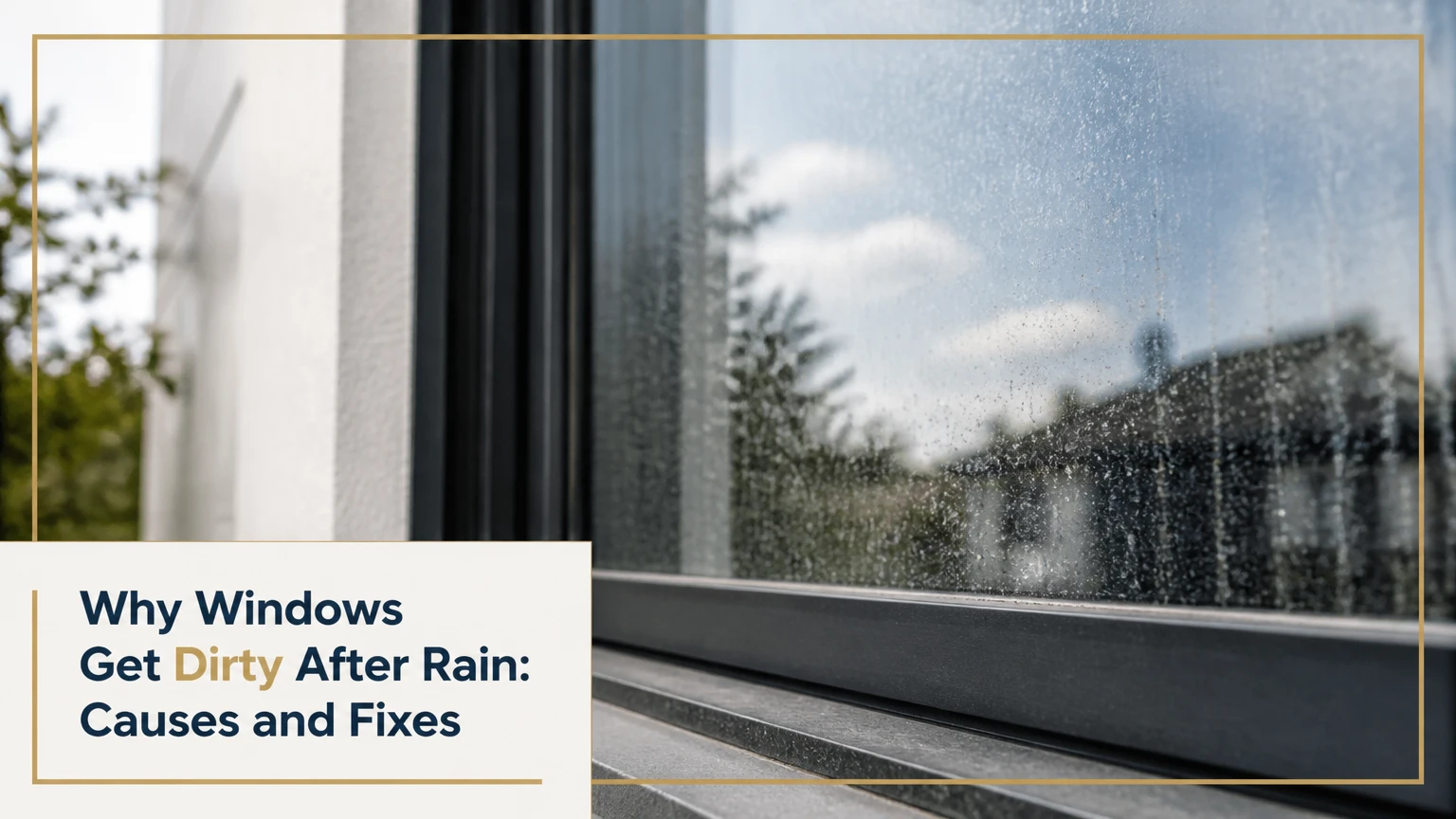
Windows get dirty after rain because raindrops collect airborne dust, pollen, smoke, salt, and pollution while falling, then spread those particles across glass and existing surface soil. When the water evaporates, concentrated contaminants and dissolved minerals remain as spots, streaks, or a dull film. Rainwater is relatively clean, but it is not contaminant-free.
Key Facts at a Glance
- Rain spotting usually comes from contaminants carried by rainwater, not from water molecules themselves.
- Dirty screens, frames, roof edges, and masonry can add concentrated mud or mineral runoff to exterior glass.
- White chalky deposits often contain calcium carbonate or other mineral residue from hard water and building materials.
- A low-total-dissolved-solids rinse reduces new spots, but technique and existing etching still determine the final appearance.
- Rain does not remove old glass residue reliably because evaporation leaves contaminants behind.
- Acid cleaners can damage stone, metal frames, seals, tinted films, and some coated glass.
Why Do Windows Get Dirty After Rain?
Rain makes windows dirty through wet deposition, surface mixing, and evaporation. Falling droplets collide with airborne particles, strike dust already on the pane, move contaminants into larger beads, and leave those contaminants concentrated when the water dries.
The process begins above the house. Dust from roads, soil, construction, agriculture, and unpaved surfaces enters the air. Vehicle exhaust and industrial emissions add soot and fine particulate matter. Trees contribute pollen, plant fragments, and sticky organic material. In coastal locations, wind carries sodium chloride and other sea-salt particles inland.
The U.S. Environmental Protection Agency describes acid rain as “a broad term referring to a mixture of wet and dry deposited material from the atmosphere.” That distinction matters here: rain can deposit airborne material directly, while dry particles can settle on glass between storms and become mobile during the next rainfall.
| Stage | What happens on the glass | Typical visible result |
|---|---|---|
| Atmospheric collection | Droplets capture dust, pollen, soot, or salt | Gray or tan droplets |
| Initial impact | Rain mixes with loose soil and organic debris | Muddy splash marks |
| Runoff | Water travels from frames, roofs, siding, or masonry | Vertical streaks |
| Evaporation | Water volume decreases while residue remains | Rings, spots, or haze |
| Rewetting | A later storm softens old residue | Larger smears and uneven film |
The first rain after a dry period often produces the worst appearance because a long interval allows more loose material to accumulate. Light drizzle can also spot heavily because small droplets remain on the glass without enough flowing water to carry residue away.
What Is Atmospheric Scrubbing?
Atmospheric scrubbing is the removal of suspended particles from air by precipitation. Raindrops capture some airborne material during descent, although the amount varies with storm duration, air quality, wind, particle size, and the height of the cloud base.
The first portion of rainfall can carry a relatively high contaminant load after dry weather. A strong, sustained storm may then rinse exterior surfaces more effectively than a brief shower. The result depends on where the water goes after impact. A pane beneath a clean overhang may receive cleaner rain than a pane below dusty siding or a corroding metal gutter.
Is Rainwater Clean Enough to Wash Windows?
Rainwater is usually cleaner than muddy runoff or untreated surface water, but rainwater alone is not a reliable window-cleaning solution. Atmospheric particles, roof residue, bird waste, pollen, and dissolved material can remain after evaporation, especially on horizontal or poorly draining glass.
Rainwater chemistry also changes by location and weather. Urban air, wildfire smoke, agricultural dust, road salt, and marine aerosols create different residue mixtures. The common claim that clean rain has a total dissolved solids level of 10-50 parts per million is a useful rough example, not a universal specification. TDS varies with collection method, region, storm history, and contamination.
TDS measures the total concentration of dissolved material. It does not identify whether the residue contains calcium, silica, sodium chloride, organic acids, or cleaning-product surfactants. Two water samples with similar TDS can leave different-looking deposits.
The U.S. Geological Survey classifies water above 120 milligrams per liter as hard and above 180 milligrams per liter as very hard, using calcium carbonate equivalents. Rainwater is often softer than local tap water, but rain falling through polluted air or flowing across mineral-rich building surfaces can still create visible spotting.
Why Does Spotting Appear After the Water Dries?
Water spots appear because evaporation removes liquid water while leaving nonvolatile particles, dissolved minerals, and residues on the pane. A droplet dries from its edge and can move contaminants toward the perimeter, producing a ring or darker outline.
A glass surface that looks clean before rain may still contain surfactant, wax, detergent, silicone, or fine dust. Rain reactivates that residue and spreads it across the pane. The next drying cycle turns a thin invisible layer into visible ghosting.
Sunlight accelerates evaporation. Wind changes droplet shape and can move soil toward seals and corners. High humidity slows drying, which can produce fewer sharp rings but longer-lasting films. A typical exterior droplet may dry in 15-45 minutes in sun, wind, and moderate humidity, while shaded glass on a humid day can remain wet for several hours.
Surface geometry controls the pattern. Vertical glass creates downward tracks, while projecting ledges create horizontal edges. Small chips, scratches, silicone smears, and rough mineral deposits interrupt water flow and become nuclei for larger spots.
Which Contaminants Make Windows Look Dirty?
The visible residue depends on the contaminant source. Identifying the pattern is more useful than treating every mark as ordinary dirt.
| Appearance | Likely source | Diagnostic clue | Appropriate first response |
|---|---|---|---|
| Tan or gray speckles | Soil, road dust, airborne soot | Worse after dry, windy periods | Neutral detergent wash |
| Green or yellow film | Pollen, algae, plant residue | Peaks during spring or wet shade | Detergent wash and screen cleaning |
| White chalky tracks | Calcium carbonate or masonry dust | Follows roof, brick, concrete, or stucco | Identify source before acid treatment |
| Clear circular rings | Mineral water spots | Rings remain after normal washing | Purified rinse and spot treatment |
| Sticky amber smears | Tree sap or organic residue | Located beneath trees or branches | Solvent-compatible glass cleaner |
| Gray oily haze | Traffic pollution or silicone residue | Feels slick or resists detergent | Glass-safe degreaser and repeated rinse |
| Cloudy salt film | Sea spray or deicing salt | Common near coasts or salted roads | Frequent freshwater rinse |
Bird droppings, insect remains, and tree sap create a separate problem because rain softens and redistributes them rather than dissolving them completely. Organic residue can also bind dust to the glass, so a pane may look dirtier after a storm even when the rain removed some loose particles.
Do Dirty Screens Make Rain Spots Worse?
Dirty screens can make rain spots worse when wind-driven rain passes through the mesh and splashes concentrated dust onto the glass. Screen fibers collect pollen, soot, insect debris, and soil, then release that material as muddy droplets during a storm.
A screen does not need removal during every rainy period. Clean the mesh first with a soft brush or low-pressure water, and remove it temporarily when heavy wind-driven rain repeatedly creates splatter. Keep windows closed if screens are removed, because an open unscreened window creates an insect and fall hazard.
Frames deserve the same attention. Water flowing from a dirty top frame can create vertical tracks even when the pane itself was recently cleaned.
How Should You Clean Windows After Rain?
Clean rain-spotted windows from the top down on a cool, shaded surface, using a clean applicator, a small amount of detergent, a squeegee, and the purest practical rinse water. The most important factor is removing residue before the glass dries again.
Before You Start
| Requirement | Typical amount or range |
|---|---|
| Time for 10 standard panes | 45-90 minutes |
| Difficulty | Low for ground-floor glass; moderate for ladders |
| Cost | $10-$35 for basic household supplies |
| Water | 2-4 gallons for washing and rinsing |
| Detergent | 1-2 teaspoons in 2 gallons of water |
| Tools | Microfiber sleeve, squeegee, bucket, soft brush, towels |
| Weather | Shade, low wind, glass temperature below about 90°F |
Step 1: Remove Loose Soil
Brush or rinse loose grit from frames, sills, screens, and the glass perimeter before wiping. Grit left on the pane can scratch glass during the washing pass.
You will know the step worked when no visible sand or dry mud remains around the lower corners. The common mistake is starting with a dry towel, which drags abrasive particles across the surface.
Step 2: Wash Frames and Screens
Clean the top frame, side channels, sill, and screen before cleaning the pane. Use a soft brush for mesh and a diluted neutral detergent for painted or vinyl frames.
You will know the step worked when a clean white towel remains free of brown or green transfer. Avoid forcing water into weep holes, locks, or insulated-glass seals.
Step 3: Wash the Glass
Apply the detergent solution with overlapping strokes, working from the top edge downward. Use enough liquid to suspend soil, but do not flood interior surfaces or untreated wood.
You will know the step worked when the glass has an even wet film without isolated dry patches. The common mistake is adding excessive soap, because surfactant residue attracts dust and creates ghosting after the next storm.
Step 4: Squeegee Immediately
Pull the squeegee in straight, overlapping passes, wiping the blade after each stroke. Detail the edges with a clean lint-free towel.
You will know it worked when no standing beads remain at the lower edge. Do not let detergent water dry on the pane, particularly in direct sunlight.
Step 5: Rinse With Low-Mineral Water
Use deionized, reverse-osmosis, or distilled water when mineral spotting is persistent. A garden-hose rinse can leave calcium and magnesium behind, particularly in hard-water regions.
You will know the rinse worked when droplets dry without a powdery outline. Low-TDS water cannot remove etched glass or silicone film, so an unchanged haze requires diagnosis rather than more rinsing.
Which Rinse Water Prevents New Spots?
Deionized or reverse-osmosis water provides the best routine defense against mineral spotting because it contains fewer dissolved ions than ordinary tap water. Distilled water works for small areas, but it is inefficient for a whole house because store-bought quantities are limited and expensive.
| Rinse method | Typical dissolved-solids level | Best use | Main limitation |
|---|---|---|---|
| Hard tap water | 120-300+ ppm | Initial wash where supply is available | Leaves mineral residue |
| Softened tap water | 50-200 ppm | Washing, not necessarily final rinse | Sodium remains dissolved |
| Reverse-osmosis water | 5-50 ppm | Exterior maintenance and rinse systems | Requires membrane and wastewater |
| Deionized water | Often below 10 ppm | Spot-free final rinse | Resin needs replacement |
| Distilled water | Usually below 5 ppm | Small indoor panes | High cost for large areas |
A final rinse below 10 ppm often dries with minimal spotting, but the threshold is not a guarantee. Silica, detergent residue, and contamination from the squeegee can remain even when the water itself is highly purified.
Which Coating Helps Most?
Hydrophilic self-cleaning glass is usually better for passive rain rinsing, while hydrophobic treatments are better for reducing droplet adhesion. Neither coating eliminates the need for periodic cleaning, and both perform poorly when roof runoff, bird waste, or heavy dust continuously feeds the glass.
| Treatment | Water behavior | Typical service life | Typical cost | Main limitation |
|---|---|---|---|---|
| Hydrophobic spray | Beads water above the surface | 1-3 months | $5-$15 per bottle | Can create uneven beading |
| Professional hydrophobic coating | Repels droplets and some soil | 1-3 years | $150-$500 per house | Requires careful preparation |
| Hydrophilic factory glass | Forms a flatter water sheet | 10-20 years with glass unit | Included in window price | Must be specified at purchase |
| No coating, purified rinse | Removes mineral load at cleaning | Until next contamination cycle | $0.05-$0.30 per gallon typical | Requires equipment or supply |
Hydrophobic products are not appropriate for every pane. Poor preparation leaves patchy islands, and some sprays are intended for automotive glass rather than architectural glazing. Follow the manufacturer’s compatibility instructions for low-emissivity coatings, tinted film, laminated glass, and sealants.
Hydrophilic self-cleaning glass also has limits. Gentle mist may not create enough flow to carry soil away, and shaded glass dries differently from sunlit glass. Coatings reduce maintenance; they do not convert a dirty runoff path into a clean water source.
Why Are Some Streaks White and Chalky?
White chalky streaks usually indicate mineral residue from hard water, concrete, mortar, stucco, brick, limestone, or deteriorating sealant. The streak pattern often reveals the source: deposits below a masonry ledge point to architectural runoff rather than ordinary atmospheric dust.
Test the least visible area first. A mild solution of diluted white vinegar can dissolve some carbonate deposits on uncoated glass, but vinegar must not contact marble, limestone, cement-based surfaces, sensitive metal finishes, or some natural-stone sills. Rinse the surrounding material promptly.
A calcium-lime remover may work faster, but the label must confirm compatibility with glass, frames, seals, and coatings. Never mix acid products with chlorine bleach or other cleaners.
Some deposits are not removable residue. Mineral-rich water can chemically etch the glass surface after repeated drying, especially under strong sun. Etching appears as uniform cloudy patches or marks that remain after careful cleaning. Polishing by a trained glass-restoration professional may improve mild damage; severe damage can require pane replacement.
Can Rain Spots Become Permanent?
Rain spots become effectively permanent when dissolved minerals etch the glass, when silica bonds to the surface, or when residue damages a coating. Ordinary loose soil and fresh water spots are temporary, but repeated drying cycles can turn a maintenance problem into surface damage.
The best diagnostic sequence is simple:
- Clean a small area with neutral detergent.
- Rinse with low-mineral water.
- Inspect the dry section under reflected light.
- Test a glass-safe mineral remover only on uncoated glass.
- Stop if the mark remains unchanged or the surface becomes uneven.
Do not scrape mineral spots with razor blades at a low angle unless the glass manufacturer permits that method. Tempered glass can retain fabrication debris, and aggressive scraping can create scratches that are more visible than the original spots.
Does Rain Always Make Windows Dirtier?
Rain does not always make windows dirtier. A long, heavy storm after a recently cleaned surface can remove loose dust, while a short first shower after weeks of drought can create severe spotting.
| Situation | Likely rain result | Reason |
|---|---|---|
| Heavy storm, clean roof, low dust | Cleaner glass | High flow carries loose particles away |
| First shower after drought | Dirtier glass | Dry deposition has accumulated |
| Light drizzle in traffic area | Spotty film | Low flow and high particle load |
| Rain below dusty stucco | White or tan streaks | Masonry runoff reaches pane |
| Wind-driven coastal rain | Salt haze | Marine aerosol mixes with droplets |
| Rain through dirty screens | Muddy speckles | Screen soil splashes onto glass |
Rain also behaves differently on old and new windows. New glass with clean seals may shed water evenly, while aged silicone, scratches, and residue create irregular wetting. The visual contrast makes old deposits appear immediately after the next storm.
How Does Coastal Air Change the Problem?
Coastal air adds sea-salt aerosol to rain spotting, producing a translucent white film that can remain after the water disappears. Sodium chloride itself is water-soluble, but salt deposits attract moisture and can accelerate corrosion on nearby hardware, screens, fasteners, and metal frames.
Freshwater rinsing is safer than waiting for the next storm. A typical coastal maintenance schedule is every 1-2 months for exposed glass, with more frequent rinsing beside beaches, prevailing winds, or saltwater pools.
Do not use a strong acid merely because a salt film looks white. Start with clean freshwater and neutral detergent. Acid is for compatible mineral scale, not the default treatment for every pale deposit.
How Often Should You Clean Rain-Exposed Windows?
Most residential exterior windows need cleaning every 3-6 months, but pollen-heavy, coastal, dusty, and industrial locations may need service every 1-2 months. The correct interval is the shortest period that prevents residue from drying repeatedly and bonding to the glass.
| Exposure | Typical cleaning interval | Prevention priority |
|---|---|---|
| Low-dust suburban interior | 6-12 months | Clean frames and screens |
| Tree-heavy property | 2-4 months | Remove pollen and sap |
| Construction or unpaved-road area | 1-3 months | Use purified final rinse |
| Coastal property | 1-2 months | Rinse salt before sun baking |
| Industrial or high-traffic street | 1-3 months | Remove oily particulate film |
| Hard-water sprinkler exposure | 2-6 weeks | Redirect sprinklers immediately |
Sprinklers often cause more severe spotting than rain because irrigation water can contain high concentrations of calcium, magnesium, iron, and silica. If spots appear only on one side of the house, inspect sprinkler arcs before blaming weather.
What Does Prevention Cost?
Prevention ranges from free maintenance changes to several hundred dollars for professional coating or cleaning. The economical choice is usually source control, because redirecting runoff and cleaning screens prevents contamination before a product is applied.
| Prevention option | Typical price | Service interval | Best application |
|---|---|---|---|
| Screen cleaning | $0-$25 DIY | Every 3-6 months | Pollen and muddy splatter |
| DIY glass treatment | $5-$15 | 1-3 months | Small, accessible panes |
| Purified-water rinse | $10-$40 DIY supplies | Monthly to quarterly | Hard-water regions |
| Professional window cleaning | $100-$300 | Every 3-6 months | Whole-house maintenance |
| Professional coating | $150-$500 | 1-3 years | Difficult exterior glass |
| Runoff correction | $50-$500 typical repair | Permanent after repair | Masonry, gutter, or roof paths |
Professional cleaning costs vary with pane count, height, screens, storm windows, access, and local labor rates. A coating cannot compensate for a leaking gutter or a dirty screen, so correct those sources first.
Common Mistakes That Make Rain Spotting Worse
Washing in direct sun
Sunlight can dry detergent solution before the squeegee removes it. Work on the shaded side of the building or clean early and late in the day.
Using too much soap
Excess detergent leaves a surfactant film that captures dust during the next storm. A small amount, often 1-2 teaspoons in 2 gallons of water, is enough for routine soil.
Rinsing with hard tap water
Hard water adds calcium and magnesium to a pane that was otherwise clean. Use purified water for the final rinse when visible mineral spots are recurring.
Cleaning the pane before the frame
Dirty frames release soil onto finished glass. Clean upper frames, screens, tracks, and sills first.
Treating etching as dirt
Repeated scrubbing cannot remove damage below the glass surface. Stop when a careful detergent wash and compatible spot treatment fail.
Applying vinegar to nearby stone
Acid dissolves carbonate stone and cement-based materials. Protect stone sills and test the product before broad application.
The Bottom Line
Windows get dirty after rain because wet deposition loads raindrops with airborne particles, while runoff and existing residue add minerals and organic material to the glass. The most reliable fix is to clean frames and screens first, wash with limited detergent, squeegee before drying, and use low-mineral water for the final rinse. Prevent roof, masonry, sprinkler, and coastal contamination at its source. A coating can reduce maintenance, but it cannot replace sound drainage and periodic cleaning.
Frequently Asked Questions
Is it better to clean windows before or after rain?
Clean windows after the rain has ended and exterior surfaces have stopped shedding runoff. Cleaning immediately before a storm wastes effort if dirty screens, roofs, or masonry will contaminate the pane. Wait until the glass is cool and dry enough to inspect, then remove frameside soil before washing the glass.
Why do only some windows get dirty after rain?
Individual windows receive different amounts of runoff, wind, shade, pollen, and pollution. A pane below a gutter joint, roof edge, balcony, tree branch, or stucco wall can spot heavily while a protected pane remains clear. Compare the streak direction and inspect the surfaces directly above the affected window.
Does rainwater damage window glass?
Rainwater normally does not damage sound architectural glass. Damage risk comes from contaminants that remain after evaporation, repeated mineral deposits, acidic or alkaline runoff, abrasive dust, and corrosion around frames. Coastal salt can damage metal components even when the glass itself remains intact.
Can newspaper prevent rain spots?
Newspaper does not prevent rain spots and can transfer ink, lint, or paper fibers to wet glass. Prevention requires removing the contaminant source, improving drainage, cleaning screens, and reducing mineral content in the final rinse. A clean squeegee and microfiber detailing cloth produce more predictable results.
Should I use a water-repellent product on every window?
Do not apply one product to every window without checking the glass and frame specifications. Automotive rain repellents, architectural coatings, tinted films, low-emissivity surfaces, and factory self-cleaning glass have different compatibility requirements. Use a labeled architectural product and test an inconspicuous section first.