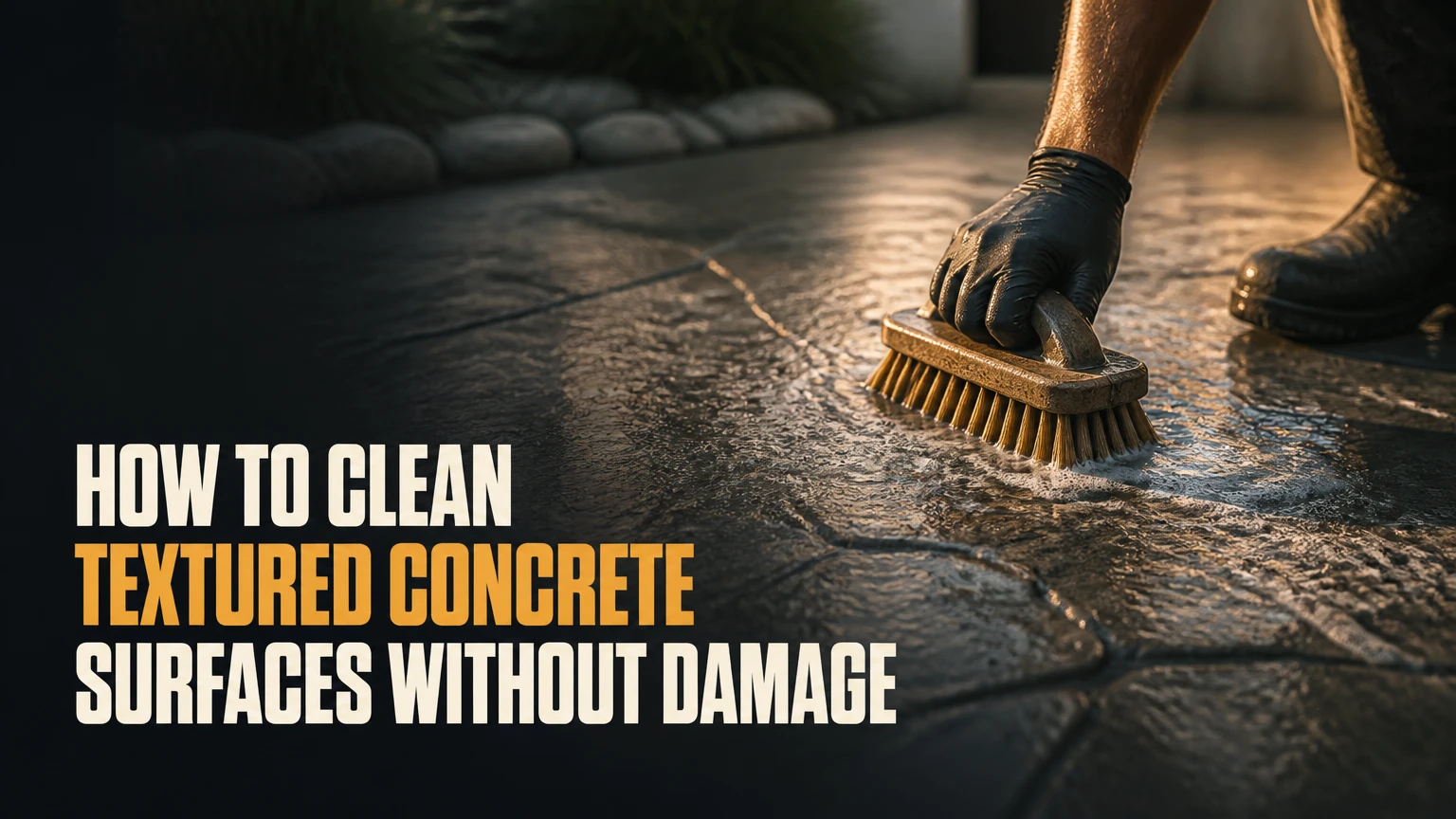
To clean textured concrete surfaces, remove loose debris, pre-wet the slab, apply a compatible cleaner, agitate recessed areas with nylon bristles, and rinse evenly with moderate pressure. Match the chemistry to the stain, test a hidden area first, and avoid acid or high pressure on sealed, stamped, or fragile finishes.
Key facts
A 25-40 degree fan nozzle is safer than a zero-degree tip for most textured concrete.
Typical residential cleaning uses about 1,500-2,500 PSI, not an automatic 3,000 PSI setting.
Concrete cleaner needs a wet 10-15 minute dwell period to work in texture valleys.
Nylon brushes dislodge debris without the rust contamination risk of wire brushes.
Muriatic acid can etch cement paste, strip sealer, damage plants, and create hazardous runoff.
A 500-square-foot patio usually takes 2-4 hours to clean, excluding severe stain treatments.
What Makes Textured Concrete Harder to Clean?
Textured concrete contains raised areas, recessed grooves, pores, or exposed aggregate that hold contaminants below the level reached by an ordinary mop. Stamped concrete can trap release-agent residue and tire soil in pattern joints, while exposed aggregate can retain algae around individual stones.
The cleaning challenge is uneven contact. A pressure stream may clean the high points while missing valleys, and a chemical sprayed onto dry concrete can concentrate in porous areas before the operator has time to spread it. Uniform wetting, controlled agitation, and a complete rinse matter more than maximum pressure.
Common textured finishes include:
| Surface type | Typical profile | Main cleaning risk | Safer starting approach |
|---|---|---|---|
| Stamped concrete | 1/8-1/2-inch pattern joints | Sealer whitening or pattern erosion | Neutral cleaner, nylon brush, 1,500-2,000 PSI |
| Exposed aggregate | 1/8-1/4-inch exposed stones | Dislodged aggregate or surface pitting | 40-degree nozzle, 1,200-1,800 PSI |
| Broom-finished concrete | 1/16-1/8-inch linear grooves | Striped appearance after uneven rinsing | Wide fan spray, 1,500-2,000 PSI |
| Salt-finished concrete | Shallow pits up to 1/8 inch | Trapped dirt and sealer loss | Mild detergent, soft-to-medium nylon brush |
| Rock-salt decorative finish | Irregular shallow voids | Excessive water penetration | Low pressure, slow rinse, no aggressive acid |
A finish that looks like bare concrete may have an acrylic, polyurethane, or penetrating sealer. Sealer changes the cleaning decision because aggressive alkaline products, solvents, heat, and acids can alter gloss or adhesion.
How Does Textured Concrete Cleaning Work?
Textured concrete cleaning combines chemical loosening, mechanical agitation, and controlled rinsing. Detergents and surfactants suspend soil, alkaline degreasers emulsify many petroleum residues, nylon bristles displace debris from recesses, and water carries the loosened slurry away.
Each stage has a different job. Pressure alone is often inefficient against oil because water does not dissolve hydrocarbons; degreaser alone may leave loosened material in the grooves. The best sequence therefore uses the mildest effective chemistry before increasing mechanical force.
Concrete is alkaline and porous, but the surface may also contain a chemically sensitive sealer. Product labels and the sealer manufacturer’s instructions take priority over generic pH recommendations. OSHA’s Hazard Communication Standard requires workplaces using hazardous chemicals to maintain accessible safety information and train workers; homeowners should also read the product Safety Data Sheet before using acids, solvents, or concentrated degreasers.
Which cleaner matches each stain?
Use a neutral or mildly alkaline detergent for ordinary soil, a labeled concrete degreaser for petroleum stains, and a specialty mineral remover for efflorescence. Avoid treating every dark mark with acid because organic stains and oil usually require a different mechanism.
| Contaminant | First-choice treatment | Typical dwell or contact | Avoid first |
|---|---|---|---|
| Mud and dust | Neutral concrete detergent | 5-10 minutes | Dry pressure blasting |
| Algae and mildew | Oxygen-based cleaner or labeled biocide | 10-20 minutes | Mixing bleach with acids |
| Cooking oil and grease | Alkaline concrete degreaser | 10-15 minutes | Solvent on unknown sealer |
| Tire marks | Alkaline cleaner plus nylon agitation | 10-15 minutes | Zero-degree nozzle |
| Rust | Oxalic, citric, or specialty rust remover | Product label, often 2-10 minutes | Chlorine bleach |
| Efflorescence | Dry brushing, then sulfamic or specialty remover | Product label | Strong muriatic acid by default |
| Paint drips | Scraper and compatible paint remover | Label-specific | Grinding decorative texture |
| Chewing gum | Ice, scraping, or gum remover | 5-15 minutes | High pressure at close range |
Bleach may lighten biological growth, but it does not reliably remove oil and can harm vegetation, metals, and some sealers. Never combine bleach with acids or ammonia. A product marketed for concrete should state the compatible surface, dilution, dwell time, and required rinsing procedure.
Before You Start: Tools, Conditions, and Safety
Plan 2-4 hours for a typical 500-square-foot residential area, with another 12-24 hours only if a poultice must dry. Choose a cool, overcast period with no rain expected during the dwell and rinse stages, because hot sun can dry cleaner unevenly and rain can spread contaminated runoff.
Typical homeowner setup
- Pressure washer with adjustable pressure, preferably 1,500-2,500 PSI
- 25-degree or 40-degree fan nozzle
- Nylon deck brush, approximately 12-18 inches wide
- Pump sprayer or low-pressure chemical sprayer
- Concrete-safe detergent or stain-specific cleaner
- Garden hose and clean-water supply
- Plastic sheeting, absorbent pads, and a wet vacuum where runoff requires control
- Chemical-resistant gloves, eye protection, long sleeves, and non-slip footwear
- Painter’s tape or chalk to mark 10-by-10-foot work sections
Disconnect or protect outdoor electrical equipment. Move furniture, vehicles, planters, and grills. Sweep first, because pebbles and grit can become abrasive projectiles under pressure.
Check drainage before applying chemicals. EPA stormwater guidance treats polluted wash water as a potential source of environmental contamination, and local sewer rules may prohibit sending degreaser, sediment, or acid into a storm drain. Block storm-drain inlets, collect slurry where required, and keep concentrated chemicals away from lawns and garden beds.
How to Clean Textured Concrete Surfaces Safely
Clean textured concrete in nine controlled steps: prepare the area, remove dry debris, test the surface, pre-wet, apply cleaner, agitate, maintain dwell, rinse, and inspect after drying. A 500-square-foot patio typically requires 2-4 hours, and consistent solution coverage determines whether the final color looks even.
Step 1: Clear and inspect the area
Remove furniture, plants, vehicles, loose decorations, and removable mats. Inspect for cracks, flaking sealer, exposed aggregate loss, oil saturation, rust, and previous acid damage.
Mark fragile sections and identify where water will flow. Do not pressure wash a slab with delaminating concrete until loose material has been removed and the cause has been assessed.
You’ll know it worked when: the entire cleaning path is accessible and runoff has a controlled destination.
Common mistake: overlooking a neighboring wall or vehicle that can receive dirty splash.
Step 2: Sweep away dry debris
Use a stiff broom or leaf blower to remove leaves, sand, gravel, and surface dust from grooves. Scrape gum and thick mud mechanically before wet cleaning.
Dry removal reduces the amount of sediment entering the rinse water and prevents grit from scratching a glossy sealer during brushing.
You’ll know it worked when: a second sweep produces little loose material from the recesses.
Common mistake: beginning with pressure washing, which turns dry sediment into a contaminated slurry.
Step 3: Perform a hidden test patch
Choose a 1-by-1-foot inconspicuous area and apply the proposed cleaner at the label dilution. Let it dwell for the intended time, brush it, and rinse it with the planned nozzle and pressure.
Wait until the patch dries, because some sealers become temporarily cloudy while wet. Stop if color transfers, gloss changes, aggregate loosens, or the surface becomes visibly rougher.
You’ll know it worked when: the test patch is cleaner without a visible halo, whitening, or texture loss.
Common mistake: judging compatibility immediately after rinsing.
Step 4: Pre-wet the concrete
Wet the surface with clean water from the hose, working from the farthest point toward the drainage area. Saturate the texture without creating standing water.
Pre-wetting reduces rapid absorption into porous concrete and gives the cleaner more working time at the surface. It does not make acid safe, and sealed concrete may require little water penetration.
You’ll know it worked when: the concrete has an evenly darkened wet appearance and no dry islands remain.
Common mistake: allowing the slab to dry before cleaner application.
Step 5: Apply the correct cleaner
Dilute the product exactly as directed. For a typical alkaline degreaser, begin with the manufacturer’s general-purpose dilution rather than the strongest concentration; stronger is not automatically better for decorative concrete.
Apply one 10-by-10-foot section at a time with a pump sprayer. Keep adjacent sections wet enough to prevent a sharp cleaning boundary, but do not flood the slab.
You’ll know it worked when: the cleaner reaches both raised surfaces and recessed joints without pooling heavily.
Common mistake: applying a concentrated chemical to dry concrete, which can create pale or dark spotting.
Step 6: Agitate recessed areas
Scrub with a medium or stiff nylon deck brush, using overlapping strokes across the texture and then along pattern joints. A rotary floor machine with a nylon brush can improve consistency on large commercial areas, but only after a test patch confirms that the brush does not abrade the sealer.
Brush while the cleaner remains wet. Do not use steel or wire bristles because fragments can lodge in grooves and rust.
You’ll know it worked when: the cleaning solution turns gray, brown, or oily and soil releases from the valleys.
Common mistake: brushing only the high points, leaving dark lines inside the profile.
Step 7: Maintain the dwell time
Keep the section wet for about 10-15 minutes for ordinary alkaline cleaning, unless the product label specifies another period. Lightly mist with water when the solution begins to dry, but do not extend contact time beyond the label.
Dwell time allows surfactants and alkaline builders to surround soil and reduce its bond to the concrete. Product chemistry, temperature, stain age, and porosity all affect the actual time required.
You’ll know it worked when: the cleaner remains uniformly wet and the stain looks softened before rinsing.
Common mistake: letting detergent dry, which can leave a white residue or create uneven color.
Step 8: Rinse with controlled pressure
Start with a 40-degree nozzle at roughly 1,200-1,500 PSI, then increase gradually if the test patch supports it. Keep the tip 12-18 inches from the surface, use overlapping passes, and keep the wand moving.
A 25-degree nozzle can provide more cleaning force on sound bare concrete, while a rotary surface cleaner often produces a more uniform result over large areas. Avoid zero-degree tips, turbo nozzles, and stationary spray points on decorative or sealed finishes.
Rinse from the highest area toward the planned collection point. Make a final low-pressure rinse to remove detergent from texture valleys.
You’ll know it worked when: runoff turns clear and no foam or oily sheen remains.
Common mistake: holding the wand too close, which can etch cement paste, expose aggregate, or strip acrylic sealer.
Step 9: Dry, inspect, and decide on sealing
Allow the slab to air-dry for at least 24 hours before judging color; 48 hours is more appropriate before resealing, depending on humidity, temperature, and the sealer label. Do not return absorbent rugs or furniture until the surface is fully dry.
Inspect in daylight for remaining oil halos, white mineral haze, patchy cleaning, and sealer dullness. A clean surface cannot restore decorative pigment that has already faded or a sealer that has failed through UV exposure.
You’ll know it worked when: the texture is free of loose soil, the finish is uniform, and no residue transfers to a clean white cloth.
Common mistake: applying new sealer over trapped moisture, which can cause clouding, blushing, or adhesion failure.
Which Pressure-Washing Settings Are Safe?
The safest pressure-washing setting is the lowest pressure that removes loosened soil after chemical treatment. Typical residential starting points are 1,200-1,800 PSI for exposed aggregate and 1,500-2,000 PSI for sound stamped or broom-finished concrete, with a 40-degree nozzle used first.
The commonly repeated 2,000-3,000 PSI range is not a universal requirement. At 3,000 PSI, a close wand can damage a weak slab or remove sealer even when the concrete appears sound. Pressure is only one variable; nozzle angle, flow rate, distance, dwell time, and operator speed determine the impact on the surface.
A surface cleaner can reduce striping on broad areas, but its rotating jets still require the correct pressure and walking speed. It is not automatically safe for loose aggregate or deteriorated stamped concrete.
Should You Use Acid on Textured Concrete?
Use acid only for confirmed mineral deposits such as efflorescence or certain rust residues, and only after milder methods fail. Acid can dissolve cement paste, etch decorative concrete, strip acrylic sealer, corrode nearby metal, injure plants, and create hazardous runoff.
Sulfamic or citric acid products are generally easier to control than raw muriatic acid, but “safer” does not mean harmless. Follow the product label, wear the specified PPE, ventilate the area, protect metals and landscaping, and never mix acids with bleach or other cleaners.
Do not rely on a universal 1-to-10 dilution. Concentrations vary substantially between products, and adding water to acid can generate heat and splashing. If acid is required, follow the label’s mixing order and contact time, test a small area, and neutralize only as the manufacturer directs. Baking soda quantity is not a universal neutralization formula because the acid concentration and runoff volume determine the required amount.
For many white deposits, dry brushing followed by repeated clean-water rinsing or a labeled efflorescence remover is a better first attempt than muriatic acid.
How Do You Remove Deep Oil Stains?
Remove deep oil from textured concrete with an absorbent poultice after degreasing has extracted the surface film. Spread a concrete-compatible poultice approximately 1/4 inch thick, allow it to dry fully for roughly 12-24 hours when the label permits, then scrape and dispose of the dried material.
A poultice may use an absorbent such as diatomaceous earth or an approved commercial powder combined with a compatible degreaser. Solvents such as acetone can damage acrylic sealers and create fire hazards, so they should not be improvised on decorative concrete.
Repeat applications may be necessary for oil that has migrated deeply into unsealed pores. The goal is reduction, not guaranteed invisibility. If the stain has chemically darkened the cement or the surrounding sealer has aged unevenly, cleaning alone cannot restore a uniform original color.
Which Method Fits the Surface and Stain?
Pressure washing is best for loose soil after pre-treatment, alkaline degreasing is best for oil and grease, and poultice extraction is best for localized deep petroleum stains. Acid belongs to mineral-deposit treatment, not routine maintenance.
| Method | Best use | Typical time for 500 sq. ft. | Typical material cost |
|---|---|---|---|
| Manual detergent cleaning | Dust, mud, light organic soil | 2-4 hours | $15-$45 |
| Pressure washing | Surface dirt and light mildew | 1.5-3 hours | $40-$100 rental |
| Alkaline degreasing | Grease, cooking oil, tire marks | 2-4 hours | $20-$70 |
| Poultice extraction | Localized deep oil | 12-24 hours drying | $15-$60 per treatment |
| Specialty mineral remover | Efflorescence or rust | 2-4 hours | $20-$80 |
| Professional restoration | Failing sealer or widespread stains | 1-2 days | $0.50-$3.00 per sq. ft. typical |
Costs vary by region, equipment availability, product concentration, water access, and waste-handling requirements. Rental pricing excludes transport, fuel, and possible damage deposits.
What Changes for Different Textured Finishes?
Stamped concrete needs sealer protection, exposed aggregate needs low-impact rinsing, and broom-finished concrete generally tolerates more brushing. Texture depth, slab condition, pigment, and coating type should determine the method rather than the name of the finish alone.
Stamped concrete
Use a neutral or mildly alkaline cleaner first. Pattern joints may need a nylon grout brush, but aggressive pressure can remove antiquing color or expose lighter cement paste.
Exposed aggregate
Reduce pressure and increase chemical dwell time. Keep the nozzle farther away, because a dislodged stone can leave a permanent pit that cleaning cannot repair.
Salt-finished concrete
Use broad, overlapping rinses and avoid forcing water into shallow pits at close range. Test for sealer whitening before using an alkaline degreaser.
Commercial walkways
A surface cleaner and recovery vacuum can improve consistency and reduce uncontrolled runoff. Divide the work into manageable sections, maintain pedestrian closures, and schedule cleaning when the slab can remain undisturbed until dry.
Common Mistakes and How to Fix Them
| Problem | Likely cause | Corrective action | Prevention |
|---|---|---|---|
| White powdery haze | Efflorescence or dried cleaner | Dry brush, rinse, use labeled mineral remover | Maintain wet dwell and final rinse |
| Zebra stripes | Uneven wand distance or speed | Re-clean the entire section uniformly | Use a surface cleaner or overlapping passes |
| Dull or cloudy finish | Sealer damage or trapped moisture | Dry 48 hours, then assess sealer compatibility | Test first and avoid excess pressure |
| Dark oil halo remains | Oil penetrated below the surface | Repeat degreaser or use a poultice | Treat fresh spills immediately |
| Aggregate becomes loose | Pressure or nozzle too aggressive | Stop, allow drying, assess for broader failure | Start below 1,800 PSI and use 40 degrees |
| Orange specks appear | Wire-brush fragments or rust runoff | Remove loose metal and use a rust remover | Use nylon tools and protect steel |
Patchy color is often caused by inconsistent chemical drying rather than an inherently defective slab. Re-cleaning only the visibly dark patch can create a second halo; uniform treatment of the entire affected section usually produces a better result.
A dull surface is not always dirty. If a clean, dry test area lacks its previous gloss, the sealer may be worn or chemically etched. Cleaning harder will not recreate the lost film.
When Should You Hire a Professional?
Hire a concrete-cleaning or decorative-concrete contractor when the sealer is peeling, aggregate is loosening, acid treatment appears necessary across a large area, or runoff cannot be safely contained. Professional equipment improves production, but it does not eliminate the risk of chemical or pressure damage.
Professional evaluation is also sensible for oil-contaminated commercial slabs, large rust fields, historic decorative concrete, and surfaces scheduled for recoating. Ask for a test patch, product names, intended pressure range, wastewater plan, and a written explanation of whether the work includes resealing.
A contractor cannot guarantee removal of stains that have altered the cement chemically or penetrated beneath a bonded coating. That limitation should be stated before work begins.
FAQ
Can I clean textured concrete with dish soap?
Dish soap can remove light surface soil because its surfactants loosen greasy residue, but it is inefficient for old motor oil, tire transfer, and heavy algae. Use a concrete-labeled detergent or degreaser for those stains, and rinse until no slippery film remains in the recessed profile.
How often should textured concrete be cleaned?
Most residential textured concrete benefits from sweeping weekly and wet cleaning once or twice yearly. Clean sooner when algae creates a slip hazard, oil remains wet-looking, or tree debris stays trapped in grooves. High-traffic commercial surfaces may need monthly spot cleaning and quarterly deep cleaning.
Can bleach remove algae from stamped concrete?
Diluted bleach may lighten algae, but it can damage plants, corrode metal, and affect some sealers. An oxygen-based cleaner or concrete-labeled biological treatment is usually a more controlled first option. Never combine bleach with muriatic acid, sulfamic acid, ammonia, or an unknown cleaner.
Why does concrete look darker after cleaning?
Wet concrete appears darker because water changes how light scatters through pores and texture. Allow at least 24 hours of drying before assessing color, and wait up to 48 hours in cool or humid conditions. Persistent dark patches usually indicate retained oil, moisture, or sealer variation.
Can I reseal concrete immediately after washing?
Do not reseal textured concrete immediately after washing. Wait until the slab is fully dry, typically at least 24 hours and often 48 hours, then confirm the sealer manufacturer’s moisture requirement. Applying coating over damp texture can trap water and cause whitening, blistering, or adhesion failure.
What is the safest way to remove rust from concrete?
Use a labeled concrete rust remover based on oxalic, citric, or another specified acid, beginning with a hidden test patch. Protect adjacent metal and plants, follow the stated contact time, and rinse thoroughly. Chlorine bleach is not a reliable rust treatment and may make some iron stains appear worse.
The Bottom Line
How to clean textured concrete surfaces depends on the finish condition and contaminant, but the safest sequence remains consistent: sweep, test, pre-wet, apply the mildest suitable cleaner, agitate with nylon, maintain a wet dwell, rinse at controlled pressure, and dry before inspection. Start conservatively, especially on stamped or sealed concrete, because a surface damaged by acid or excessive pressure may require restoration rather than another cleaning pass.