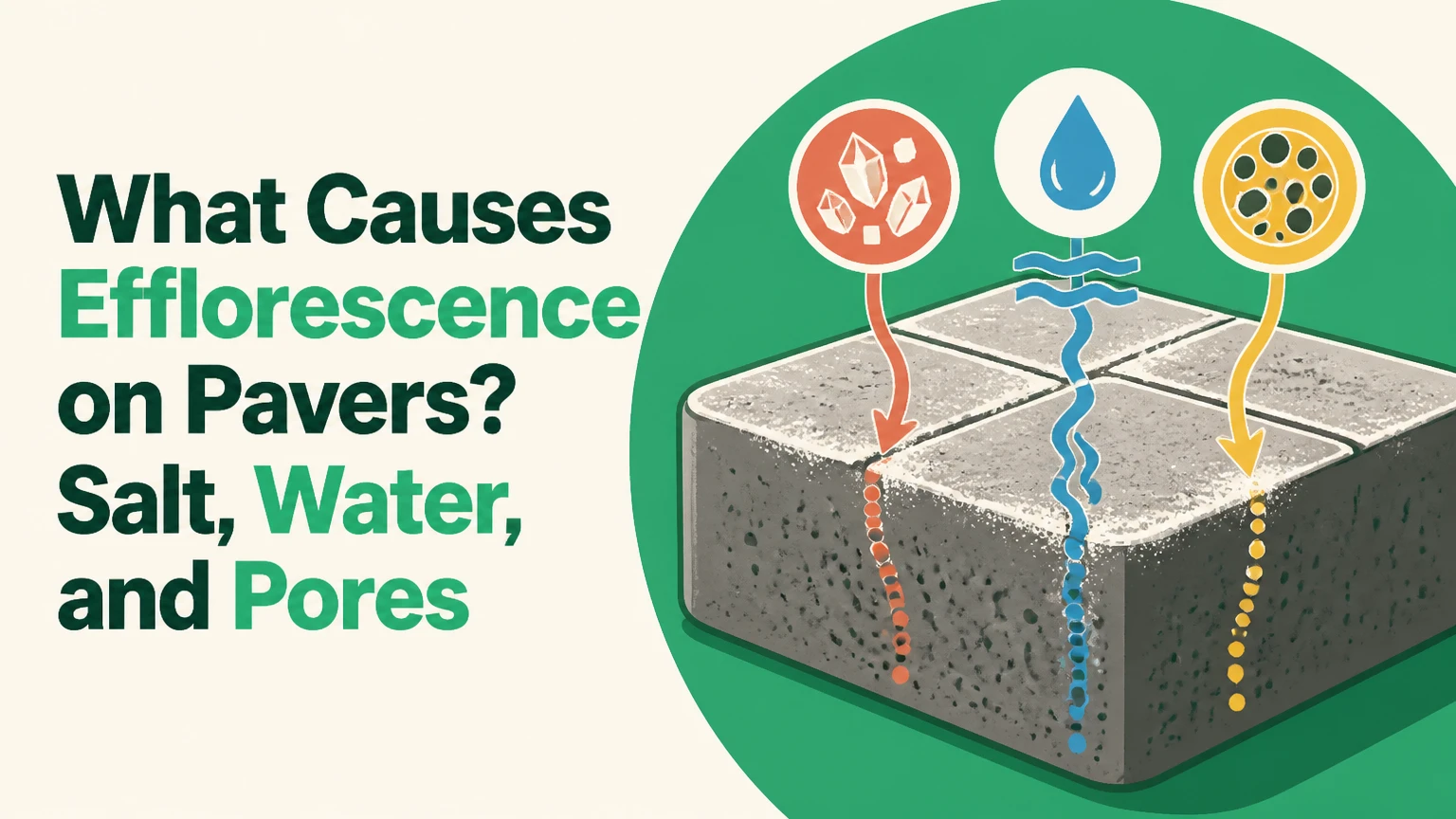
Efflorescence on pavers is caused by soluble salts, moisture, and connected pores acting together. Water dissolves salts inside concrete, bedding sand, joints, or the base, then carries them through capillary paths to the surface as the installation dries. Evaporation leaves a white powder, haze, or crystalline crust behind.
Key Facts at a Glance
- Concrete paver efflorescence is usually an appearance problem, not evidence that the paver has lost structural strength.
- Calcium hydroxide, alkali compounds, and calcium carbonate can contribute to the visible deposit.
- Primary efflorescence commonly appears during early concrete curing, while secondary efflorescence follows later water movement through the installation.
- Efflorescence can recur after cleaning when rain, irrigation, groundwater, or trapped moisture continues transporting salts.
- Natural weathering may reduce early deposits over roughly 12-24 months, although persistent deposits require investigation.
- Sealing before the surface and bedding layers dry can trap haze and make future cleaning more difficult.
What Is Efflorescence on Pavers?
Efflorescence is a surface deposit of water-soluble salts that crystallizes on porous concrete pavers. The Portland Cement Association describes efflorescence as “a crystalline deposit that sometimes develops on the surface of concrete,” and the deposit can range from loose powder to a firmly bonded white crust.
The material may appear bright white, gray-white, cloudy, or slightly yellow. Dark charcoal and red pavers make it more visible because even a thin deposit changes the apparent color. Efflorescence usually does not mean the paver is fading, delaminating, or structurally failing.
A useful field clue is location. Deposits that follow low spots, paver joints, edges, wall lines, or irrigation spray patterns point toward water movement. An even haze across recently installed concrete pavers is more consistent with early curing-related efflorescence.
How Can You Tell Efflorescence From Other White Deposits?
Efflorescence usually feels dry and powdery, wipes away partially, and reappears after the surface becomes wet. Hard-water scale feels more granular or chalky and commonly appears where sprinklers repeatedly wet the same area. Mold and algae usually show green, black, or brown biological coloring.
Sealer haze can look milky or glossy rather than crystalline. Cement grout residue often forms a thin film immediately after construction and follows installation work, while efflorescence may continue emerging for weeks or months.
| Surface condition | Typical appearance | Simple diagnostic clue | Likely response |
|---|---|---|---|
| Efflorescence | White powder, haze, or crystals | Reappears after wetting and drying | Dry brush, then use a specialty cleaner if needed |
| Hard-water scale | Chalky white rings or spots | Concentrated under sprinklers | Remove mineral scale and correct irrigation |
| Mold or algae | Green, black, or brown film | Slippery and organic-looking | Use a suitable biocide or cleaner |
| Sealer haze | Milky, uneven, or glossy film | Sits as a continuous coating | Identify sealer and use compatible remover |
| Cement residue | Gray-white construction film | Appears immediately after installation | Use manufacturer-approved cement residue cleaner |
Why Do Moisture and Pores Create Efflorescence?
Moisture and interconnected pores create the transport system that brings dissolved salts to a paver surface. Without water, salts cannot move; without accessible pores or cracks, the salt solution cannot travel; without evaporation, the salts remain dissolved rather than crystallizing visibly.
Concrete contains capillary pores formed as mixing water leaves during hydration. Paving units also contain joints, bedding sand, and base interfaces that can hold or redirect water. A wet subbase can therefore contribute to a surface deposit even when the paver itself is manufactured correctly.
The process has four practical stages:
- Dissolution: Rain, dew, irrigation, or groundwater dissolves mobile salts.
- Migration: Capillary action and pressure differences move the solution through pores and joints.
- Evaporation: Drying concentrates the solution at or near the exposed surface.
- Crystallization and carbonation: Salts crystallize, while calcium hydroxide can react with carbon dioxide to form calcium carbonate.
The commonly simplified reaction is:
Ca(OH)₂ + CO₂ → CaCO₃ + H₂O
Calcium carbonate is less soluble than calcium hydroxide, so a deposit that initially brushes away may become more bonded after exposure. The chemistry is more varied than one reaction, however. Sodium, potassium, sulfate, chloride, and other ions may occur depending on the cement, aggregates, water, soil, deicing materials, and surrounding construction.
Which Materials Supply the Salts?
The paver concrete is the most common source, especially during early curing. Bedding sand, joint sand, crushed aggregate, soil, masonry walls, and concrete slabs can also supply soluble material when water moves through them.
Clean, well-graded aggregate does not guarantee zero efflorescence because cement chemistry and curing remain important. Conversely, a paver can show recurring deposits because an adjacent retaining wall or wet base is supplying water and salts.
What Is the Difference Between Primary and Secondary Efflorescence?
Primary efflorescence develops from moisture and soluble compounds present during concrete manufacturing and curing. Secondary efflorescence develops after installation when external water transports salts through the paver assembly, bedding layer, base, or adjacent materials.
The distinction helps with diagnosis, but the two processes can overlap. An installation that shows primary deposits during its first season may later develop secondary deposits if a downspout, irrigation line, or high water table keeps the base wet.
| Type | Common timing | Main water source | Typical pattern | Best first response |
|---|---|---|---|---|
| Primary | First 30-90 days, sometimes first year | Manufacturing and curing moisture | Broad, light haze | Wait, dry brush, monitor |
| Secondary | Months or years after installation | Rain, irrigation, groundwater, drainage | Low spots, joints, edges | Correct moisture source |
| Joint-related | Any age | Wet bedding or joint sand | Lines and halos around joints | Inspect joints and drainage |
| Deicing-related | Winter and spring | Salt-contaminated runoff | Walkways, driveways, splash zones | Remove residue and reduce salt input |
The often-cited 1-3 month peak period is a typical pattern, not a guarantee. Cold, damp weather slows drying, while a wet base can extend salt transport far beyond the first season.
How Long Does Efflorescence Usually Last?
Early efflorescence often becomes less visible through rainfall, abrasion, and repeated drying over 12-24 months. Weathering does not guarantee a clean surface, especially when the installation receives continual irrigation or groundwater.
A deposit that returns within 24-48 hours after cleaning is more informative than its age. Rapid recurrence indicates that the source remains active, so additional acid usually treats the symptom rather than the cause.
Which Conditions Make Paver Efflorescence Worse?
Poor drainage, repeated wetting, slow drying, and open transport paths increase the chance and severity of efflorescence. Low areas collect water, clogged edge drains retain moisture, and sprinkler overspray repeatedly dissolves salts at the same surface zone.
Common aggravating conditions include:
- Downspouts discharging onto the paver base.
- Soil or mulch placed higher than the paver edge.
- Irrigation spray crossing a patio or driveway every day.
- A concrete slab beneath pavers draining toward the surface.
- Saturated bedding sand caused by a high water table.
- Narrow, poorly draining side yards with limited sunlight.
- Deicing salt tracked onto freeze-thaw surfaces.
- Recently compacted construction materials that remain wet.
A nominal 2% surface slope, equal to approximately 1/4 inch per foot, is a common hardscape drainage target, but slope alone cannot fix a saturated base or blocked outlet. Water must have a functional path away from the installation.
| Moisture source | Observable sign | Recurrence risk | Corrective action |
|---|---|---|---|
| Irrigation overspray | Wet stripe near lawn or beds | High | Redirect heads and shorten watering |
| Downspout runoff | Deposits below roof outlets | High | Extend outlet to a suitable drainage point |
| Low spot | Standing water after rain | High | Correct grade or rebuild affected area |
| Groundwater | Damp joints during dry weather | High | Improve subsoil or install drainage |
| Dew and rain | Broad, temporary haze | Moderate | Allow drying and monitor seasonally |
| Deicing salt | Deposits after winter events | Moderate | Reduce salt use and remove tracked residue |
How Do You Remove Efflorescence From Pavers Safely?
The safest removal sequence is to identify the moisture source, let the pavers dry, dry-brush loose material, test a small area, and use a manufacturer-approved efflorescence cleaner only when necessary. Cleaning works best when the installation is no longer actively saturated.
Step 1: Inspect and Document the Surface
Photograph the deposit when dry and mark low spots, sprinkler paths, wall edges, and downspout outlets. Check whether the pavers were sealed, because a solvent-based or acrylic sealer changes which cleaner is safe.
Do not clean during rain, freezing conditions, or intense heat. A typical small patio requires 2-4 hours of active work plus drying time, and the surface should remain dry long enough to evaluate recurrence.
Step 2: Remove Loose Crystals
Use a stiff nylon or natural-fiber brush on dry pavers. Sweep the loosened powder away instead of washing it into joints, where water can carry salts back into the bedding layer.
Avoid wire brushes. Steel fragments can rust and stain concrete, while aggressive brushing can expose aggregate or remove a surface treatment.
Step 3: Pre-Wet and Test the Cleaner
Pre-wet adjacent vegetation and the paver surface when the product instructions require it. Apply the chosen cleaner to a 1-2 square foot test area, observe the stated dwell time, scrub with nylon, and rinse completely.
Specialty efflorescence cleaners often use safer organic or buffered acids than raw muriatic acid, but “safer” does not mean harmless. Follow the product safety data sheet, protect skin and eyes, and control runoff.
Step 4: Rinse Without Flooding the Base
Rinse thoroughly using moderate pressure and a wide fan pattern. Keep the nozzle moving, avoid blasting joints, and prevent dirty water from pooling at the lowest edge.
High pressure is not automatically wrong, but a narrow nozzle held close to the surface can erode the cement paste and remove joint sand. The practical risk depends on pressure, nozzle angle, distance, paver age, and surface finish.
Step 5: Let the Installation Dry and Recheck
Allow the pavers and bedding layers to dry before judging the result. A seven-day dry observation period is a useful practitioner benchmark when weather permits, but the true requirement is adequate drying rather than a fixed number of sunny days.
You will know the cleaning worked when the deposit does not return after several wetting and drying cycles. If white powder returns quickly, stop repeating the same wash and investigate drainage.
Is Muriatic Acid a Good Efflorescence Cleaner?
Muriatic acid is effective against some calcium-based deposits but is a poor default choice for homeowners because it can etch concrete, alter pigment, damage nearby metal, injure skin and eyes, and create hazardous fumes. A dedicated cleaner should be preferred.
Product directions control dilution because formulations and paver finishes differ. A commonly cited range of 1 part muriatic acid to 12-20 parts water is not a universal recipe, and stronger mixtures should not be improvised. Never mix acid with bleach or other cleaners.
If an acid product is professionally selected, the operator should pre-wet the pavers, test first, control dwell time, protect surrounding surfaces, manage runoff, and follow the label’s neutralization instructions. Baking soda is not a substitute for the product’s required neutralizer or waste-disposal procedure.
How Do Cleaning Methods Compare?
Natural weathering is safest for mild primary efflorescence, while a specialty cleaner offers a faster controlled treatment. Muriatic acid has the greatest chemical risk, and pressure washing alone often fails when salts remain in the paver assembly.
| Method | Typical homeowner cost | Active time | Best use | Main limitation |
|---|---|---|---|---|
| Natural weathering | $0 | 15 minutes monitoring | Light deposits under 12 months old | Appearance may persist 12-24 months |
| Dry nylon brushing | $10-$30 | 1-2 hours | Loose, unbonded powder | Weak against carbonated crust |
| Specialty cleaner | $40-$80 per gallon | 2-4 hours | Bonded deposits after testing | Requires rinsing and runoff control |
| Professional low-pressure wash | $250-$800 typical small job | 3-6 hours | Large or delicate installations | Does not repair drainage |
| Muriatic acid treatment | $15-$30 per gallon | 2-3 hours | Limited professional last resort | Etching, burns, fumes, discoloration |
Prices are typical United States homeowner ranges and vary with access, square footage, regional labor, product quantity, and waste controls. A low cleaning price is not economical if the treatment damages pigment or sealer.
Why Does Efflorescence Come Back After Cleaning?
Efflorescence returns when water continues dissolving and transporting mobile salts from the paver, joints, bedding sand, base, soil, or adjacent masonry. Cleaning removes the visible deposit, but it does not remove every soluble compound inside the installation.
A recurrence pattern helps locate the source. Deposits below a downspout suggest roof runoff, deposits beside a lawn suggest irrigation, and deposits concentrated at the lowest edge suggest drainage or groundwater. An even return across all units may indicate moisture retained beneath the entire surface.
What Should You Do When White Powder Returns in 48 Hours?
Stop acid washing and inspect the installation for active moisture. Check irrigation schedules, downspouts, surface slope, wet joints, clogged drains, and adjacent walls before attempting another cleaner.
If the pavers were sealed while damp, the sealer may also be slowing evaporation. Removing a failed sealer can require a compatible coating stripper, and that work should be tested carefully because solvent or chemical damage can exceed the original haze.
What If Acid Washing Turns the Surface Gray or Yellow?
Gray discoloration can indicate etching, exposed aggregate, removed pigment, or chemical residue. Yellow or orange discoloration can result from iron contamination, rust transfer, organic residue, or a reaction involving nearby metals.
Rinse according to the product instructions and stop further acid use. A damaged surface may require color-matched restoration or replacement of affected units, but a tinted sealer can hide variation without repairing the etched concrete.
How Can You Prevent Efflorescence on New Pavers?
Prevention depends on limiting water residence time and using materials installed according to the paver manufacturer’s system requirements. Installers should manage grade, base drainage, bedding material, joint sand, compaction, and curing expectations together rather than treating efflorescence as a cleaning issue.
Practical measures include:
- Maintain positive surface drainage, commonly near a 2% slope where site conditions allow.
- Keep downspouts and irrigation discharge away from the paver base.
- Use clean, compatible bedding sand and aggregate specified for the project.
- Avoid washing excess water into open joints during construction.
- Compact the base in appropriate lifts and correct soft or saturated areas.
- Keep soil, mulch, and masonry wash water from contaminating the finished surface.
- Follow the paver manufacturer’s waiting period before applying sealer.
- Explain primary efflorescence in the installation contract and maintenance handover.
ASTM C33 addresses concrete aggregates and may be referenced for suitable sand, but it is not a universal substitute for the paver manufacturer’s bedding-sand specification. Bedding sand, jointing sand, and base aggregate perform different functions and should not be treated as interchangeable.
Should You Seal Pavers to Prevent Efflorescence?
Sealer can reduce staining and change color, but sealer cannot reliably prevent salts already moving through a damp paver assembly. Applying sealer over visible efflorescence can trap crystals beneath the coating and create a permanent-looking white sheet.
Seal only after the surface is clean, the joints are stable, the installation has dried, and the selected product is compatible with the pavers. A breathable treatment may be preferable in some assemblies, but product compatibility and manufacturer instructions govern the decision.
When Should You Repair Instead of Clean?
Repair becomes more appropriate when deposits accompany settlement, standing water, loose joints, cracked units, damp subgrade, or repeated recurrence after the moisture source has been corrected. Cleaning alone cannot correct a failed slope, saturated base, leaking irrigation line, or defective drainage outlet.
A few isolated deposits on otherwise dry, stable pavers usually justify monitoring or localized cleaning. Deposits across a broad area that return after every storm justify drainage evaluation before cosmetic treatment.
One practitioner rule is especially useful: if the surface looks clean only until the next wetting cycle, the project is not primarily a cleaning project. It is a water-management project.
Frequently Asked Questions
Does efflorescence mean pavers are defective?
Efflorescence does not automatically mean concrete pavers are defective. Early deposits are a recognized characteristic of cement-based products and may weather away. A defect investigation becomes more reasonable when units crack, spall, lose structural integrity, or show severe recurring deposits linked to manufacturing or installation conditions.
Can rain remove efflorescence?
Rain can reduce loose efflorescence by dissolving and carrying away surface salts, but rain can also reactivate deposits when it moves through salt-bearing pavers or bedding layers. Natural weathering is most effective after the installation has stopped receiving concentrated moisture from irrigation, runoff, or groundwater.
Is efflorescence harmful to pets or people?
Ordinary concrete efflorescence is generally an aesthetic mineral deposit rather than a toxic surface contaminant, but its exact composition is not known from appearance alone. Keep children and pets away from chemical cleaners, rinse runoff responsibly, and use gloves and eye protection during removal.
Can pressure washing remove white paver haze?
Pressure washing can remove loose surface powder, but it may not dissolve bonded calcium carbonate or salts inside the paver assembly. Excessive pressure, a narrow nozzle, or close spraying can erode the surface and remove joint sand, increasing future water movement and maintenance.
Does dark-colored concrete show more efflorescence?
Dark charcoal, black, red, and blended pavers show thin deposits more clearly than pale units because white crystals create greater contrast. The color does not necessarily indicate more salt or a weaker paver. Cleaning and sealing decisions should depend on deposit chemistry, surface condition, and moisture behavior.
Should you wait before cleaning newly installed pavers?
Waiting is often sensible when the installation is less than a year old, the deposit is light, and drainage is working. Dry brushing can remove loose powder, while aggressive acid treatment should wait until the pavers are dry and the likely source of moisture has been assessed.
The Bottom Line
What causes efflorescence on pavers is the combined action of soluble salts, water, and capillary pathways. Early curing commonly produces a temporary haze, while recurring deposits usually indicate continued moisture from irrigation, runoff, groundwater, joints, bedding sand, or the base.
Start with observation and drainage correction. Dry-brush loose material, test a dedicated cleaner on a small area, rinse without eroding joints, and postpone sealing until the pavers and underlying layers are demonstrably dry.