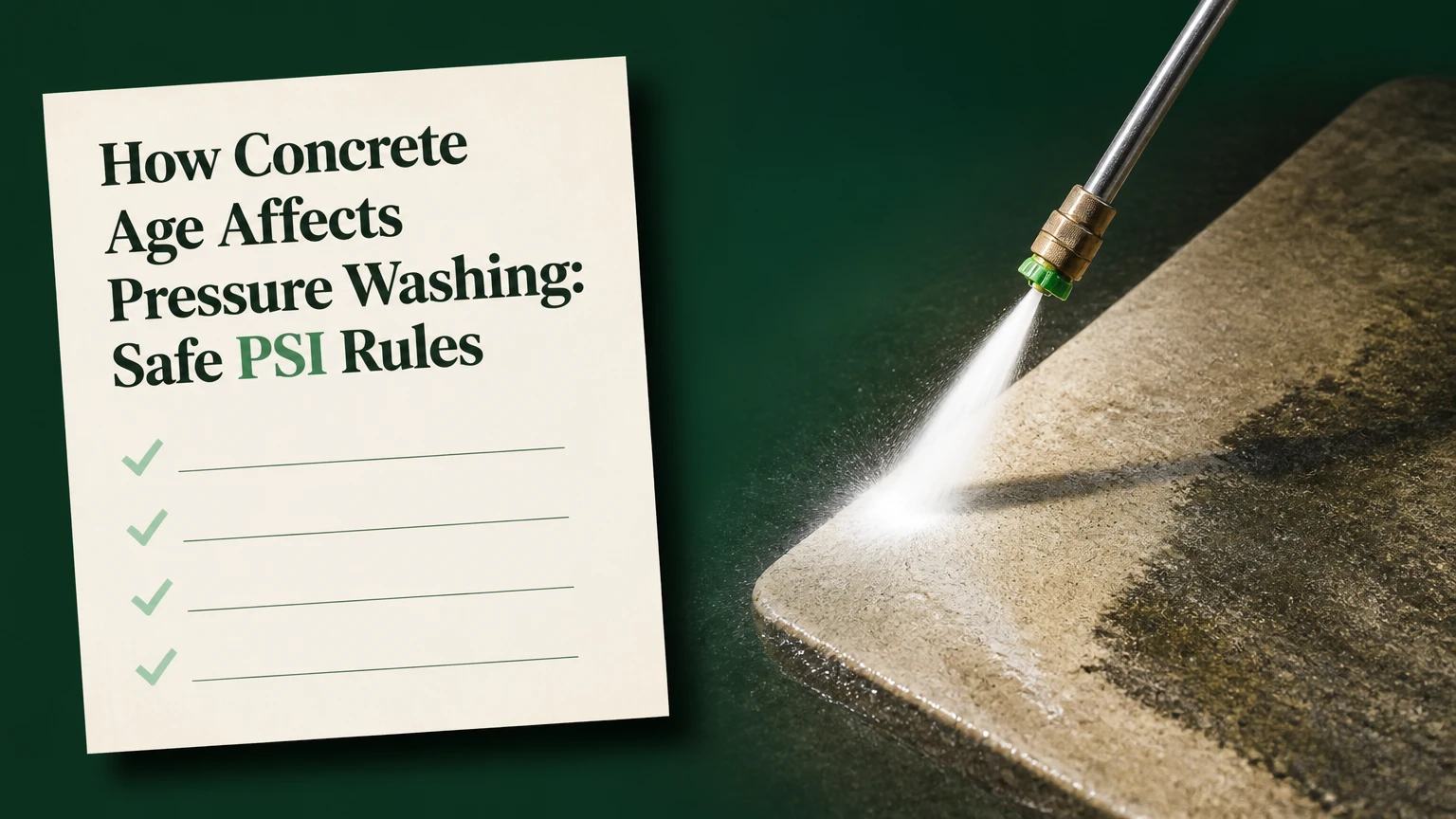
Concrete age affects pressure washing by changing the hardness, cohesion, moisture condition, and defect risk of the cement-paste surface. Concrete younger than 28 days should not receive pressure washing, while older slabs still require inspection because scaling, weak paste, decorative finishes, and freeze-thaw damage can make aged concrete vulnerable to erosion.
Key Facts at a Glance
The 28-day concrete age is a standard compressive-strength testing point, not an automatic pressure-washing approval date.
Concrete under 28 days should receive no pressure washing; use only an ordinary garden-hose rinse when the concrete professional permits it.
Pressure, water flow, nozzle distance, nozzle angle, dwell time, and surface condition determine cleaning risk together.
Mature concrete commonly tolerates controlled cleaning around 2,000-3,500 PSI, but weak or scaled concrete may require soft washing below that range.
A rotary surface cleaner usually produces more uniform results than a hand wand because it maintains a consistent nozzle distance.
Pressure washing cannot repair surface paste already lost through scaling, spalling, or aggregate exposure.
What does concrete age actually change?
Concrete age changes the maturity of the cement paste that binds aggregate at the surface. During hydration, cement reacts with water and forms products that gradually stiffen and strengthen the matrix, but strength development depends on the mix, temperature, moisture, cement type, curing method, and admixtures.
The American Concrete Institute’s ACI 308R addresses curing as the process of maintaining moisture and temperature conditions that support cement hydration. ASTM C39 uses 28-day cylinders as a common compressive-strength reporting age, but that laboratory benchmark does not prove that every slab has the same surface hardness or pressure-washing tolerance.
A pressure washer does not test the whole slab. Its water jet attacks the thin surface paste first. If the jet’s impact and shear exceed the paste’s cohesion, the washer can remove sound material along with dirt.
What does the 28-day mark actually mean?
The 28-day mark usually means the concrete reaches its specified reference strength for design and testing purposes. It does not mean that the surface is fully mature, dry, sealed, or immune to mechanical damage.
A properly cured slab may continue gaining strength after 28 days, while a poorly cured slab can remain weak despite reaching the calendar date. Concrete placed in cold weather, exposed to rapid drying, or finished with excess bleed water may have a weaker surface than its mix design suggests.
That distinction corrects a common oversimplification: “28-day concrete” is not automatically safe at 2,000 PSI. The pour date is one screening factor, not a complete operating specification.
Can you pressure wash concrete before 28 days?
Concrete before 28 days should not be pressure washed because impact can disturb the immature surface paste, interfere with curing, and leave permanent streaks or pitting. A normal household hose may be acceptable for a controlled rinse only when the installer, finisher, or project specification permits water contact.
A typical residential garden hose delivers roughly 40-80 PSI, not 500 PSI. The 500-PSI figure sometimes repeated in cleaning advice is already far above ordinary hose pressure and should not be treated as a safe “light wash” threshold for green concrete.
Protect young concrete from concentrated streams, rotating tips, turbo nozzles, stiff brushing, aggressive chemicals, and standing water. If construction dust must be removed, use the least aggressive method that accomplishes the task, keep the nozzle broad and distant, and avoid directing water at joints or slab edges.
How should recently placed concrete be cleaned?
- Confirm the placement date and curing instructions.
- Remove loose debris by hand or with a soft broom.
- Use an ordinary hose with a gentle, diffuse spray only if approved.
- Keep runoff away from uncured joints, edges, landscaping, and adjacent finishes.
- Stop if the water exposes paste, creates cloudy runoff, or leaves a visibly rougher track.
A scratch test with a key can reveal an obviously weak surface, but it cannot certify pressure-washing readiness. Concrete may resist a key and still suffer jet erosion, especially where the surface has a weak laitance layer.
How much pressure is safe at each concrete age?
Typical working pressure depends on the slab’s condition more than its calendar age. The following ranges are conservative field starting points, not universal limits, and the lowest effective setting should always be tested in an inconspicuous area.
| Concrete age and condition | Starting pressure | Typical upper working range | Preferred method |
|---|---|---|---|
| 0-27 days, curing | 0 PSI washer pressure | No pressure washing | Approved hose rinse only |
| 28 days-6 months, sound surface | 800-1,200 PSI | 1,500 PSI | Chemical wash, white tip |
| 6-12 months, sound surface | 1,000-1,500 PSI | 2,000 PSI | Wide fan or light surface cleaner |
| 1-20 years, sound plain slab | 1,500-2,500 PSI | 2,500-3,500 PSI | Surface cleaner, controlled passes |
| 20+ years, sound but weathered | 1,000-2,000 PSI | 2,500 PSI | Wide fan, low-impact cleaning |
| Any age, scaling or spalling | 500-1,000 PSI | Lowest effective setting | Soft wash or specialist assessment |
PSI alone cannot determine risk. A 4-GPM machine at 2,000 PSI can clean differently from a 2-GPM machine at the same pressure because the higher flow changes rinsing force, productivity, and water volume.
What is surface pressure?
Surface pressure is the force delivered to the concrete after nozzle angle, distance, orifice size, and flow are considered. A narrow 0-degree tip concentrates energy into a tiny area, while a 40-degree tip spreads the same water over a larger fan and generally reduces localized damage.
The machine’s pressure gauge also measures pump pressure, not the exact force at the slab. Worn nozzles, extension wands, hose length, nozzle distance, and surface-cleaner bar height all alter the result.
| Tool or nozzle | Typical spray pattern | Practical concrete use | Main risk |
|---|---|---|---|
| Red 0-degree tip | 0 degrees | Avoid on residential concrete | Deep etching and gouging |
| Yellow 15-degree tip | 15 degrees | Limited edge or spot work at distance | Lines and paste loss |
| Green 25-degree tip | 25 degrees | Mature plain concrete detailing | Overlap marks if held close |
| White 40-degree tip | 40 degrees | Young, delicate, or weathered surfaces | Slow removal of heavy grease |
| Rotary surface cleaner | Enclosed rotating jets | Uniform mature-slab cleaning | Circular marks if stopped or mis-sized |
Which nozzle and surface cleaner fit the slab?
A white 40-degree nozzle is the safest general starting point for recently cured or weathered concrete because its broad fan distributes impact. A 25-degree nozzle can detail edges on sound mature concrete, but the operator must maintain distance and keep the wand moving.
A rotary surface cleaner is usually preferable for a sound, plain slab older than one year. It keeps multiple jets at a consistent height, reduces wand fatigue, and limits the uneven distance changes that cause zebra striping. Use a unit whose nozzle orifice matches the pressure washer’s actual flow; an incorrectly sized bar can produce weak cleaning or excessive impact.
Keep the cleaner moving at a steady walking pace. Do not park it on the slab, pivot sharply over one spot, or use a surface cleaner with damaged spray arms.
Why can older concrete need less pressure?
Older concrete can need less pressure when its surface paste has been weakened by freeze-thaw cycles, deicing salts, water intrusion, abrasion, or previous cleaning. Age may increase the strength of intact interior concrete while simultaneously reducing the cohesion of the exposed surface.
Scaling appears as flakes or shallow chips. Spalling creates deeper breaks and exposed aggregate. Powdering produces a soft, dusty surface. These defects matter more than the birth date of the slab.
A mature slab in a mild climate may tolerate 3,000 PSI, while a 25-year-old driveway with salt scaling may deteriorate under 1,500 PSI. Age is therefore a risk indicator, not a pressure setting.
How should recently placed concrete be cleaned?
Recently placed concrete should be cleaned with chemical action and low mechanical impact. For a sound slab between 28 days and one year, begin with a small test area, a mild surfactant solution, and a white nozzle or low-pressure rinse rather than a concentrated jet.
For algae, mildew, and organic staining, a professional may use diluted sodium hypochlorite with surfactant, selected according to the product label, local rules, plant sensitivity, and runoff controls. Residential exterior cleaning often uses lower concentrations than heavily contaminated commercial work; a universal bleach recipe is unsafe because product strength and site conditions vary.
Keep the surface wet during dwell time, commonly 5-15 minutes, and never allow treatment to dry. Pre-wet nearby plants, protect metals, control runoff, and rinse vegetation afterward with clean water. Sodium hypochlorite is not the right first treatment for rust, mineral deposits, or oil.
What is the correct young-concrete protocol?
- Inspect for powdering, laitance, cracks, exposed aggregate, and sealer.
- Test a 1-square-foot area with the selected chemical and rinse method.
- Apply the labeled cleaner through a downstream injector or pump sprayer.
- Allow 5-15 minutes of dwell while keeping the surface wet.
- Rinse with a 40-degree tip from at least 12 inches away.
- Stop when the surface color changes or paste begins releasing.
- Allow the slab to dry fully before considering a compatible sealer.
You will know the process is working when organic discoloration lifts without a rougher texture, visible fan lines, or cloudy cement paste in the runoff. A common mistake is increasing pressure when dwell time or chemical selection is the real problem.
Which cleaner matches the stain?
The correct chemical reduces the pressure required, which is especially valuable on young, decorative, or weathered concrete. Oil requires alkaline chemistry and absorbent treatment, while biological growth responds to an appropriate disinfecting cleaner.
| Stain type | Suitable first treatment | Typical dwell or action | Avoid |
|---|---|---|---|
| Algae or mildew | Labeled sodium hypochlorite plus surfactant | 5-15 minutes | Letting solution dry |
| Oil or grease | Alkaline degreaser, absorbent, hot water | 10-30 minutes | Expecting one cold rinse to erase oil |
| Rust | Concrete-safe oxalic or specialty rust remover | Product-label time | Mixing acids with bleach |
| Efflorescence | Dry brushing, mild specialty efflorescence cleaner | 5-15 minutes | Sealing before salts stop migrating |
| Paint | Manufacturer-approved stripper and scraping | 15-60 minutes | Blasting paint into surrounding pores |
| Tire marks | Alkaline cleaner and controlled agitation | 5-15 minutes | Narrow tip at close range |
Acidic cleaners can etch cement paste and alter color. Phosphoric or specialty acid products may help mineral deposits, but the product label, ventilation, protective equipment, neutralization, and runoff management control the procedure.
How does surface condition change the age rule?
Surface condition changes the age rule because two slabs of identical age can have different paste quality. Examine the concrete before selecting a nozzle or chemical.
Look for hairline cracks, open joints, prior patching, exposed stone, flaking, dark moisture zones, and areas that sound hollow when lightly tapped. Decorative stamped concrete may contain a sealer or color hardener that requires manufacturer-specific cleaning, and aggressive pressure can remove color even when the underlying concrete remains intact.
Exposed aggregate is intentionally textured. A close wand pass can dislodge decorative stones or expose more aggregate than the design intended. Concrete with a film-forming sealer may develop whitening, peeling, or delamination if pressure is used to compensate for incompatible cleaning chemistry.
What should you do when the pour date is unknown?
Treat unknown-age concrete as delicate until inspection proves otherwise. Begin with a 40-degree nozzle, low pressure, a distant test pass, and chemical dwell rather than assuming the slab is mature because it looks gray and hard.
Ask the property owner about construction, resurfacing, sealing, winter salt, and previous washing. A recent overlay or repair may be younger than the original driveway. Mark the test area and compare texture, color, and runoff before proceeding.
Unknown-age concrete should not receive a red tip, turbo nozzle, or full-pressure pass as a first attempt.
What damage does excessive pressure cause?
Excessive pressure can remove cement paste, expose aggregate, create permanent wand marks, and accelerate existing scaling. Pressure washing can clean a stain while leaving structural or cosmetic damage that costs more to repair than professional cleaning.
| Failure mode | Visible sign | Likely cause | Correct response |
|---|---|---|---|
| Etching or scarring | Narrow grooves or bright tracks | Close 0-degree or 15-degree spray | Stop; document damage; assess resurfacing |
| Zebra striping | Parallel light and dark bands | Uneven wand distance or speed | Rewash uniformly only if paste remains intact |
| Circular marks | Swirl patterns | Stopped or poorly sized surface cleaner | Inspect nozzles; make overlapping passes |
| Aggregate exposure | Coarse stone becomes visible | Paste blasted away | Stop cleaning; consult resurfacing contractor |
| Scaling | Flakes or chips lift | Weak paste, salt, freeze-thaw, or pressure | Use low-impact cleaning; repair deterioration |
| Efflorescence | White powder returns after drying | Soluble salts migrate with moisture | Correct moisture source before sealing |
A key practitioner rule is to stop when the concrete texture changes, not when every stain disappears. Some discoloration is embedded in the paste and cannot be removed without sacrificing sound material.
Can pressure-washing damage be repaired?
Light striping may be visually reduced with a uniform rewash if the paste remains intact, but true etching is permanent surface loss. Aggregate exposure, deep spalling, and severe scaling may require a cementitious overlay, microtopping, patching, or slab replacement.
Cleaning chemicals cannot replace removed concrete. Photograph the condition before and after testing, especially on commercial work or recently placed slabs.
Should you seal concrete after washing?
Concrete should be sealed only after cleaning is complete, the slab is dry, and the selected sealer matches the surface and moisture conditions. A breathable penetrating silane or siloxane sealer is often considered for exterior plain concrete because it reduces water absorption without creating a thick surface film.
Do not seal over efflorescence, trapped moisture, active scaling, oil residue, or uncured repairs. Many products require a dry substrate and an application temperature within the manufacturer’s stated range; exact wait times vary, but 24-72 hours of dry weather is a common planning window.
Film-forming acrylic sealers can change color, add gloss, and peel when moisture moves through the slab. Penetrating sealers usually offer less visual transformation but lower peeling risk.
How much does age-sensitive concrete cleaning cost?
Typical professional concrete cleaning costs range from $0.15-$0.35 per square foot for accessible mature plain concrete, $0.25-$0.45 for delicate or chemical-led cleaning, and $0.40-$0.75 for hot-water commercial degreasing. Minimum service charges, access, drainage, stain severity, local labor, and post-cleaning sealing can change the total.
| Service situation | Typical price per square foot | 400-square-foot example | Typical duration |
|---|---|---|---|
| Mature plain driveway | $0.15-$0.35 | $60-$140 | 1-1.5 hours |
| Young or delicate slab | $0.25-$0.45 | $100-$180 | 1.5-2.5 hours |
| Heavy oil with hot water | $0.40-$0.75 | $160-$300 | 2-4 hours |
| Hand-wand-only cleaning | $0.25-$0.60 | $100-$240 | 2.5-4 hours |
| Cleaning plus penetrating sealer | $0.50-$1.25 | $200-$500 | 2-4 days including drying |
These are typical planning figures, not published universal rates. A two-car driveway often covers about 400 square feet, but measuring the actual slab gives a better estimate than using vehicle count.
What equipment is appropriate for DIY and professional work?
DIY users generally have better control with an electric washer in the 1,500-2,000 PSI range, 1.2-2.0 GPM, a 40-degree tip, and a 12-inch surface cleaner. The equipment may clean organic soil effectively, but it will struggle with deep oil, paint, rust, and large commercial areas.
Professionals may use 3,000-4,000 PSI machines at 4-8 GPM for sound mature concrete, but that capacity increases the consequences of poor nozzle choice and slow movement. A high-flow machine is productive, not automatically safer.
What is pressure washing not good for?
Pressure washing is not a repair method for structural cracks, delaminated overlays, active spalling, or badly scaled concrete. It is also a poor substitute for stain-specific chemistry when oil, rust, paint, or efflorescence has penetrated the surface.
A contractor should recommend repair or assessment instead of promising complete stain removal when removal requires taking away sound paste. That limitation is central to responsible work.
Common mistakes and how to fix them
- Using the calendar instead of inspecting the slab: A 28-day date does not prove surface maturity. Start with a test area and low impact.
- Using a red nozzle on concrete: The concentrated jet can cut grooves in seconds. Replace it with a 40-degree tip.
- Holding the wand too close: Move back to at least 12 inches for a broad fan, then adjust gradually.
- Stopping a surface cleaner: Stationary jets can leave circular marks. Keep the unit moving continuously.
- Relying on pressure for oil: Apply an alkaline degreaser, allow dwell, agitate, and repeat before raising pressure.
- Sealing immediately: Moisture and salts can become trapped. Confirm dryness and product compatibility first.
The Bottom Line
How concrete age affects pressure washing is a risk-management question, not a single PSI calculation. Concrete under 28 days should not be pressure washed, concrete between 28 days and one year should receive chemical-led low-impact cleaning, and mature slabs can tolerate more mechanical action only when the surface is sound.
Inspect paste condition, scaling, sealers, repairs, and decorative finishes before choosing equipment. Start with the widest practical nozzle and lowest effective pressure, use chemistry for the stain, and stop whenever the surface texture changes.
Frequently Asked Questions
Can I pressure wash a two-year-old driveway?
A two-year-old driveway can often tolerate controlled pressure washing if the surface is sound, unsealed or compatible with the method, and free from scaling. Begin around 1,500-2,000 PSI with a surface cleaner or 40-degree test pass, then increase only when cleaning remains incomplete and the paste shows no change.
Is hot water safer than high pressure for concrete?
Hot water can be safer for oil because heat and alkaline chemistry reduce the pressure needed for removal. Hot water does not make weak, scaled, decorative, or recently cured concrete safe; temperature, chemical compatibility, dwell time, and surface condition still control damage risk.
How long should concrete dry before sealing?
Concrete commonly needs 24-72 hours of dry weather before sealing, but the sealer manufacturer’s moisture and temperature requirements control the decision. Efflorescence, recent rain, subsurface moisture, and shaded locations may require longer. A dry-looking surface is not proof that internal moisture has stopped moving.
Can I use a turbo nozzle on a concrete patio?
A turbo nozzle is risky on most residential patios because its rotating concentrated jet can etch, stripe, or expose aggregate quickly. Avoid it on young, decorative, sealed, cracked, scaled, or weathered concrete. A 40-degree fan or correctly sized surface cleaner offers more predictable coverage.
Does pressure washing remove efflorescence permanently?
Pressure washing may remove visible efflorescence temporarily, but it does not correct the moisture movement that carries dissolved salts to the surface. Dry brushing and a compatible efflorescence cleaner can improve appearance; lasting control requires addressing drainage, leaks, vapor movement, or porous concrete before sealing.