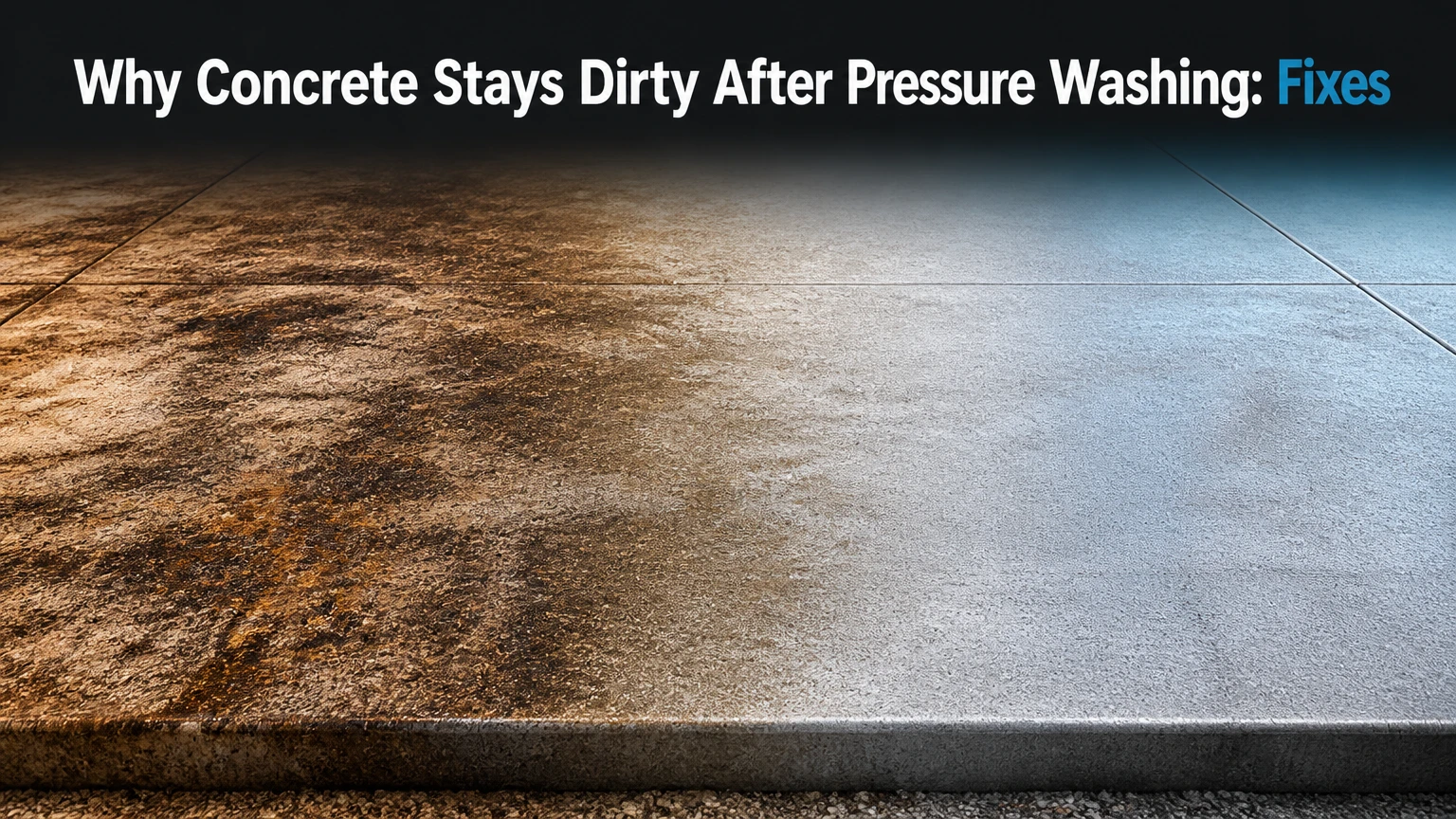
Concrete stays dirty after pressure washing because water pressure removes loose surface soil more readily than absorbed oil, rust, organic discoloration, mineral deposits, or embedded carbon film. Concrete pores, surface texture, uneven cleaning technique, and recurring moisture can all leave discoloration behind, so the correct remedy depends on the stain’s color, chemistry, and depth.
Key Facts at a Glance
- Concrete porosity allows water, oil, iron, salts, and organic contaminants to enter capillaries below the visible surface.
- A pressure washer removes loose soil mechanically, but many stains require a compatible detergent, degreaser, oxidizer, or acid.
- Tiger stripes usually result from uneven wand movement, incorrect nozzle distance, insufficient overlap, or a damaged surface.
- A rotary surface cleaner normally produces a more uniform finish than a hand wand on broad, flat concrete.
- Rust, oil, organic growth, and efflorescence require different treatments; one chemical cannot safely remove all four.
- Typical residential driveway cleaning costs $0.20-$0.45 per square foot, with difficult stains increasing labor and chemical costs.
Why Does Concrete Stay Dirty After Pressure Washing?
Concrete remains discolored after pressure washing when the remaining material is chemically bonded, absorbed below the surface, or located in unevenly cleaned pores. Water pressure is a mechanical cleaning force, not a universal solvent, and increasing PSI cannot reliably dissolve petroleum, convert iron oxide, or stop biological growth.
Portland cement concrete contains capillaries and voids created during mixing, finishing, and curing. The surface may look dense while still absorbing sprinkler water, vehicle fluids, leaf tannins, and airborne particles. Rough broom-finished concrete also holds soil in ridges that a spray pattern can miss.
The AI Overview is directionally correct that porosity matters, but two common explanations need precision. Mold and algae do not usually grow through ordinary concrete as plants with literal roots; they leave spores, biofilm, and organic residues that can recolonize a damp surface. Oil is not necessarily pushed deeper by pressure, although aggressive washing can spread it, emulsify it, or move contamination into adjacent pores.
What does the stain look like when concrete dries?
A dry surface reveals the most useful diagnostic clues. Green or black patches usually indicate biological growth, orange marks suggest iron, white powder points to salts, and dark translucent patches commonly indicate petroleum contamination. Uniform gray film often means atmospheric grime or incomplete rinsing rather than one deep stain.
Inspect the slab twice: once wet and again after 24 hours of drying. A stain that disappears while wet but returns strongly when dry may be below the surface. A line that remains sharply defined after cleaning can indicate etching or a difference in concrete texture, not dirt.
Which Stains Resist Pressure Washing?
The most resistant concrete stains are oil, rust, organic growth, efflorescence, hard-water scale, and embedded carbon film. Each stain has a different removal mechanism, so selecting chemicals by color and source is more reliable than simply using a stronger nozzle.
| Stain appearance | Likely source | Why water alone fails | Suitable first treatment |
|---|---|---|---|
| Black, green, or gray patches | Algae, mold, mildew, lichen | Biofilm and spores remain after surface soil is removed | Diluted sodium hypochlorite or labeled outdoor biocide |
| Orange, red, or brown marks | Iron fertilizer, metal, well water | Iron oxide is insoluble in plain water | Oxalic, citric, or phosphoric acid cleaner |
| Dark, slick, translucent spots | Motor oil, grease, transmission fluid | Hydrocarbons repel water and enter pores | Alkaline degreaser, agitation, hot-water rinse |
| White powder or crust | Efflorescence, sprinkler minerals | Dissolved salts migrate back as water evaporates | Dry brushing or labeled mineral-dissolving cleaner |
| Uniform dull gray film | Exhaust, tire soil, airborne carbon | Fine particles bond to textured cement paste | Surfactant or alkaline detergent with agitation |
| Alternating light and dark lines | Uneven wand passes or surface damage | Uncleaned bands or etched cement paste remain | Controlled rewash, then assess for etching |
How should organic stains be treated?
Organic stains should receive a compatible disinfecting or oxidizing treatment before mechanical washing, because pressure alone can remove visible growth while leaving biofilm and spores on a damp, shaded surface. Sodium hypochlorite is commonly used by exterior cleaners, but concentration, dwell time, runoff control, and plant protection determine whether the treatment works safely.
For a homeowner, a labeled outdoor concrete or masonry biocide is the lowest-risk starting point. Professional cleaners may use sodium hypochlorite with a surfactant, but a stronger solution is not automatically better. Pre-wet nearby plants, keep the concrete visibly wet for roughly 5-15 minutes according to the product label, agitate heavy patches, and rinse thoroughly where runoff could reach vegetation.
Lichen is harder than a thin algae film because its crust adheres tightly. Scraping or brushing may be necessary after chemical treatment. Do not mix bleach products with acids, ammonia, or unknown detergents.
What removes oil and grease from concrete?
Oil and grease require an alkaline degreaser, agitation, and adequate flushing; severe or old contamination may require hot water or a poultice. A pressure washer by itself often lightens an oil spot without removing the absorbed residue, leaving a gray or brown “shadow” after drying.
Apply a concrete-safe degreaser to a dry or slightly damp surface as directed. Scrub with a stiff nylon brush, allow the labeled dwell period, and prevent the product from drying. Hot water around 180-200°F can improve commercial degreasing, but heat does not make every detergent safe for sealed, painted, or polymer-modified surfaces.
A poultice is more appropriate when oil has penetrated deeply. The absorbent paste remains over the stain for several hours or overnight, drawing petroleum toward the surface as it dries. Test first because some poultice products lighten cement paste or leave a temporary halo.
How should rust be removed?
Rust should be treated with a concrete-compatible iron remover, usually based on oxalic, citric, or phosphoric acid, rather than with higher water pressure. Acid converts or complexes iron compounds so they can be rinsed away, but the wrong acid or concentration can etch cement paste and expose aggregate.
Oxalic acid is common for orange iron staining, while phosphoric acid products are often selected for mineral and rust treatment. Hydrochloric acid, commonly called muriatic acid, acts aggressively and can create a lighter etched patch, fumes, unsafe runoff, and damage to nearby metal.
Wet adjacent surfaces, use protective equipment specified by the label, apply only as directed, and rinse completely. Never combine an acid cleaner with sodium hypochlorite. The reaction can release toxic chlorine gas.
Why does efflorescence return after washing?
Efflorescence returns when dissolved salts move through concrete and crystallize at the surface as moisture evaporates. Pressure washing can remove visible powder temporarily, but it cannot stop water migration from soil, joints, cracks, poor drainage, or the slab itself.
Dry-brush light deposits first. If a hard mineral crust remains, use a labeled efflorescence or phosphoric-acid cleaner after confirming that the product is suitable for the concrete. Sprinkler overspray is a frequent source of recurring white deposits, especially when irrigation water contains substantial dissolved minerals.
Efflorescence differs from hard-water scale by location and source. Salt migration may cover broad areas or appear near joints, while sprinkler scale often forms on the splash side of a curb, wall, or slab edge. Fix the moisture source before repeating chemical cleaning.
Why Are Stripes Left Behind?
Tiger stripes occur when a hand wand cleans adjacent bands at different distances, speeds, angles, or overlaps. A 25-degree fan held too far away leaves soil behind, while a close pass can remove more cement paste and create a permanently lighter or rougher line.
A rotary surface cleaner reduces these differences because enclosed spinning nozzles maintain a more consistent distance from the slab. It still requires an appropriately sized machine, steady walking speed, overlapping passes, and a final rinse around edges.
| Cleaning approach | Typical operating range | Finish consistency | Main limitation |
|---|---|---|---|
| 25-degree wand | 2,500-3,500 PSI, 2.5-4 GPM | Low on broad slabs | Stripes and edge variation |
| 15-inch surface cleaner | 2,500-3,500 PSI, 2.5-4 GPM | Moderate to high | Slow if machine output is low |
| 20-24-inch surface cleaner | 3,500-4,000 PSI, 4-8 GPM | High with matched nozzles | Requires commercial flow |
| Hot-water surface cleaner | 1,500-4,000 PSI, 4-8 GPM, up to about 200°F | High on oil-contaminated slabs | Rental and runoff cost |
The machine’s GPM determines how quickly dirty water is flushed, while PSI influences impact at the nozzle. A 4,000-PSI washer with inadequate flow may perform worse than a lower-pressure machine with a properly matched surface cleaner.
What Is the Correct Cleaning Sequence?
The reliable sequence is preparation, diagnosis, chemical pretreatment, controlled agitation, surface-cleaner washing, rinsing, and selective post-treatment. The chemical must stay wet for its labeled dwell time, and the dirty slurry must leave the slab rather than dry back onto it.
- Sweep and inspect the concrete. Remove leaves, sand, gravel, gum, and loose soil. Mark cracks, soft areas, paint, sealers, and drains.
- Protect surrounding surfaces. Pre-wet grass, shrubs, siding, and adjacent metal. Cover sensitive plants when runoff cannot be controlled.
- Match the pretreatment to the stain. Use a biocide for organic growth, an alkaline degreaser for oil, and a labeled acid cleaner for rust or mineral scale.
- Maintain dwell time. Keep the chemical visibly wet for about 5-15 minutes unless the label specifies another period. Apply in manageable sections.
- Agitate problem areas. Use a stiff nylon brush on oil, lichen, tire marks, and textured broom-finished concrete.
- Wash with controlled equipment. Move a surface cleaner at a steady walking pace with overlapping passes. Keep a wand away from the slab unless cleaning edges or joints.
- Rinse the slurry. Flush dirty water toward an approved drainage route. Do not allow concentrated degreaser, bleach, or acid runoff to enter storm drains.
- Post-treat selectively. A light labeled biocide treatment can help organic stains, while oil and rust require additional targeted treatment rather than a generic final spray.
- Inspect after drying. Wait until the slab is fully dry, normally 12-48 hours, before deciding whether a second treatment or sealing is needed.
You know the cleaning worked when the surface dries evenly, organic discoloration does not return quickly, and no chemical residue or dirty slurry remains at the edges. A sharply outlined pale line after complete drying may be etched concrete, not incompletely washed dirt.
What Are the Most Common Cleaning Mistakes?
The most damaging mistakes are using a turbo nozzle too close, letting chemicals dry, ignoring runoff, and treating every stain with the same product. Stronger pressure can make a cosmetic problem permanent by removing the cement-rich surface layer known as the surface cream.
| Mistake | Visible result | Recovery approach | Prevention |
|---|---|---|---|
| Turbo nozzle held close | Etched circles or lines | Stop aggressive washing; assess texture and aggregate exposure | Use a surface cleaner or wider fan |
| Detergent dries in sun | White rings or sticky residue | Re-wet, lightly scrub, and rinse thoroughly | Work in shaded sections |
| No overlap between passes | Zebra striping | Rewash uniformly with matched equipment | Overlap each pass by 2-4 inches |
| Acid used on unknown surface | Light patches or roughness | Neutralize or rinse as directed; avoid repeated acid | Test a hidden area |
| Bleach runoff reaches plants | Leaf burn or grass damage | Rinse vegetation immediately with clean water | Pre-wet, control runoff, and post-rinse |
| Oil is washed without degreaser | Larger but lighter halo | Use degreaser or poultice after drying | Remove absorbent spills early |
A common practitioner rule is to judge concrete by texture as well as color. If a dirty band feels rougher or smoother than the surrounding slab, additional pressure will not restore the original finish.
What If Concrete Still Looks Dirty After Rewashing?
Concrete that still looks dirty after a second controlled wash may have permanent discoloration, embedded oil, failed sealer, uneven porosity, or surface damage. Repeating high-pressure passes without diagnosis increases the risk of spalling, exposed aggregate, and visible wand marks.
Perform a small test area with the appropriate chemical, not a stronger nozzle. Compare the test after drying for 24 hours. If the test area does not improve and the stain has a fixed outline, options may include sanding, grinding, decorative resurfacing, recoloring, or accepting the remaining variation.
Old concrete often contains patches with different water-cement ratios, repairs, curing compounds, and exposure histories. Uniform color is therefore not guaranteed even after professional cleaning. A sealer can deepen and even the appearance, but it cannot hide every stain and may trap moisture if applied to damp concrete.
Can pressure washing damage concrete?
Pressure washing can damage concrete when excessive impact removes cement paste, enlarges cracks, exposes aggregate, or drives water beneath coatings. Fresh concrete deserves particular caution: many contractors wait roughly 28 days for standard curing before aggressive cleaning, although the concrete specification and coating system control the actual requirement.
Keep the nozzle moving, avoid zero-degree tips on flatwork, and test pressure in an inconspicuous area. Painted, coated, stamped, or previously sealed concrete needs lower-risk testing because pressure can lift coatings or expose uneven repairs.
How Much Does Concrete Cleaning Cost?
Typical residential concrete cleaning costs about $0.20-$0.45 per square foot, while difficult oil, rust, access, drainage, and stain-treatment work can increase the total. A two-car driveway commonly takes a homeowner 3-5 hours including setup and dwell time, or a professional crew roughly 1-2 hours with a higher-flow machine.
| Service or resource | Typical quantity or range | Typical cost | Typical time |
|---|---|---|---|
| Consumer pressure washer | 2,500-3,000 PSI, 2.5 GPM | $100-$300 purchase | 3-5 hours per driveway |
| Commercial washer rental | 3,500-4,000 PSI, 4-8 GPM | $70-$120 per day | 1-3 hours operating time |
| Concrete chemical concentrate | 1 gallon | $20-$60 | 15-45 minutes dwell and agitation |
| Professional flatwork cleaning | $0.20-$0.45 per square foot | $150-$400 for many two-car driveways | 1-2 hours |
| Deep oil or rust treatment | One or more targeted applications | Add $25-$150 typically | Additional 1-24 hours |
Prices vary by region, access, minimum service charges, wastewater rules, and whether sealing follows cleaning. A low quote that includes only wand washing may not include stain treatment, edge work, or runoff management.
Should You Seal Concrete After Cleaning?
Concrete should be sealed only after the slab is clean, dry, and suitable for the chosen sealer. Sealing reduces future absorption of water, oil, and some organic contaminants, but it does not remove existing stains or solve moisture migration beneath the slab.
Many products require concrete moisture conditions within the manufacturer’s specification and several dry days after washing. Penetrating silane or siloxane sealers preserve a more natural appearance, while acrylic sealers can add color enhancement or sheen but may wear, whiten, or become slippery if poorly selected.
Do not seal efflorescent concrete before correcting the moisture source. Trapped moisture can push salts through the sealer and produce whitening or peeling.
Which Cleaning Method Fits Each Situation?
Chemical pretreatment plus a surface cleaner is the best general method for a dirty, unsealed residential slab. Hot-water cleaning is more effective for heavy petroleum contamination, while acid treatment is reserved for compatible rust or mineral deposits and should not replace ordinary detergent cleaning.
| Situation | Preferred method | Avoid | Expected result |
|---|---|---|---|
| Light mud and leaf soil | Broom, detergent, surface cleaner | Zero-degree nozzle | Even soil removal |
| Green growth in shade | Labeled biocide, dwell, rinse | Pressure alone | Reduced growth and slower return |
| Fresh vehicle oil | Absorbent, degreaser, agitation | Immediate high-pressure blasting | Less spreading and lighter residue |
| Old oil shadow | Poultice or hot alkaline cleaner | Repeated cold-water passes | Partial to substantial improvement |
| Rust from irrigation | Oxalic or phosphoric product | Uncontrolled muriatic acid | Orange stain reduction |
| White sprinkler scale | Mineral cleaner and irrigation correction | Repeated pressure washing | Less crust and recurrence |
| Etched or spalled slab | Repair, resurfacing, or recoloring | More pressure | Restored appearance only through surface work |
Concrete cleaning has limits. Pressure washing is not a repair for delamination, structural cracking, severe spalling, failed coatings, or color variation caused by inconsistent original finishing.
What Prevents Concrete From Getting Dirty Again?
Preventive sealing, corrected drainage, controlled irrigation, and rapid spill cleanup reduce recurring contamination more effectively than increasingly powerful washing. Keep sprinklers off driveways, direct downspouts away from slabs, remove leaves from shaded areas, and absorb vehicle-fluid spills before they soak in.
Clean oil while it is fresh. Cat litter, oil absorbent, or another compatible absorbent can reduce penetration before degreasing. Do not sweep the contaminated absorbent into a storm drain.
Trim vegetation that keeps concrete damp and shaded. Organic growth needs moisture, a food source, and time; removing one of those conditions often slows regrowth more reliably than repeated pressure alone.
Frequently Asked Questions
Can I pressure wash concrete with only water?
Water-only washing works for loose mud, dust, and some surface soil, but it is unreliable for oil, rust, organic growth, and mineral scale. A wider nozzle and surface cleaner improve uniformity, while the correct chemical addresses the stain’s chemistry. Higher PSI cannot substitute for degreasing or rust treatment.
How long should concrete dry before judging the result?
Wait at least 12-24 hours in warm, dry weather and up to 48 hours in cool or humid conditions before judging color. Wet concrete temporarily darkens and can hide oil shadows, striping, and uneven porosity. Inspect the slab after complete drying, especially before applying sealer.
Is bleach safe for a concrete driveway?
A labeled sodium hypochlorite product can be suitable for organic growth on unsealed concrete when diluted and applied according to its label. Bleach is not an effective primary remover for oil or rust, and runoff can damage plants, metals, coatings, and aquatic environments. Never mix bleach with acids or ammonia.
Why did pressure washing make my driveway look worse?
Pressure washing can make a driveway look worse by exposing pre-existing color variation, spreading oil residue, leaving stripes, or etching the cement paste. A uniform pale line with a different texture usually signals surface damage rather than remaining soil. Stop aggressive washing and test a targeted treatment in one small area.
How often should a concrete driveway be pressure washed?
Many residential driveways need cleaning every 1-3 years, but shaded, damp, heavily trafficked, or sprinkler-affected concrete may need attention annually. Cleaning frequency should follow visible soil, biological growth, and spill exposure rather than a fixed calendar. Sealing and drainage correction can extend the interval.
The Bottom Line
Why concrete stays dirty after pressure washing usually comes down to a mismatch between the stain and the cleaning method. Pressure removes loose soil, but oil needs degreasing, rust needs a compatible iron remover, organic growth needs a biocidal treatment, and efflorescence requires moisture-source correction.
Diagnose the color and texture after drying, pretreat the specific contaminant, use a properly matched surface cleaner, control dwell time and runoff, and avoid aggressive nozzles. If the remaining mark has a fixed outline or altered texture, the problem may be etched or permanently discolored concrete rather than dirt that more pressure can remove.