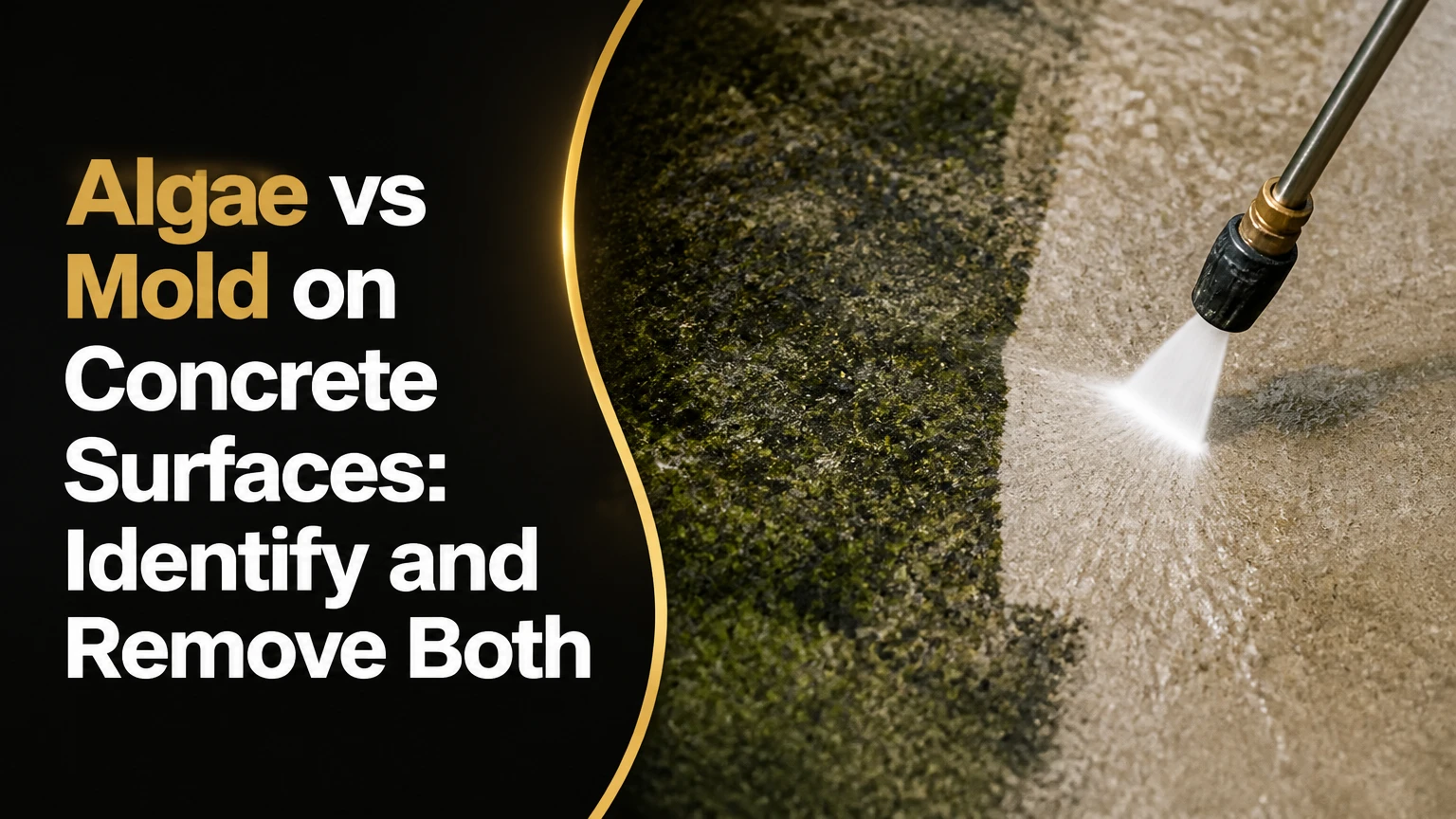
Algae on concrete is usually a photosynthetic surface film that needs light and recurring moisture, while mold is a fungus growing on damp organic residue. Green, slippery growth outdoors is more likely algae, but dark staining alone cannot identify mold. Texture, moisture pattern, location, and a controlled cleaning test provide a better diagnosis.
Key Facts at a Glance
Algae requires light, water, and carbon dioxide; mold requires moisture and an organic food source.
Green, slick films following irrigation or runoff are commonly algae or a mixed biofilm.
Concrete is inorganic, so mold usually colonizes dust, soil, leaves, oils, or other residue on its surface.
Black staining is not proof of toxic black mold, and visual inspection cannot identify a mold species.
Efflorescence is a mineral deposit, not a living organism, and usually appears as a dry white powder.
Removing the moisture source is more important for long-term control than choosing between pressure washing and soft washing.
Algae vs Mold on Concrete Surfaces: The Core Difference
Algae makes food through photosynthesis and uses concrete mainly as a supporting surface. Mold obtains nutrients by decomposing organic material that has accumulated on or near the concrete, such as soil, pollen, wood fragments, dust, or food residue.
The distinction matters because the organisms respond to different conditions. Algae commonly occupies sunlit patios, steps, retaining walls, and driveways exposed to irrigation overspray. Mold is more common in shaded, poorly ventilated, persistently damp locations, especially basements, crawlspaces, garages, and areas affected by leaks.
The AI Overview is directionally correct about sunlight, moisture, and nutrient sources, but two details need correction. Algae are not all “simple plants,” and they do not consume limestone filler particles as a normal food source. Also, mold on concrete does not automatically mean structural damage or a high health risk. The risk depends on species, exposure, area, occupants, and moisture conditions.
How Do Algae and Mold Grow on Concrete?
Algae uses light energy to convert water and carbon dioxide into organic compounds. Concrete pores provide attachment points and retain thin water films, while runoff supplies minerals and carries dust that can support a broader biofilm.
Mold spores are widespread indoors and outdoors. A spore can germinate when the surface remains damp long enough and organic debris supplies carbon. Mold hyphae may penetrate surface pores, but ordinary surface colonization does not mean the concrete itself is being eaten or weakened.
The U.S. Environmental Protection Agency states, “The key to mold control is moisture control.” That principle applies to both organisms, although algae control also requires reducing light or nutrient-laden wetting where practical.
How Do You Tell Algae From Mold?
Algae is more likely when growth is green, smooth, slimy, and arranged in streaks that match water flow. Mold is more likely when growth is fuzzy, powdery, irregular, or concentrated in a dark, humid area with visible organic residue.
No color test is definitive. Green mold exists, algae can darken, and outdoor concrete often carries algae, fungi, bacteria, and soil in the same thin biofilm. A hand lens can reveal texture, but species-level identification requires laboratory analysis and is rarely necessary for exterior cleaning.
| Observation | More consistent with algae | More consistent with mold | Important limitation |
|---|---|---|---|
| Color | Bright green, yellow-green, dark green | White, gray, olive, brown, black | Color alone cannot identify either organism |
| Texture | Slick, smooth, gelatinous when wet | Fuzzy, velvety, powdery, patchy | Old dried algae may look crusty |
| Light | Indirect or direct daylight | Shade, darkness, or weak indoor light | Some fungi tolerate outdoor sunlight |
| Water pattern | Runoff stripes, sprinkler arcs, damp edges | Leak zones, condensation, stagnant corners | Mixed growth can follow the same pattern |
| Typical site | Walkways, patios, pool surrounds | Basements, crawlspaces, damp garages | Outdoor mold also occurs on dirty concrete |
| Main immediate concern | Slip hazard when wet | Exposure and persistent moisture | Neither observation proves a health diagnosis |
Is Green Growth on a Patio Always Algae?
Green growth on a patio is often algae, but green mold, moss, lichen, and mixed biofilm remain possible. A smooth film that becomes extremely slippery after rain points toward algae, while a raised, hairy colony in a persistently damp shaded corner points more toward mold.
Moss has visible leaf-like structures and tends to form cushions or tufts. Lichen often appears as a firmly attached, crusty gray, orange, or green growth. A bacterial or fungal biofilm may feel slimy without being predominantly algae.
Is Black Staining Always Black Mold?
Black staining is not always mold and is not evidence of “toxic black mold.” Dark marks may come from algae, Cladosporium, soot, tire rubber, tannins, rust, oil, dirt, or cyanobacteria. Stachybotrys chartarum is associated with persistently wet materials containing cellulose, such as gypsum board and paper, rather than being diagnosed from a black mark on bare concrete.
The names “black algae” and “black spot” are used inconsistently by cleaning companies. Gloeocapsa magma is commonly discussed in roofing contexts, but a homeowner should not identify a concrete stain as that species from appearance alone.
What Else Could the Concrete Stain Be?
Concrete discoloration can be mineral, chemical, biological, or mechanical. Identifying the category prevents unnecessary biocide use and avoids aggressive cleaning that damages the cement paste.
| Look-alike | Typical appearance | Useful clue | Appropriate first response |
|---|---|---|---|
| Efflorescence | White, dry, powdery crust | Reappears after moisture migration | Brush dry, correct water entry |
| Rust | Orange, red-brown spots | Near steel, fertilizer, or metal furniture | Identify source, use concrete-safe rust treatment |
| Oil | Dark translucent patches | Softens or spreads with petroleum cleaner | Absorb, then use an alkaline degreaser |
| Tire transfer | Black-gray arcs or rectangles | Matches parked tire contact | Use a rubber-mark or alkaline cleaner |
| Lichen | Crusty attached gray, orange, or green growth | Firm attachment and lobed texture | Wet removal and masonry-safe treatment |
| Moss | Tufted green structures | Leaf-like stems or cushions | Remove mechanically and improve drainage |
| Soot or carbon | Flat gray-black film | Near exhaust, fire, or chimney | Detergent cleaning after source control |
How Can You Check for Efflorescence?
Efflorescence is a water-carried salt deposit, not mold. A dry brush usually removes some of it, and a small damp test area may dissolve or become transparent; vinegar can react with some alkaline deposits, but vinegar is not a reliable universal diagnostic and should not be used broadly without a compatibility test.
A white colony that remains fuzzy after drying is more consistent with biological growth. If white deposits return after rain or basement humidity, investigate water movement through the slab or wall instead of repeatedly applying disinfectant.
Does Algae or Mold Damage Concrete?
Algae usually creates a cosmetic film and a serious slip hazard, while mold is usually a surface moisture indicator rather than a direct structural threat to sound concrete. Damage becomes more plausible when biological growth retains water, traps abrasive soil, blocks drainage, or occupies already deteriorated concrete.
Repeated wetting and freezing can enlarge existing cracks and cause scaling or pop-outs. The freeze-thaw mechanism is caused by water and temperature cycling, not by mold digesting cement. In warm climates, the more common consequences are staining, slippery surfaces, joint deterioration, and accelerated surface wear.
A polished, painted, sealed, or decorative slab can be damaged by aggressive scrubbing or incompatible chemicals before the organism itself causes meaningful harm. Test a small hidden area first.
What Health Risk Does Mold on Concrete Create?
Mold on concrete can contribute to allergic or respiratory irritation, especially when disturbed and aerosolized, but the presence of a dark stain does not establish toxicity. The Centers for Disease Control and Prevention advises removing mold and fixing the moisture problem rather than relying on species labels for ordinary household decisions.
People with asthma, mold allergies, chronic lung disease, or immune suppression may need a lower threshold for professional assessment. Outdoor algae generally presents a physical fall risk, while indoor mold raises additional exposure concerns because enclosed spaces concentrate spores and cleaning aerosols.
Which Cleaning Method Should You Use?
For small outdoor growth, detergent and mechanical scrubbing may be sufficient; for extensive algae or mold, a labeled concrete-safe biocide or dilute sodium hypochlorite can work when used with runoff controls. Pressure washing removes residue quickly, but excessive pressure can etch concrete and spread contaminated water.
| Method | Typical equipment or concentration | Best use | Main limitation |
|---|---|---|---|
| Detergent scrub | Stiff nylon brush, 1-2 gallons water | Light film, small patio | More labor, limited deep staining |
| Oxygen-based cleaner | Product-specific dilution, dwell time | Sensitive landscaping areas | Often slower than chlorine chemistry |
| Sodium hypochlorite | Product label dilution, plastic sprayer | Exterior biological staining | Plant, skin, and runoff hazards |
| Pressure washing | 25-40 degree fan tip, controlled distance | Rinse and physical removal | Can etch cream layer or drive residue |
| Professional soft washing | Metered chemical application and recovery | Large or difficult exterior areas | Requires competent chemical handling |
| HEPA-contained cleaning | HEPA vacuum, damp methods, containment | Indoor mold-sensitive work | Not a substitute for leak repair |
“Soft wash” is not a magic category. The result depends on concentration, dwell time, surface temperature, agitation, and rinsing. A low-pressure application that dries immediately can perform worse than a carefully controlled moderate-pressure rinse.
How Do You Remove Algae or Mold From Outdoor Concrete?
Outdoor concrete growth can usually be removed in six controlled steps over 1-3 hours for a typical 400-500 square-foot driveway. The success factor is keeping the treatment wet for its labeled dwell time while preventing chemical runoff into plants, drains, ponds, or neighboring property.
Before You Start
| Item | Typical requirement | Safety or compatibility note |
|---|---|---|
| Work area | 400-500 square feet | Estimate chemical quantity before mixing |
| Time | 1-3 hours | Add time for plant protection and drying |
| Cleaner | Label-directed concrete product | Never improvise concentrated mixtures |
| Sprayer | 1-2 gallon plastic pump sprayer | Do not use metal equipment with corrosive bleach |
| Brush | Stiff synthetic or nylon bristles | Avoid wire brushes on finished concrete |
| PPE | Chemical-resistant gloves, goggles, long sleeves | Use respiratory protection according to label |
| Rinse water | Garden hose or controlled washer | Prevent dirty water from entering storm drains |
Step 1: Remove Dry Debris
Sweep leaves, soil, pollen, and loose flakes from the concrete. Organic debris feeds mold and shields algae from the cleaning solution.
You will know the step worked when the surface shows its actual stain pattern rather than a layer of loose dirt. The common mistake is wetting the debris first, which turns dry soil into a smear that blocks cleaner penetration.
Step 2: Protect Surrounding Areas
Pre-wet nearby grass, shrubs, flowers, painted surfaces, and metal fixtures with clean water. Cover vulnerable plants when practical, and plan where rinse water will flow.
You will know the area is protected when foliage is saturated and runoff can be directed onto a suitable vegetated area or collected. The common mistake is treating the concrete before checking a downspout, drain, or pond downhill.
Step 3: Apply a Compatible Cleaner
Apply a labeled concrete cleaner or biocidal product evenly with a plastic pump sprayer. If using sodium hypochlorite, follow the product label and never mix it with acids, ammonia, vinegar, or other cleaners.
Household bleach commonly contains about 5-6% sodium hypochlorite, while pool products may contain about 10-12.5%, but age and storage change strength. A fixed “1:1” recipe is not universally safe or necessary. Product concentration, surface porosity, temperature, and plant exposure determine the appropriate dilution.
You will know the step worked when the entire affected area is uniformly wet. The common mistake is applying too little solution to save material.
Step 4: Maintain Dwell Time
Keep the cleaner wet for the label-specified period, often 5-15 minutes for exterior biological staining. Reapply a light mist if the surface begins drying, especially in wind or direct summer sun.
You will know the step worked when green growth loses color and the film loosens before rinsing. The common mistake is allowing a chlorine solution to dry, which increases residue and reduces controlled treatment.
Step 5: Agitate the Surface
Scrub stubborn areas with a stiff synthetic brush after the cleaner has had time to work. Use overlapping strokes on steps, ramps, joints, and textured concrete because those locations retain more residue.
You will know the step worked when the film releases without gouging the cement paste. The common mistake is using a wire brush, which can scratch decorative finishes and leave rust-prone metal fragments.
Step 6: Rinse With Controlled Pressure
Rinse from the cleanest edge toward the drainage point. If using a pressure washer, start with a wide fan tip, keep the nozzle moving, and begin at least 12 inches from the surface, increasing distance if the concrete is soft or decorative.
You will know the step worked when no slippery residue remains underfoot after rinsing. The common mistake is using a narrow 0-degree tip or holding a high-pressure stream stationary.
How Should Indoor Concrete Mold Be Handled?
Indoor concrete mold requires moisture correction, dust control, and limited water use rather than outdoor pressure washing. Small surface areas may be cleaned with damp methods, but widespread growth, sewage contamination, HVAC involvement, or vulnerable occupants justify professional assessment.
Do not pressure wash a basement floor or foundation wall indoors. High-volume water raises humidity, spreads contaminated liquid, and can move moisture into joints and porous materials.
Basement and Crawlspace Procedure
- Stop the leak or condensation source before cleaning.
- Isolate the work area when disturbing visible growth.
- Remove porous contaminated materials that cannot be cleaned.
- Use damp wiping, HEPA vacuuming, or a labeled cleaner appropriate for concrete.
- Dry the area with dehumidification and airflow.
- Keep indoor relative humidity below 50-60%, with the lower end preferred when mold has recurred.
The EPA advises that moldy porous materials may need disposal, while hard surfaces can often be cleaned and dried. A quaternary ammonium product may be appropriate only when its label permits concrete use. Never combine it with bleach or another disinfectant.
How Much Does Concrete Growth Removal Cost?
Typical DIY material costs range from $25-$100, while professional exterior washing commonly costs about $0.15-$0.55 per square foot, depending on access, staining, chemical handling, and local labor. Indoor remediation costs much more because containment, drying, disposal, and verification may be required.
| Project type | Typical area or scope | Typical cost | Typical duration |
|---|---|---|---|
| DIY small patio | 100-250 square feet | $25-$60 | 1-2 hours |
| DIY driveway | 400-500 square feet | $40-$100 | 2-4 hours |
| Professional exterior wash | 400-500 square feet | $100-$350 | 1.5-3 hours |
| Basement surface cleaning | 100-500 square feet | $500-$2,500 | 1-3 days |
| Extensive indoor remediation | Multiple rooms or HVAC impact | $2,000-$10,000+ | Several days |
| Concrete repair after scaling | Cracks, spalls, or surface loss | $300-$3,000+ | 1-5 days |
These are typical planning ranges, not guaranteed quotes. Local labor, access, containment, disposal, test requirements, and the underlying water problem can move the price substantially.
Why Does Growth Return After Cleaning?
Growth returns when the concrete repeatedly receives moisture, shade, organic debris, or contaminated runoff. A cleaning treatment removes existing organisms but does not change a leaking gutter, sprinkler arc, condensation problem, blocked drain, or shaded surface.
Use this prevention sequence:
- Redirect downspouts at least several feet away from the slab where site conditions allow.
- Adjust sprinklers so they do not wet walls, steps, or paving daily.
- Improve slope and drainage around low areas.
- Remove leaves and soil from joints and edges every few weeks during wet seasons.
- Increase airflow around shaded walls by pruning vegetation where appropriate.
- Repair cracks and failed sealant that hold water.
- Consider a breathable penetrating silane-siloxane sealer for suitable exterior concrete.
Sealer reduces water absorption but does not sterilize an already dirty surface. It can also change appearance and traction, so confirm that the product is designed for the concrete finish and traffic conditions.
How Long Will a Cleaning Last?
A typical exterior cleaning may remain visibly effective for 3-12 months in a wet, shaded setting and longer in a sunny, well-drained area. A penetrating sealer may extend the interval, but no sealer guarantees 18-36 months because climate, irrigation, shade, and surface contamination control the regrowth rate.
What Are the Most Common Cleaning Mistakes?
The most damaging mistake is treating a moisture problem as a stain problem. The organism returns because the environment remains suitable.
| Mistake | Likely result | Better correction |
|---|---|---|
| Using 4,000 PSI with a narrow tip | Etched or streaked concrete | Use a wide fan and moving passes |
| Mixing bleach with vinegar or ammonia | Toxic gas or hazardous reaction | Use one labeled product at a time |
| Applying cleaner in full sun until dry | Uneven cleaning and residue | Work in small sections and maintain wetness |
| Ignoring plant runoff | Leaf burn or vegetation loss | Pre-wet, divert, and rinse foliage |
| Calling every black mark mold | Wrong treatment and unnecessary alarm | Check texture, source, and look-alikes |
| Cleaning without fixing drainage | Regrowth within weeks or months | Repair water entry before retreating |
What If Green Streaks Return in Two Weeks?
Green streaks returning within two weeks usually indicate continuing wetting, incomplete coverage, or organic residue left in textured pores. Check sprinklers, gutters, shade, and drainage before increasing chemical strength.
Retreat only with a product labeled for the surface and organism. Use a test patch, maintain the required dwell time, scrub mechanically, and rinse thoroughly. If the stain persists without biological texture, investigate rust, oil, tire transfer, or mineral discoloration instead of repeating biocide treatment.
Which Treatment Fits Your Situation?
The correct choice depends more on location and surface condition than on color. A shaded patio, indoor foundation wall, and painted concrete floor require different controls.
For a Slippery Outdoor Walkway
Treat the area promptly because algae creates a fall hazard when wet. Prioritize physical removal, drainage correction, and a traction-safe finish rather than relying on a decorative sealer.
For a Shaded Patio With Green Film
Use a labeled cleaner, nylon agitation, and controlled rinsing. Trim or redirect the moisture source if plants or sprinklers keep the slab damp.
For a Basement Foundation Wall
Avoid pressure washing. Fix bulk water, condensation, or humidity first, then use damp cleaning methods and professional help if the affected area is extensive or occupants are medically vulnerable.
For a Painted or Decorative Concrete Surface
Read the coating manufacturer’s instructions before using bleach, strong alkaline cleaner, or pressure. A chemical that is acceptable on bare gray concrete can fade acrylic coatings or damage exposed aggregate.
For a Commercial Walkway or Ramp
Document slip zones, drainage defects, cleaning dates, and recurrence. Schedule inspection before wet seasons, but use a facility-specific risk assessment rather than an automatic twice-yearly chemical program.
When Should You Hire a Professional?
Hire a qualified remediation or cleaning professional when mold covers a large indoor area, follows sewage or flood water, affects HVAC components, returns after moisture correction, or occurs around occupants with significant respiratory or immune conditions. Professional help is also sensible when the concrete is structurally deteriorated or chemically sensitive.
A cleaner is not automatically a mold remediator. Ask whether the provider controls dust, contains indoor work, handles contaminated materials, protects plants, manages wastewater, and documents the moisture correction. Mold testing is not always required for ordinary visible growth, and a species name does not replace removal and drying.
FAQ
Can Algae Grow in the Shade?
Algae can grow in indirect light and shaded outdoor locations if moisture remains available, although dense darkness favors fungi more than photosynthetic algae. A shaded, wet patio can therefore contain a mixed biofilm rather than a single organism. Texture and water pattern remain more useful than shade alone.
Does Mold Eat Through Concrete?
Mold generally does not digest the mineral cement matrix as a food source. Mold grows on organic residue, coatings, dust, or embedded contaminants at the surface. Moisture associated with mold can still worsen existing concrete deterioration through freeze-thaw cycling, corrosion around exposed reinforcement, or repeated saturation.
Is Bleach the Best Cleaner for Concrete Growth?
Bleach can rapidly discolor and kill much surface biological growth, but it is not automatically the best cleaner for every concrete surface. Bleach creates plant, skin, runoff, and mixing hazards, while some coatings and sealers are incompatible. A labeled concrete-safe product and controlled mechanical cleaning may be safer.
Should I Test the Stain for Mold?
Routine species testing is usually unnecessary for a small visible outdoor stain because the practical response is removal and moisture control. Testing or professional assessment becomes more useful when indoor growth is extensive, the HVAC system is involved, occupants have serious health vulnerabilities, or the source and extent are uncertain.
Does a Concrete Sealer Stop Algae and Mold Permanently?
Concrete sealer does not permanently stop algae or mold. A suitable penetrating sealer can reduce water absorption and slow recurrence, but leaves, shade, irrigation, and drainage still determine surface moisture. Clean and dry the concrete first, then confirm that the selected sealer preserves required traction.
The Bottom Line
Algae is the more likely explanation for a green, slick film on sunlit or partially shaded outdoor concrete, while mold is more likely in persistently damp, enclosed, organic-dirty areas. The safest decision comes from combining color, texture, moisture pattern, and location rather than labeling every dark stain as mold.
For algae vs mold on concrete surfaces, remove loose debris, control water, use a compatible cleaner, maintain wet dwell time, scrub with synthetic bristles, and rinse without etching the slab. Treat indoor growth and extensive recurrence as moisture-management problems, not merely washing jobs.