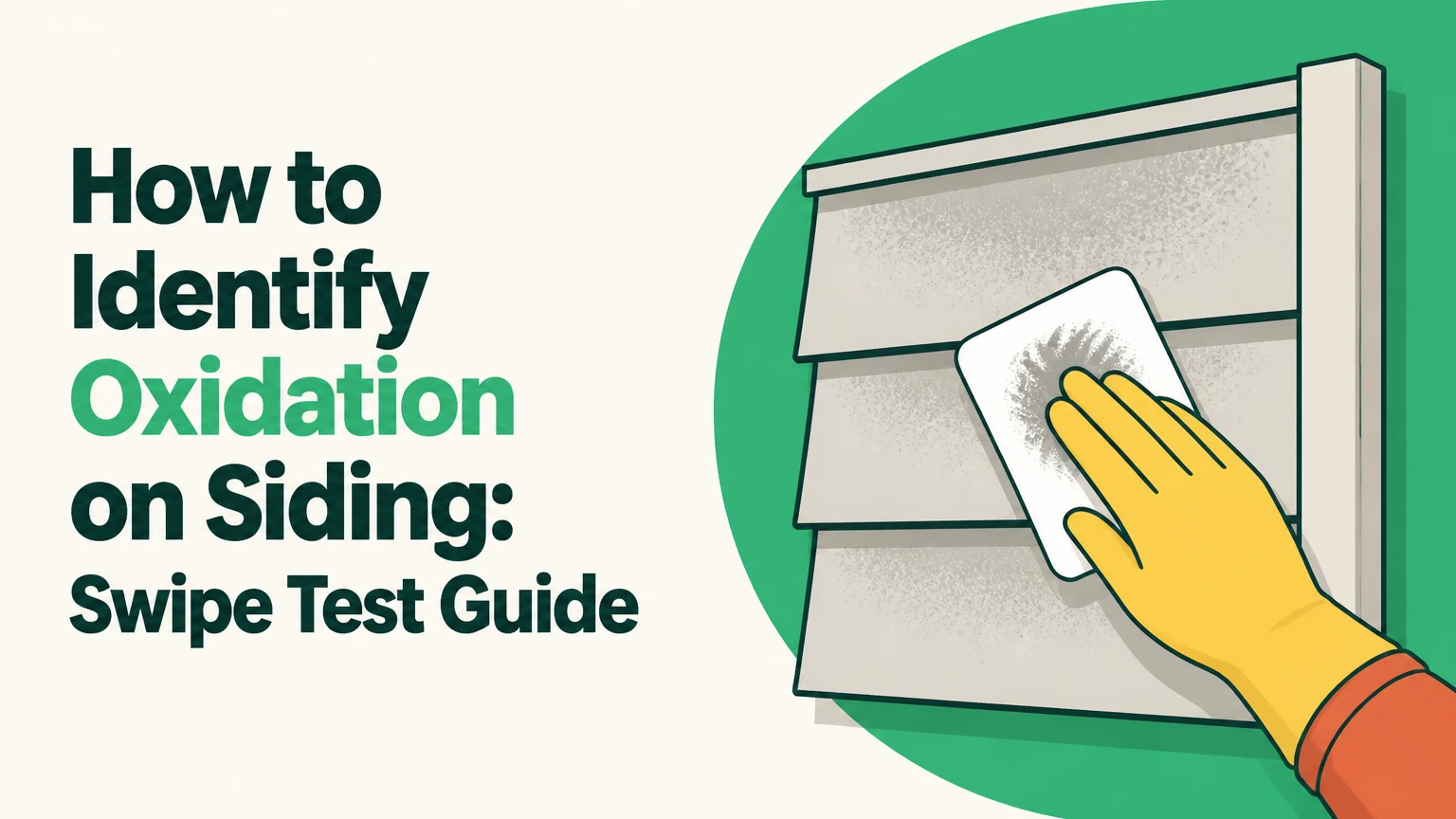
Vinyl siding oxidation is surface weathering that produces a dull finish and chalky residue after prolonged ultraviolet exposure, heat, oxygen, and outdoor pollutants affect the PVC surface. To identify it, inspect dry panels for directional fading, compare sun-exposed and shaded areas, then swipe a dark cloth across the siding and check for loose white or pale powder.
Key Facts at a Glance
- Oxidized vinyl siding usually feels dry, dusty, or slightly rough rather than slimy.
- A clean dark microfiber cloth is more reliable than a fingertip for detecting light chalking.
- South- and west-facing elevations often weather sooner because they receive stronger afternoon sunlight.
- Oxidation can be cleaned when the vinyl remains flexible, intact, and structurally sound.
- Bleach can affect mildew and algae, but a bleach test alone cannot prove that a surface is oxidation-free.
- Cracks, brittle panels, severe fading, or recurring chalk after proper cleaning may justify painting or replacement.
Why Does Vinyl Siding Oxidize?
Vinyl siding oxidizes when solar ultraviolet radiation and weathering gradually alter the exposed PVC surface, binders, and colorants. The surface loses smoothness, becomes less reflective, and releases loosely attached weathered material that appears as chalk.
Titanium dioxide is commonly used as a white pigment and ultraviolet stabilizing component in vinyl siding, but the common explanation that oxidation simply “releases” titanium dioxide is incomplete. Chalking is a broader surface-weathering process involving the polymer matrix, pigments, additives, dirt, and repeated heating and cooling. The exact residue depends on the siding formulation, color, age, and environment.
The Vinyl Siding Institute’s care guidance recommends following the siding manufacturer’s cleaning instructions and using ordinary household cleaning methods rather than assuming every restoration chemical is compatible. That limitation matters because a cleaner can remove dirt while leaving weathered polymer, or soften a degraded surface that no longer has much serviceable material.
What Conditions Accelerate Chalking?
| Condition | Typical effect on siding | Inspection implication |
|---|---|---|
| South or west exposure | Stronger daily UV and afternoon heat | Check these elevations first |
| Dark siding color | Greater heat absorption and visible fading | Compare hidden and exposed areas |
| Coastal or industrial air | Salt, soot, and pollutants increase surface deposits | Rinse and test after cleaning |
| 15- to 25-year-old siding | Higher probability of chalking and brittleness | Check flexibility before restoration |
| Tree or sprinkler exposure | Moisture, algae, and mineral spotting | Rule out organic growth and deposits |
Oxidation is not automatically a structural failure. A panel may chalk while remaining usable, especially when the weathered layer is thin and the locking edges, nail hem, and seams remain intact. Conversely, a clean-looking panel can still be brittle if its plasticizers and surface protection have deteriorated.
What Does Oxidized Siding Look and Feel Like?
Oxidized siding usually looks faded, gray-white, frosted, or unusually dull, with the strongest change on broad sun-facing walls. The surface commonly feels dry and powdery, and a firm swipe with a dark cloth transfers pale residue that is difficult to attribute to ordinary dust alone.
Inspect the siding at eye level and from an angle. Gloss loss often appears before heavy powdering, while advanced chalking can make a colored panel look several shades lighter than the original product. The most useful visual clue is a pattern that follows exposure: areas under eaves, window projections, shutters, and porch roofs retain more color than adjacent uncovered panels.
Look for continuity across several panels. Oxidation usually affects a broad exposure zone, whereas a fertilizer splash, hard-water deposit, or detergent streak follows a local shape. Record the elevation, color, panel profile, and approximate installation age before cleaning because those details help explain uneven results.
Step 1: Inspect a Dry, Clean Test Area
Choose a 2-foot by 2-foot section away from corners, downspouts, hose bibs, and visibly dirty ground-level trim. Let the siding dry for at least one hour after rain or rinsing, then inspect the surface in indirect daylight.
Check four attributes:
- Color: Is the exposed panel substantially lighter than the protected area?
- Sheen: Does the panel look matte or frosty instead of uniform and slightly reflective?
- Texture: Does the surface feel dusty, rough, or dry?
- Pattern: Does the change follow sun exposure rather than a splash or runoff path?
You will have a stronger oxidation indication when all four clues occur together. A single white mark is not enough because mineral deposits, dried cleaner, and bird residue can look similar.
Step 2: Perform the Dark-Cloth Swipe Test
Rub a dry, dark microfiber cloth firmly across a clean, dry section for approximately 10-15 seconds. Use a fresh part of the cloth for each test area, including one shaded control area and one exposed area.
| Swipe result | Likely meaning | Next action |
|---|---|---|
| No visible transfer | Little or no loose chalk | Inspect for fading and brittleness |
| Fine pale haze | Early or light chalking | Test a small cleaning area |
| Obvious white powder | Moderate surface oxidation | Assess cleaning compatibility |
| Thick residue with dirt | Oxidation plus accumulated soil | Clean a controlled test panel |
| Sticky or greasy transfer | Coating, adhesive, or pollutant | Do not treat as ordinary oxidation |
A fingertip can detect heavy chalk, but skin oil and moisture can change the result. A dark microfiber cloth provides a clearer visual record, and photographing the cloth beside the test area creates useful documentation for a contractor or warranty claim.
Step 3: Compare Sun and Shadow Areas
Compare an exposed panel with a similar panel under a roof eave, porch ceiling, window sill, or permanently shaded projection. Oxidation becomes more likely when the protected section retains deeper color and the exposed section has both lower sheen and powder transfer.
The shadow test has limits. Shaded panels can remain dirty, and recently washed siding may temporarily show less residue. North-facing walls can also chalk in climates with strong reflected light, while trees may shade a south wall unevenly. Use the shadow comparison as supporting evidence, not as a standalone diagnosis.
Is Oxidation the Same as Mildew or Mineral Deposits?
Oxidation is a dry, powder-forming surface-weathering condition, while mildew is a biological growth and mineral deposits are inorganic residue left by water or masonry materials. Texture, distribution, moisture behavior, and controlled cleaning response separate these conditions more reliably than color alone.
| Surface condition | Typical appearance | Texture or pattern | Safer first check |
|---|---|---|---|
| Vinyl oxidation | Dull white, gray, or faded color | Dry powder across sun-exposed panels | Dark-cloth swipe |
| Mildew | Black, gray, or green spotting | Speckles or colonies in damp shade | Manufacturer-approved cleaner |
| Algae | Green or dark green film | Moisture-related streaks | Inspect nearby water source |
| Efflorescence | White crystalline deposit | Concentrated near masonry or joints | Check adjacent mortar and runoff |
| Hard-water scale | White rings or vertical spots | Follows sprinkler or drip paths | Inspect irrigation and water marks |
| Dried detergent | White streaks or cloudy film | Matches application and rinse paths | Re-rinse a small area |
A diluted bleach solution may lighten mildew or algae, but bleach is not a conclusive oxidation test. It can damage nearby plants, discolor some surfaces, corrode metal, and create hazardous fumes when mixed with acids or ammonia. If a spot test is necessary, follow the siding manufacturer’s dilution directions, protect vegetation, wear eye protection, and test an inconspicuous area first.
How Can You Rule Out a Paint or Coating Problem?
A painted or coated panel may shed residue differently from unpainted vinyl. Look for peeling edges, an abrupt color boundary, roller marks, gloss variation, or a film that transfers as flakes instead of fine powder.
Ask whether the siding was previously painted, treated with a restorer, or exposed to overspray. A topical coating can fail through poor preparation even when the underlying vinyl is intact. Chemical restoration cannot reliably correct peeling paint, and aggressive scrubbing may enlarge the failure.
How Severe Is the Oxidation?
Oxidation severity depends on residue quantity, color loss, surface integrity, and panel flexibility, not on age alone. Light chalking may respond to careful cleaning, while deep weathering combined with brittleness or cracking indicates that restoration has limited value.
| Severity | Field signs | Typical response |
|---|---|---|
| Light | Slight matte finish, faint cloth transfer | Gentle cleaning and monitoring |
| Moderate | Visible fading, clear powder, uneven sheen | Controlled restoration test |
| Heavy | Thick chalk, strong color loss, rough surface | Professional evaluation |
| Advanced | Cracks, brittleness, warped edges, failed locks | Replacement planning |
| Mixed | Clean sections beside coated or stained areas | Separate each surface condition |
Typical onset occurs around 10-15 years on exposed vinyl, but the range is not a service-life rule. A dark product in a hot, high-UV climate may show noticeable fading earlier, while a light-colored premium product under broad eaves may remain visually stable longer. Product warranty documents and installation records are more useful than age estimates alone.
What Should You Check Before Cleaning?
Press gently on an accessible panel, without bending the siding sharply. Vinyl should flex slightly and return to shape; a brittle panel may crack, whiten at the bend, or fail around the nail hem.
Inspect these areas before buying restoration chemicals:
- Nail hems and locking edges
- Bottom edges near splashback
- Seams and corner posts
- Holes, cracks, and warped sections
- Areas behind downspouts
- Previous paint or coating
- Caulked joints and replacement panels
Do not use a restoration wash to conceal structural damage. Cleaning cannot repair failed interlocks, impact cracks, water intrusion, or siding installed too tightly for thermal movement.
How Should You Clean Oxidized Siding?
Oxidized siding should be cleaned with a manufacturer-compatible product and low-pressure rinsing after a small test area confirms that the color and texture remain acceptable. The main success factor is complete, even removal without allowing the cleaner to dry on hot panels.
Before You Start
| Planning item | Typical requirement |
|---|---|
| Test area | 2 feet by 2 feet |
| Work sections | 6-10 feet wide |
| DIY labor | 6-10 hours for a 2,000-square-foot home |
| Professional labor | 4-8 hours for accessible, moderate oxidation |
| Basic tools | Pump sprayer, soft-bristle brush, garden hose |
| PPE | Chemical-resistant gloves, eye protection, long sleeves |
| Working condition | Shade, low wind, damp vegetation, no imminent rain |
| DIY cleaner budget | Approximately $0.10-$0.25 per square foot |
Product chemistry varies. Sodium metasilicate appears in some heavy-duty cleaners, but the ingredient alone does not establish that a product is safe for every vinyl formulation, painted surface, aluminum trim, plant, or sealant. Read the label, follow the siding manufacturer’s guidance, and never mix cleaners.
Step 1: Protect Plants and Adjacent Materials
Wet nearby vegetation, cover sensitive plants temporarily, and disconnect or protect outdoor electrical equipment. Close windows and doors, remove patio furniture, and identify surfaces that may react to alkaline cleaner, including natural stone, unfinished wood, and oxidized aluminum.
You will know the area is prepared when runoff can be controlled and no unprotected plant or porous material sits directly below the test section. A common mistake is beginning at the highest wall without planning where chemical runoff will travel.
Step 2: Apply Cleaner in the Shade
Work from the bottom upward when applying cleaner so dirty runoff does not create premature streaks, unless the product label specifies another method. Keep the panel uniformly wet and apply only enough solution to suspend soil and weathered residue.
Do not clean hot siding in direct sun. A product that dries before rinsing can leave streaks, discoloration, or concentrated chemical marks. The recovery is to re-wet the section, reapply according to the label, and rinse before the surface dries.
Step 3: Agitate With a Soft Brush
Use a soft nylon or car-wash brush with light pressure, following the siding profile rather than scrubbing across sharp edges. Avoid wire brushes, abrasive pads, melamine sponges, and aggressive scraping because they can scratch the PVC skin and create dirt-trapping grooves.
The test area is acceptable when residue loosens evenly without color bleeding, gloss changes, or visible brush marks. Stop immediately if the original color appears on the cloth in a way that suggests pigment loss rather than removable chalk.
Step 4: Rinse With a Garden Hose
Rinse thoroughly with clean water, working from the top down after the cleaner has been removed from the test area. A garden hose with a broad spray is generally easier to control than a pressure washer.
The Vinyl Siding Institute warns that concentrated water streams can force water behind siding and damage adjacent components. A pressure washer may be used only when the manufacturer permits it, with the lowest effective pressure, a broad tip, and a spray direction that does not drive water upward behind laps.
Step 5: Let the Test Dry and Reinspect
Allow the section to dry completely, then compare it with an untreated exposed panel and a shaded control. Cleaning can make permanent fading more obvious because the chalk had been masking the underlying color.
You will know the test succeeded when the panel is uniformly clean, the surface is not sticky or rougher than before, and no heavy chalk returns after several dry days. Do not clean the entire elevation until the test shows acceptable color and texture.
Which Restoration Path Fits the Siding?
Cleaning is the first choice for intact, flexible vinyl with removable chalk; painting is a color-management option for sound but permanently faded panels; replacement is the better path for brittle, cracked, warped, or repeatedly failing siding. The correct decision follows substrate condition rather than cosmetic frustration.
| Option | Typical cost | Typical duration | Best condition | Main limitation |
|---|---|---|---|---|
| DIY cleaning | $0.10-$0.25/sq. ft. | 6-10 hours | Light to moderate chalk | Labor and chemical handling |
| Professional restoration | $1.50-$3.50/sq. ft. | 4-8 hours | Broad, accessible oxidation | Results may last 2-5 years |
| Vinyl-safe painting | $2.50-$5.50/sq. ft. | 1-3 days | Stable, faded panels | Prep, maintenance, warranty limits |
| Siding replacement | $6-$12+/sq. ft. | 2-7 days | Brittle or damaged siding | Highest cost and disruption |
These are typical planning ranges, not national price guarantees. Labor access, stories, trim, repairs, disposal, regional wages, color changes, and substrate damage can move a quote substantially. Ask whether a professional estimate includes test cleaning, plant protection, panel replacement, rinsing, and post-cleaning inspection.
When Is a Vinyl Restorer Worth Considering?
A topical vinyl restorer may improve gloss after thorough cleaning, but it is not a permanent reversal of polymer weathering. The coating requires a uniformly clean, dry, compatible surface, and poor application can produce lap marks, peeling, uneven sheen, or future recoating difficulty.
Use a restorer only when the product is specifically rated for the siding material and the owner accepts periodic maintenance. A glossy finish can hide remaining chalk temporarily, so inspect the cloth and test panel before application. Do not treat a coating as evidence that the underlying vinyl has regained its original UV resistance.
When Should You Paint Instead?
Painting can make sense when the vinyl is flexible, firmly locked, free of major cracks, and permanently faded after cleaning. Use a high-quality exterior acrylic paint approved for vinyl, choose a color compatible with the siding manufacturer’s heat guidance, and follow the paint label.
Painting does not correct warped panels, failed seams, brittle nail hems, or water-management defects. It may also affect a manufacturer warranty, so check the warranty language before applying paint. On older siding, the cost of extensive preparation can approach replacement while offering a shorter maintenance cycle.
When Is Replacement the Better Choice?
Replacement is usually more defensible when oxidation appears with brittle panels, cracking, warping, loose locks, widespread impact damage, or recurring moisture problems. A contractor should inspect the wall assembly, flashing, sheathing, and trim rather than quoting new siding solely from surface color.
Replacement also makes sense when the desired color cannot be achieved safely with vinyl paint, or when more than one elevation has advanced weathering. Replacing one elevation can create color mismatch because newer vinyl rarely matches heavily faded existing panels.
What Mistakes Make Oxidation Look Worse?
The most damaging mistakes are high-pressure washing, applying chemicals to hot siding, using abrasive tools, and skipping a test section. Each mistake can convert a cosmetic chalking problem into staining, water intrusion, scratched panels, or an uneven finish.
- Using a narrow pressure-washer tip: Water can enter behind laps and around windows. Use a controlled hose rinse unless the manufacturer permits pressure washing.
- Letting cleaner dry: Dried alkaline solution creates streaks and concentrated marks. Work smaller sections in shade.
- Scrubbing with wire: Wire and abrasive pads damage the PVC surface. Use soft nylon bristles.
- Treating every white deposit as oxidation: Efflorescence and hard-water scale need a different diagnosis. Follow the runoff pattern.
- Cleaning only the obvious wall: Partial cleaning creates visible color boundaries. Test adjacent elevations before committing.
- Applying restorer over chalk: Residual powder undermines adhesion. The substrate must be clean and dry.
- Ignoring old repairs: Replacement panels, caulk, and paint can react differently from original vinyl. Test each material.
A practitioner rule of thumb is to stop a restoration project when the cleaning test reveals texture loss rather than color improvement. More chemical strength cannot rebuild weathered PVC, and additional scrubbing usually increases damage.
Why Does Chalk Return After Cleaning?
Chalk that returns within a month usually indicates incomplete removal, residue that was temporarily wetted rather than removed, or severe ongoing weathering. A clean, dry test panel should be monitored before the entire home receives a restorer or paint.
Check these causes in order:
- Incomplete cleaning: Compare the cloth transfer before and after drying.
- Uneven application: Overlapping spray bands can leave untreated strips.
- Surface residue: Rinse again with clean water and allow full drying.
- Advanced weathering: A rough, faded surface may continue shedding material.
- New contamination: Dust, pollen, or nearby construction residue can mimic returning chalk.
- Incompatible coating: A failing restorer can flake or powder independently of the vinyl.
If chalk returns after a properly controlled cleaning and the siding is also brittle, obtain a replacement assessment. Repeated chemical cycles can cost more than a targeted panel repair or planned re-side, especially on a two-story elevation.
What Should a Professional Assessment Include?
A competent siding assessment should identify the material, installation age, exposure pattern, surface condition, cleaning chemistry, and repair threshold before recommending restoration. A quote that says only “pressure wash exterior” does not establish that the contractor understands vinyl oxidation.
Request these details in writing:
- Cleaning method and maximum pressure
- Product name and label dilution
- Test-area procedure
- Protection for plants, windows, and metal
- Whether chalk removal or ordinary washing is included
- Treatment of paint, coating, mineral scale, and mildew
- Repairs included before cleaning
- Warranty impact and expected maintenance interval
- Photos of test results before full application
A professional cannot guarantee that cleaning will restore original color because UV exposure may have permanently changed the pigment. The honest deliverable is a documented test area and a clear decision about whether the remaining color justifies full treatment.
How Much Does Oxidation Treatment Cost?
Typical residential planning costs range from $0.10-$0.25 per square foot for DIY cleaning supplies, $1.50-$3.50 for professional restoration, $2.50-$5.50 for vinyl-safe painting, and $6-$12 or more for replacement. Actual pricing depends more on access, preparation, repairs, and siding condition than on square footage alone.
For a 2,000-square-foot siding area, those ranges imply approximately:
| Path | Typical unit range | Approximate 2,000-square-foot total |
|---|---|---|
| DIY supplies | $0.10-$0.25/sq. ft. | $200-$500 |
| Professional restoration | $1.50-$3.50/sq. ft. | $3,000-$7,000 |
| Professional painting | $2.50-$5.50/sq. ft. | $5,000-$11,000 |
| Replacement | $6-$12+/sq. ft. | $12,000-$24,000+ |
The calculation assumes the quoted square footage represents siding area, not total living area. Confirm measurements because contractors may price gables, trim, scaffolding, disposal, and substrate repairs separately.
FAQ
Can New Vinyl Siding Oxidize?
New vinyl siding can develop early chalking when it has unusually intense UV exposure, dark coloring, manufacturing defects, incompatible cleaners, or surface contamination. Noticeable powder on siding under a few years old should be documented with photographs and installation records before aggressive cleaning, because warranty review may be more appropriate.
Does Oxidation Mean Vinyl Siding Must Be Replaced?
Oxidation alone does not require replacement. Flexible panels with intact locks, seams, and edges may respond to careful cleaning, while oxidation combined with brittleness, cracks, warping, or repeated chalk return makes replacement more practical. A test area should determine whether the cosmetic improvement justifies full restoration.
Can I Remove Oxidation With Vinegar?
Vinegar may help with some mineral deposits, but it is not a dependable treatment for weathered PVC chalking. Acidic products can affect adjacent masonry, metals, plants, and sealants. Identify whether the deposit is mineral scale or oxidation before choosing chemistry, and follow the siding manufacturer’s cleaning instructions.
Will Rain Wash Oxidation Away?
Rain may remove loose dust but usually does not reverse vinyl oxidation. Repeated wetting can also leave mineral spotting or streaks as water evaporates. A dry-cloth test after the surface has fully dried provides better evidence than judging the siding immediately after rainfall.
Is White Powder on Dark Siding Always Oxidation?
White powder on dark siding is not always oxidation. Dried detergent, efflorescence, hard-water scale, construction dust, and coating failure can produce similar residue. Oxidation becomes more likely when the powder covers sun-exposed panels, accompanies matte fading, transfers onto a dry dark cloth, and contrasts with protected areas.
How Long Does Oxidation Removal Last?
A professional cleaning improvement may remain visible for approximately 2-5 years when the siding is sound and the exposure is moderate, but no fixed interval applies to every home. Dark colors, strong UV, coastal air, and advanced weathering shorten the cosmetic benefit. Replacement provides the longest-term change because it removes the weathered panels.
The Bottom Line
To identify oxidation on siding, inspect dry panels for directional fading and loss of sheen, compare exposed and shaded areas, and perform a dark-cloth swipe test for pale powder. Confirm the diagnosis against mildew, algae, mineral scale, and detergent residue before cleaning. If the vinyl remains flexible and intact, test a manufacturer-compatible low-pressure cleaning method; if the surface is brittle, cracked, warped, or repeatedly chalking, compare painting and replacement costs instead. Knowing how to identify oxidation on siding prevents unnecessary chemical treatment and helps match the repair to the actual condition of the panels.