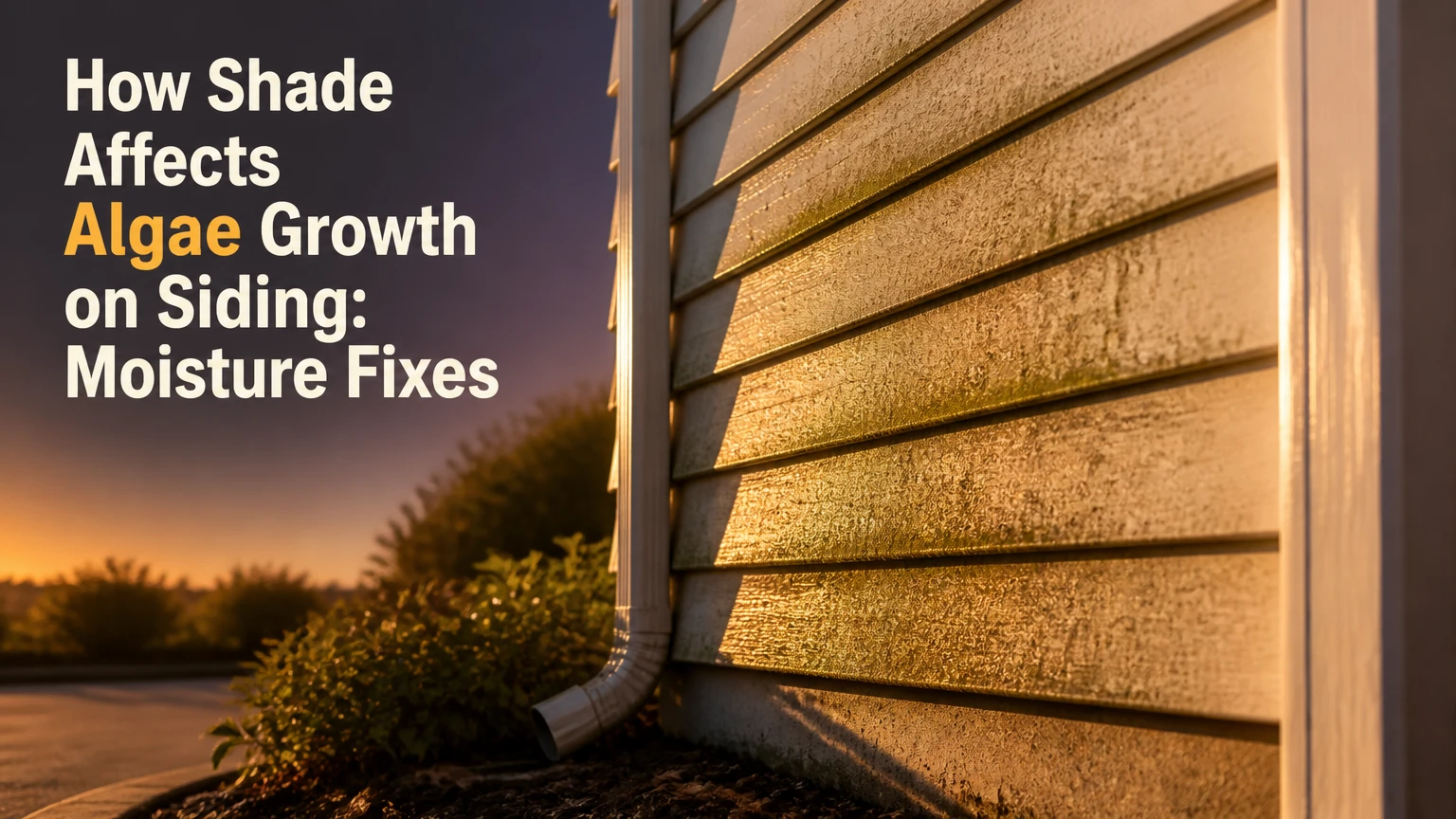
Shade usually increases algae growth on siding because it reduces solar heating and slows evaporation, leaving the surface damp for longer periods. Algae still need light for photosynthesis, so shade does not create algae by itself; the strongest growth occurs where shade combines with repeated wetting, humid air, poor airflow, surface dust, and a textured or porous finish.
Key Facts at a Glance
- Shaded siding often dries more slowly because trees, buildings, and roof overhangs reduce solar heating and wind exposure.
- Algae need moisture, light, and a small nutrient supply from dust, pollen, sap, or airborne organic residue.
- North-facing walls commonly show more growth in the Northern Hemisphere, but local wind, rainfall, trees, and wall orientation determine the result.
- Vinyl can stain in shade even though the material is non-porous because textured surfaces retain water and dirt.
- Wood siding has the highest structural risk because persistent moisture can support swelling, paint failure, fungal decay, and rot.
- Cleaning without correcting a gutter leak, dense canopy, or irrigation spray usually produces short-lived results.
Why Does Shade Increase Algae on Siding?
Shade increases algae on siding by extending the time that water remains available on the surface. A shaded wall receives less solar radiation, often has weaker air movement under vegetation, and may remain cool enough for dew or rainwater to persist after a sunny wall has dried.
Algae spores arrive through wind, splashback, birds, insects, and contaminated dust. Once a spore lands on a damp siding surface, water activates metabolism and allows attachment. Dust and pollen provide small amounts of nutrients, while light that penetrates the shade supports photosynthesis.
Shade is therefore a moisture-management problem rather than a simple absence-of-sun problem. Dense tree cover can also trap humid air against a wall, while branches may drip water onto the same area after rainfall. A north-facing wall under an overhang can be more affected than a south-facing wall beside an open lawn, even at the same latitude.
The U.S. Environmental Protection Agency summarizes the broader building-maintenance principle as, “The key to mold control is moisture control.” That statement concerns mold, but the same practical priority applies to exterior algae: reduce wetness duration before relying on repeated chemical cleaning.
Does algae need direct sunlight?
Algae do not need direct sunlight, but most algae need some usable light because photosynthesis supplies energy for growth. Bright indirect light, reflected daylight, and short periods of sun can support colonies, while deep darkness generally limits photosynthetic algae.
Direct ultraviolet radiation can damage exposed microorganisms, yet ordinary daylight is not a dependable disinfectant. A shaded wall can support more visible algae than a sunny wall when its longer wetting period outweighs the inhibitory effect of stronger UV exposure.
What nutrients does siding provide?
Siding rarely provides a rich food source by itself. Algae use light and carbon dioxide, while airborne deposits such as pollen, dust, bird residue, tree sap, and decomposing leaf particles create a favorable attachment surface and may support associated bacteria and fungi.
This distinction matters for vinyl. Vinyl does not become an algae food source merely because it is shaded. Its grooves and surface residue can retain water and organic particles, which lowers the time required for colonization.
How Does an Algae Colony Form?
An algae colony forms through deposition, wetting, attachment, growth, and repeated spread along water paths. The visible green or dark film is usually the late stage of a surface community, not a single large organism with roots.
- Deposition: Air movement, rain splash, birds, and nearby vegetation place microscopic cells or spores on the wall.
- Wetting: Dew, rain, condensation, irrigation, or gutter overflow supplies liquid water.
- Attachment: Cells adhere to rough paint, siding grooves, pores, and accumulated dust.
- Activation: Water allows photosynthetic activity and cell division when temperature and light are suitable.
- Expansion: Repeated wetting creates streaks below joints, windows, downspouts, and roof edges.
- Community formation: Algae may coexist with cyanobacteria, mildew, fungi, and lichen, making color alone unreliable for identification.
Algae commonly appear as green films, green streaks, or dull brown deposits. Black staining may indicate cyanobacteria, mildew, embedded dirt, oxidation, or another contaminant. Color should guide inspection, not determine the cleaning chemical automatically.
What makes shaded siding stay wet?
| Moisture source | Typical observation | Main risk | Corrective action |
|---|---|---|---|
| Tree canopy | Wall remains damp after midday | Slow evaporation and poor airflow | Prune branches and thin dense foliage |
| Gutter overflow | Vertical streak below roofline | Repeated concentrated wetting | Clear gutters and repair pitch or joints |
| Downspout discharge | Dark band beside corner | Saturated siding and foundation splashback | Extend outlet 1.5-3 metres where practical |
| Irrigation spray | Wet patch at lawn or bed height | Daily rewetting during warm periods | Redirect sprinkler heads |
| Condensation or humid air | Dew-like film without rain | Persistent surface moisture | Improve ventilation and reduce wall obstructions |
Which Siding Materials Are Most Affected by Shade?
Wood and textured stucco generally face the greatest combined risk from shade and moisture, while vinyl and fiber cement more often experience surface staining without immediate structural damage. Material condition, coating integrity, surface texture, and drainage can reverse that ranking on a particular house.
| Siding material | Surface behavior in shade | Main consequence | Relative cleaning risk |
|---|---|---|---|
| Painted wood | Absorbs water through failed paint and end grain | Swelling, peeling, fungal decay, rot | High, because aggressive pressure damages fibers |
| Stucco | Texture retains dust and water in pits | Embedded discoloration and cracking risk | Moderate to high, because water can enter cracks |
| EIFS | Finish coat and drainage details matter | Staining, moisture behind cladding if damaged | High, especially around openings and penetrations |
| Vinyl | Grooves retain film and organic residue | Green or dark surface streaks | Moderate, because panels can crack or lift |
| Fiber cement | Coating protects a relatively absorbent composite | Staining and coating deterioration | Moderate, with care around edges and joints |
| Aluminum | Smooth finish dries comparatively quickly | Oxidation, chalking, or surface staining | Moderate, because chemicals can discolor metal |
Vinyl siding
Vinyl siding commonly develops algae where shaded grooves collect dust and remain wet. The material itself is not a nutrient-rich porous substrate, so claims that a universal “static charge” makes vinyl inherently more vulnerable are not well established for ordinary residential siding.
Vinyl panels can tolerate gentle cleaning, but high pressure can drive water behind laps, loosen panels, damage caulk, or force dirt into seams. A low-pressure detergent application followed by a controlled rinse is safer than close-range blasting.
Wood siding
Wood siding has the highest consequence when shade preserves moisture. Water enters through worn paint, end grain, nail holes, joints, and unsealed cuts; repeated wetting can cause paint failure before rot becomes visible.
Algae is often a symptom rather than the primary structural threat. Inspect soft spots, cupped boards, peeling coatings, failed caulk, and damp areas near windows after cleaning. A clean appearance does not confirm that wood is dry or sound.
Fiber cement siding
Fiber cement siding usually resists biological damage better than unprotected wood, but its cut edges, joints, fastener locations, and worn coatings can absorb water. Shaded surfaces may retain algae staining longer because the film receives fewer drying cycles.
Keep spray away from panel edges and avoid forcing water into laps. Repainting can reduce future retention when the existing finish has chalked or failed, but paint cannot compensate for a leaking gutter or trapped vegetation.
Stucco and EIFS
Stucco and EIFS collect algae in textured recesses, especially beneath roof overhangs and beside dense planting. EIFS requires additional caution because damaged finish coats, joints, or flashing can allow water into wall assemblies.
Cleaning should not substitute for an envelope inspection. Cracks, open sealant joints, failed window transitions, and staining that returns in one narrow path require building-maintenance diagnosis rather than stronger chemicals.
Which Wall Locations Grow Algae Fastest?
The fastest-growing locations are shaded, repeatedly wetted areas with restricted airflow. North-facing walls often meet those conditions in the Northern Hemisphere, but a west-facing wall under trees or an east-facing wall below a leaking gutter can grow more algae than a clear north wall.
| Location | Why growth appears there | Inspection priority | Typical maintenance response |
|---|---|---|---|
| North wall under trees | Low winter sun and trapped humidity | High | Canopy thinning and annual inspection |
| Below roof gutters | Overflow creates repeated wetting | Very high | Gutter cleaning and leak repair |
| Beside downspouts | Concentrated runoff follows seams | Very high | Redirect discharge and repair splash damage |
| Behind shrubs | Restricted wind and poor access | High | Create a vegetation gap and improve airflow |
| Under roof overhangs | Rain protection also blocks sun | Moderate to high | Check condensation, dust, and airflow |
| Around window trim | Failed joints retain water | High | Repair sealant and inspect flashing |
A fixed statistic such as “80%-90% of severe cases occur on north and west walls” should not be generalized across climates. Coastal fog, prevailing wind, winter sun angle, tree density, wall insulation, and rainfall distribution change the pattern substantially.
How can you tell whether shade or water is the main cause?
Compare the stained area with nearby surfaces at the same height. If algae follows a downspout, window edge, sprinkler arc, or gutter joint, concentrated water is more important than orientation. If staining covers the entire wall behind dense foliage, shade and airflow are stronger suspects.
A practical check is to photograph the wall at morning, noon, and late afternoon after rain. Record when the surface first looks dry. Persistent dampness into the afternoon, especially beside a drainage component, identifies a correctable moisture source.
What Is the Safest Way to Clean Shaded Siding?
The safest general method is low-pressure washing with a siding-compatible cleaner, adequate dwell time, and thorough control of runoff. The exact product, dilution, and dwell period must follow the label because bleach, quaternary ammonium compounds, oxygen cleaners, and alkaline detergents have different risks.
Before cleaning
- Identify the siding material and locate loose paint, cracks, failed caulk, and open joints.
- Disconnect or protect outdoor electrical equipment and cover delicate plants.
- Test the cleaner on an inconspicuous 30-centimetre area.
- Use gloves, eye protection, protective clothing, and the label-required respiratory precautions.
- Keep runoff away from ponds, storm drains, edible gardens, and sensitive landscaping.
- Work in sections small enough to keep the surface wet for the stated dwell time.
Apply cleaning solution according to the product label. Many professionals apply from the bottom upward to reduce uneven dirty streaks during dwell time, then rinse from the top downward. That sequence is not universal; the label and siding manufacturer take priority.
Use the least force that removes the residue. A wide fan nozzle, greater distance, and low-pressure rinse reduce the chance of driving water behind panels or removing paint. Never aim directly into siding laps, window seals, soffit vents, or electrical penetrations.
Cleaning method comparison
| Method | Typical homeowner cost | Best use | Main limitation |
|---|---|---|---|
| Garden sprayer cleaner | $20-$60 in materials | Light film on accessible vinyl | Slow visual results and runoff control required |
| Soft washing | $250-$800 per house, typical U.S. range | Whole-house organic staining | Chemical handling and recurring service cost |
| Low-pressure rinse with detergent | $100-$300 rented equipment and supplies | Moderate surface residue | Requires careful technique and water access |
| High-pressure washing | $150-$500 service range | Limited hard, sound surfaces | Can damage paint, wood, seals, and panel joints |
| Manual soft-brush cleaning | $30-$100 in tools | Small areas and delicate finishes | Labor-intensive and easy to over-scrub coatings |
Prices vary by country, house size, access, height, travel, and contamination. The Bangladesh taka figures in the supplied overview should not be treated as universal pricing; local contractor quotes are more useful than converting an arbitrary regional estimate.
Does bleach remove algae permanently?
Bleach can kill or discolor exposed biological growth, but bleach alone does not permanently prevent algae from returning. Residue inside textured surfaces, continued moisture, shaded airflow, and new airborne cells can recreate staining after treatment.
Sodium hypochlorite can damage plants, corrode some metals, affect fabric, and discolor finishes when mixed or rinsed incorrectly. Never mix bleach with ammonia, acids, or other cleaners. A product labeled for exterior siding is safer than an improvised concentration.
How Can You Prevent Algae in a Shaded Area?
Prevent algae by shortening surface wetness, increasing airflow, reducing organic deposits, and scheduling inspections before visible staining becomes heavy. Removing shade is optional; repairing water paths usually produces a larger benefit with less landscape disruption.
- Repair drainage first. Clean gutters, seal leaking joints, correct downspout discharge, and check roof runoff.
- Redirect irrigation. Keep sprinkler spray off the wall and adjust watering time so incidental moisture can dry.
- Prune for airflow. Maintain a practical gap between branches or shrubs and siding, while preserving plant health and local safety requirements.
- Remove surface debris. Clear leaves, cobwebs, pollen deposits, and mud from ledges and joints.
- Maintain coatings. Repaint failing wood and fiber cement after the substrate is dry and repairs are complete.
- Inspect seasonally. Check shaded elevations after the wettest season and clean small patches early.
- Use preventive products selectively. Choose only labeled exterior treatments compatible with the cladding and nearby plants.
A one-to-two-metre vegetation gap can improve access and airflow, but it is not a universal requirement. Mature trees may provide valuable shade, privacy, and storm benefits, so targeted thinning often makes more sense than removal.
Can antimicrobial paint solve the problem?
Antimicrobial paint can slow surface colonization, but it cannot correct gutter overflow, failed flashing, or a permanently damp wall. Coatings work best after substrate repairs, cleaning, drying, priming, and application at the manufacturer’s temperature and humidity limits.
Exterior paint warranties and biocidal claims vary. Treat antimicrobial additives as one maintenance layer, not as a substitute for drainage and ventilation. On wood, coating all exposed faces and end grain matters more than choosing a product label with the strongest-sounding claim.
Why Does Algae Return After Professional Cleaning?
Algae returns quickly when cleaning removes visible color but leaves the moisture cause unchanged. Regrowth in 2-3 months usually indicates ongoing wetting, dense vegetation, inadequate rinsing of textured areas, contamination from a nearby untreated surface, or misidentification of the stain.
Use this troubleshooting sequence:
| Regrowth pattern | Likely cause | Verification | Corrective response |
|---|---|---|---|
| Returns below one gutter joint | Overflow or leak | Observe during rainfall | Repair gutter and clean the affected strip |
| Returns evenly behind trees | Shade and low airflow | Compare with open wall | Thin canopy and increase circulation |
| Returns in grooves only | Residue retained in texture | Inspect close-up when dry | Use labeled detergent and gentle agitation |
| Black color remains after algae treatment | Cyanobacteria, mildew, oxidation, or dirt | Test a small area and inspect texture | Use material-specific diagnosis before retreatment |
| Whole wall stains after every rain | Surface contamination or runoff | Trace water routes | Correct roof, landscaping, or adjacent-wall runoff |
Gloeocapsa magma is often discussed in connection with dark roof discoloration, but a black siding stain should not automatically receive that diagnosis. Artillery fungus typically appears as small hard black spots from landscape mulch, while oxidation and mildew require different treatment strategies.
If wood feels soft, stucco cracks widen, interior paint blisters, or a smell persists indoors, stop treating the appearance alone. A building-envelope contractor, siding specialist, or qualified inspector should assess concealed moisture.
What Should Different Homeowners Choose?
The best intervention depends on the siding, the moisture source, and the owner’s tolerance for recurring work. A renter may use a label-compliant low-risk cleaner with permission, while a property owner with wood rot needs repair and drying before any cosmetic treatment.
For the budget-conscious homeowner
Start with gutter cleaning, sprinkler adjustment, branch pruning, and a small test application of a labeled exterior cleaner. A typical DIY maintenance budget is $30-$100 for basic tools and cleaner, excluding ladder work or major tree service.
Do not buy a stronger chemical before finding the water source. Repeated low-cost washing can exceed the price of one gutter repair within a year.
For the low-maintenance homeowner
A professional soft-wash service can reduce labor and lower pressure-related damage when the contractor identifies the siding and controls runoff. Typical service intervals range from annual to every 2-3 years, but shaded coastal or forested homes may need more frequent inspection.
Ask for the chemical type, dwell process, pressure approach, plant protection, and warranty terms. “Soft wash” is a method description, not proof of competent work.
For the renovation-minded homeowner
Combine drainage repairs, vegetation management, coating renewal, and material replacement only when the existing siding has reached the end of its serviceable life. Fiber cement or well-maintained vinyl may reduce future maintenance, but no siding remains algae-free in a persistently wet microclimate.
Replacing sound siding solely to remove green staining is usually poor value. Correct the wall’s drying conditions first.
Common Mistakes and How to Fix Them
Using maximum pressure
High pressure can gouge wood, strip paint, crack brittle vinyl, erode stucco, and force water behind cladding. Move the nozzle farther away, use a wider fan, lower the pressure, and let chemistry and dwell time perform more of the work.
Treating every dark stain as algae
Black marks may be mildew, cyanobacteria, artillery fungus, oxidation, soot, or embedded dirt. Test a small area, inspect the stain’s shape, and select a product based on the material and diagnosis.
Removing trees before repairing drainage
Canopy reduction may increase sunlight while leaving gutter overflow untouched. Trace the water path during or immediately after rain before authorizing expensive landscape work.
Cleaning in direct heat
Strong sun can dry cleaner before its dwell period ends, producing uneven results and increasing plant or finish damage. Follow the label’s weather limits and work on a cool, calm day.
Sealing damp siding
Sealants and paint applied over wet wood, unresolved cracks, or contaminated surfaces trap problems beneath the finish. Confirm that the substrate is dry and structurally sound before coating.
Ignoring the back of the wall
Siding may look clean while leaks continue around windows, penetrations, roof edges, or flashing. Staining that follows a joint deserves an envelope inspection, not another general wash.
Frequently Asked Questions
Does shade cause algae on all types of siding?
Shade does not cause algae on every siding surface. Shade raises risk when it combines with moisture, organic residue, and limited airflow. Wood and textured stucco usually retain more water than smooth aluminum, while vinyl can still stain because grooves hold damp dust. Orientation and drainage matter more than shade alone.
Is north-facing siding always the worst?
North-facing siding is often wetter in the Northern Hemisphere because it receives less direct winter sunlight, but it is not always the worst elevation. A tree-covered west wall, a leaking gutter, or sprinkler overspray can create faster growth on another side. Compare drying time and water paths before relying on compass direction.
How long does algae take to grow back after cleaning?
Visible regrowth can occur within several weeks in a persistently wet, shaded location, while a well-maintained wall may remain presentable for 1-3 years. The interval depends on climate, surface texture, cleaning quality, canopy density, and whether gutters or irrigation continue wetting the siding.
Can sunlight alone stop algae growth?
Sunlight alone rarely stops algae because shaded structures can still receive indirect light and remain wet after rain. More sun may improve drying and expose organisms to stronger UV, but opening airflow, correcting drainage, and reducing surface residue usually provide more dependable control than waiting for seasonal sunlight.
Should I remove nearby trees to stop siding algae?
Tree removal is usually unnecessary unless branches create a safety or severe moisture problem. Targeted pruning, canopy thinning, and a clear space around the wall can improve sun and airflow while preserving privacy and landscape value. Repair gutter leaks and irrigation spray before choosing costly tree work.
Can algae damage siding structurally?
Algae usually causes surface discoloration rather than direct structural damage, especially on sound vinyl or coated fiber cement. Persistent moisture associated with algae can damage wood, coatings, joints, and concealed wall components. Soft boards, peeling paint, cracks, and recurring localized streaks require repair-focused inspection.
The Bottom Line
How shade affects algae growth on siding is best understood through drying time, not darkness alone. Shade reduces solar heating and often restricts airflow, allowing dew, rain, irrigation, and gutter runoff to remain on the wall longer; that wet surface then supports algae and related organisms when light and airborne nutrients are available.
Start with drainage and airflow. Clean with a siding-appropriate, low-pressure method, identify stains before choosing chemicals, and maintain vegetation and coatings after the surface dries. The most durable solution is not the strongest wash; it is a wall that no longer stays wet long enough for algae to establish.